Main Stories, Selene Cheng, Top Story - Written on Sunday, September 14, 2008 23:00 - 41 Comments
Bloggers speak up against public transport shortcomings at Speakers’ Corner
Selene Cheng
Following the news that public transport fares are to go up on Oct 1 this year, six bloggers spoke up against the fare hike at a one and a half hour forum at the Speakers’ Corner last Saturday. The event, which started at 5pm, attracted a crowd of about 150 people. Spotted amongst the crowd were notable figures like Nominated Member of Parliament Mr Siew Kum Hong, and former non-Constituency Member of Parliament Mr Steve Chia.
The six speakers were Mr Choo Zheng Xi, Chief Editor of The Online Citizen (TOC); Mr Leong Sze Hian, President of the Society of Financial Service Professionals; Mr Bernard Chen, Secretary of the Workers’ Party Youth Wing; Mr Goh Meng Seng, member of the National Solidarity Party; Dr James Gomez, member of the Workers’ Party; and Mr Gerald Giam, Deputy Editor at TOC.
The event kicked off with TOC’s Editor in Chief, Choo Zheng Xi, making a return to Speakers’ Corner after 8 years. He highlighted the glaring injustice that a company such as SMRT, which made $135m in 2007, is raising fares now which will affect the poor.
Leong Sze Hian: fine LTA as congestion increases
Mr Leong, who spoke in English and Mandarin, questioned the figures and calculations used or given by the public transport authorities. Amongst other things, he highlighted the absence of a figure for the estimated profits of the two transport operators due to the increase, the income yardstick used by the transport companies to determine profitability, and the public transport companies’ return on total assets as compared to their counterparts elsewhere.
Mr Leong suggested that the Land Transport Authority (LTA), which currently sees increasing Electronic Road Pricing (ERP) charges as a way to decrease congestion, be fined instead as the road gridlock worsens.
Bernard Chen: tertiary students deserve concession rates too
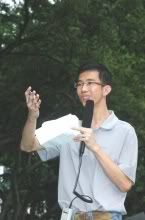
Mr Chen gave observations and recommendations on the public transport system from the viewpoint of a student. He spoke about the unfairness in granting concession rates to primary to junior-college level students, but not to tertiary students, the current car license scheme, and questioned ERP’s current ability to control peak hour traffic.
He recommended revamping all fare conditions by allowing children not of school-going age to travel for free, and not base it according to height. He also suggested that all full-time students from age 7-25 enjoy “fair transport fare rates, concession or otherwise”.
Other suggestions Mr Chen gave was relooking the Road Traffic Act by increasing the legal age when a person can obtain a license to operate a motor vehicle from 18 to 21. “Public transportation should take precedence over private [car] ownership in the minds of youth today,” he said.
“Why are we encouraging them to take up a license at the age of 18?” he said.
He also recommended the formation of a public-private partnership between car-sharing companies and public transport companies for maximum route coverage. Lastly, he suggested that the Government provide tax relief for employers whose employees take alternative modes of transport to work
Goh Meng Seng: current economic and residential model not realistic in meeting public transport needs
Mr Goh, who spoke in English and Mandarin, talked about how the current revenue-generation model of public transport companies and residential layout of housing estates worked against developing an effective transport system. He gave extensive comparisons with the Hong Kong public transport system, which he is familiar with as he has travelled there frequently .
He explained that transport companies here, being a monopoly, saw no reason to earn revenue by courting advertisers’ dollars as they could easily increase fares. He suggested liberalising the transport sector by allowing free competition so that advertising could eventually become a potential revenue source.
Mr Goh also felt that the current residential layout of housing estates was partially to blame for the inadequate public transport coverage. He argued that residential areas here were too spread out, unlike in Hong Kong where there was heavy concentration of residential housing within the immediate vicinity of each train station, making the provision of adequate services here difficult and expensive.
James Gomez: immigration and workforce policy partly to blame for transport woes
Dr Gomez gave a short speech on the meaning of “public transport”. As it serves large numbers of people – the public – its costs should be kept low but without sacrificing quality of service, he argued.
Dr Gomez also higlighted Singapore’s current immigration and workforce policy which has allowed an influx of foreigners, and suggested that the increase in volume has put a strain on Singapore’s public transport system.
Gerald Giam: more competition and accountability needed
Mr Giam’s speech covered some points from the public transport proposal released by TOC on 10 September. Among other things, he talked about how bus operators should be allowed to collect rent from retail outlets at bus interchanges, which are currently owned by LTA. This would allow bus operators to diversify their revenue sources, making it harder for them to justify fare increases. He also talked about how more competition should be introduced for public transport operators, through allowing private players into the market and dramatically shortening tender contract durations.
Lastly, he spoke on increasing regulation on public transport companies to ensure compliance, and imposing fines of $100,000 or more when service standards are not meant. He also advocated increasing public accountability through making the Public Transport Council multi-partisan, with opposition members making up part of the group to ensure checks and balances.
A member of the public, James, felt that the points made by the speakers were valid. “After so many years, where’s the improvement [in our public transport system]?” he said. “We should not just be happy with the current standards. They’re having profits, so why [don't they] put back the profits and improve it further?”
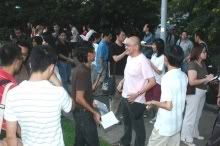
Mr Siew felt that “on the whole the ministry is on the right track” as they were now putting people as the central consideration in the public transport system, such in their implementation of distance-based fares. However, he said that there was room to “reconsider and review the public transport companies and how their returns are being assessed right now”, as even during the off-peak period trains were crowded and infrequent, meaning that operators were maximising profits as they liked at the expense of the commuter.
The following quote from Mr Chen’s speech summarised the overall sentiment of the speakers at the Speakers’ Corner last Saturday.
“The transportation system must change and suit to fulfill the needs of every interest group as much as possible. But instead of being represented by public transport companies, we are being managed, and we, the people, have to change to meet the system.
This is wrong. The system must change to meet the people’s needs. Put “public” back into ‘public transportation’.”
Several members of the audience later suggested that TOC should hold such events regularly, one even suggesting that it be a monthly affair. However, the person in charge of organising Saturday’s event, Andrew Loh, says that he wants to take a rest first before even thinking of doing another one.
—————
Below is a short slideshow of what took place on Saturday. A video of ‘live’ scenes will be posted here on Tuesday.
Related posts:
41 Comments
Fact Check FAIL
mouth is our we can talk what we want and quiet what we want yeah hip hip hurray for opposition party!!
I think all this hue and cry whenever there is an increase of public transport fares, ERP charges, Polyclinic or hospitalisation charges, etc, is futile and in fact counter-productive as it distracts us from the real issues. One real issue is that despite the several generations of political leaders, there has been serious intellectual and political stagnation in our country. Most policies and their general directions are carried over from the early days and their net effect is to maintain the status quo. Most so-called social changes are largely cosmetic and ineffectual. Of course, this is hardly surprising as the incumbent Party is too powerful and too entrenched and sees no need to rock the boat. As what Mr James Gomes posit in his recent thesis, I believe that more blogging, more electronic feedback, and more ventilation of opinion on the internet is not going to make a huge difference to the social progress of Singapore. If we are sufficiently talented, courageous and loyal to our country, we should do more than post our rantings here. Depending on how our conscience and intellect affect our inclinations, we should join one of the political parties including the PAP to positively influence the political development of our beloved nation. We should waste less time on the computer.
> Fact Check on September 15th, 2008 1.04 am
> (blah, blah, blah)
>
>Saint Splattergut on September 15th, 2008 1.46 am
> Fact Check FAIL
>
> mouth on September 15th, 2008 1.52 am
> mouth is our we can talk what we want and quiet what we want yeah hip hip hurray for opposition party!!
This sadly shows that the standard of opposition hasn’t raised much, and that some supporters of the opposition are still naive to think that toppling the PAP will improve their lives. Choices are useless with nothing useful to choose from.
The only advantage from this blurt on Saturday, other than letting people an avenue to vent their frustration, is that this might make PAP to better communicate their policies after which talk could become less speculative and more concrete.
Please make the speaker’s speech transcript available online here.
Am surprised to observe that an allegedly non-partisan organisation such as TOC has only invited OP members to speak/ share their views. May I ask if there is a reason for this?
Fact Check – on your last point, the state pays for the infrastructure, the SMRT and SBSTransit only has to cover the operating costs.
The Singapore Daily » Blog Archive » Daily SG: 15 Sep 2008
[...] Transport Forum at Hong Lim Park – TOC: Rethinking public transport – TOC: Bloggers speak up against public transport shortcomings at Speakers’ Corner – Gerald Giam: Thank you for attending TOC’s public transport forum – Things and experiences [...]
Leong Sze Hian wants to fine the LTA, which is funded by taxpayers. So Leong Sze Hian is going to punish taxpayers for road congestion — including taxpayers who don’t own cars.
The fine collected from LTA will become government revenue to benefit back the taxpayers.
Bernard Chen wants to raise the vehicle license age from 18 to 21. What happens to those young people who use a driving license to find work? What about people who need a despatch rider job? “Workers’ Party”? — sounds more like Bernard Chen is taking away job options from youth workers!
Think commercial driving license is different from passenger car driving license. We can discuss more on the merit of having different age requirements for commercial and passenger driving licenses.
Goh Meng Seng says he’s familiar with Hong Kong. Yet he said trains come “every 20 seconds” in Hong Kong during peak hour — how can this be right? Goh Meng Seng said a lot of things about Hong Kong, but he didn’t tell you how much train fares cost in Hong Kong. Was it because the facts might have been an inconvenient truth?
Think it is possible if we are talking about the next train arrives 20sec after the previous train departs the platform. MRT is doing it partially by having another train tailing the first train, similar to bus-bunching when we see 2 or 3 buses from the same route arrive at the same time.
Good question about the train fare cost. He should provide the details in his blog.
James Gomez wants things cheap, fast and good. Tell us how.
Remind me of PAP said lift upgrading can’t be cheaper in Parliament debates with Mr Chiam See Tong only to came back with cheaper methods later.
Also new NKF found ways to cut charges and gave more subsidy.
If the government and the transport companies are willing to provide detailed cost and operation data, I believe the public can provide good ideas on how.
Remember last GE, Mah challenged opposition to build cheaper HDB only to refuse to provide the data when someone took up the challenge?
Gerald Giam called for shorter tender contracts, from 30 years down to 5 years. How many rail companies will agree to run a railway for only 5 years, especially if they’re picking up even more of the construction costs?
Yes, a 5 years contract will means much change in the operation structure. The details need to be discussed in details. Take the example of government’s “best-sourcing” change to streamline the administration structure and cut cost and we should know that there are alternatives that can be better.
All in all, the speakers are making alternative suggestions to brain-storm the public, It is good to spring up debates to improve on the ideas and not settle on the assumption that the existing ideas and systems are the best.
It is time we move away from depending on a few wise men / scholars to govern our country and tape on the collective wisdom of the public via public discussions and questioning existing “best practices” to bring our society to new height.
> Fact Check – on your last point, the state pays for the infrastructure, the SMRT and SBSTransit only has to cover the operating costs
It has always been the goal of public services to earn enough to cover their costs. The greater goal is to provide services at a LOW cost, and it is not obvious what is the best way to do it.
The government can fully dictate the price with public ownership. But this does not necessarily guarantee low cost (even if it may make you feel better that the service is provide at cost price).
On the other hand, operation can be more efficient (and so lowers operating costs) with privatisation. The flipside is that you have to allow the private operator to earn a profit margin. That’s how privatisation work.
Privatisation and nationalisation of public transportation each has different degree of success in different countries (such as Hong Kong, Japan, UK, France).
Just came back from HK and realised their transport system is cheaper than ours. Their MTR uses a distance rated system and the most expensive fare is about HKD40.80 (SGD7.50) and it is from Sheung Wan to Lok Ma Chau (which if anyone’s been to HK knows it is from Hong Kong Island to New Territories, a distance that is much greater than anything our MRT caters to, I think it is about 20-30km).
They have trams that are HKD2 (SGD0.35) that runs the front length of hong kong island. Their buses (most expensive) starting fare is HKD45 (SGD8.25) and that would be a 40 min high way (i.e. no stop starting) journey, so in Singapore’s context it would be a 2.5 hrs journey.
Seriously, who is more expensive now? People who have never been to HK to experience their public transport system should never say it is expensive, I’ve just been there and with just HKD100 (SGD18.35), I spent 1 week there without having to top up my octopus card. How many days (as a tourist) can you travel with just SGD20 in Singapore?
I have reside and work in Hong Kong for over 9 years. Regretably, I was unable to attend this event albeit I would very much like to hear what had been presented. With this, I can only rely on what has been posted here asfactual information to pen my comment.
If what “Fact Check” says about Goh Meng Seng is right, I could not agree more with him. Peak hour train schedule in Hong Kong come at every 1~2 minutes interval, off peak hour is 3~4 minutes interval. Both MTR and KCR had merged and now operate under a single entity (MTR~ 港鐵). In general, the cheapest fare starts from HK3.80 and within HK and Kowloon station the highest fare to pay is HK11.80 (now this had been lowered to HK11.20). There are light rails and other train stations (previously under KCR, off shore islands, prices can run from HK30+). However, these station’s pricing is now partly subsidised by HK-Gov to ease the lower income group. The MTR company is also trying to lower its price (since merger) to make it more affordable during this trying time. at it is now, if you travel single connecting train (i.e. From HK to Kowloon then to say Shatin, you no longer need to pay to exit from Kowloon and reboard a train to Shatin and pay again), it is now counted as a single fare travel. To some, this is enormous savings can be more than 30~40% that they used to pay for their traveling.
I do not agree too with GMS that the HDB spacing should be similar to Hong Kong. This is where I think most Hong Kongers are not happy with. Too close a proximity and the way the housing are designed stiffle the environment. As it is now, it has created a problem to the HK environment. To relate the current service level with this reasoning does not hold any water. I tend to think that the LTA should help to look at the following:
1) How to increase the capacity intake (this again is largely dependent on the current infrastructure, such as; what is the maximum carriages a single train can accommodate?) To give an example; HK MTR, each train is equipt with 20 carriages, each carriage can hold a capacity crowd of 120+ .
2) The schedule frequency and be review and improve. You cannot ignore the fact that if there are more people taking the train, it will be crowded, this is a norm in a crowded metro (HK is no exception but no one is complaining aloud as what is important is the train schedule is effective).
3) The connecting transport from station to the desire destination such as shuttle service schedule and other alternative traveling vehicles. In Hong Kong, you can choose from buses, MTR, MiniBus or MiniVan and these are operated in different competing entities. Prices varies but it is kept decently affordable for the convenience of public transportation. If more operators are allowed to run SIngapore public transportation, I believe it will create healthy competition thereby rasing the service level for its citizenry (barring of course the uncontrollable fuel cost).
4) Government’s role is to moderate the price height request and act accordingly. (this is the catch area I believe).
It is inevitable that convenience will come at a cost, but if it is reasonably acceptable and made affordable to the general public (in particular the lower income, senior citizens and under privilege ~ transportation company can do more to help to give them better concession rate), I think most citizenry can and will likely bear with a slightly higher price.
If these improvements can be in place, I believe most car owners will indeed more incline to opt to take public transport.
These issues will not go away anytime soon and there is no easy way out. I think the important thing is that LTA and the operators are willing to open up to listen to constructive input.
Oops my mistake, the distance is about 40-50km and not 20-30km. sorry
To top off what Desmond had posted. Those were Express Airport Buses. Hong Kong also features an express Airport Train that travels from Central Station (offering early check-in for travellers convenient). If you are on group travel (i.e. more than 2 person, you pay a concession rate). By far, it is much cheaper than you travel by taxi (In Singapore ~ from City to Changi Airport). These transportation are all operated in 24 hours round the clock with some schedule change of course for some bus route, but in general, public transportation in Hong Kong is a good experience for any tourist as well as its living residents.
I forgot to mention there are also free shuttle service from Airport to most hotel for tourist. For residential area, there are also free shuttle services to shopping centres (this is subsidised by converservancies and management services paid by residents).
All these can be an example that Singapore can learn from. Do not forget, Hong Kong’s current population is more than 7 million but in terms of useable mass area, it si smaller than Singapore.
“Hong Kong’s current population is more than 7 million but in terms of useable mass area, it si smaller than Singapore.”
what’s more, do not forget that Hong Kong has potential natural disaster , such as Typhoon that result in property damage and loss that obstruct smooth transport operation. Singapore ? Only billion-dollars gov-made disaster !
It is interesting to note that The “Shit” Times photoshot of the TOC event misleading showed very few attendees!! I would say the action of ST is downright despicable.
All our long-standing public transporty woes would be over if we can somehow force all ministers to take public transport everyday for a month!!
“All our long-standing public transporty woes would be over if we can somehow force all ministers to take public transport everyday for a month!!”
It can be written too as
“All our long-standing public transporty woes would be over if we can somehow pegged all ministers’s salary to happiness of the citizen in taking public transport.”
Hi Donaldson,
The transcripts of the speeches will require lots of work and also the speeches that the speakers made were mostly off-the-cuff. Also, the audio recordings of some parts aren’t very clear. So, I do not think we will be putting up the transcripts.
However, we are working on a video which will feature parts of the speeches. It should be done by tomorrow. My apologies for the delay.
Regards,
Andrew Loh
Man I missed all the action (I just got back online after killing WORMS and TROJANS)!!
18) ronin on September 15th, 2008 2.58 pm All our long-standing public transporty woes would be over if we can somehow force all ministers to take public transport everyday for a month!!
This is precisely why the internet is so powerful. The more the government tries to disadvantage or cover up the event, the more people will see through the filter.
So it will do the government and the ’state’ times no good ultimately. People begin to notice these loopholes, lop-sided reportings and how ineffective the MSM has been.
Of recent months, there had been so many highlights (esp mrbrown’s blog) of changing headlines and photos that one wonders if there were even experienced editors in MSM to begin with.
Sigh… when will they learn? How long can they continue to hide the ‘truth’?
Kaffein
10) sarek_home on September 15th, 2008 12.58 pm
“Good question about the train fare cost. He should provide the details in his blog.”
Here is the link. It is publicly available if Goh Meng Seng did a little more research to avoid any unintended misrepresented or misleading facts.
http://www.mtr.com.hk/jplanner/eng/planner_index.php?spot=1&start=1&destin=68&x=51&y=11
You can type in any departure area and to the destination, a pricing table is made available for you to plan your trip if you are a tourist (including suggest route, the appox travel time and the schedule frequency of the train).
At moment S$1=HKD5.3 give and take +- 10%.
Hope this help to give you all an idea what is real first class transportation service looks like.
how come no bloggers are commenting on the paralympics? I am really proud of those tru blue Singaporeans, unlike those made in china ones!
Bravo to them.
I am a closet supporter of TOC , Accountability and Integrity.
While so few take it upon themselves to voice the concerns of the many,
TOC have done what majority singaporeans dare not do in the name of voicing up concerns.
The population lacks a few Good Men found in TOC.
Well done! Please keep up the good work for the community!
TOC has added a new dimension to the concept of People Representation.
For decades, this is what I have wished for. For the people.
Most singaporeans take the excuse that they are too tired and too busy with work and family to even voice up for the people. Look at TOC, they too are busy people.
TOC just need to focus on Accountability and Integrity, concept of Public Service to be able to have a good discussion for a long time.
Do not be mistaken. This does not mean singapore has no accountability.
Merely 1 of our greatest example exist by the name of Wong. He exemplified integrity and honesty plus accountability. The 3 basic characters of a public servant.
So, what I meant by what TOC should focus on is based on the fact that these factors : Accountability, Integrity and the idea of Public Service should always be in our minds and for each democratic citizen to play their part in Maintaining and / or Ensuring they exist before , now and the future for your children’s sake.
Berlin Wall showed that it takes many people’s effort to built it.
The statue of many ‘leaders’ also take time to build.
While I am not capable of contributing to TOC’s efforts, I am happy for the people to have now a new Voice to speak up for them.
Just 1 suggestion :
Please could you provide the same kinds of commentaries for all or most news published in our MSM ? Despite their artificial change of coloration and layout design, I am still bored by the news which is very world class I must say. ;)
Integrity and propriety, may I say, are not virtues that could be enforced on others, they are forms of self disciplines.
Conscience and compassion have to come from the heart, they must be sincere.
We experience the diplomatic and pragmatic relationships from our rulers all the time, THEY DEAL WITH US WITHOUT FAIL, the Rule of Laws BUT JUSTICE SEEMS SECONDARY, they have NEVER TREATED US SINCERELY. We have the most practical and pragmatic Leadership that has ever existed.
TOC have been doing great and noble calls, Singaporeans should be thankful and grateful that we do have professionals, intellectuals and wise fellow citizens who are willing to sacrifice their times and risk their own wellbeings for the goods of others.
I like to view TOC as a non political organization, as such, do hope that it does not involve itself too much with opposition parties and politicians. Preferably it(TOC) is neutral in politics and seeks social justices for all.
Btw, oppositions should organize their own activities, publicise their own agendas and gather supports. As it is, they are pretty dormant and that’s their prerogatives.
patriot
Hello Observer,
You cannot just look at the fare along. Let me tell you why.
If you would have noticed, the salary base in Hong Kong is much higher than Singapore. It could be 1.5 to 2 times higher than Singapore.
Secondly, for an uninformed reader of the mtr website, one may conclude wrongly or unjustly the fare there with ours. You would have noticed that for some fare, it is higher even if it is a few stops away. The reason being that if you are crossing over to the Hong Kong island, the fare will increase dramatically due to the fact that it needs to pay toll fee for the underground tunnels. This also apply to trips made to Lantua Island which hosted the Airport. There is a toll fee charges for the use of the Qing Ma bridge.
But generally, if you travel mainly on Kowloon or Hong Kong island along without crossing over to the other side, the fare is fairly cheap if not cheaper.
Secondly, we must bear in mind that Hong Kong as a whole, is a bigger place than Singapore with New Territory, Kowloon, Lantua Island and Hong Kong island added together.
There is no doubt about it, Hong Kong system is definitely more effective and efficient as a whole as compared to Singapore. I do not need to use misleading data to make my point. Anyone who have been there would understand exactly what I mean. :)
Goh Meng Seng
Dear Goh Meng Seng,
“You cannot just look at the fare along”
Thank you for agreeing. I reckon you mean “fare alone”. I live and work in Hong Kong for over 9 years now and still going. I am perfectly aware of the settings and the operational cost associated with businesses here as well including the core subject matter here “public transportation”. As I do not have full access to what had transpired during your speech at Hong Lim Park, I can only based my comments purely on what I have read from this post and some of the comments noted by others.
On the other hand, I trust that you do know (this is my assumption) that there might be others who were present at the gathering had never step foot in Hong Kong before. I generally would think that if other country’s effectiveness (in this case Transportation issues) is quoted, reasonable care had to be taken in presenting facts and figures (these are what the Governing party is good at to prevent any rebuttal or name calling ~ not that I would believe entirely what had been said without finding out more neutral information if it is of interest to me).
Coming to your point that I should not be looking at fare alone. Exactly, but you do notice (based again on those interviewed, pricing is all they are concerned with albeit there were only 3 folks being interviewed). None had touched on service level (as commented by others).
My main disagreement with your speech is clear and it is not of any dis-respect to what you are advocating. I have raised the point on capacity load issue (hearing from my Sg friends that SMRT had indeed improve their frequency of arrival slightly ~ i.e. a tap shorter waiting time during peak hours), however, if capacity load is limited, the congestions will still be unbearable at the current population taking the train let alone when it grows to a burgeoning number (say Singapore population to 6.5million?). This is one major issue and requires major overhauling or another entire set of lines had to be build to promote public transport utilization. This is only one side of the issue.
The other being the connecting transportation means. i.e. SMRT do not take you from door to door, so there are invariably connecting transport vehicle. This is very lacking in Singapore particularly if you are outside of the major shopping stations (even that, I think it can be improved). If only if more operators are allowed to run public transportation besides SBS and Tibs, this will definitely help to ease the conjestion and when the alternatives are there for people to choose, public transportation will be more desirable to take. As for pricing, again this is largely based on competition (you can’t have best of both world). However, Singapore can take a cue from Hong Kong, the operators here are considered reasonable in terms of fare charge (still there are complains from some section even with all these subsidiaries and help). I have yet to mention that Public Transportation here also cater to those who goes on wheelchair…etc. Even their Taxis are better run here.
Lastly, since you have been to Hong Kong frequently, you will realize that there are many exits postioned in most MTR stations to ease the people traffic congestions. Another major point, people here queue up and quite orderly (without asking) even during peak period travelling. During peak hours travel, they have station master to help manage the crowd. Even the station announcement are more frequent and timely and within each of the MTR interior, you know exactly which side to face when you alight (see those led indicators in each of the carriage?). This I must say, Singapore has a long way to go.
At the end of the day, there are two main issues to deal with for improvement. Service Level and Pricing assuming LTA/SMRT/PTC can sort out the capacity load issue and allowed more operators to plough the road for alternative travelling.
I applaud all your effort especially TOC’s. But again, if there must be any issue raised, constructive and viable improvement will always win the hearts of your supporter. Two wrongs does not make one Right.
No logic to raise fares in the midst of high inflation. Seems like CASE is redundant here.
Rather unfortunate that despite the fact we have been using out train buses and transport systems to be part and parcel of our propaganda machine since the 80s (remember all the MRT and Bus videos you saw as a kid?), it seems like there’s very little effort into actually improving them.
Most buses are bordering on filthy. Roads are congested. Trains are always too full, and don’t service all of the island. Where’s the world class system i’ve been induced to believe?
Nation building in my humble view is not merely about the tangibles like what you can see on a piece of paper like economic performance.
The Intangible aspects needs to be focussed on as well.
While the Majority had spoken,
maybe its time to hear what the minority is speaking.
Think that even as fuel prices can jack up the costs, the profits they’ve accrued should technically be able to offset? Though that is dependent on the kindness of their hearts o.o At least they’re not raising concessionary prices yet, phew. Nevertheless it does seem a bit insensitive and callous to raise prices when world economy is plummeting :(
hai…
the transport system is control by tamask ba…
PROFIT PROFIT…what is the salary for the MRT HEAD got per month ar..i wonder..$$$..
always take money from citizens…
don talk all the bull shit about JUST COVER THEIR EXPENSES..
WHo donate money to bulit MRT>>>>
WE MAN…
but what they did to ask….
i can see tat PAP is having bigger communication gap to the public.
FALLING ways to the PAP…….{>___<}
Dear Observer,
I think you have mistaken my stand then. In fact, I have not particularly focus on the increase in fare or the fare itself. My whole speech focus on 4 main points:
1) Businees Model
2) Economic Model
3) Efficiency
4) City-town system planning
I do not think I should post the details here else it will become a lengthy thesis in comment column. I will write it out in details on my blog instead.
But the juice of it is
1) Transport companies should not focus on getting profit from fares along. In fact, if any transport companies think that it could make huge profits by charging higher fare, then the CEO must be sacked. If you have noticed, transport companies in HK, especially MTR, even the mini-bus, earns quite a bit from advertising. The business model should be similar to free software or services provided by internet companies.
2) But in Singapore’s context, the problem is our economic model is one of monopolies.i.e. GLCs dominates the whole economy. Thus, unlike Hong Kong, there isn’t a huge group of SMEs with their own brands to put advertising; limited advertising dollars. eg. Mooncake festival, Hong Kong will have quite a number of advert from local SME on MTR etc but in Singapore, quite limited….or that I don’t see any.
3) Efficiency. The govt is the largest shareholder of local transport companies. There is basically a conflict of interests here, between the companies that they are supposed ot regulate and the fact that they are the regulator themselves. They should be setting the service standards like timing or frequency for the transport companies during peak and off peak hours. In a small country like SIngapore, imagine waiting for more than 30 mins for a bus during off peak hours. That is a bit ridiculous.
4) The city -planning model of Singapore affects the efficiency and effective use of public transport. You don’t find many high rise flats in town centres in Singapore which are also transportation nodal points. Instead, they like to plan so much that they have spread out the HDB flats but the Town Centre, ironically, nearest to transport services, were lack of residential flats. You can observe in HK that at every each main MTR stations, there will be many flats built above or just near to the stations, along with shopping malls and such. That’s why its very convenient. But here, we are made to stay far away from the transportation points, forced to take those inefficient feeder buses or worse, the light rail.
Besides all these, MTR in HK have income from building and managing estates right near their various stations. They are in the business of Mass public transport but they are earning more from the MASS instead of the TRANSPORT part.
Anyway, I think I am already writing a thesis here. ;)
Goh Meng Seng
Goh Meng Seng,
you are right. I am waiting for government to publish a book on how they can reconcile private/public business with governing without conflict of interest. The whole world will love to hear the “Singapore’s success story”.
Dear Goh Meng Seng
Thanks for putting up the details. In this context, I am with you. Singapore or rather most local businesses are run in a very textbook style manner. It is not just the government sector albeit the latter deserved a smack on their head.
However, these people have crash proof safety helmets to prevent them from any concussion, so until a crisis hit them hard (just like now the WS Financial Tsunami), only then they will be awake from their dreams.
Dear Goh Meng Seng
Just want to add one point with regard to your point 4 on the hosuing palnning. Hong Kong’s business model is largely based on High Value Property, so it is no surprise here. However, it has a detrimental impact on its environment which the common citizens are not happy about.
Despite the foes of the other many issues, I think as far as housing ownership is concerned, I personally felt that Singapore housing system works better than Hong Kong (just comparing these cities as we are of similar size and generally with no natural resources other than people). It does have its draw back like what you have pointed out, however, this has little impact if the LTA/SMRT/PTC and the government really want to make changes to its current transportation services.
Great talk.
singapore transport system made me feel like shit,.
SUch a lousy system still ask so much money..
ANd the bus engine really make so much noise pollution..
1 class,don joke man…ALL IS LIE>AFFORTABLE?? only the high post salary!!
NO FATE towards this current GOV AND TRANSPORt system…
DOWN DOWN DOWN…
@young generation@
The Singapore Daily » Blog Archive » Weekly Roundup: Week 38
[...] Transport Forum at Hong Lim Park – TOC: Rethinking public transport [Recommended] – TOC: Bloggers speak up against public transport shortcomings at Speakers’ Corner – Gerald Giam: Thank you for attending TOC’s public transport forum – Things and experiences [...]
Its 5 months since the big rally. Anyone has any updates on improvements or have things got worse….let start the next round of reviews.
I touch lottery recently, Thank You Singapore Pools…so not riding on buses for while…until the taxis service use up all my money. Its really quite expensive these days. Cannot afford if didn’t touch lottery.
Hope the bus service gets better in a few months…when I have to travel on them again.
Congrats Alex! But if I were you, I would keep the money to either enroll in courses or build an online business……or save it. Frugality will save you from in times when you have no lottery winnings!
Leave a Reply
Uncategorized - Jan 15, 2010 10:12 - 125 Comments
It is affordable – Mah Bow Tan
More In Uncategorized
- Rebutting Law Minister K Shanmugam
- Challenge of communication
- TOC & Talk Politics hold successful Year in Review forum
- “Live” from Post Museum – TOC’s Year End Review
- The Fajar Generation
Uncategorized - Jan 15, 2010 10:12 - 125 Comments
It is affordable – Mah Bow Tan
More In Uncategorized
- Rebutting Law Minister K Shanmugam
- Challenge of communication
- TOC & Talk Politics hold successful Year in Review forum
- “Live” from Post Museum – TOC’s Year End Review
- The Fajar Generation


Leong Sze Hian wants to fine the LTA, which is funded by taxpayers. So Leong Sze Hian is going to punish taxpayers for road congestion — including taxpayers who don’t own cars.
Bernard Chen wants to raise the vehicle license age from 18 to 21. What happens to those young people who use a driving license to find work? What about people who need a despatch rider job? “Workers’ Party”? — sounds more like Bernard Chen is taking away job options from youth workers!
Goh Meng Seng says he’s familiar with Hong Kong. Yet he said trains come “every 20 seconds” in Hong Kong during peak hour — how can this be right? Goh Meng Seng said a lot of things about Hong Kong, but he didn’t tell you how much train fares cost in Hong Kong. Was it because the facts might have been an inconvenient truth?
James Gomez wants things cheap, fast and good. Tell us how.
Gerald Giam called for shorter tender contracts, from 30 years down to 5 years. How many rail companies will agree to run a railway for only 5 years, especially if they’re picking up even more of the construction costs?