Terence Lee / Youth Editor
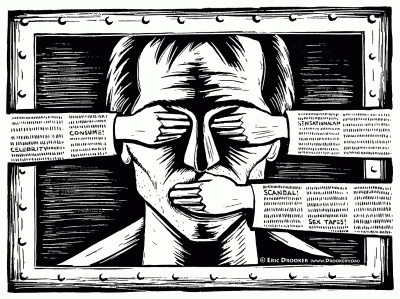
Almost every student I spoke to agreed with me: censorship is outdated. In fact, when I wrote the article entitled “NTU censors campus news coverage of Chee Soon Juan visit“, I had difficulty finding students who agreed with NTU’s actions.
But if there is anything this whole fracas has demonstrated, it would be the idea that censorship is an antiquated notion, belonging to a past era. In the age of the Internet, supression of information is difficult, if not impossible. Even before the said article was written, one of the editors at the Chronicle had already posted her displeasure about the whole issue online.
Some will argue that students have nothing better to do, and that we are just making use of the Internet to voice senseless grouses. While it is true that the blogosphere is sometimes a cauldron for complaint, it can also be a platform to voice genuine concerns. In this case, students felt that a great injustice was wrought, and something must be done about it.
In fact, this is the first time in the history of the Nanyang Chronicle that such a censorship has occured. The university’s stand was that “there was a feeling of concern over the use of student media to publicise and promote unsolicited views of an uninvited person to the campus.” But what they fail to anticipate is that while they may be able to censor the official campus media, information has a way of slipping out into the Internet.
And who can blame them? One can recall how our parents struggle with the notion of using the computer, let alone the Internet. This saga has made apparent the gap between the Internet generation and the typewriter generation, and this incident will be a rude awakening for them.
Perhaps there is some justification in the fact the Dr Chee came in uninvited, attempting to use campus grounds as a means to spread unorthodox political ideas. But having said that, news is still news. Even if the university were to go so far as to label his actions as a ‘crime’, it should still be covered. We sure did not see the recent murder of three women in Yishun being censored from the media, “for fear of spreading unwarranted fear among the Yishun populace.”
The other issue at stake here is of course one of freedom of expression. This censorship issue was partly controversial because of Chee Soon Juan, but we shouldn’t centre the debate around him. Rather, the issue is how the university, perhaps acting out of fear or influence from higher ups, chose to adopt measures that even the restricted mainstream press like The Straits Times or Today will find draconian.
The Straits Times was not censored when Dr Chee went on a hunger strike. And the same applies for many of his acts of ‘civil disobedience’. While it is arguable whether the local media has portrayed him in a fair light, at the very least they documented his existance and his actions.
By censoring the news media in NTU, the bureaucracy is implying, perhaps latently, that students do not know how to think for themselves; that we are gullible; that we will brainlessly follow what the media says. Elaine Lee, the humanities student whom I interviewed, said it well: “If we aren’t exposed to anything, how can we be expected to gauge one political view from another?”
Perhaps the university feared that the arrival of Chee Soon Juan will spark civil unrest among students, but this is found to be an exaggeration. As the student journalists on the ground will tell you: students were generally apathetic about his visit. Some did not even know who he was. I stated in my article that Dr Chee created a whirlwind when he came to NTU, leaving behind only a whimper. But as the original writer of the censored article kindly told me, this is not true. In fact, he left only a whimper when he came, but the incident blew out of proportion, turning into a whirlwind. And it was not even his doing.
Opinions among the more politically-aware students about Chee Soon Juan are wide-ranging. Some admire him; others abhor him. Some display a sort of distant admiration for his actions; yet others question their effectiveness.
But it seems that ignorance is not just displayed among the student body. The censorship shows an utter lack of common sense on the bureaucracy’s part. Perhaps they have lost touch with the sentiments of the student body, but surely they have not lost touch with their logical judgments as well?
Figures of authority have been lecturing to the youths like us about media literacy and how we cannot be taken in by everything we read online. But it seems that some of the leadership in the establishment tend to exaggerate the power of the media, likening it to some old-world magical charm that has the ability to hypnotise students. They fear the media, thinking that students will believe anything and everything that is broadcasted or put into print.
Instead of media literacy, some in the establishment have what I call “media lunacy” — the belief that the media has a spell-binding influence on the populace. Modern communications theory has in fact long discredited this notion. The “magic bullet” perspective of communications — which theorizes that an intended message is directly received and wholly accepted by the receiver — is considered obsolete today.
Instead, the consensus among many media scholars today is the “agenda-setting” theory of communications, which contends that the media influences what consumers consider as important. In other words, the media does not tell people what to think, but what to think about. Whether consumers believe the messages that are communicated in the media is entirely their perogative.
Perhaps the university is going to the extreme of not even wanting a vestige of Dr Chee’s influence among the student population. But at what cost, I wonder?
Let it be clear that despite my biting criticisms, I do not despise the university. In fact, my feelings are quite on the contrary. I love the school, and it certainly has done many things right. In the realm of science and engineering, it has made many invaluable contributions. Also, the setting up of the School of Humanities and Social Sciences and the School of Art, Design, and Media certainly goes a long way in enriching the educational landscape in Singapore.
But understanding the heartbeat and concerns of the students — that should be the main priority of the overall university administration as well.
————-


