TOC thanks Malaysiakini for allowing us to publish the following article from its website.
Rahmah Ghazali
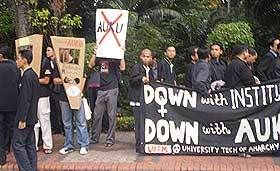 The controversial Universities and University Colleges Act (UUCA) was in the spotlight again today when a deputy minister reinforced the government’s stand that university students should not get involved with political parties.
Amid the amendments, Deputy Minister of Higher Education Idris Harun said Section 15 of the act, which states that students can join outside bodies but are still banned from joining political parties, was still relevant in preventing students from being influenced by any political party.
“They have to know that their priority in university is to study,” he said in response to a supplementary question in the House posed by Khairy Jamaluddin (BN-Rembau).
Idris justified the ban by stressing that political influence will not create a “conducive environment” for the students in which to study, but also promote “racial ideology and racial polarisation”.
He said students had many other means to get involved in politics by not joining a particular party.
“A lot of universities offer Political Science as a subject where they (students) can study the subject academically and systematically without leaning towards political culture.
“They are also not restricted from doing research and academic writing pertaining to politics in the country. Besides that, they still have the freedom to get involved in campus elections,” stressed Idris.
The UUCA has been widely condemned by student bodies in the country who feel that they should be given the freedom to voice their opinions on both local and international political issues.
Students allowed to join NGOs
Earlier, the deputy minister responded to a question from Abdul Hadi Awang (PAS-Marang) who queried if the amendment to the act was made with agreement from political parties, organisations, universities and student leaders.
Idris said his ministry had consulted members of parliament, from both the government and opposition, and also various ministries.
 “We also consulted the university directory boards, academicians, chancellors, legal advisors and student leaders,” he explained, adding that a human rights commission was also consulted.
Idris said students were still free to join non-governmental organisations, in order to become “the leaders of the future”.
Among others, the amendments to the UUCA once passed would see students facing disciplinary action instead of prosecution if found to be involved in political parties or unlawful organisations.
Other latitudes of the altered act also allows for the enrolment of politicians for courses in universities without having to sacrifice their political career with the discretion of the vice-chancellor of the university.
The date of the debate in the House for the UUCA amendments is yet to be fixed.
———–


