Monday, October 20, 2008 8:01
TOC YOUTH WEEK: Yes to elites but no to elitism
In Guest Writers, Main Stories, Top Story, Youth Focus • 2,687 views • 35 Comments
TOC’s Youth Week kicks off with this article by 15-year old student Pearl Lee. She writes on the issue of elites and elitism in schools and why Singapore’s school system breeds elitism, particularly the Gifted Education Programme (GEP) and the Integrated Programme (IP).
Pearl Lee / Student
Love them or hate them, elites are present everywhere in the world – in politics, in the workforce, and in sports. It is undeniable that elites have to be present in order to ensure a continuously progressing society. However, with the Gifted Education Programme (GEP) in place here in Singapore, the very word “elite” takes on a different meaning altogether.
Gifted education in Singapore causes two problems. Firstly, it gives rise to elitism. Secondly, it results in reverse discrimination — giving rise to a growing stigma against elites. We should not question the presence of elites. A society needs elites in order to progress, but a society definitely does not need elitism, the bashing of the elites themselves, and unequal and unmeritocratic education policies.
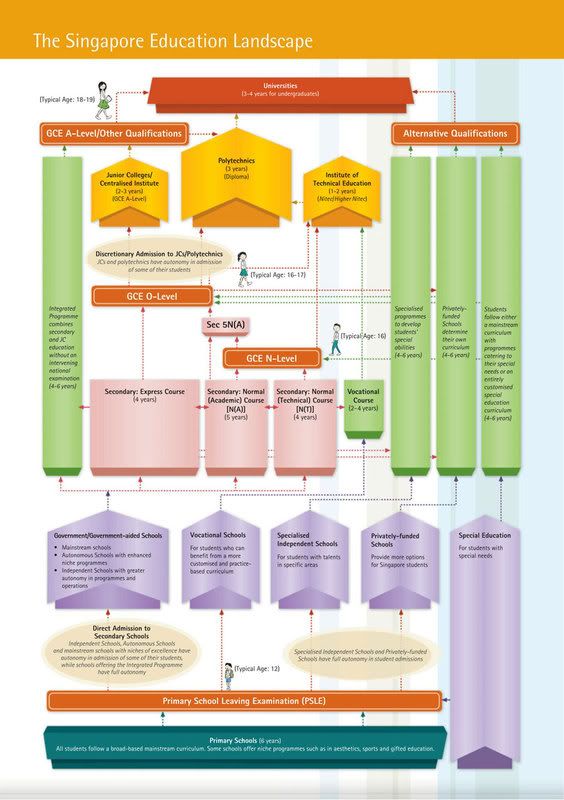
The education process in Singapore is succinctly illustrated in this diagram taken from the Ministry of Education’s website (see picture right, click to enlarge). The presence of streaming — which causes the discrimination of EM3 students in the past —was a hotly debated topic, as judged by articles in the media about the social divides between streamed classes.
Streaming at Primary Four has now been replaced by customized learning in subject-based banding called the Learning Support Programme (LSP). The LSP is a specialised early intervention programme aimed at providing learning support to pupils who enter Primary 1 with weak English language and literacy skills. Pupils are identified for LSP through a systematic screening process carried out at the beginning of Primary 1 (MOE, 2008).
Likewise, the Learning Support Mathematics programme is an early intervention scheme to provide additional support to pupils with a shaky Mathematical foundation and do not have the knowledge to access the Primary 1 Math curriculum. This is viewed as a means of support for students who are falling behind academically and preventing the academic gap from exacerbating further as they move on to higher levels of Primary education.
However, despite this measure taken at a Primary school level, the GEP and the Integrated Programme (IP) are still the main factors causing the rise of elitism mindsets and discrimination against elite students.
The mission of the GEP, according to the Ministry of Education (MOE), is to provide leadership in the education of the intellectually gifted. Gifted individuals are “nurtured to their full potential for the fulfillment of self and betterment of society”. It is generally acknowledged that one has to be the “top one per cent of the cohort” and fare excellently in the Intelligent Quotient test as well.
GEP contradicts “equal opportunities”
The image on the left is taken from a Facebook group called “Don’t hate me because I am Gifted“, which has over one thousand and six hundred individuals. This is a group where Facebook users previously or currently from the GEP join. Recently, there was much discussion on the group about printing tee shirts. This is one such design.
The presence of GEP contradicts Singapore’s idea of creating “equal opportunities”. MOE constantly stresses that the education system is ‘meritocratic and ability-driven’. However, to be a meritocratic society, all citizens have the opportunity to be recognized and advance in proportion to their abilities and accomplishments. Equal opportunity comes for citizens to display their recognition of abilities. In Singapore’s context, what is preached is not being practised as one is recognized for abilities first before opportunities come around.
With the use of the word intellectual “gifted”-ness, which means having an inborn intellectual ability higher than average, GEP breeds elitism as young students grow to believe that their self-worth and intellect is confirmed by being in the programme, determined by mere academic test scores. Students who are not in the programme lose faith in their potential, and are displeased at the various widened opportunities given to GEP students which are not provided to them.
Parents too, contribute to the existence of social stratification. After all, who doesn’t want an elite education for their child, and the tag of having an elite mind that automatically comes with it as well? This leads to elitist attitudes in both child and parent, and the bashing of GEP students by those who fail to get through the selection.
Definition of “elite” should be redefined
It can be argued that creating equal opportunities means not only widening resources to more students, but also to provide students with greater intellectual ability with a more fitting learning experience. However, even intellectual abilities can be broken down into different subjects, for example, mathematical, linguistic or scientific. A fantastic test score for a general exam does not necessarily make you a truly elite student, much less the rudimentary language, scientific and mathematical skills primary students are assessed on during the GEP selection.
There are also multiple intelligences that encompass many different areas, e.g. naturalistic, visual-spatial, musical and so on. The definition of ‘elite’ should be redefined. Elites should not come under a class of educational excellence defined by an ideal model set by the government. Potential is defined as being a true measure of capability of development into actuality. Should that be the case, despite GEP students being seen as having the most academic potential, they are in fact merely the best scorers in the selection test which has a very small scope of selection criteria. GEP is an inherently flawed system and promotes elitism in the process. The selection criteria and the scope of selection should be reviewed.
Opportunities cannot be limited to only a handful of pupils who continue to receive these benefits throughout their whole lives while students who were unable to get a headstart will continually fall behind.
Integrated Programme
Another such hindrance is the Integrated Programme or IP. The IP was implemented in 2004 to provide a seamless secondary and Junior College enriched education without requiring pupils to sit for the GCE O-Level Examination. The time “saved” by not having to prepare for the GCE O-Level Examination is used to develop pupils’ intellectual curiosity, encourage them to undertake research work and provide a broad-based education that is more in tune with desired real-world competencies. More on the IP can be found on the MOE website.
Also, schools offering IP assess students not based on an ‘O’ level syllabus but one developed by that individual school. Every IP school’s end-of-year exams differs in format and topics tested. Without a uniform criteria of admission into the IP schools, non-IP students will have less likely a chance of getting into the junior colleges due to unequal levels of competition. Also, there is no baseline criteria for determining if a secondary school student enjoying the benefits of the IP deserves to move on to the junior college.
The myth that non-IP students are less academically or intellectually-able than IP students is further aggravated should they fare badly in an education system they are unaccustomed to when they enter these IP schools due to different examination or teaching formats. This contributes to the academically elite students’ belief in their prestige of being in a school undergoing an elite education.
Conversely, a flawed education system can result in discrimination against elites. Many students studying in top schools have been labeled “elitist” or “snobs” despite the fact that it is not true. Students in top schools have also taken up social projects like environmental protection, reducing world poverty and organising inter-school newspaper collection programmes.
There is not enough communication between students from various levels because of the little time students have outside of academic work. Singapore should rethink the definition of an elite student and an elite education. The current model of education creates no equal opportunity among students of different ability, resulting not in a gracious society but one of division.
———–
About the author:
Pearl Lee is “15 going on 16”. She describes herself as an “average dysfunctional student.” She is interested in all visual/performing arts (and shopping trips), and enjoys sleeping during lessons. She prefers to ignore people when she is not coming up with painfully bad jokes to drive them mad.
———–
Join the Facebook Group – Anti-elitism and anti-discrimination:
———–
Related posts:
35 Comments
Donaldson Tan
Jackson
Personally I think such rankings is outdated because everyone can excel in different aspects of life, not just in studies. If a person is very good at certain sports but no good in studies, can we say the student is no good?
Dingfeng
There is also a huge sacrifice that the elite (students) make. A cost so subtle that many fail to recognize it after paying the price.
For those who have not read ; An article about elite education:
The Disadvantages of an Elite Education, By William Deresiewicz
http://www.theamericanscholar.org/su08/elite-deresiewicz.html
By the way,
—
It can be argued that creating equal opportunities means not only widening resources to more students, but also to provide students with greater intellectual ability with a more fitting learning experience.
—
I totally agree that elites are enjoying intellectually deserving and rewarding opportunities. But how else could Singapore develop and retain the brilliant minds that are so necessary for its research-based industries?
Change please
for a 15 year old turning 16, writing an article like this is an excellent achievement itself. we should pay more attention to the questions raised by the teenager than dismissing her conclusions that we are not satisfied with.
there is one thing to create an elite class like how singapore do and there is another thing to create a hierarchies of talents/skills/knowledge/wisdom. what any country needs to achieve is the latter, but what singapore’s method of elitism or creating elites fail to achieve is precisely that.
Hierarchies of Productivity
The continual performance management of labour force is supposed to create these hierarchies of productivity in the labor force. Unless where the output of labour is very quantitative such as sales figures etc, Singapore totally lacks the ability to manage performance of labour force because of Singapore employers who are either unable to measure productivity qualitatively and/or that they have idiosyncracies such as judging employers on a relationship basis, etc etc.
Hierarchies of Skills/Talents/Knowledge
To achieve this, you need income inequalities to be very minimal in society. Opportunities for minorities need to be as accessible and available as it is to the majority. There are many cases that i have seen of students who come from lower income family and/or minority group who somehow succeed in going abroad to the West either through scholarship or through saving up by working and subsequently achieving huge academic and work successes from PHds to high positions in organizations etc. Interestingly they were mediocre achievers within the Singapore system till they leave.
Hierarchies of Wisdom
The higher heirarchies of wisdom normally lies with those who exhibit higher standards in moral authority, spirituality and intellectual abilities. You wont find them amongst politicians of course. For this hierarchy to develop, freedom of expression, freedom to disagree, freedom to be independent by individuals have to be a characteristic of the political system. Since Singapore lacks that since 1959, this kind of hierarchies of wisdom have been lost since then. As one famous intellectual in the region pointed out “Singapore has lost its scholarship in recent times”
What then does Singapore have today?
Its purely hierarchies of GCE ‘A’ level/GCE ‘O’ Level grades. Though not totally because i have seen some students getting straight As for ‘A’ levels and first class honours from NUS in hot fields such as engineering not securing jobs in the workforce that they should get and instead having to settle for whatever they can find. but largely enough its purely hierarchies of grades that Singapore has achieved due to the brand of elitism that it practies. that is why this hierarchy which is determined by socio-economic factors raises so many questions on fairness, ethics etc.
Er….definitely the GEP is missing the best because this Pearl is not in it?
Sometime back I wrote a series of articles on eliticism….I think Pearl hit it when she said the problem is not with having elites but elitism.
Elitism 101: http://singaporemind.blogspot.com/2006/03/elitism-101.html
Elitism 201: http://singaporemind.blogspot.com/2006/10/elitism-201.html
Elitism 301: http://singaporemind.blogspot.com/2006/11/elitism-301-transforming-meritocracy.html
There is an important difference between meritocracy which we pretend to have and elitism which is what we have. From the eugenics ideas of the 1980s, GEP, and the notion that the best leaders can be selected from a group of elites, elitism is widespread in Singapore. Elitism has killed meritocracy.
chainsawieldinun
“Gifted education in Singapore causes two problems. Firstly, it gives rise to elitism. Secondly, it results in reverse discrimination — giving rise to a growing stigma against elites. ”
No, and no. This is a tautological argument. The problem is not with gifted education per se, it is the way in which the education system is set up to “stream” and “feed” different students into career paths according to their grades and not according to their talents and interests.
In fact, not providing students — “gifted”, artistically-inclined, intellectually-disabled alike — the education that they need to blossom to their greatest potential, THAT is discrimination.
And no, I did not attend the GEP.
Pin-Quan Ng
The root cause of the issue is the de facto state monopoly over education. In a competitive education market with differentiated products and services, all of your concerns about meeting the needs of individuals, gifted or otherwise, would be addressed. All of your criticism towards particular policies would be tested in the market, and if you are indeed correct, then firms will adjust accordingly or fall behind.
Dingfeng
What Pin-Quan does not emphasize out is that the education market can never be competitive. Even without state monopoly, the inputs (teacher effort and quality? programs?) and outputs (grades? skills?) are both intangible and hard to observe even in the long run. There are also many factors, like student motivation, luck, changing industry demands, the goal of the student in life, etc, that makes it hard to isolate the cost and benefit of any offering in the education market.
In the absence of such knowledge, a consumer cannot pick the education that is best. A consumer that does not clearly know whether one education is better than another cannot pick the better one, a firm that does not know cannot adjust accordingly. Such a market fails to test the products and services of education based on a criteria it cannot observe nor infer.
Pin-Quan Ng
I refer Dingfeng to the empirical work of James Tooley and the E.G. West Centre at Newcastle, which addresses all your points. You may also wish to consider the work of Caroline Hoxby of Stanford, among many others who find similar results.
dodo
the singapore education system is going no where for the past decades. the dot.com era and the recent financial crisis should have taught us a lesson or two. very smart people (harvard, stanford, yale, princeton, cambridge, oxford graduates) didn’t even know how to run the world properly.
education should be about “cultivating the love for learning among young minds for life so that they will always question the norms and try to make the world a better place to live”. i don’t think our lives should be about who is best although some people like us to compete and be number one. everyone is important from cleaners to ministers because they are different and have different gifts/talents. singapore, like any other countries in this world, needs all these people to make up the country. the minister cannot fix his car when its engine goes “kaput”. an ITE-trained mechanic can.
laserpointer
@pin quan–
how does having a ‘free market’ if there is ever such a thing for educational systems be beneficial for the curbing of elitism?
why wouldn’t the “market” tends towards an elite-centric model in a competitive environment? appreciate if you can explain.
Otherwise, a good article by a 16 year old. My only question is why would there be a need for elites? Fixing the gep system seems to be like changing the chess pieces without changing the chess board.
Dingfeng
Pin-Quan: I thank you for the references (but I can’t refer to some of them. no subscription!). It is important to know arguments from all sides, and to know why we choose to side with any. However, I believe a discussion at that level does not belong here. Here, I’ll appreciate the different perspectives being brought up
For me, I chose to reject the conclusions of some of the works. I believe you think otherwise. If it matters, we could evangelize our views via email.
Red
Streaming is not ideal but probably the best option we have.
Schools just need to cultivate humility in some students and self-esteem in other students.
isa
While we do not need elitism, we need elites.
That is such a nice play on the words and contrast the two extremes!
This gal is smart man!
It’s like ..”When you fail to prepare, you prepare to fail”. WhicH i Also loved as there is so much truth to it as well.
Anyway, nice article.
Final word, Whether there is elitism or not, it is beyond our control as this is human nature to segregate and classify as have been for centuries of monarchies, nobles, lords, colonisation etc etc.
What is important, however, is the attitude of the individual.
If you are capable, you will be destined to be an elite whether elitism exists or not.
Elites exist in every society, including communist systems which is supposed to treat everyone fairly even if it means sharing poverty.
There are some misconceptions about elitism.
- Equity does not equal uniformity for everyone. One size fits all in education or employment just won’t work.
- Equality does not mean that everyone should have the same amount of wealth and power.
- Elites would benefit the nation as it brings out the best of everyone. Elites could be present in different fields and expertise.
- The existence of elites however should not lead to the neglect of the rest.
There has to be built in social safety net and readiness to offer a helping hand, and care for the less fortunate so that no one would be deprived of equal opportunities or unfairly left behind. It is also important to ensure that the gap between the elite and the majority is not too wide.
Cynic
Wow, such a naive and fatalistic point of view. So what i got off that was, GEP inevitably breeds elitism, so to combat that, we need to redefine who the elites are and solve this conundrum through a simple linguistic process!
While i believe that, the de facto monopoly on the education system has led to certain levels of inefficiency in the industry, notably elitism/social segregation, i think the root of the problem is simply anthropological in nature. Most country and city, from the aristocrats in ancient France to the private schools in modern day Manhattan, has its fair share of elitism and social stratification. To say that a mere review would solve this timeless problem, is hopeless myopic.
I guess the best we can hope for as a society is pluralism, which in theory is practically impossible anyways. So I guess the best can we can *realistically* hope for, is a semblances of pluralism, of which Singapore has actually done quite well. Thus, i say, do the review; do away with IP and GEP; so that we may maintain the charade of pluralism.
Price of an Elite Education
“#3) Dingfeng on October 20th, 2008 9.40 am
There is also a huge sacrifice that the elite (students) make. A cost so subtle that many fail to recognize it after paying the price.
For those who have not read ; An article about elite education:
The Disadvantages of an Elite Education, By William Deresiewicz
http://www.theamericanscholar.org/su08/elite-deresiewicz.html”
That is so very very true. For those, especially the current elite students, do take a look at it. As an ex-half-elite student, I never knew how much I was missing, what different lives others lead, till I got out of one of the top schools. I spent the first few years getting rid of the accent and learning Singlish (yes, Singlish, and am still trying to catch up even now). I learnt there are other universities around besides NUS and NTU. I learnt that life is very different at different levels of society, and this isn’t just limited to the infamous question of peanuts. Dreams, expectations, views, fears and worries… they’re are all different too. The real world, well, seems so much more real than the world at the top.
Yes, elite students do get many more material opportunities. But are they really worth it? Only you can decide.
And on a side note to non elite students… there’s no need to feel jealous about the elite students. What grades for almost all exams in Singapore really reward is the ability to memorise and regurgitate. Thinking is optional (and often discouraged). I imagine with IP, this only got worse instead of better. I could be wrong of course. There could be vast changes in the educational system since I left it a few years ago, but I doubt it. Besides, when you get out into the real world, what really matters is your people skill. Your EQ and ability to relate and work well with people from all walks of life. Not your IQ (though it does help some), and certainly not how many fancy papers you have (with the exception of civil service, ahem).
Eidetical
To Pearl: This is very well-written for someone who is only 15! I must say that you write much better than quite a number of junior college and even university students, so kudos to you for that.
As for the education system, I think it is flawed because of a lack of choices at the secondary level, and an over-emphasis on the sciences. Think about it, why is it that the subject combination you do at secondary 3 and 4 are defined according to how many or what kind of science subjects you do? While it was possible (I’m not sure if it’s still the case now, though) to do triple sciences, why is it not possible to do triple humanities/arts subjects? In fact, out of 9 subjects I did in secondary school, only 2 were counted as humanities/arts – a Social Studies/History combination, and Literature.
I think the problem with this sort of system is that students at the secondary level become defined by how good they are at mathematics and the sciences, which I think is a very skewed way of ‘grading’ and ‘examining’ students. What if a student is good at humanities but terrible at maths and science, and fails to make it to junior college and/or university as a result? Is it not a failure of the education system that a student with the potential to do well in arts and social sciences at the university level is already excluded from the opportunity to pursue further studies because of the restrictions of the science-favoured education system?
Personally, this could have happened to me – in secondary school, I failed every single Additional Maths test and exam, and with the exception of Biology (the only science where you can actually regurgitate information without really understanding), I was barely passing Physics and Chemistry. At one point in time my grades were so bad, I got an L1R5 of 25, which as everyone knows, automatically disqualifies you from junior college and the more prestigious polytechnic courses.
I managed to pull through in the end and made it to ‘one of the top 6 JCs’, and am doing well in my third year in NUS now. However, I always can’t help thinking – what if? What if I had just fallen through the cracks, because I could hardly do mathematics or science, which accounted for over half of my ‘O’ level grades, and was something I did not have a choice about? In my secondary school days, despite being in the ‘top’ class of a well-known girls’ school, I could not help but feel like a failure because I was doing badly for so many of my subjects. It was only in university that I realised the only reason why I was a ‘failure’ was because I was not in my element.
Now, I believe that if a student does not get good grades, it’s only because he/she is not doing or learning what he/she is best at. Everyone is good at something, it’s just a matter of finding out what it is. A good education system helps people discover their talents, and clearly, the Singapore education system is rather lacking in that aspect.
hansen
think from the viewpoint of the people in charge…
it’s a bloody small island, and they have been telling you since you were in kindergarten that the ‘only resource we have is PEOPLE’. *think Matrix and the machines using human beings for energy*
Wanna bloom in your own way, at your own pace? Be the next Einstein or win the Pulitzer prize? Not here…we need people to till this land! Financial hub, growing biomed industry, factories all over, best place to do business…you name it we have it and who’s going to form the labour force? So all children must learn the same stuff from Day 1 and it doesn’t matter if you’re not the best in it, you are fine as a worker. The better ones become your leader. The best? Long gone before you discovered their absence.
Once you deviate from the system, it’s a downward spiral, unless you happen to be rich and can afford to find greener pastures elsewhere.
2 cents worth of opinions from endless days of mugging for my exams….don’t study, can meh?
epzack
@ 19) hansen :
Cheer up, and all the best :D Though maybe it’s more of the fact that here, if you wanna be creative you’ve gotta do it really well or not at all.
Ah, such is life. But creativity doesn’t work that way, so what are we to do? =/
I wish I could write like Pearl when I was 16 :-)
Keep up the good work, and keep those articles coming in!
Amanda
To Eidetical
I actually believe that many skills throughout the course of our educationwe acquire are multidisciplinary and learning various subjects at school,the arts,math and the sciences seek to hone and refine these skills in us.As such,one can score well for each and every subject if the correct skills are applied.But I do not disagree that we all have our forte which we will invariably do better at.
To Pearl
Great article!
I definitely agree that “there is no baseline criteria for determining if a secondary school student enjoying the benefits of the IP deserves to move on to the junior college”,because there are no national possibly “life changing” exams like the Os,the students could simply be swimming and not really absorbing and learning holistically.Isn’t the IP supposed to provide the students with the luxury of time,resources and space to pursue their interests and enhance their learning?
Well Done!
Vincent
“Students who are not in the programme lose faith in their potential, and are displeased at the various widened opportunities given to GEP students which are not provided to them.“
I do not think this is true. 1% or less of the cohort goes into the GEP programme, they are not visible to many during the whole course of education for most singaporean students. There were really no “hard feelings” or whatsoever to most of the other students.
My first encounter with GEP students were in my junior college and no, there was absolutely no loss of faith after seeing them. Most of them were like us, except some of them were pretty deficient when handling human relationship. But all in all, nice people.
But yes, I do agree that elitism is something that we should eradicate. But the contributing factor to elitism is much more then GEP. It is like Pearl say, the definition of an Elite. The defn of elite is always link to the ideal model of success. And unfortunately, in Singapore, “success” is dull and simple: high earning private executive or high flying public scholar. Most of them are not GEPers.
The presence of GEP contradicts Singapore’s idea of creating “equal opportunities”. MOE constantly stresses that the education system is ‘meritocratic and ability-driven’. However, to be a meritocratic society, all citizens have the opportunity to be recognized and advance in proportion to their abilities and accomplishments. Equal opportunity comes for citizens to display their recognition of abilities. In Singapore’s context, what is preached is not being practised as one is recognized for abilities first before opportunities come around.
Pardon me, but I do not quite understand the argument here. Of course, in an ideal meritocratic society, every single individual has the maximum opportunity to learn. They are granted the resources they require and given all the guidance they need to develop their interests and talents.
However, the world is not ideal, and such resource allocation is impossible, so in reality it is a compromise: we have classes of different levels and let those who have the greatest capability to join the top class, and then so on for the different quanta of capability. And since resources are limited and varied (e.g. we have teachers of different standards), it would make sense from an economic perspective and a educational point of view to distribute the better teachers to the top class. This is still a simplification of reality, but I think it describes the situation well enough.
Therefore, in a sense I do not know what you mean by contradiction of equal opportunities. If you mean “equal opportunities” to be everyone getting the equivalent amount of resources and education, then it’s quite impossible realistically. This stratification of education levels will be a better way of distributing the opportunities, since it is somewhat tailored to the capability of the students.
Granted, this raises many issues such as discrimination and elitism which you mentioned.
Segregation breeds elitism and vice versa. It would help if there are exchanges mandatory exchanges between gifted and all other streams, peace corps program, social work and voluntary work included in CCA to broaden the horizon of skewed academically driven elitist students. The measure of success is more complex.
I concur with many readers and I think you write extremely well for your age. There’s a lot of maturity in your writing and I hope to see your writings and thoughts again.
Like you said, I think that there’s nothing wrong with elites as more than often, they are the catalyst to societal advancement. I think the issue here is not the presence of elites, but the current system that perpetuates and entrenches elitism.
Why do I say so? An elitist system is one that denies equal opportunities at many levels. Such a scenario is becoming increasingly evident in the past few years, what with the introduction of the IP programme on top of the GEP Programme. Students from different school affiliations are made on compete on an unequal playing field for entry into elite schools.
I think what the government has in mind is the nurturing of future leadership. However, hothousing and protecting them within these elite alliances (Raffles, Hwa Chong) is hardly a good way to nurture leadership that is down-to-earth,approachable and mature.
Dingfeng
@Price of an Elite Education:
—
Yes, elite students do get many more material opportunities. But are they really worth it? Only you can decide.
—
Decide whether it’s worth it, but not whether to pursue it. The expectations from family, peers, and society overwhelms any objections, any free will, the individual has.
Besides the most wilful or rebellious (or the lucky ones with the right family culture), the elites, like the rest, are streamed into their respective role in life. They don’t enjoy options and the benefits of choosing the better options. They are merely “streamed” to a particular role in life, the role of an elite. Whether that is truly good for any person’s life has never been a concern.
It doesn’t have to be like this, but elitism in Singapore makes it so.
Price of an Elite Education
#27) It doesn’t have to be like this, but elitism in Singapore makes it so.
As you say, it doesn’t have to be like this. And if it’s elitism that makes it so, why not change it? If you truly want changes, you have to start it yourself. If you’re not willing to make sacrifices and work towards what you want, why should anyone else do it for you?
And yes, you can decide if you want to pursue it too. You just have to be prepared to disappoint a lot of people, and be prepared to put up with a lot of comments like “but how can you throw your life away???!!”
On a side note, I do recommend getting a degree regardless. Sucks to be in Singapore without one, and it’s also your way out if you don’t see a possible future here anymore. Or of course, you can stay to fight for one. As with the rest of life, it’s all about the choices you make.
In the movie The Incredibles, Syndrome says, “”When everybody is super, nobody is super.” Actually, that is the reality. In a sense, each of us are super (or elite), so nobody is better than anyone else.
@Price of an Elite Education:
As you say, it doesn’t have to be like this. And if it’s elitism that makes it so, why not change it? If you truly want changes, you have to start it yourself. If you’re not willing to make sacrifices and work towards what you want, why should anyone else do it for you?
Change requires popular support and continual articulation of interest from civil society. Assuming that “making sacrifices and working” is in order for personal success, then the weakness of the unequal opportunities of “elitism/meritocracy” as practised is really about your fellow man suffering an unjustly uphill battle for his personal success.
ACACIA
My sister in law took a bunch of JC students from a good JC air rifle shooting.
They were asked to change a bulb with a ladder throw in.
They couldn’t do it let alone climb up the ladder! In the end she had to do it herself!!! You all make the judgements for yourself , these are our future leaders and protecters of our country!!!
well written
Ms Pearl Lee, your article itself shows how intelligent you are. Never sell yourself short. This type of education system is discriminating in itself and teaching the youth bad examples eventhough it does produce good results in academia.
Your IQ is like your DNA, it is unique, as a result we are going to have differences. The differences in us make it interesting or we shall all be doing the samething and boring. Just remember everyone of us dependent one another. A garbage collector is as important as a doctor.
Are We Entitled to Education or Is It A Privilege? « Misery Needs Company
[Elitism in the form of a Facebook App]
What ranks first? The public or their perceived misery?
XEN
Our dear Miss Pearl Lee is from RGS by the way. and we happen to have 2 mutual friends on facebook!


A society needs elites in order to progress, but a society definitely does not need elitism, the bashing of the elites themselves, and unequal and unmeritocratic education policies. – Pearl Lee
Well said! This is a substantial improvement from your draft. No doubt that IP is over-rated.
Many students studying in top schools have been labelled “elitist” or “snobs” despite the fact that it is not true. – Pearl Lee
I guess this is the case of black sheep spoiling the reputation of the others. There are indeed snobs, but there are also many genuine and sincere students attending the top schools.