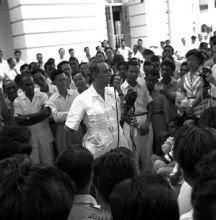
Monday, November 10, 2008 14:57

Minority PM: Singapore boleh in 1955 but not in 2008

In Guest Writers, Main Stories • 1,987 views • 54 Comments

Serville Zervant

On 6th April 1955, Singapore saw its first chief minister equivalent to its prime minister today being elected into parliament (then known as legislative assembly). He was not from the Chinese community who form the majority of the local population. Nor was he a Malay, the largest minority group and indigenous community of Singapore. Nor was he an Indian which is one of the two official minority groups in Singapore. Instead he was from a more pronounced minority group who numbered around 500 then. The people of Singapore then elected a Jew to lead their country.

This political party that this Jewish chief minister was affiliated to was the then Labour Front. It did not have a history of parliamentary victories to propel him to his seat. The election of David Marshall, a Jew, was rather not a freak result of the election but the choice of the people. In his short-lived two year government he did not lose favor with his people either. Instead he only resigned due to his failure to win independence for Singapore.

1955 was a time Singapore population lacked the present day affluence. Though literacy was not as high as now, people were well informed as they had a huge variety of print newspapers. The country was still recovering from the post second world war instabilities and uncertainties. The world was changing itself like never before. The empire on which the sun never used to set started falling apart. Even in such a confused and apprehensive environment, the Singapore population was sure about choosing a minority as its leader. On a global scale this was indeed a remarkable achievement since even many civilized western countries had not seen a minority individual being elected as head of state by the electorate then. Only fifty years later are they able to achieve what Singapore achieved in 1955. Even India, the largest democracy, only was able to provide sufficient votes for a non-Indian to be the leader of the government a few years ago.

However fifty three years later, we hear our Singapore prime minister saying a minority PM is not possible today. He is probably right. But then that brings about the question why is Singapore not able to repeat this achievement today. Why is it that in this area where other countries are making giant leaps upwards, we have fallen to where they were fifty years ago?
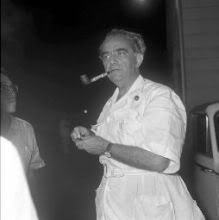
One might argue the population then had little wealth and so they were gambling their votes away. Realities cannot be that simple. There were certain proportions of the population who were at poverty line and they were desperate to get out of it. The working class Singaporeans saw the active reconstruction of the post war economies in Europe and Asia and they were keen to see that happen in Singapore. If this is not true, we will never have seen the enthusiasm and high productivity in the then labour force.

Given the large variety of information across a huge number of print media, the population was definitely more informed than the current population. Choice was something they could make confidently. Old photos clearly show large turnouts at any political event of any party which only show the population had great interest for politics also.

Contrasting that to Singapore in 2008, we see today a population that has only one news company to serve their whole domestic information needs. Their interest in politics is pathetic. It is at the most discussed in taxi journeys and coffeeshops. Discussions by some really tiny groups like TOC is a far cry from how it used to be in 1955. Even when a PAP MP speaks at dinners, half the times the crowds are totally not interested at all.
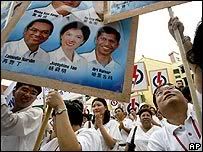
I have noticed that the average Singaporeans gets depressed when politcal issues are discussed. They are more interested in entertainment, recreation, making more money and buying more products. Even the ruling PAP is having problems finding good candidates. There is probably a slight improvement today from a few years ago but overall the situation dismally is a huge step backwards from 1955. It is about time Singaporeans sit back and reflect what has caused all this deterioration in the last 53 years and seek to rectify the situation. No economic achievement can sustain itself without parallel political achievements.

———-
The writer wishes to remain anonymous for personal reasons.
———-

Related posts:

  1. Malaysia boleh! Can Singapore boleh too?
  2. S$400b in Singapore market cap wiped out in 2008
  3. Amnesty International Report 2008 – Singapore
  4. The Tak Boleh Tahan protest case
  5. Minority PM: Time for the leadership to take the lead


54 Comments

You can follow any responses to this entry through the RSS 2.0 feed. You can leave a response, or trackback from your own site.

A Tan
Nov 10, 2008 15:12

Two reasons.

Not that many educated people with balls then.

Pre PAP hegemony.

EEr thinking abt it , not that many educated people with balls today.

I hate Apathy
Nov 10, 2008 15:34

As long as this person can bring Change for the better, I will support him or her NO MATTER who this person is or what race he belongs to. Will choose anyone and anyone like that. Plain and simple.

Zefly (aka Joshua Chiang)
Nov 10, 2008 16:32

Anyone noticed that the PAP no longer talks about the ‘can’, but always about the ‘cannot’ now, and keeps talking about ‘the real world’?

Singlish
Nov 10, 2008 17:10

Singapore today is a totally different from that of 1955. Both in the political front and the social front.

The PAP has control over all aspect of information and even to some extend the way we live. Sensitive information will be supressed. The newspaper of toady provide positive news about the country. This is a good way to keep every citizen calm so that the leaders can activate their thinking cap and focus on solutions. But on the other hand, citizens may not know the true picture and thus not prepared if things turn bad.

You will notice that today’s international news in the papers are mainly bad news. Mainly tragedies, corruptions, unemployment, assinations, racial riots and etc.. Not many are good news. Thus most Singaporean will feel that we are all living in heaven as compared to living elsewhere outside Singapore.

Thus you will know why there is strict control of international newspapers circulation in Singapore.

AhKao
Nov 10, 2008 17:22

Awesome article :)

Thanks for showing PAP’s latest rhetorics for what it was. With a history lesson :)

Donaldson Tan
Nov 10, 2008 17:32

The PAP has control over all aspect of information and even to some extend the way we live. Sensitive information will be suppressed. The newspaper of today provide positive news about the country. This is a good way to keep every citizen calm so that the leaders can activate their thinking cap and focus on solutions. – Singlish (#4)

Without an informed public, democracy ceases to exist. Such paternalism is an obstacle to democracy and an insult to the intelligence of the public. When Dr Vivian Balakrishnan stressed the mainstream media plays should be a responsible media, he didn’t clarify responsible to who and for what.

Jackson Tan
Nov 10, 2008 17:38

First of all, the political situation in 1955 Singapore is rather different from present-day Singapore. To begin with, Singapore is not independent; she wasn’t even fully self-governing. The British crown still can wield sufficient power over local decisions, and thus the Chief Minister’s job is not as crucial to Singapore as the Prime Minster’s job today.

Also, even though the British were disgraced in the eyes of the locals after WW2, I speculate that people then still had a favourable impression of westerners than locals as leaders. (Anyone from those times who can share an opinion or two?)

In his short-lived two year government he did not lose favor with his people either.

I’m not so certain about this either. The Hock Lee bus riots and other unrest happened during his short watch, and I think this does burn off some credibility in the eyes of the people.

Donaldson Tan
Nov 10, 2008 17:58

The Hock Lee bus riots and other unrest happened during his short watch, and I think this does burn off some credibility in the eyes of the people. – Jackson Tan (#7)

The bus drivers at Hock Lee Bus Company were protesting against poor working conditions, long work hours and low pay. If not for such marginalisation by the Employer, would this happen? The government did not do a fair job in looking out for citizen workers. In fact, students from the Chinese middle schools were sympathetic to the workers’ cause to the extent that they organised donation drives, brought food and money, and even entertained the workers with songs and dances. Singapore then and Singapore now are 2 different worlds.

Shihan
Nov 10, 2008 18:16

“In his short-lived two year government he did not lose favor with his people either.”

This is true. His hesitation to use force to subdue the riots cast him in favourable light within the eyes of Singaporeans (back then, Malayans). In fact, it was this love for his countrymen that diminished his standing among the colonial powers who saw this hesitation to use violence as a weakness.

Most vernacular press (Chinese, Malay, Tamil..) were supportive of him through his struggle to increase the scope of the Chief Minister office. The colonial powers didn’t even give him an office when he was elected CM, until he protested by setting up office in public.

People definitely had a more favourable impression of locals rather than westerners, precisely because of WW2. Philanthropists like Lee Kong Chian, Tan Kah Kee and such were local heros, compared to the ang mohs.

David Marshall was elected probably because 1) he could be the middleman between Malayans and the colonial powers, 2) PAP was still divided, 3) the LF’s biggest rival the PAP didn’t contest in full force because they were relatively inexperienced in political maneuvering and didn’t want to shoulder the uncertainty that comes with being the frontman.

alphavilleSG
Nov 10, 2008 19:42

Pleas stop using the phrase PAP hegemony, donno what it mean.

sad
Nov 10, 2008 20:25

It would be wise to read what has been revealed by the declassified British archive records or the alternate history that has been written by other authors rather than blindly believe the official discourse. The shrewd politicans have always manipulated people and history to remain in power and rewrite history. On that count we have the master mind (MM) to thank. Records are now showing that the racial riots could have been politically motivated to create chaos. Records also show that operation cold storage was more about getting rid of strong political opponents and not only about getting rids of communist leading leaders. Marshall was a true leader who put country before self and had the morall authority to step down when he could not deliver his promise. We do not see such honour and responsibility now. Everything is a honest mistake so we have been told to move on. While communism was the bogey man back then, race has replaced it and thus has been a weapon of manipulation to control the people and to introduce schemes (GRC) and policies (Racial harmony bill) to ensure hegemony.

At present times race has become the bogeyman for the elite leaders

Too Old
Nov 10, 2008 22:37

Good Article. Something you won’t find in school history books cos history of Modern Singapore starts ten years later in 1965.

#11 Good Point.

Historical narratives somehow always tend to skew towards the ruling class advantage…

me
Nov 10, 2008 23:10

“Even when a PAP MP speaks at dinners, half the times the crowds are totally not interested at all.”

that half mentioned are interested in the food. the other half that seems to be interested? they are good actors.

“Historical narratives somehow always tend to skew towards the ruling class advantage…”

skew? i would say totally slanted. a independent look at historical archives based on cambridge records would reveal a rather different picture painted by history books today about many issues, for example Hock lee Bus riots, chinese students protests and lky’s claim to power.
NOT a single history book in school’s syllabus mentioned that LKY was a japanese translator. they lauded lim boo seng’s sacrifices while conveniently neglecting that crucial fact about our Great Leader. if they placed them both side by side and compared, my oh my…..

LCC
Nov 10, 2008 23:31

Hmm… If I am not wrong, there was only limited franchise/suffrage in 1955, i.e. a lot of people, especially the Chinese, residing in Singapore then did not get to vote. Hence, perhaps the election cannot really count as Singaporeans voting in a non-majority race Chief Minister.

However, do not be mistaken; I am not saying that Singaporeans voted and/or are still voting along ethnic lines. I am just trying to present what those who think Singaporeans vote along ethnic lines may dispute about using David Marshall as an example.

singapooor
Nov 11, 2008 0:26

“not that many people with balls then”???

not true… there were more political parties and in each constituency it was a 2 or 3 or 4 corner fight. many of these candidates were well educated, literate and skilled. the list of candidates are as follows
http://www.elections.gov.sg/past_parliamentary1955.htm
do go and check their backgrounds and see how few of them were lay men.

“Chief Minister’s job is not as crucial to Singapore as the Prime Minster’s job today”

well why did the electorate take it so seriously then? why did so many well abled men came forward to run for seats let alone david marshall.

“a lot of people, especially the Chinese, residing in Singapore then did not get to vote”

majority of voters were the chinese…. if you still dont wanna believe just go to the museums and glance through the photos… the crowds were predominantly chinese… many of the photos with Marshall on shoulders of chinese crowds is common….

Ho Cheow Seng
Nov 11, 2008 4:25

I was born when the ‘Hinomaru’ [Flag of the Rising Sun] instead of the Union Jack [British Flag] fluttered supreme over Syonan-to. Do you know what I’m talking about, all my younger countrymen out there born during the period of peace and prosperity under the PAP?

Syonan-to was the name the Japanese gave Singapore when they took over control of this ‘island of the Southern Seas’ from 1942 to 1945. Japan surrendered after the U.S. dropped 2 atomic bombs on 2 Japanese cities namely, Hiroshima and Nagasaki. That ended World War II and led to the British Re-occupation of Singapore.

Now you may ask why I am writing about these things that had nothing to do with the topic under discussion. I beg to differ with you. It’s about our Singapore’s history when we were still a non-Nation. And to understand certain events that was part of our journey to Nationhood you have to know the history of our Country. Without such a knowledge you may at best indulge in intelligent speculation or draw probable inferences based on books you have read on Singapore.

This leads us to one very important distinction between the older generation who are now in their sixties and beyond, and those who came into being with the singing of Majullah Singapura. The critical distinction here between these different generations has to do with ‘a historical data-base’ which the older Singaporeans have that the younger do not. And this explains why sometimes the young are perplexed by events in the life of our Nation that seem so strange to them, as is evident in the eponymous question that forms the topic of our present discussion on this TOC site.

I will try to explain ‘Apa sebab’ a Minority Singaporean P.M. in 1955 ‘boleh’, and why now it is ‘hern koon nan, aah’ [problematic]. Like me the older generation also know what the problem is about because they have lived through that period of Singapore’s history. So we have the historical data-base and therefore we know why such and such situation was possible in the past and why that situation is now not immediately possible because of certain intervening events that occurred between 1955 and 1965. So it has nothing to do with ‘a one-party system’ or the many speculative reasons given which I have read on this site.

When the British was in control of Singapore they were not interested in governing the people. If at all they were interested in the people of Singapore, that interest was incidental to their primary interest of ensuring that law and order prevailed in this British colony so that they could continue to use this island as a station to facilitate their lucrative mercantile activities in Southeast-Asia and the Far East for the benefit of the Motherland Britain.

The period between 1945 and 1950 was a momentous phase for Asia in general. This period witnessed a stirring of political consciouness and nationalism in countries like India and China whose people suffered injustice and exploitation under European imperialism.

This political awakening also impacted on the people of Singapore and Peninsular Malaya who gradually realised that freedom from British colonial rule would allow them to choose their own leaders to form a government that would look after the well-being of the population that was formed of the different ethnic communities.

Soon the people in Singapore [as was also the case in Malaya] began forming political parties. The leaders and key members of the few inital political groupings were the relatively more educated of the local population. There were then the Singapore Democratic Party, the Singapore Progressive Party, the UMNO-MCA, the Singapore Labour Front and the handful of Independent candidates.

The SDP and the SPP comprised mainly of the English-speaking who were also Westernised in their ideas and behaviour. Consequently they had the support of the English-educated minority segment of the local populace. The UMNO-MCA hoped to gain support from their respective ethnic communities while the Independents were a motley group of English speaking individuals whose ideas and agenda eluded the local populace. The Singapore Labour Front was made up of members from the different communities most of whom, though English-speaking, had no more than the Senior Cambridge qualification. The exception in the Singapore Labour Front was a lawyer who was also a Jew. And his name was David Marshall. At that time the Jews were about the smallest community in Singapore.

David Marshall helped formed the Singapore Labour Front and was also subsequently chosen to lead the Party he had helped to organise. He was a brilliant criminal lawyer, a verycompetent orator, an egalitarian and by disposition, of unpredictable temperament. His high ideals inevitably led him to champion the cause of the masses. He was to a considerable extent helped in his ability to connect with the working-class masses by party-members who themselves were of the working class. Hence David Marshall was able to empathise with the working class and to appeal to them and win over their trust and support. It was precisely David Marshall’s ability to win over the hearts of the people at large that led to his being elected as the First Chief Minister of Singapore, short as his rule was, over the British colony.

The SDP, SLP, and SPP were rejected precisely because the working class could not identify with their Westernised ideas and ways. UMNO-MCA did manage to garner support from the people, but not enough to pose a challenge to the Singapore Labour Front. So these were the circumstances that led to a Jew from about the smallest of the few minority ethnic groups of a British colony, in a far-flung location of Southeast Asia, to emerge as the colony’s first Chief Minister.

When the PAP soon made its appearance on the political scene with its overseas-educated English-speaking members and its equally competent dialect and Mandarin-speaking fellow party-members, the writing was soon on the wall for the other political parties, including the Labour Front. When David Marshall subsequently stuck to his vow and resigned as Chief Minister, because he failed in his mission to achieve Independence for Singapore, he was succeeded by his law firm’s clerk in the person of the infamous Lim Yew Hock.

The events that followed the exit of David Marshall from the political scene, and the appearance simultaneously of the PAP led by the newly returned Cambridge-educated lawyer in the person of none other than the brilliant, forceful and fiery Lee Kuan Yew, is a phase of Singapore’s history with which we need not be concerned about in regard to the topic of our present discussion.

Ho Cheow Seng

Jackson Tan
Nov 11, 2008 8:14

Donaldson Tan (#8): The bus drivers at Hock Lee Bus Company were protesting against poor working conditions, long work hours and low pay.

And my point of that was to raise the possibility that he didn’t seem too favourable a Chief Minister because of these events, but I think Shihan (#9) and Cheow Seng (#15) has given a contrary description.

And I think Cheow Seng gave an excellent and succinct summary of events from a personal perspective. Thanks a lot; it’s very insightful.

gemami
Nov 11, 2008 8:41

Dear Cheow Seng,

By your account, and I am sure the account of our older generation, one can see clearly the sensitive mood of an age that was so traumatized, first by the Japanese Occupation followed by the British Imperialism and local political parties fighting for the right to represent the people.

While reading your excellent account of a part of history that most of the younger generation might have forgotten, I cannot help but wonder: “does race had a part in all these events?”

Did it happen that because the people of this generation were so traumatised that other issues of the day were of more concern to them than racial issues? Was the racial issue inconsequential at a time when the people were calling for a change in the way they were governed and their need to survive with basic needs while the country went through its reconstruction and rebuilding processes?

My point is, the present generation, although not having gone through the same experience or trauma their forefathers went through, are in the same predicament as the generation you’ve spoken about.

We have to decide what is best for Singapore and for its people.

Who is going to be PM and whether he is Chinese or minority is inconsequential. He must be able to do the job and do it well. On these factors will the people respond and they will respond as they did in the generation that saw a Jewish Chief Minister in Mr David Marshall.

DC
Nov 11, 2008 8:57

Hi Cheow Seng,

Thank you for sharing your personal experiences during those early formative days of Singapore’s modern history.

gemami
Nov 11, 2008 8:58

10) alphavilleSG on November 10th, 2008 7.42 pm
Please stop using the phrase PAP hegemony, donno what it mean.

Definition:
authority or control: control or dominating influence by one person or group, especially by one political group over society or one nation over others

Singlish
Nov 11, 2008 12:18

Cheow Seng has given a good account of the period from Japanese occupation till the early days of PAP.

From all the events taken placed, we can conclude that every moved made is for only one objective – a CHANGE for the better. Every fight, every protest is for the purpose of moving forward to a better life, better living condition, better welfare. Fight to get our own FREEDOM. Don’t want to be control by the Japanese, don’t want to be under the British Imperialism, don’t want to be under the Malayan government.

I guess, there is no difference in today’s society of modern Singapore. We have been under the PAP rule for more than 40 years. The PAP did well in the early days, bringing Singapore out of poverty and into a develop nation. We had progressed very fast as compared to many other nations because we are a very obedient lot. This is because we all have a common goal – No More Poverty for Singaporean.

But I guess things had gone too far. Our government continue to treat us like little kids. Telling us what to do and what not to do. Any slightest disobedience, we will be sued, put in jail or locked away under the ISA act. Our government has been “controlling” our lives to a certain extend. This has happened because we let them do it. But I think it is time for a CHANGE.

andrew chuah
Nov 11, 2008 12:38

11/11/08
Hi Jackson Tan-Singapore is majority Chinese and today, we have the best of the very best from this majority Chinese unlike in 1955 where the majority were poor and uneducated, and further, Singapore is unlike USA which has more than 200 years of history after Presdient Abraham Lincoln abolished slavery, we only have less than 50years of Independence.The majority Chinese were once not comfortable when we had a Singaporean Indian as Education Minister and they are not comfortable with a Singaporean Indian as Finance Minister (I also have my reservation and I am not a racist but a realist). Even, the late opposition leader JBJ was not really accepted by the majority Chinese in Singapore.For President, ok as it is a mere ceremonial position and we had Malay and Indians as our Presidents besides Chinese.

Regards
Andrew Chuah

AhKao
Nov 11, 2008 12:51

I think while Ho had a decent attempt at summarizing the transition from Japanese to British rule to independence and the present day, he was un-necessarily brief in the transition of power between the Labour Front and the PAP :)

“When the PAP soon made its appearance on the political scene with its overseas-educated English-speaking members and its equally competent dialect and Mandarin-speaking fellow party-members, the writing was soon on the wall for the other political parties, including the Labour Front.”

While I was not born at the same era as he was, I have met people who were and like many here, we do read about that period of our history beyond what is written in our textbooks.

Suffice to say, there was a lot of political manouverings that are worthy of Machiavelli’s writings that resulted in the change of power.

Some would say, even the Hock Lee Bus Riots were engineered ;) for a political gain.

Ho Cheow Seng
Nov 11, 2008 12:54

Comment #18 Gemami

Hi Gemami,

When Tuah T!un, Kena Terok and Aiyoh-yoh have all lost all their hard earned savings which they deposited with the Singapore extension of the Bank of America, will they still think of race in deciding on the best person to help them all with their misfortune?

The issue of race will take a back seat when the People are faced with an issue of paramount concern to All. Hope this helps. Cheers!

Ho Cheow Seng

DC
Nov 11, 2008 13:00

I don’t know what to make out of Andrew Chuah’s comment. Perhaps I’m reading too deep, but Mr Chuah, are you implying that uneducated chinese singaporeans because they are uneducated are more willing to vote a non-chinese CM in?

Can I ask why?

gemami
Nov 11, 2008 13:02

#21) Singlish

I think you’ve given a very good take on the article.

People everywhere all over the world cry for one reason. To be heard, usually because they want something done, or something changed. It transcends every generation for human beings are still human beings and we cry when we are in pain.

The other point is your use of the word obedient.
Indeed, PAP was able to achieved what it has achieved because of our obedience. This is one area where credit has never been accorded to the citizens from the time of our fathers to the present.

However, just like a rebellious child, when obedience is forced upon him, he retaliates. Don’t mind the consequences. He does not care.

I think we are heading in this direction.

Ho Cheow Seng
Nov 11, 2008 13:07

Comment #23 AhKao

It’s evident you don’t understand what the topic under discussion is all about. We are not talking about how the PAP got into power in the closing years of the 1950’s. We are not discussing the struggle for power between the Barisan Sosialis (The Socialist Front) and the PAP here. The topic is, how was it possible for a member of the minority to be elected to the highest office when Singapore was still a Britsh colony, and, why is it that the current P.M. has said that it would take some time before a member of the minority ethnic group could become the P.M. of Singapore. O.K.? Clear now for you I hope.

Ho Cheow Seng

gemami
Nov 11, 2008 13:13

24) Ho Cheow Seng

You’re right, and i believe we too, at this moment, have far more important issues to think about then the race of our PM.

Fantastic article, just like the stories I used to hear from my late father.

Thank you for sharing.

zilster
Nov 11, 2008 14:05

if you could recall… there isnt such a thing as a civil society in singapore in the eyes of the govt. what we have are civic society organizations…ones that are run by the govt(indirectly). Already…this issue has come to be seen as destablising because a civil society can bring about the ideals of a western liberal model which many could possibly subscribe to if such an issue was actually pursued.

With the ISA around…who would dare to stand up against such things especially so if this was view as a much radical issue that others?

AhKao
Nov 11, 2008 14:12

Mr Ho, you brought up the history lesson. I didn’t. You wanted it to be the context for how our society has changed over time. I felt there was a need to fill in the blanks.

Ho Cheow Seng
Nov 11, 2008 15:54

Author: AhKao

Hi Ah Kao,

The PAP did not exist when David Marshall decided to form his Singapore Labour Front to fight for Singapore’s independence. So what is the relevance of your earlier remark?

I was simply giving an account of the socio-economic and political background of Singapore against which David Marshall, a Jew and a member of about the smallest ethnic community at the material time, was able to gain the support of the other bigger communities…Chinese, Malays, Indians and Others alike…to become the First Chief Minister of Singapore. Incidentally some of the key PAP leaders were still studying in the U.K. or elsewhere at that time. So how is it possible for LKY or whoever to play dirty against anyone?

I suggest you read up on the history of Modern Singapore. Let me recommend you the following books:

1. The History of Modern Singapore by John Drysdale [title may not be totally accurate; available at NUS Library, Kinokuniya and Borders]

2. The History of Singapore by Prof. M Turnbull [Available as in 1. above]

3. Singapore: The Unexpected Nation by Prof. Edwin Lee
[Also available as with the other 2 mentioned titles]

Best!

Ho Cheow Seng

Donaldson Tan
Nov 11, 2008 16:07

One more book to Ho’s list:

Comet in Our Sky: Lim Chin Siong in History

http://www.selectbooks.com.sg/getTitle.cfm?SBNum=31610

fedup
Nov 11, 2008 16:19

Apart from David Marshall, another minority candidate, JB Jeyaratnam, won the Anson election too. What does it tell us?

AhKao
Nov 11, 2008 16:39

Mr Ho, as far as I can recall, the PAP was formed ONLY a year after the Labour Front. Hardly the kind of time frame you seemed to imply.

Ho Cheow Seng
Nov 11, 2008 20:10

Author: AhKao
Comment:

Hullo Mr AhKao,

David Marshall entered the political arena in 1949 when he joined the Singapore Progressive Party. Then Mr. Lee Kuan Yew was still at Cambridge. Yes the PAP was formed in 1955. So Marshall had a good 6-year start ahead of LKY. Also before 1949, Marshall was already cultivating his political base by being involved in many civic organisations. The thrust of my message in my latest write-up was that Marshall although a member of the minority ethnic group was able to win over the support of the majority working class and perceived at the material time as the best person to be Singapore’s First Chief Minister.

The PAP which was formed in 1955 was able to defeat the Singapore Labour Front because it had the unquestionable support of the dialect speaking Chinese as well as the Chinese educated Singaporeans who were the majority group. The English educated politicians, by the time LKY had joined in the fray, were rejected by the majority Chinese community. LKY,although English educated, was discerning enough to know the crucial need to join forces with Chinese political activists like Lim Chin Siong who was equally fiery and especially eloquent in the Hokkien dialect as well as Mandarin. So YES, race was a factor in politics even in the 1950’s. Otherwise how do you explain that the PAP, which was formed one year after Marshall joined forces with the Labour Party , was able to convincingly defeat the Labout Front?

Ho Cheow Seng

sim
Nov 11, 2008 21:54

Well, I guess the political system of now as compared to the 1950s constitute to the “unlikely” PM from other race.

Under a state largely controlling every single thing from the press, financial institutions, politically and even the manipulating on her population demographics, the state increasingly wields power in controlling issues that may threaten their power.

Looking at the GRC policy that requires at least one minority to be in the team, it is another form to highlight the power still lies on the majority side?

AhKao
Nov 12, 2008 9:39

Mr Ho

The point was and is: PAP was around and active during the short 2 years of Labour Front’s term as the ruling party. The Hock Lee bus riot, one of the key factors that led to the end, was orchestrated by at least 2 members of the PAP, one of whom was Lim Chin Siong, who was recruited by LKY

As you said, LKY knew with his background, he was unable to reach the Chinese educated majority but he recruited Lim Chin Siong and his contempararies, who did.

Without the Hock Lee bus riot, would Marshall have been successful in his bid for independence? We’ll never know. But if circumstances were different: we would not be asking “Is Singapore ready for a minority PM?” today.

:)

A non-chinese Prime Minister in Singapore? Let’s look at the cold hard facts. « Readings From A Political Duo-ble
Nov 12, 2008 10:28

[...] Zervant in an Online Citizen article, ‘Minority PM: Singapore boleh in 1955 but not in 2008′, suggests that the likely reason is political apathy. He notes, ‘I have noticed that the [...]

andrew chuah
Nov 12, 2008 11:24

12/11/08
Hi DC (25)-My answer is Yes, there were none highly educated Chinese in Singapore,as Ho Cheow Seng (35) wrote, Lee Kuan Yew was then in Cambridge and these poor and uneducated Chinese in Singapore had no choice but to vote for the late David Marshal who became Singapore’s first Chief Minister.Today, we have the very best of the very best Singaporean Chinese whom we can tap from unless the other minority races namely Singaporean Indians and Singaporean Malays are the la cream top three then I have to accept that they qualify to be the first non Chinese Prime Minster of Singapore.

My reply to Fedup (33) is the late JBJ did not represent the majority Singapore Chinese across the board in Singapore (he was elected on Anson seat)

Regards
Andrew Chuah

Ho Cheow Seng
Nov 12, 2008 11:29

Mr. AhKao,

Please bear in mind the topic of discussion procceded from the short article by the 3rd year law ubdergraduate who had asked why it was possible for Siingapore to have a member of a minority ethnic group to be the Chief Minister in 1955 but not a P.M. in 2008.

My main point is that Marshall ‘was the man of the time’ when he became the first Chief Minister of Singapore. The Jewish community was very small numbering a few hundred. So Marshall could not have been perceived as representing the Jews. Besides, he was ‘cosmopolitan’ and very concerned with justice for the people under colonial rule. And his support came mainly from the Chinese community because he knew he had to play to the ‘Chinese gallery’ to succeed in his mission to become the Chief Minister and then to fight for Singapore’s independence. For that matter anyone who wished to be the Chief Minister had to ‘play to the Chinese gallery’.

However when LKY and Lim Chin Siong of the PAP came on the scene, the crucial support of the Chinese commnunity swung to the PAP. So, YES, race was a factor in the politics of the 1950’s. Why then do you think LKY thought it necessary for him to learn to speak Hokkien and to address his audience in that dialect at rallies and over the T.V.? And he subsequently went on to learn Mandarin as well. And you should have seen the crowd whenever Lim Chin Siong spoke. He was a great orator using the Hokkien dialect and equally adept at Mandarin. And both LCS and LKY knew the Chinese psyche and could empathise with the Chinese crowd. In short they could connect with the great majority of the Chinese community in their ‘lingo’ using their idioms and cultural norms to advantage. These were ‘things’ which eluded Marshall.

If you don’t mind my saying, you are nit-picking to no purpose. Please explain to me the relevance of the Hock Lee Bus Workers’s strike to the issue under discussion. Incidentally there was also the STC Bus worker’s strike.

A discussion should serve the purpose of participants being richer for it by having gained in their knowlege. It is not a game of one-upmanship. And sincerely speaking, I would acknowledge you were right if in fact that was the case. But you have been irrelevant from the very start of this dicussion. Without intending to offend you, I’d like not to continue this dicussion any further.

Cheers!
Ho Cheow Seng

andrew chuah
Nov 12, 2008 12:02

12/11/08

Hi Ho Cheow Seng (40)-You made many good highlights but miss one good point ie the Hock Lee Bus & STC Bus Workers strikes were masterminded and instigated by the communists, and the Chinese community at that time were poor and uneducated, and were easily taken for a ride by these events.

Regards
Andrew Chuah

AhKao
Nov 12, 2008 12:26

Mr Ho,

Fact is: David Marshall was able to serve Singapore as its first Chief Minister, irrespective of race. True, he had party members who were able to appeal to the Chinese-educated majority, but the fact that he himself was NOT Chinese did not have a bearing on those who supported him and his party in the first elections.

THIS was the whole point of the writer of this article. And it still stands.

In your treatment of history, I felt you gleaned over how PAP rose to power subsequently.

Fact is: Hock Lee bus riot (incited by PAP committee members) was a direct contributory cause as to why the British DID NOT grant Singapore independence, citing Marshall’s response to the crisis. And Marshall resigned as a result of not achieving his goals.

Fact is: PAP won in part because the Labour Front lost steam without Marshall at the helm.

Had the riots not been incited, another course of history might have emerged.

So, the point that the predominantly Chinese PAP came to power subsequently on the back of the Chinese educated majority is IMHO not as relevant. We can agree to disagree on what might have happened otherwise, but I still stand by these facts.

gemami
Nov 12, 2008 12:39

I would like to thank AhKao and Ho Cheow Seng for contributing to the discourse above. I have learnt a part of history from two perspectives and will be reading up on them further when I have the time to do so.

I’d also like the way the discourse ended with both retreating to their positions and allowing the discourse to stand according to each one’s position.

I think there is a lot to learn for the rest of us tuning in to the arguments, especially on how to end an argument in a civilised manner.

Thank you both.

Ho Cheow Seng
Nov 13, 2008 0:44

Hi People,

How ever brilliant and capable the people in the PAP maybe, the ultimate power still resides in the people of Singapore. I say this because short of the PAP turning Singapore into a military dictatorship, so long as we still possess that one vote, we still have the last say. The fact is every citizen has one vote like AhKao, but, to AhKao’s dismay not everyone will cast his vote in AhKao’s direction.

And again THE fact is, despite all cursing, swearing, bad-mouthing,etc., somehow the PAP still gets more votes than all the Opposition Party put together. Now don’t repeat that list of ‘PAP controls the media, PAP redraws the electoral boundaries before every election, PAP should do away with the GRC, and etc.,’. Please, we all know these things are true. It is for the Opposition to think of these constraints as challenges, and think of how despite all these disadvantages the Opposition can still get the people to vote for them.

Maybe we should ask Chiam See Tong how he manages to do it so far. Or maybe Low Thia Khiang. Think about it, man!

Ho Cheow Seng

AhKao
Nov 13, 2008 12:06

I am not big fan of conspiracy theories, but the GRC gerrymandering excuse goes on every time there is an election.

Witness what happened to Eunos after Francis Seow’s narrow defeat. Or Cheng San after JBJ and Tang Liang Hong contested.

I find it funny that in every link in Wikipedia regarding these narrow margin GRCs, they always seem to disappear the following elections :)

Having an Elections Office that reports to the Prime Minister’s Office just suggests a lack of even playing field.

And while I am not the “confrontational type”, I do understand why CSJ feels that campaigning for a complete reform of the electoral process is necessary. Sadly, MANY people I know are still seeing him the way the MSM portrays him. Mr Ho may not feel that having the MSM against you is a big disadvantage but I beg to differ.

I am inclined to think that CST and LTK are token opposition MPs that the PAP is content to leave standing. To appease those international observers and for fear of backlash here. Even so, their size of their constituencies have been marginalized over time. When CST steps down for the next elections, I suspect that seat will be lost.

But that seems to be waay off topic for this thread :)

For what it’s worth, I’d have supported Dhanabalan if he had been PM. I have worked with him before. Or JY Pillay, had he decided to go into politics.

And yes, in case the moniker AhKao isn’t a big enough clue, I am of Chinese descent, with both parents being TeoChews to boot :)

Ho Cheow Seng
Nov 13, 2008 12:31

AhKao on November 13th, 2008 12.06 pm

My dear AhKao,

Who’s talking about conspiracy theories? And what do you mean by that? Let’s get real AhKao, if you really know how to fight the PAP you won’t be spending time on TOC site. You’ll be in the thick of things getting ready for the next GE especially as people are already anticipating a possible snap elections. But if you are on this site to play to the gallery, go and do sth more purposeful for the many people there who may need your help like what Tan Kin Lian is doing. Thank you for your time and good day!

Ho Cheow Seng

AhKao
Nov 13, 2008 14:35

Mr Ho

You mentioned that you do not believe that
- the ever changing, ever expanding GRC system,
- the more than slightly biased media coverage of opposition members
- etc etc etc
are impediments to the opposition.

There are many who group such practices as a “conspiracy theory” to “fix the opposition” or “do them in”. And I merely referred to them as such. While I do not subscribe to the same theory, I am a realist enough to acknowledge that the dice is loaded against any who stands under the opposition flag.

I know Tang’s daughter and I witnessed first-hand how scary things can be when the whole party machinery is “brought down upon thee with great vengeance and furious anger”, to quote a line from Pulp Fiction.

And the scrutiny on James Gomez after the PAP won the elections would have been so laughable for its pettiness, if it wasn’t happening to you personally. I doubt my own employer would have been as forgiving if I had to leave for a business trip and had my passport confiscated at the last minute.

In the light of how Obama and McCain handled their differences after the recent US elections, it just makes our PAP leadership look incredibly petulant.

I have a day job and that daily grind saps me mentally for the most part. It pays my bills, but with rising costs everywhere and a looming recession, I am forced to stay focused. I know of many in my predicament. With HDB prices at “market” rates rather than cost, I am stuck with a 30 year HDB loan, and I have to worry abt whether I have the minimum sum when I retire, or hope I can die before I have to retire. At least, then, the wife will get the insurance to pay off the home.

With my paltry bank balance, I doubt I can withstand even a single lawsuit. I’d be bankrupt in a day :)

I am however thankful that Mr TKL has come out of retirement and been championing the cause of the common man. Not all are called to serve, but seeing them, my morale is replenished.

I will definitely make sure my vote count.

Participating in an online discussion IMHO is not playing to the gallery. I have learnt from others here and I believe a good healthy discussion is fundamental for growth, spiritually or mentally.

Ho Cheow Seng
Nov 14, 2008 1:07

AhKao on November 13th, 2008 2.35 pm :

Re. What you wrote below:

“You mentioned that you do not believe that
- the ever changing, ever expanding GRC system,
- the more than slightly biased media coverage of opposition members
- etc etc etc
are impediments to the opposition. ”

Show me in which of my postings on TOC have I written the above? You are putting words in my mouth. Read my comments in #47 above. Do you really understand English or is there someone ‘ghosting’ for you?

You consider yourself a ‘hero’ in the opposition camp by the swaggering manner or tone of what you say. Have you seen clips of what politics was like in the 1950’s and 1960’s? If you have been following the goings-on in Thailand in the recent past several months, you’d would have just a slim idea of what politics was like in Singapore in the 1950’s and the 1960’s.

I was a young teacher when racial riots broke out between the Chinese and the Malay Communities. In the block of SIT flats where I lived were a few Malay families. And the Malay families were on different levels. The family next to mine was Malay. We could hear the sound of knives being sharpened in the early hours of the morning. The heads of the Chinese households on the same floor spoke with the Malay family who occupied the flat next door to my family and assured the members of this Malay family that no harm would come to them and the other Malay families living in the same block. We assured them that we would stand up for them and shield them should they be in danger of being assaulted.

The riot had broken out along Geylang Road on the Prophet Mohammed’s Birthday and soon spread to other parts of the island. The same evening a few deaths by stabbing was reported. There were various versions of what led to the riots. Then Singapore was already a part of Malaysia and a big contingent of policemen and soldiers from West Malaysia were stationed in Singapore.

According to my friend, who was a young Police Inspector attached to the Kandang Kerbau Police Station (opposite the Tekka Mall), tensions developed even between the Singaporean Police Force and the Malaysian Police Force at several police-stations because of perceived indiscriminate shooting by the latter at the Chinese.

[I'm now writing randomly,so my thoughts may not follow one from another in a sequence.] I witnessed one episode during the Maria Hertog trial along Serangoon Road where Komala Villa Restaurant still stands. Young Malay men and youths were seen stopping cars along the main Serangoon Road and looking for ‘orang puteh’ or ‘white men’. I saw from a distance a caucasian being pulled out of his car and given a severe beating. Then they overturned the car and set fire to it. Singapore was a colony and the Police Force under the British could do nothing much.

I have much more frightening things to tell than what you try to portray of Singapore today in your comments above. And they are not stories I hear from my elders. The ‘oId guards’ of the PAP were at least a decadeolder than I am today. Even the older current PAP leaders are a few years older. They have seen what had happened in the past and knew the close calls we’ve had. And the MM does not want, I believe, a repeat of that past. This perhaps explain some of his harsh actions against opposition members he thought was trying to unscramble the present system. I’m NOT saying I agree with everythin MM has done.And neither do many Singaporeans my generation and older. I am just giving you a sampling of the background against which he had to fight to keep Singapore safe for all Singaporeans. AND, I am not a PAP member.

On another occasion, I followed my friends to KL when PAP contested in the Malaysian General Elections. PAP fielded 9 candidates. I followed my friends to KL and stayed at the then Coliseum Hotel along Jalan Tuanku Abdul Rahman. My friends were helping the PAP candidate for Bungsar. I literally trembled as I walked through the Malay kampongs. They were very hostile and you did not know if they would attack you although there were some policemen around. YES, UMNO was very influential and strong in KL and in Malaysia in general.

The Malaysian P.M. then, Tunku Abdul Rahman, was a good man. He booted Singapore out of Malaysia, so I was told, because the ‘ultras’ in UMNO wanted LKY arrested under the ISD and locked up without trial. Do you know what would have had happened if they did that to LKY? In Singapore the PAP had just won a landslide victory. Do you think Singaporeans then, would wring their hands in despair and do nothing? The Tunku acted swftly and decisively inorder to prevent a communal blood-bath on a national scale.

So let me assure you, Ah Kao, you haven’t seen politics at its most thrilling and frightening yet. Please believe me. All the references to Hock Lee Bus-workers’s protests and STC[Do you know what the initial stand for] Bus-workers’s strike, and oh yes,have you heard of Tay Koh Yat? Come on AhKau! Forgive me for saying this but the fact is, I have tasted more salt than you eaten rice.

Now let me share with you a song sung by the bus-workers on strike as they marched in two’s down the street where I lived off Serangoon Road. This song was translated for me by my Chinese Educated friends who also knew English. The title of the song was:

I Love My Malaya

I love my Malaya,
Malaya is my Home.
Japanese time we’re not free
Presently we suffer more [under the British]
After dogs[the Japs] gone, monkeys[the Brits] come,
Malaya is my Home;
Come dear brothers and sisters,
Let us wait no more.

The Chinese title of this song was : Woh ai wor de Mar-lai-yah

Wor ai wor de Mar-lai-yah,
Mar-lai-yah shi wor de chia.
Jepunshi-hoew, pu che yew,
Sian chye hern kern khoo.
Sui chi koew ch!i
Hoew-chi lai,
Malaya shi wor de chia.
Siong tee mern kern chi-ay mei mei
Bu nern chye tern tai!
[Repeat over and over]

AhKao, no offence O.K.? But you really don’t know about the politics of the 1950’s and1960’s. You may have realtives or friends my generation but they were casual onlookers, perhaps the Chinese chauvinists of the time, leftists and supporters of the MCP.

Ho Cheow Seng

gemami
Nov 14, 2008 9:04

Hi Mr Ho,

Thanks for the very gripping first hand account of what it was like in the early days of Singapore’s history. I have heard similar stories from my late father who also had a lot of stories to tell about the attrocities committed by the Japanese during their short occupation of Singapore.

They were all first hand accounts about his struggle to survive as well as about how the people of those times did what they had to do order to survive. These are parts of Singapore’s history that ought to be archived before they are forever forgotten.

If you don’t mind, I’d like to deviate and point out one portion of your narration, in particular:

And the MM does not want, I believe, a repeat of that past. This perhaps explain some of his harsh actions against opposition members he thought was trying to unscramble the present system. I’m NOT saying I agree with everything MM has done. And neither do many Singaporeans my generation and older.

Although the backdrop of events might have led MM to take harsh decisions to ensure that Singapore doesn’t go back to ever experiencing such events ever again, it does not mean that it gives him the right to imposed such decisions. Yes, it can shape his decision making process, and I am sure it did, but he cannot be always using it to force his decisions on the populace.

There is a mention of harsh actions (taken) against opposition he thought was trying to unscramble the present system which really puzzles me.

Was LKY in the opposition camp during the time these events happened? If he was, then he ought to see opposition in a better light. Unless, of course, the opposition were the trouble-makers who got Singapore kicked out of Malaysia. In this case, he is right to be wary of the opposition and worry that they might create the same sort of trouble the opposition created at that time, because he would be looking at himself, will he not?

Also, surely with all the intelligence he possesses, he would know that having too hard a grip on things can only lead to one result, you’ll break it, crush it.

Don’t get me wrong, I’m not trying to be smart or anything but these are questions I need to ask after reading this portion of you post, so that people like your good self might be able to provide me the education I seek.

Thanks.

AhKao
Nov 14, 2008 9:38

Again, we are getting off topic from the original discussion but in an earlier post, the following was said:

“Now don’t repeat that list of ‘PAP controls the media, PAP redraws the electoral boundaries before every election, PAP should do away with the GRC, and etc.,’. Please, we all know these things are true. It is for the Opposition to think of these constraints as challenges”

Interesting what MM had to say about this when the shoe was on the other foot :)

“But we either believe in democracy or we not. If we do, then, we must say categorically, without qualification, that no restraint from the any democratic processes, other than by the ordinary law of the land, should be allowed… If you believe in democracy, you must believe in it unconditionally. If you believe that men should be free, then, they should have the right of free association, of free speech, of free publication. Then, no law should permit those democratic processes to be set at nought, and no excuse, whether of security, should allow a government to be deterred from doing what it knows to be right, and what it must know to be right… ”
Lee Kuan Yew 1955

“If it is not totalitarian to arrest a man and detain him, when you cannot charge him with any offence against any written law – if that is not what we have always cried out against in Fascist states – then what is it?… If we are to survive as a free democracy, then we must be prepared, in principle, to concede to our enemies – even those who do not subscribe to our views – as much constitutional rights as you concede yourself.”
Lee Kuan Yew 1955

“Repression, Sir is a habit that grows. I am told it is like making love-it is always easier the second time! The first time there may be pangs of conscience, a sense of guilt. But once embarked on this course with constant repetition you get more and more brazen in the attack. All you have to do is to dissolve organizations and societies and banish and detain the key political workers in these societies. Then miraculously everything is tranquil on the surface. Then an intimidated press and the government-controlled radio together can regularly sing your praises, and slowly and steadily the people are made to forget the evil things that have already been done, or if these things are referred to again they’re conveniently distorted and distorted with impunity, because there will be no opposition to contradict.”
Lee Kuan Yew 1956

“If we say that we believe in democracy, if we say that the fabric of a democratic society is one which allows for the free play of idea…then, in the name of all the gods, give that free play a chance to work within the constitutional framework.”
Lee Kuan Yew 1956

“Repression can only go up to a point. When it becomes too acute, the instruments of repression, namely the army and the police, have been proved time and time again in history to have turned their guns on their masters.”
Lee Kuan Yew 1959

“I pointed to an article with bold headlines reporting that the police had refused to allow the PAP to hold a rally at Empress Place, and then to the last paragraph where in small type it added the meeting would take place where we were now. I compared this with a prominent report about an SPA rally. This was flagrant bias.”
Lee Kuan Yew 1959

One can almost sense his fervour and passion in these speeches. And I can definitely see why he had, and still has a great following.

Also, I am not triviliazing that the challenges Singapore faced in 60s, not by any means. No doubt, the PAP has accomplished a lot during this tumultous period, which as you mentioned, was achieved with “harsh” actions.

Ho Cheow Seng
Nov 14, 2008 12:25

AhKao on November 14th, 2008 9.38 am
Hi AhKao,

You quote what I wrote below:
Please, we all know these things are true. It is for the Opposition to think of these constraints as challenges”.

Does this translate into my saying that they are not ‘impediments to the Opposition?’. Of course they are ‘impediments’. But do you give up in the face of these impediments? That is the thrust of what I intended to mean.

As for gemami on November 14th, 2008 9.04 am :

Hi Gemani,
I stand shoulder to shoulder with you in our mutual desire to see a harmonious multi-racial Singapore where all citizens regardless of race,language or religion may particpate in and speak their minds without fear or favour about the affairs of the Nation. YES, you have raised some very pertinent points. However the road to Democracy as practised in the West is a long and winding one even as it is an uphill climb. So patience isof the essence here.

You have seen what is happening in Thailand, Malaysia, South Korea and Taiwan where the People’s Representatives on both sides of the demarcation have been shown on TV behaving like hooligans and disrupting the business life of the Nation in one instance and in another, getting violent and physical by throwing objects at one another and and even getting into fisticuffs. This is not Democracy; it is Anarchy, to use the term loosely.

Also let us not allow ourselves to be bamboozled by the Americans about their being the model for Democracy. A lot of ’shenanigans’ and arm-twistings take place behind the scene. As a model Democracy, America should have abided by the consensus of the UN not to invade Iraq, but what happened? As the late Chairman Mao said of Western Democracy: “It is about power through the barrel of a gun”. It is about holding the Bible in one hand and the rifle in the other.

Also, like our children [to use an illustration to make my point], we need to teach them self-discipline, consideration for others, learning to put the common interest before self-interest under certain circumstances, their obligations and duties to their peers before we could grant them total freedom. So the way to go is to grant these children the freedom they want in instalments. When they have learnt to appreciate some pre-requisites of sustainable Democracy, then do we grant them some more freedom. Until such time when we feel they are mature, disciplined, responsible, civic-minded, law-abiding, possessed of good social values and able to co-operate for the good of the ‘commonweal’, they are not ready for absolute Democracy. Democratic issues such as freedom and the rights of the individual are not birth-rights. We have to be seen as ready and deserving of such privileges. We have to earn these privileges.

But yes, the Singapore Establishment must accord the citizens more trust and allow more freedom than they have at the moment. Personally I don’t agree with the reasons for having the GRC’s as well as the huge deposits individuals have to cough out inorder to take part as candidates in the GE’s. Taking part in elections whether as candidates or as supporters of a certain party is a sacred duty and right our citizens.

So YES, Gemani my Fellow Countryman, I agree with you where your arguments for a sustainable Democracy is concerned. Do also remember Democracy for different countries may mean differnt things at different stages of a Nation’s growth or development to full Nationhood.

Mao-zedung also believed in Democracy. For him it is freedom from foreign oppression, freedom from hunger for the people, a more equitable sharing of the Nation’s wealth, and the leaders must practise servanthood. Likewise the legendary Mahatma taught about unity in diversity, the sense of self-worth, being proud of one’s tradition and heritage, fortitude, and the readiness to make great sacrifices for the Nation that one loves.

Meanwhile thank you for your sharing. I enjoy this discussion with you.

Ho Cheow Seng

smallvice585
Nov 14, 2008 12:52

The Hock Lee bus riots and other unrest happened during his short watch, and I think this does burn off some credibility in the eyes of the people. – Jackson Tan (#7)

Actually, the riots did not burn the government’s credibility. Instead, it reflected the limited scope of power granted by the British to the autonomous government of Singapore.

gemami
Nov 14, 2008 13:22

Hi Mr Ho,

I am very thankful for your bite-size ‘lessons’ on democracy and its various possible permutations. Indeed, we do share the common desire of seeing Singapore the way you’ve described it:

to see a harmonious multi-racial Singapore where all citizens regardless of race,language or religion may particpate in and speak their minds without fear or favour about the affairs of the Nation.

I also noticed that you have given some very extreme examples of how democracy can go wrong and I cannot help but wonder if these examples would act more as a hindrance rather than a help in our pursuit of democracy, our own unique style or model of democracy (very much unlike what it is at the present moment, I must add).

Could this be scaring our present govt from even considering it?

We do know about American style democracy and the Hollywoodness of it. However, I feel we also need to look at the positive side to it, minus the Hollywooding, the shenanigans, as you have described.

One of the most telling positive of Western style democracy is freedom.
Freedom of speech, freedom of association, freedom to choose etc. It gives the power to the people to decide how they want to live their lives. Nothing much like our beloved Singapore…sigh :(

Also, about your illustration on our growing children, I have a worry I need to highlight. You use the pronoun WE. Now I take this to mean the government of the day, although in your context, it probably means the parent or parents. It’s like a parent giving medicine to his child.

Won’t there be a problem if the parent/s have too much control on deciding how much of the dosage to measure out? Too much is no good, it might do more harm than good, and; too little is also no good, it might not be effective. So, the difficulty becomes a problem. How does the parent measure out the correct amount? It has to be almost perfect, won’t it. Quite impossible also.

Other than this, I am very glad that we do see the need to change some of the ways our beloved Singapore is presently being run.

And there may be a need to create a democracy of our own, different from the others, where every citizen has a part to play in.

Thank you for taking time to share these wonderful lessons with me.

Gemami P.

brick
Jan 21, 2009 6:05

FACT: Two terms of the elected presidency in Singapore during the last decade were won uncontested by a former civil servant of a minority race that makes up less than 8% of the voting population.

CONSEQUENCE: Is the Prime Minister suggesting that two miracles had happened in those two consecutive elections? Has the country suffered as a result of that choice? Did we pay a great social cost having a person of a racial minority elected to the most highly-paid public office in our system? Did a field survey – that the Prime Minister has done and yet to share with us – showed that our racial-minority President has not been popularly accepted? What makes him say such things?

Does Singapore not deserve the best leaders available, regardless of gender, race and religion? Isn’t that the main reason we are paying the highest salary packages in the world per capita to our Ministers? To get only the best and not just the next best? Can some skin colours possibly be less “best” in the Prime Minister’s eyes? We are not seeing the logic here, but some true colours seems to be showing.

HISTORY: Ready or not ready, Singapore had accepted the President’s dedicated service to watch over the country’s reserve and perform distinguished ceremonial duties for more than 10 years. We haven’t seen violent objections. “Not any time soon” has been happening sooner than you think or remember.

One can never be ready for history. But some will continue to live in denial of history.

This country really has a warped and twisted sense of history and time…progress in this country happens in the most bizarre and topsy-turvy sequence – we can be so blind to what has already happened, and then when it is almost gone and happily over, realise we were never ready for it in the first place!!!

Leave a Reply

Comment


theonlinecitizen on Facebook