Gilbert Goh / Writer
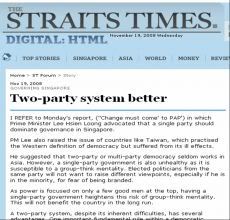 Recently, I wrote an article on the reasons for a two-party democracy in reply to PM Lee Hsien Loong’s endorsement of a one-party system and it was published on Straits Times. In my letter, I argued that a one-party system allows group think to flourish and that there will be a gross lack of checks and balances.
There was a passionate yet civil exchange between supporters of two-party democracy and advocators of the one-party system. Many vocal netizens on the ST Forum supported a two-party democracy. Reading the published letters and views, I realised that both systems have its merits. A new question dawns on me: which system would be more applicable for Singapore‘s context today?
Are the Arguments for One-Party System skewed?
Advocators for the one-party system generally favour a stable and authoritarian government as history has showed that the two-party democracy has brought forth many political problems. Many cited the example of Taiwan with its ugly fist-fights when parliament is in session. Chairs and tables were often hurled at opposition camps when ruling party members could not see eye to eye on common topics that affect the country. Surely, Singaporeans would like to see their parliamentarians to avoid engaging in uncivil acts.
Malaysia was also cited as a bad example of multi-party democracy as the country is seen as unprogressive and chaotic. With the rise of Anwar Ibrahim, much is yet to be seen. He managed to unite some splinter parties to form a large coalition and challenged the mandate of the ruling coalition Barisan Nasional. Only time will tell whether Anwar Ibrahim will manage to topple the ruling party UMNO and the Barisan Nasional from their traditional power bases. While Anwar Ibrahim was persecuted under the Internal Security Act by some UMNO members, one should take heed it was the Malaysia Prime Minister Abudulah Badawi from UMNO who released him. It is unpatriotic of any political party to clamp down another political party for the sake of holding onto power.
The two-party democracy in the USA is a common example that is cited by proponents of both the one-party system and two-party democracy. Some advocators of the one-party system argued that the USA President and other holders of executive power can potentially be a stumbling block to the country’s progress by curtailing certain proposals for political reasons, but political reasons exist regardless if the country adopts a one-party system or a two-party democracy. On the other hand, many favoured the American two-party democracy as the Congress provides the necessary check and balance on the executive power holders. Moreover, the American two-party democracy discourages entrenchment of individuals in executive power as no President can remain in office beyond 2 four-year terms.
Proponents of the one-party system are wary that two-party democracy may throw up unnecessary debate and other parliamentary procedures which will hamper certain policies from being implemented. This is known as filibustering. One finds filibustering a problem if one supports the policy being pushed in parliament. In Australia, the ruling party Labour has difficulty pushing through certain policies as the Shadow government uses all its might to oppose Labour in parliament. For example, Labour had wanted to introduce school ranking to the Australian public school system, but the Shadow government had put up such a strong resistance that the plan was postponed indefinitely.
Minister Mentor Lee Kuan Yew claimed that the one-party system is superior over the two-party democracy, citing the past success of the People’s Action Party (PAP) in transforming Singapore into a modern city state. However, this only qualifies as a potential reason to vote for PAP during General Election and why PAP should be the only political party if Singapore adopts a one-party system. It does not actually explain why a one-party system is better than a two-party democracy.
Prime Minister Lee Hsien loong claimed that Singapore does not have room for one more party to share in the governance of Singapore becase political talents in Singapore is so scarce that it is already so difficult to recruit a team of ministers, talk alone to form an equally capable alternate Cabinet. While his arguement does not acknowledge the climate of fear in Singapore, it also highlights PAP’s interest to ensure that no political talent will join the ranks of the Loyal Opposition.
Which system is more applicable to today’s Singapore?
Singapore‘s multi-party system has evolved into a dominant-party system over the years. This is evidenced by the presence of various Loyal Opposition parties in Singapore. They are Reform Party, Worker’s Party, Singapore Democratic Party, Singapore People’s Party, Singapore Malay National Organisation and National Solidatary Party. In 2008, only 2 elected Members of Parliament (MP) and 1 Non-Constituency Member of Parliament (NCMP) represent the Loyal Opposition. The parliament is dominated by the 82 MPs from PAP – an overwhelming parliamentary majority that provides ease for the introduction and entrenchment of unpopular public policies and laws.
Many have cited PAP’s overwhelming parliamentary majority as a result of relentless persecution of the Loyal Opposition in Singapore. There is some truth here as depicted by the many instances of unfair political tactics used during election campaigning period and also the use of law suits to destroy Loyal Opposition candidates. Such acts have propagated a climate of fear so much so that many able men and women will avoid politics unless they are standing on the PAP’s side. This effectively dampens the rise of an influential Loyal Opposition party. If one day something were to happen to PAP, surely Singapore will be doomed if there is no strong viable alternative. Why should Singapore put all its eggs in one basket?
However, the PAP did attempt to improve representation of dissenting voices in Singapore. The NCMP scheme was first introduced in 1984 to provide greater legitimacy and public confidence to the Singapore‘s political system. The sole 5-year NCMP seat is typically offered to the best performing Loyal Opposition candidate in each General Election. The Nominated Member of Parliament (NMP) scheme, first introduced in 1990, is open to a maximum of 9 unelected MPs for a 2-year term, after which they may be re-appointed. Prime Minister Lee Hsien Loong lately liberalised the local political space by allowing demonstration to take place at Speaker’s Corner without the need for a permit. The recent popularity of Speaker’s Corner demonstrated that there always have been a much needed avenue for political freedom in expressing an alternate voice in governance.
Events of late have show that the current dominant-party system with all its self-checking facilities can only do so much. For example, the recent town councils’ exposure to investment fiasco has caused quite an uproar and many only recently realised that Town Councils make investment from their accumulated Service & Conservancy Charges (SC&C). They were both shocked and frustrated. Many who learned that the PAP Town Council funds have accumulated nearly S$2 billion were also irked over the possibility that they could have been paying excessive monthly SC&C. How and who can they take their grievances to?
Right now, Singaporeans can only depend on MPs, NCMPs and NMPs to question the respective ministry over emerging issues in parliament. Yet when PM Lee Hsien Loong stressed that the party is the fundamental unit of parliament and when NMP Eunice Oslen, who is not in charge of any Town Council, did all the questioning in Parliament with regard to the issue of the town council’s investment, it is no longer clear if all elected parliamentarians prioritise nation-building over party allegiance. Many people wrote to the ST Forum to voice their concern and anger – the citizens’s main outlet for specific dissent and concerns.
Indeed, the dominant-party system has major flaws here and adopting one-party system will further entrench these flaws in Singapore‘s political system via elimination of all Loyal Opposition. The self-checking system only works when its own MPs will attempt to do the dirty work and speak on behalf of the people regardless of real or perceived consequences. Unless the Whip is lifted, many PAP MPs may not want to press on any issue by going against the grain. They may put up their questions to the ministry but may not want to cause any mayhem in Parliament.
The lack of strong interest groups in Singapore does not help to keep group-thinking among PAP MPs in check. In many developed countries, these interest groups act as a strong check on the public policies being pushed by the ruling party. For example in Australia, the powerful environmental groups have spoken against the emission of carbon dioxide in the country and the government sometimes has to invite such groups for their opinions when they formulate environmental policies. Such groups not only provide a voice to many who may share similar concerns on the environment but also act as a check against unilateral implementation of environmental policy that does not address social, political and economic concerns adequately.
Which political representation is better for Singapore & Singaporeans?
One-party system and two-party democracy have their inherent advantages and disadvantage.
Those who advocates for an efficient and effective system tend to favour the one-party system as it allows the ruling party to implement many policies for the country without much fuss and fury. This group are slightly apathetic and they prefer to let the government does their job without questioning. As long as the government provides peace. economic progress and stability, they are contented while remain oblivion to their blind faith that the ruling party can deliver the goods indefinitely.
Those who want a check and balance system for our governance will gun for the two-party democracy even though it may throw up some friction between political parties. They prefer the government is checked to prevent excessive power excercised on the people. Different political parties are sensitive to different issues to different extent, so having more than one political party in parliament would adequately capture interest and concerns of the people. Politicians would finally do their necessary part of speaking up for the people.
Whether an individual choose a one-party system or a two-party democracy must be backed by the interest of long term benefit for Singapore and Singaporeans. My personal opinion is that the current system seriously lacks accountability now and if left unchecked may prove to be disastrous for all Singaporeans. As the population is increasingly upset by many hiccups occurred this year alone, a two-party democracy is the most logical and reasonable political representation. An effective check and balance system is an essential instrument to safeguard Singapore‘s future.
———

