Tuesday, December 2, 2008 14:31
More political space for Singaporeans if Government accepts proposals: AIMs
In Andrew Loh, Main Stories, Top Story • 1,220 views • 28 Comments
Andrew Loh / Deputy Editor
Author’s Note: AIMs has clarified that they are not recommending a “blackout period”. Please see the clarification below, after the report. I apologise for the mistake.
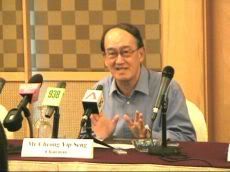
After months of consultation with various sectors of society and organizations, the Advisory Council on the Impact of New Media on Society (AIMs), finally presented its report on Internet regulations this morning.
“If the Government warmly embrace what we are suggesting…it will lead to more diversity, more choices, more space for political discussion,” AIMs chairman, Mr Cheong Yip Seng, said at the press conference which was held at the Grand Copthorne Waterfront Hotel at Kim Seng Road.
The report, titled “Engaging New Media, Challenging Old Assumptions”, is a 224-page document, neatly packaged and given out to the media. It comes after consultation with groups such as the Law Society, Government Parliamentary Committees, businesses, bloggers and individuals.
As with previous public forums held by AIMs, the focus today was on the Films Act – particularly Sections 33 and 35.
Section 33 bans the making of party political films while Section 35 prohibits films which are “against the public interest”.
In its report, AIMs is proposing that the Government repeal Section 33 altogether – but in phases. Explaining why it is calling for the total repeal of the Section, AIMs gave the following reasons:
1.The present ban is too wide-ranging and stifling
2. Techonlogy has out-paced the law
3. Other legislation are already in place to deal with potential threats to our society
4. The present legislation is too restrictive
5. There is no reason why New Media cannot be responsibly used for political purposes..
But if the Section were to be repealed, AIMs suggested that the “risks that follow be managed.” It is with this in mind that it also recommends that a “blackout period” for political films during election periods be introduced into law. “During the blackout period, political parties, candidates and their agents as well as individuals are not allowed to distribute or exhibit new party political films as defined under the present Act,” it said in its report.
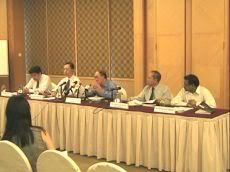
Acknowledging that this is “open to criticism”, AIMs feels that this is a possible compromise between a “free-for-all” option and a “not-at-all” regime.
To a question by The Online Citizen, Deputy Chairman of AIMs, Professor Tan Cheng Han clarified that this did not mean no new films would be allowed during election period. He cited the examples of “factual material” such as videos of election rallies or of political parties’ walkabouts during the hustings. These, he said, should be allowed.
Nonetheless, in lieu of full repeal, AIMs is suggesting that the Government decriminalize the making of political films as a first-step towards abolishment and also to narrow the scope of the law to target only party politial films which “intentionally mislead viewers”.
Turning to Section 35 of the Act, which gives the Minister the power to ban films which are “against the public interest”, AIMs proposes that it be retained in the law. It explained that it did not review Section 35 because “there are indeed films that are against the public interest,” citing the recent Dutch film Fitna as an example.
However, AIMs suggested two improvements to current legislation:
- That Section 35 is amended to spell out clearly the basis on which the Government should ban a film contrary to the public interest
- The independent advisory panel for party political films should advise the Minister before a film is banned under Section 35 and that the Minister should be obliged to give reasons for the ban.
“These two measures,” said AIMs, “is to address the concerns of those who fear that Section 35 would be used to limit political debate.”
Also in its list of proposals, AIMs asks the Government to allow civil servants to voice out their opinions online. It explained that these civil servants are in a unique position to articulate balanced and unique perspectives first-hand.
When asked by TOC if AIMs had approached any opposition parties for their views or if any opposition parties had voluntarily presented their views to AIMs, Mr Cheong said that no opposition parties had done so.
Mr Cheong, however, reiterated that if the Government accepted these proposals, Singaporeans would have a ‘broader space’ for political discourse and discussion.
TOC will do a fuller review of the AIMs report at a later time.
You can visit AIMs’ website here.
—–
Clarification from AIMs on “blackout period”:
I read your article on this morning’s press conference on TOC and would like to clarify a point.
In the below paragraph from your article:
But if the Section were to be repealed, AIMs suggested that the “risks that follow be managed.” It is with this in mind that it also recommends that a “blackout period” for political films during election periods be introduced into law. “During the blackout period, political parties, candidates and their agents as well as individuals are not allowed to distribute or exhibit new party political films as defined under the present Act,” it said in its report.
You had suggested that AIMS recommends a blackout period however, that quotation from the report is from page 68 which contains the recommendations we had proposed in the consultation paper.
In AIMS’ finalised recommendations from page 74, we had recommended that Section 33 of the Films Act be repealed in stages. There was no mention of any blackout period or any conditions attached to this ultimate goal of a total repeal.
We would like to clarify this and appreciate if you could amend your article to reflect this point as I imagine many bloggers would be referencing TOC for a summary of our press conference.
Thank you for taking your time to come down today and please feel free to contact me if you have any questions.
Yvonne
————-
Related posts:
28 Comments
Gilbert Goh
Triple Threat
The AIMS is supposed to be neutral in its stand, thus no opp parties are approached.
Triple Threat
Point 5 and 6 are the same, please rectify. Thanks.
Mohamad Hamim
Indeed the Gov should take the proposal from AIMs.
In modest society, thinking creative are the best way to open up.
See the future with aspiration, passion and leader are the one to create the good things in the society for better Singapore.
Mark
AIMS sought the views of Govt Parliamentary Commitees so it should make sense that views from political parties – both PAP and opposition – are also heard. For that matter, did they seek the views of filmmakers like Martyn See?
Sometimes only
I wonder is it that the obama campaign has inspired some to change mindset on the use of films ? any useful effect? i no no leh. u know?
singaporedaddy
I love the wallpaper looks like a chessboard. Can I get it in ikea?
It’s ironic that political parties, being one of the main stakeholders in the issue of media liberalization, have chosen to stay silent.
Kudos to Aims for recommending an eventual full appeal of Section 33 of the Films Act.
sweet_gingerz
This is a positive and interesting development :)
To Gilbert Goh, I don’t think it is strange that AIMS did not approach the Opposition, though I acknowledge the point made by Gerald that political parties are significant (not main) stakeholders in the virtual realm. The opposition could have taken a more proactive approach and presented their views/suggestions. That would have been a good opportunity for positive publicity for them, is it not?
My guess is that views from both PAP and Opposition were sought indirectly through the consultation sessions with groups such as the Law Society, Government Parliamentary Committees, businesses, bloggers and individuals, who may be partisans but had not identify themselves as one.
Finally theres action taken in the positive interests of the community! They sure are slow huh.. but well, better late then never. Still, i wonder how ist he black-out going to take place.
Tan
There will be no amendmants. It is all talk. Does anyone really believes that changes will take place that can actually benefit the opposition?
gemami
Acknowledging that this is “open to criticism”, AIMs feels that this is a possible compromise between a “free-for-all” option and a “not-at-all” regime.
Why go for half an egg without even trying for the full egg? This is very typical of our civil service who self-censure and censor themselves before they even try asking.
this did not mean no new films would be allowed during election period. He cited the examples of “factual material” such as videos of election rallies or of political parties’ walkabouts during the hustings. These, he said, should be allowed.
Herein lies the catch. Nothing in ‘factual’ that is outside of the PAP box. It is clausesand statements like these that already protects the PAP even before they are approved.Worse, the opposition are already condemned because whatever films they might put up would certainly be their death-knell.
Nonetheless, in lieu of full repeal, AIMs is suggesting that the Government
decriminalize the making of political films as a first-step towards abolishment and also to narrow the scope of the law to target only party political films which
“intentionally mislead viewers”.
Isn’t it clearer now? Who is going to deem if there are intentional misleadings or not? Our kangaroo court again?
Turning to Section 35 of the Act, which gives the Minister the power to ban films which are “against the public interest”, AIMs proposes that it be retained in the law.
See what I mean, The Minister has the last say and AIMs says it is okay and this
authority should be retained.
“These two measures,” said AIMs, “is to address the concerns of those who fear that Section 35 would be used to limit political debate.”
AIMs should try to address the root cause of such fears, which is, the power of the
Minister who holds the authority to decide at his whim and fancy whether the film
contents are misleading or not. AIMs ought to have this authority removed and
given to the court of law to decide, independently. Perhaps, AIMs also realises that we have a kangaroo court?
AIMs asks the Government to allow civil servants to voice out their opinions online. It explained that these civil servants are in a unique position to articulate balanced and unique perspectives first-hand.
Good step but these civil servants must not come online and start behaving like
Elaina and Durian Thrower Gang. They must be brave enough to speak up againstpolicies and issues in full honesty and sincerity and not to use it to curry-flavour or to gain personal career mileage.
btw, this morning’s TODAY papers hinted that the civil service would do well to emulate TOC and its ability to attract credible contributions and discourses on its platform. Well, done TOC, again.
When asked by TOC if AIMs had approached any opposition parties for their
views or if any opposition parties had voluntarily presented their views to AIMs,
Mr Cheong said that no opposition parties had done so.
Well, well. Is AIMs really serious, half-serious or just playing a joke on us all?
We will know when the govt throws the proposal into the waste bin that
this is all but one real big joke to smoke-screen the people again.
Jingo
8) Gerald Giam on December 2nd, 2008 11.07 pm
“It’s ironic that political parties, being one of the main stakeholders in the issue of media liberalization, have chosen to stay silent.”
I do not feel that you are being fair making this statement.
we all know the constraints.
You speak as if there is ZERO constraints.
I have been a fan of your articles. This comment of yours disappointed me.
no offens juz my honest feelings.
Jingo
I meant, Alternative partys may have faced some constraints.
And for the ruling party, how do you know they have not spoken to the AIMS team?
And could you clarify is it that ZERO members of AIMS is a member of any political parties?
Please lah, lets be clearer leh.
jy
Mr Cheong Yip Seng,
Were you the former Chief Editor of The Straits Times?
Belajian
I recall Gerald was the TOC member who once told a group at SubStation
that not all MSM people are ‘like that’.
I wonder what does he mean?
The fact is they work in the MSM.
They choose to work in the MSM.
And they are the ones giving us the news that we read because its written by them. For decades.
15) jy on December 3rd, 2008 8.44 am
I read your comment with interest. You mean, as one of the MSM chief, the person should not be a member of any political party to show that he is more neutral and unbiased? I wonder how the rest of you feel about this? My question is why should a newspaper chief be a member of a political party? I do not object to it but just like to know if this is a pre-requisite and do all of you feel this is a step forward to unbiased news.
Of course, I can only say our MSM chiefs have been excellent and totally unbiased. Even they would agree. right?
To Belajian
16) Belajian on December 3rd, 2008 9.54 am
I think your answer is in front of you.
All singaporeans have not done anything to show they are not happy with the people helming the MSM.
So, by that we have to assume, they all have no issue with how they are appointed. Sporeans must be responsible for their decisions.
widowmaker
btw how much did AIMS cost the taxpayer?
gemami
#17) Sporeans must be responsible for their decisions.i>
Hi Fellow Singaporeans,
Allow me to deviate from the main topic a little.
How often have we heard the above expression in our course of conversations, whether here in TOC or elsewhere in our own private gatherings. Do we really believe that Singaporeans are fully responsible for the rubbish perpetuated by the PAP govt? I seriously think we should stop thinking that we are at fault.
Look at the various election platforms by which the PAP sourced for our votes.
- A more open and consultative government.
- A gracious society
- The next lap (where we look after one another especially those lagging behind).
These are just of the few telling ones; and; it is by these promises that majority of the voters were taken in, believed and voted.
When things go wrong, the blame suddenly falls on the people for giving the PAP govt the blank check to govern. How wrong this percetion is. If it is true, then every democratic govt of the world can do likewise and blame the people for every failed policy.
It is time for us to wake up and be clever enough to discern the lies that this PAP govt has been feeding us. When you start to chant these lies like a mantra, you will end up believing that they are truth – which is furthest from the truth.
Think about it, won’t you?
Regards to all.
Complain got any effect or not?
Singaporeans are limited by the limited experience they have. Actually, we have never experienced rule under another partee.
We have never experienced many other thingies:
1. cannot say….
2. oso cannot say….
3. still not at liberty to say….
4. better dun say….else….kenna…..
5. my mudder told me never to say and say….
6. better let others say….
7. dun be hero lah….
8. say like no say….
9. say no use wan…..
A. got people representedtatives to lapresent you already wat. let them rep us lor. all 82 or so wor.
B. wait until the palpitation is no longer palpitating.
C. Got opposition in the parl already mah…they so solid bombastic speak up on all issues of public interest wor….i name you exampers…..erm…..i….need to find the examples….
Daniel
Once the citizen accept proposal what is there to ensure the government will not change the proposal at their own will, own time and own target ? Is the gov using the same tactic of making the concession first , and once agree, change it to their own liking over time (Isn’t this same as CPF thingy etc). We have seen that happened in Singapore, don’t we ? Do we even trust the kangaroo system here anymore ?
Who will fight against the kangaroo system if kangaroo make punk again ? The AIMS with people consisting of MSM people ?
There must be someone accountable when the proposal will be amended by the government in the future by who the one really ?
What I mean is that proposal look good now but What is there to stop the government from meddling the agreement without consulting the ground in the future ?
gemami
The PAP govt is like one who has risen above the clouds and together with him, he has a team of people to tend to his needs like pedicure, manicure, and all sort of cures like pace-setters etc.
While above the clouds his vision of the earth is so clouded that he needs his team of advisors to advise him on the happenings below the clouds. Unfortunately, these advisors are up there with him and what they see from up there are no different from what he himself sees.
What do we do down here?
Yes, like what anyone with a sound mind would do. PULL THEM DOWN!.
This is the only solution to all our problems.
IBA ABI
U60 and then AIMS. I wonder ……. IBA IBA untooneh!
Gerald u got time or not?
if got, could you respond to #13, #14?
LPC
AIMs is doing a great job. Pls keep it up your good work.
Tan
Ai ya, this is just all talk, will not change anything of significance. The gahmen where will allow changes that might ACTUALLY benefit the opposition? Forget it lah, better stick to the old Films Act.
smallvice585
Unless the PAP withhold its monopoly claim on determining public interest, Singaporeans will never be free from PAP’s tyranny.
PAP and New Media « Blogscapes
[...] this month, the Advisory Council on the Impact of New Media on Society (AIMs) presented its report on Internet regulations, with recommendations made for laws on political videos and online election material to be [...]

Thanks for the reporting Andrew. Appreciate it.
It is strange however that AIMS did not approach any opposition parties for their views on the project. It struck me as odd and very unlikely.
I have doubts that AIMS objective is not skewed at all here,
Just my opinion here anyway.
We will see how much change will be effected by the findings.