Wednesday, February 25, 2009 21:45

What the Temasek debacle reveals

In Guest Writers, Main Stories, Top Story • 4,168 views • 81 Comments

Aloysius Foo

A Temasek wrapped up in a mystery within the abyss of the Singapore economy

Public displeasure should be directed correctly, for it to be effective. The recent revelation, that Temasek Holdings has lost 31 percent of its net portfolio value between March and November 2008, is initially shocking, given its supposed reputation as a professional and long-term investor. Temasek also seemed to have made a wrong judgement on hindsight, when it injected capital into Barclays and Merrill Lynch.

Understandably, especially during this recession, Singaporeans are concerned about Temasek’s performance. It is for a very good reason; Singaporeans believe they have a share in Temasek’s money through the sole shareholder, the Ministry of Finance.

Firstly, Temasek’s performance is not very shocking if market indices elsewhere are examined. Temasek parks a third of its investments in Singapore, holds stakes in 7 out of the 10 largest companies here, and nests another 22 percent of its portfolio in China, South Korea and Taiwan. A sizeable chunk is also held in OECD economies (see below). As the name ‘Holdings’ implies, Temasek owns stocks in companies, and they don’t keep tonnes of cash in its drawers.
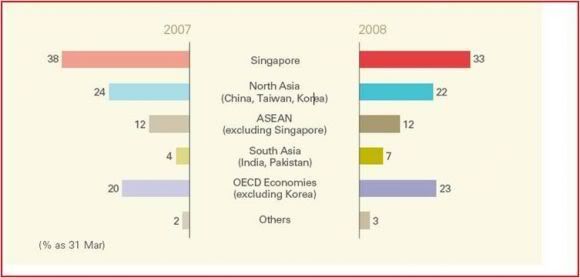
 

Figure 1: Temasek’s investment portfolio by geography (Source: Temasek Review 2008)


Figure 2: Performance of major market indices (Source)

Hence when markets fall, it is not surprising to see the value of Temasek’s portfolio falling as well. The figure above shows major global stock indexes – nearly all of them have dropped more than 30 percent in 2008, with some losing more than 40 percent. The (not shown in figure) MSCI (Singapore) and MSCI (Asia ex-Japan) stock indices are good benchmarks for Temasek’s performance: 31 percent loss against the 44 and 45 percentage losses suffered respectively. Furthermore, Temasek’s drop “is exactly in line with the MSCI world share index”.

Temasek is also not the only ‘sovereign wealth fund (SWF)’ to lose money. According to The Economist’s report on 22 January this year, “Gulf foreign-reserve funds and SWFs (the distinction is often blurry) lost $350 billion last year, or 27% of the value of their assets”. Though Temasek has failed to produce results, it has not failed spectacularly, giving assurance to the public their money has not been squandered away. In fact a 31-point loss is arguably a better performance, given the context of the market.

Finally, Temasek is not plagued with structural financial problems. While it may have bled money in Barclays and Merrill Lynch, and also encountered problems with Shin Corp and the Indonesian government, it has made other sound investments too, such as in the Bank of China and China Construction Bank. Its losses are likely to be reversed once the recession ends, the banking system is fixed, and investors are once again confident in the markets. Public anger directed at Temasek over its losses, if any, is unreasonable – Temasek is not an immediate failure.

Pointing your concern to the right way

While the Western financial world fears an onslaught of SWFs with hidden agendas, Singaporeans fear that Temasek has skeletons in its closets. There are three broad categories of problems which Singaporeans can express some reasonable suspicions: Temasek’s lack of transparency, soundness of its investment strategy and Temasek’s relationship with the giant local companies here.

The first problem is a recurrent theme. A recent Wall Street Journal article summed it up nicely –

“it has never provided historical financials to back up its claim of an 18% compounded annual “total shareholder return” by “market value,” nor has it released detailed results showing how money flows among its subsidiaries, the holding company and its government shareholder. Temasek outlines its compensation arrangements but doesn’t say how much it pays its top executives”.

What is the definition of ‘transparency’? Should Temasek publish its consolidated financial report like any other listed company, not just its summary – which is already quite detailed in stating its goals and investments? What stuff do Singaporeans want to see which is not publicly available?

The essence of this transparency issue is not regarding Temasek’s financial status, but more on its vague goals and the perception that it is a government-run body.

Temasek should be transparent for its own good – a pragmatic and financial purpose. Together with the GIC, they can detail their internal workings, goals and strategies to create a force of certainty and stability in the financial market. If Temasek, for no known reason, decides to give up its stake in a company, it will lead to speculations, rumours and uncalled panic, and Temasek will eventually be affected. More importantly, political tensions can be reduced in sensitive investments, as it has learnt in Thailand. Surely such benefits of transparency can better achieve its bureaucratically-crafted goal, “maximise long-term shareholder value as an active investor and shareholder of successful enterprises”?

The second problem is the soundness of Temasek’s investment strategy. Some have criticised it for pursuing a ‘high-risk strategy’, and so expose Singaporeans’ money to unnecessary losses. Temasek is not a low- or high-risk investor. Stashing money in fixed deposits or bonds are safe, but may not secure high returns. Similarly, pumping money into hedge funds or real estate speculation may offer higher returns, but Temasek is unlikely to be doing that. It is more likely Temasek is a mid-risk investor which made some bad decisions in Barclays and Merrill Lynch (Temasek’s losses cannot be fully attributed to just these two banks; as mentioned, it depends on the performance of stock markets worldwide).

Temasek holds stakes in companies in diverse sectors, ranging from financial services to consumer lifestyle to technology. Critics will jump at this again, arguing that diversification ought to act as a shock-absorber. However, 2008 was an unprecedented year where everything seemed to be going downhill. Even diversification may not work in such exceptional times, when confidence level is zilch in the market; but it will probably work once the economy recovers.

With the appointment of Charles Goodyear as chief executive, it looks set to diversify into asset classes such as commodities, where he has had experience. Benefit of the doubt can be extended to Temasek over its investment strategy, and Singaporeans need not be anxious that aggressive, high-risk investments will bleed them.

The third problem is the consistent link drawn between Temasek and companies where it is a stakeholder. Singapore’s commanding heights – the telecommunications, energy, industrial, transport and banking sectors – are anchored by local firms such as Singtel, Mediacorp, Singapore Power, SembCorp, PSA, SMRT and DBS. Some of these local firms were originally owned by the Singapore government to stimulate the growth of new industries, which then cut a route for private capital once viability was shown. As the economy grew, the government transferred part or all shares to Temasek, which is supposed to be an investment manager for the Ministry of Finance.

Temasek has stated clearly it is not involved in the commercial running of its companies. The evidence suggests so: in 2002, a battle was fought between DBS and 98 Holdings for NatSteel. Though Temasek owned shares in all three firms, there is no evidence to show it was the puppet master of this saga. Furthermore, Temasek firms such as SembCorp and Keppel compete actively against each other in their respective fields. Yet there are lingering doubts, especially when one of Temasek’s ‘investment themes’ is to ‘deepen comparative advantage’ – one can guess it means the ‘national champions’.

Most importantly, there is a perception the government directs Temasek in their investment ventures. Temasek and GIC are 5th schedule companies – their CEO and board members are appointed by the President (but this can be override by two-thirds majority in Parliament, which is not difficult to do so). Most people believe that because Temasek reports to the executive, it is likely to carry out its orders. This image problem has been compounded by Temasek’s lack of transparency.

Some Singaporeans are quick to jump at this – shadowy and subtle strokes to manipulate the economy behind the curtain, all in the aim of entrenching political dominance. Secondly, critics of local firms claim they crowd out small players. What is more significant is that the image problem may deter foreign partnerships or takeovers, limiting the growth of local firms.

The abyss of the Singapore economy

Some of these worries are unfounded. For a start, claims that Temasek-linked/Government-linked companies crowd out small players may be false. Mediacorp, PSA are natural monopolies e.g. one firm is able to satisfy the entire market at lower costs than two firms. Remember the Mediacorp and SPH forays into each other’s market? Small and local players are unlikely to take on Singapore Zoo or ST Technology anytime, given the characteristics of their industries which require high capital outlay.

Singaporeans should be more rightly concerned at the government’s tendency to pick winners. The government’s current role in the economy is most prominent in their attempts to nurture dynamic comparative advantage in promising industries. Other countries do so through protectionism or creating state-owned enterprises to monopolise the industry, but Singapore does it through fiscal incentives and infrastructure investments to attract FDI. Electronics, pharmaceuticals, tourism, digital media etc – these industries are not grown from the bottom, but deliberately nurtured from the top.

The problem with this is not the government’s inability to pick winners – pharmaceutical output was partly responsible for vigorous growth before last year – but economic development in Singapore has reached a stage where orderly  planning may not lead to the next frontier. Technological innovations and capital stock accumulation are required to expand the economy’s productive capacity; attracting FDI has done a fine job, but the next step must be taken. Singapore needs to unleash the local, so-called ‘creative forces’ for long-term growth.

Temasek is a prime example of the government’s belief of orderly mobilisation of resources to tap on market forces. Temasek’s grip on some local giants such as Mediacorp and Singapore Power may be essential for national security reasons, but ownership and control of the vital companies by foreign firms can be limited through regulations. But from a commercial perspective, Temasek owns shares in them simply because they are profitable. Not everyone believes so, again, due to their image problem of being government-directed.

Temasek and the local giants symbolise the sometimes unfathomable economic thinking of the government. On one hand, it says it does not interfere in the commercial running of national champions; on the other hand, its continued stakes in them evokes a nagging feeling the government believes such firms should still be tied to their aprons, for unknown reasons. The Singapore government combines a strange mixture of socialist and free-market thought in the economy –national champions, state-led planning, heavy public subsidies on housing, healthcare and education; free-trader, fiscally conservative and aversion to welfare as to polyesters.

To be sure, Singapore’s development can be identified as ‘dirigisme and free markets’. But it is time the state reduces its direct influence. Signs have been encouraging; the government decided on two casinos, and both are now being built by foreign firms, not TLCs or GLCs. The ‘creative forces’ can come from both local and foreign, but it’s unlikely they will come from the government.

Likewise, the public should not waste its energy on the short-term losses of Temasek, but see the greater picture: Temasek as a symptom of the government’s forceful belief only it can secure Singapore’s economic future. It is time for the government to share the steering wheel with the private sector, and take a backseat, instead of driving the economy into their chosen road.

——–

Related posts:

  1. Temasek, “no regrets” for $6.8bn loss?
  2. Temasek losses – Enough is enough
  3. Temasek: Lose so much, tell so little?
  4. The Temasek Charter 2009 – a Post Mortem
  5. P65 blogger reveals he is Young PAP member


81 Comments

You can follow any responses to this entry through the RSS 2.0 feed. You can leave a response, or trackback from your own site.

albino manta ray
Feb 25, 2009 22:29

Even when such major things have happened, its kinda of unshocking that singaporeans generally do not need them to disclose, as in really wanting them to disclose.

If the opposition cannot even make progress,
then, they deserve it.

who is they, i cannot say. ;)

Gary North
Feb 25, 2009 22:52

The banking system of Europe is at the edge of the abyss. A brief story by The Telegraph revealed this last week. The original was almost immediately deleted. A new version was substituted.

You can see the original headline on Google:

http://www.google.com/search?hl=en&as_q=banks%2B16.3%2Bfeb.%2B2009%2Beuropean&as_epq=&as_oq=&as_eq=&num=10&lr=&as_filetype=&ft=i&as_sitesearch=&as_qdr=all&as_rights=&as_occt=any&cr=&as_nlo=&as_nhi=&safe=images

European banks may need £16.3 trillion bail-out, EC document warns …

There are dozens of these links. I read the story last week. I saved the link. But, lo and behold, when I clicked my saved link on Monday morning, the story did not mention a specific figure.

There was a reason for this. The editors at The Telegraph had taken out the following paragraphs:

European Commission officials have estimated that impaired assets may amount to 44pc of EU bank balance sheets. The Commission estimates that so-called financial instruments in the trading book total £12.3 trillion (13.7 trillion euros), equivalent to about 33pc of EU bank balance sheets.

In addition, so-called ‘available for sale instruments’ worth £4trillion (4.5 trillion euros), or 11pc of balance sheets, are also added by the Commission to arrive at the headline figure of £16.3 trillion.

Fortunately, web sites around the globe have posted the deleted paragraphs.

Converted into dollars, £16.3 trillion euros are the equivalent of $25 trillion.

The original paragraphs can be found in several links in the Google list of headlines.

Why did the editors do this? A call from some government bureaucrat? Or the realization that the article might start a bank run? I think the latter. In either case, it’s scary.

The current article begins with a lie: “Last updated: 6:34 GMT, 11 Feb 2009.”

WHAT THE EUROPEAN ESTABLISHMENT IS FACING NOW

The original February 11 story was a shocker. The author claims to have seen a secret European Commission report. The report estimates that losses (write-downs) by European banks will be in the range of $25 trillion.

If true, then to save the banking system, European governments will have to find an extra $25 trillion, fast. There is only one source of such funding: the central banks, mainly the European Central Bank (ECB).

For comparison’s sake, consider the $700 billion banking bailout in the United States last fall. Of this, only about half has been spent. That was sufficient bailing wire and chewing gum to keep the American banking system going. More will be needed, but so far, this has sufficed. The Federal Reserve did a lot of asset swaps in 2008 – Treasury debt for toxic assets – and pumped in an extra trillion dollars or so. But the system has held.

Adding these together – the increase in the monetary base and $350 billion in bailout money – the total is around $1.5 trillion. Then think “$25 trillion.” This is a sobering thought for some, and a reason to get unsober, fast, for others.

The European Central Bank will have to serve as the lender of last resort. There are over a dozen national EC governments. How will they coordinate their respective bailouts? Think of a dozen Barney Franks and a dozen Nancy Pelosis. Think of a dozen Henry Paulsons. Think of a dozen Gordon Browns. Terrifying, isn’t it?

Here is the story, as airbrushed by the editors.

“Estimates of total expected asset write-downs suggest that the budgetary costs – actual and contingent – of asset relief could be very large both in absolute terms and relative to GDP in member states,” the EC document, seen by The Daily Telegraph, cautioned.

Very large? That’s it? Just very large? Twenty-five trillion dollars in losses are merely very large? That is twice the size of the gross domestic product of European Union.

It is not as though there is a lot of time to deal with this. Bank runs can take place very fast. What if Europeans try to pull out currency? There will not be enough currency. So, they will move their assets to American or Japanese banks. They will have to sell their domestic currencies to buy dollars and yen. The euro will crater.

“It is essential that government support through asset relief should not be on a scale that raises concern about over-indebtedness or financing problems.”

Wait a minute. If asset relief is not on this scale, then what will sustain a bankrupt European banking system? You are telling me that these banks are sitting on top of $25 trillion in losses, and this can be concealed? Does no one audit these banks?

The secret 17-page paper was discussed by finance ministers, including the Chancellor Alistair Darling on Tuesday.

National leaders and EU officials share fears that a second bank bail-out in Europe will raise government borrowing at a time when investors – particularly those who lend money to European governments – have growing doubts over the ability of countries such as Spain, Greece, Portugal, Ireland, Italy and Britain to pay it back.

National leaders apparently have a clear perception of the public’s lack of faith in the in specific governments’ ability to repay. But that does not answer the crucial question: “What are the depositors’ fears regarding their individual banks?” It’s one thing for a government to be unable to pay back loans over the next two decades. Of course they will not pay it back. No national debt is ever paid back. It is rolled over. It’s another thing to deal with bank runs.

The Commission figure is significant because of the role EU officials will play in devising rules to evaluate “toxic” bank assets later this month. New moves to bail out banks will be discussed at an emergency EU summit at the end of February. The EU is deeply worried at widening spreads on bonds sold by different European countries.

In line with the risk, and the weak performance of some EU economies compared to others, investors are demanding increasingly higher interest to lend to countries such as Italy instead of Germany. Ministers and officials fear that the process could lead to vicious spiral that threatens to tear both the euro and the EU apart.

Ministers and officials have got the picture. They are facing a breakdown of Europe’s economy. If the bailouts are insufficiently large in every nation to reduce depositors’ fears regarding their banks, there will be a rush out of the euro and into dollars and yen. If the bailouts are sufficiently large to stem the tide on bank fears, then there will be a rush by bond investors out of government bonds. This will make the existing recession much worse.

If each country has widely different rates, the euro will break down. The poorer countries will borrow at low rates from the European Central Bank. The Germans will revolt. They could demand an end to the ECB, which will have become a welfare agency for the Mediterranean governments. That would end the euro. That would end the attempt to create a new European order. This thought brings to mind one of Johnny Mercer’s masterpieces.

So you met someone who set you back on your heels – goody, goody
You met someone and now you know how it feels – goody, goody
You gave him your heart too, just as I gave mine to you
And he broke it in little pieces, now how do you do?

You lie awake just singing the blues all night – goody, goody
And you think that love’s a barrel of dynamite
Hooray and hallelujah, you had it coming to y’a
Goody goody for him, goody goody for me
I hope you’re satisfied, you rascal you,
I hope you’re satisfied ’cause you got yours

But I digress.

“Such considerations are particularly important in the current context of widening budget deficits, rising public debt levels and challenges in sovereign bond issuance,” the EC paper warned.

These considerations are indeed important. But solutions are a lot more important. The report is 17 pages long. The solutions – if any – will be a lot longer.

SO FAR, SO GOOD

So far, the euro has not collapsed. It has fallen, but there is no rush for the exits. Why not? These answers come to mind.

1.

The story is not true: no such document.
2.

The document is wrong: banks are not really that much in the hole.
3.

The banks are in the hole, but public faith in their governments remains high.
4.

The report is true, but it is not believed by currency speculators.
5.

The report is true, but currency speculators believe that the governments and central banks can handle it without major shifts in currency values.

European bank stocks have fallen since the article was published, but they are not in free-fall.

In my view, the European public still has faith that the governments and the central banks will successfully intervene to restore commercial banks. But if the original article was correct, that 44% of bank balance sheets have disappeared, then the public is living in la-la land. The entire structure of Europe’s capital markets is at risk. Or, I should say, what remains of the capital markets is at risk.

How are governments going to replenish lost capital? It’s gone. It’s missing in action.

EASTERN EUROPE

Ambrose Evans-Pritchard has explained this is a Telegraph article published on February 15.

If mishandled by the world policy establishment, this debacle is big enough to shatter the fragile banking systems of Western Europe and set off round two of our financial Gotterdammerung.

He was referring to loans to Eastern Europe. He used Austrian banking as the example.

The European Bank for Reconstruction and Development (EBRD) says bad debts will top 10pc and may reach 20pc. The Vienna press said Bank Austria and its Italian owner Unicredit face a “monetary Stalingrad” in the East. . . .

Stephen Jen, currency chief at Morgan Stanley, said Eastern Europe has borrowed $1.7 trillion abroad, much on short-term maturities. It must repay – or roll over – $400bn this year, equal to a third of the region’s GDP. Good luck. The credit window has slammed shut.

Not even Russia can easily cover the $500bn dollar debts of its oligarchs while oil remains near $33 a barrel. The budget is based on Urals crude at $95. Russia has bled 36pc of its foreign reserves since August defending the rouble.

“This is the largest run on a currency in history,” said Mr Jen.

This reminds me of the bankruptcy of Long-Term Capital Management in 1998. That hedge fund had bought ruble-denominated assets on a leveraged basis: 30 to one. When the Russian central bank failed to defend the ruble, LTCM went bust in a few days. It had to be bailed out by $3.6 billion in loans from New York banks. Today, the European banks are gutted, not a lone hedge fund.

Russia is going belly-up. It will have to liquidate most or all of its reserves of Western currencies. It has stopped buying U.S. Treasury debt. It is selling.

In Poland, 60pc of mortgages are in Swiss francs. The zloty has just halved against the franc. Hungary, the Balkans, the Baltics, and Ukraine are all suffering variants of this story. As an act of collective folly – by lenders and borrowers – it matches America’s sub-prime debacle. There is a crucial difference, however. European banks are on the hook for both. US banks are not.

Almost all East bloc debts are owed to West Europe, especially Austrian, Swedish, Greek, Italian, and Belgian banks. En plus, Europeans account for an astonishing 74pc of the entire $4.9 trillion portfolio of loans to emerging markets.

They are five times more exposed to this latest bust than American or Japanese banks, and they are 50pc more leveraged (IMF data).

This is the ringing of the bell. The bell of the Great Depression of the 1930’s rang on Wall Street in October 1929. But that was not the cause of the Great Depression. The causes were these: (1) monetary base expansion in the 1920s, (2) the cessation of this expansion in 1929; (3) the governments’ raising of tariff and trade barriers in 1930 all over the West, and (4) the collapse of the Austria’s Credit Anstalt Bank in 1931. In the USA, we saw the first two, 2000–2007.

Central banks will inflate to keep any major bank from collapsing. But the trend is ominous. Russia and Eastern Europe are gonners. European banks that lent to them are, too. So is the purchasing power of the euro – and maybe even the actual euro. I can see Germany cutting and running sometime before 2011. Evans-Pritchard pulls no punches. This is a gutsy forecast.

Whether it takes months, or just weeks, the world is going to discover that Europe’s financial system is sunk, and that there is no EU Federal Reserve yet ready to act as a lender of last resort or to flood the markets with emergency stimulus.

If he is correct about the inability of the ECB to imitate the Federal Reserve System, this means a collapse of the banks. That means the collapse of Europe’s economy.

“This is much worse than the East Asia crisis in the 1990s,” said Lars Christensen, at Danske Bank.

“There are accidents waiting to happen across the region, but the EU institutions don’t have any framework for dealing with this. The day they decide not to save one of these one countries will be the trigger for a massive crisis with contagion spreading into the EU.”

He ends with this: “If one spark jumps across the eurozone line, we will have global systemic crisis within days. Are the firemen ready?”

The capital markets do not indicate agreement with his assessment. People still trust the banking system. Generally, I trust capital markets rather than journalists. But I think the report is too explosive to ignore. I think the optimism of investors is greater than the optimism of European bankers, bureaucrats, and newspaper editors.

CONCLUSION

The West’s economy really is at the edge of a leveraged disaster. The politicians know only one answer: deficit spending. The central bankers have only on significant tool: monetary inflation. The speed of events is increasing.

The markets don’t reflect this yet. This gives time to a few people to get out. But the vast majority cannot get out. There are too few escape hatches open.

Ah Lian
Feb 25, 2009 22:54

Sorry mate, not all SWF lost money.

China Investment Corp may see 5 percent return last year

China Investment Corp, with registered capital of US$200 billion, made a profit of around US$10 billion last year due to its massive cash assets and halt of new investment in western banks… read more: http://www.p5w.net/english/financialnews/200902/t2187479.htm

“halt of new investment in western banks” – this should be what top talents are paid to foresee!

The current crisis did not happen with fall of Lehman in Sep 08. The sub-prime crisis already broke out in Aug 07, more than a year earlier.

If you care to read the comments of our leaders, you can see how blind they chose to be. “Verge of Golden Age”, remember?

Recall how Tony Tan was “made to retract” his observation earlier last year by that the world was entering its worst financial crisis in 30 years? Despite gurus like Li Kai Shing and Wee Cho Yaw all saying the same thing.

Temasek is a holding company, but what did they choose to grab and hold? Strategic natural resources like coal mines, gold mines, oil fields?ABC Learning!! What strategic value is there in a kindergarten chain in Australia? At least investing in kindergartens in Singapore would do some good for OUR KIDS.

Speaking about ABCs, simple due diligence into the background and reputation of the company and its directors before investment would have saved US US$400million.

When its boom time, invest. When its down, withdraw. Why risk the money. OUR MONEY. Even with inflation, my portfolio of saving accounts and fixed deposits outperformed Temasek. Didn’t yours?

tiredsingaporean
Feb 25, 2009 23:14

If all these continues further, maybe after they managed to stay in power by winning the GE again for another term, then follow by annoucing that the nation is now going into bankruptcy, then how? singaporeans going to eat shit liao! sure mati liao, all our cpf monies gone down in the drain, kapoot! gone, gone, gone . . . .

question
Feb 25, 2009 23:51

hi,
can anyone advise me if any swf of sg is still investing in AIG?

i heard from a news channel aig is in big trouble.

thanks.

ACACIA
Feb 26, 2009 0:10

I think what is more frightening is when a new party or parties take over after the next election to find out that this country is really broke! That will be the day for LKY and his PAP.
Any comments or speculations from all of you?

Imustbestupid
Feb 26, 2009 0:34

“Firstly, Temasek’s performance is not very shocking if market indices elsewhere are examined. Temasek parks a third of its investments in Singapore, holds stakes in 7 out of the 10 largest companies here, and nests another 22 percent of its portfolio in China, South Korea and Taiwan. A sizeable chunk is also held in OECD economies (see below). As the name ‘Holdings’ implies, Temasek owns stocks in companies, and they don’t keep tonnes of cash in its drawers.

Hence when markets fall, it is not surprising to see the value of Temasek’s portfolio falling as well. The figure above shows major global stock indexes – nearly all of them have dropped more than 30 percent in 2008, with some losing more than 40 percent. The (not shown in figure) MSCI (Singapore) and MSCI (Asia ex-Japan) stock indices are good benchmarks for Temasek’s performance: 31 percent loss against the 44 and 45 percentage losses suffered respectively. Furthermore, Temasek’s drop “is exactly in line with the MSCI world share index”.”

Dear Aloysius,

You are totally missing the point when you compared the performance of Temasek Holdings to that of an index.

It is useless to perform as well as an index or even marginally better than one if you have bought stocks during the peak of a bubble or even anywhere near it.

Look at what has happened to the japanese real estate bubble of the 90s. Tell me if you would be pleased with your performance if you had invested in japanese real estate during the peak and outpeformed an index tracking japanese real estate marginally.

Besides, you seemed not to realise the main problem with Temasek – it invested in businesses which it did not fully comprehend. By doing so, it’s not suprising that Temasek lost so much money .Failure to acknowledge this mistake will guarantee repeats in the future.

Spirit-centred
Feb 26, 2009 1:01

In good times , its ok to leave everything to the government of the day, no transparency ok no problem. Even they made some losses here and there, it doesnot hurt our hard-earned reserve. But during this extraordinary bad time, to play save that our reserve are not further depleted by over-ambitious misinvestment, we want them to open the books. Only a change of government can force Temasek and GIC to open their books to public due diligent. In fact , investment more than a couple of billions dollars should seek approval from the president or parliament executives to safeguard against adventurous fund managers in Temasek and GIC.

noblackgold
Feb 26, 2009 1:03

Temasek is also not the only ‘sovereign wealth fund (SWF)’ to lose money. According to The Economist’s report on 22 January this year, “Gulf foreign-reserve funds and SWFs (the distinction is often blurry) lost $350 billion last year, or 27% of the value of their assets”. Though Temasek has failed to produce results, it has not failed spectacularly, giving assurance to the public their money has not been squandered away. In fact a 31-point loss is arguably a better performance, given the context of the market.

Your argument is flawed. Gulf SWFs are different from Temasek. They can afford to lose money as reserves were built up from selling OIL! That is a commodity which we do not have the luxury of it! The same goes to Norway Pension Fund. These countries have oil or other natural resources to trade. We don’t!

Hello, do we have any natural resources we can depend on? Where do you think are our reserves from?

oh bleah
Feb 26, 2009 1:34

As long as the integrity of CPF is maintained (admittedly a grey area), I’m not concerned about SG not having natural resources with which to build our reserves from. Oil producing countries cannot depend on oil forever anyway.

I’m actually not that concerned about the Temasek / GIC losses. In this period of crisis, losses are expected and a 30+% loss, in my opinion, is acceptable. This is arguable, of course.

What I think the loss highlights however, is the inability of “experts/talents” employed in Temasek / GIC / Govt to beat the trend. I think this is something people who do their own investing have known for a long time. Fund managers are generally unable to consistently ‘beat the market’ year after year. It also highlights politicians’ inability to forecast and predict the global economy (recall all the rosy predictions a year back).

Given these inabilities, I think transparency and accountability thus become important. Highly paid talents who are presumed to know things cannot be the reason we relinquish check and balance anymore.

$58B monopoly game
Feb 26, 2009 1:52

From Micropolis ……….fast forward to Temasek, Ho Ching has no regrets.
She has proven that failure to acknowledge mistakes will guarantee repeats.
It is truly scary that it takes $58B before some kind of decision is made on her.
No brainer who and what kind of system put her there .

Small Time Businessman
Feb 26, 2009 1:55

the two casinos are builit by foreign firms because 1. sg govt does not have the expertise to run casino 2. sg govt would rather pass the risk of building casinos to foreign firms, than undertake the huge risk

exsingaporean
Feb 26, 2009 1:57

The biggest issue for Temasek and GIC is transparency. It is also unclear what their investment objectives are. Given that they manage the country’s savings and reserve, one would assume that their goals should be more like those of pension funds rather than hedge funds. Howerver, concentrated positions like those in financials are against the principle of capital preservation. Further, most pension funds have guidelines that require them to dis-invest from a company that is failing (e.g. stock price under $5 in the U.S.) Because they are opaque, Temasek and GIC will continue to be subjected to rumors and speculations. Hopefully the new CEO will bring much needed change to Temasek (and GIC.)

reader
Feb 26, 2009 6:45

“blah blah blah …….. heavy public subsidies on housing, healthcare and education; free-trader, fiscally conservative and aversion to welfare as to polyesters.”

article still some credibility until i saw HEAVY PUBLIC SUBSIDIES ON HOUSING, HEALTHCARE AND EDUCATION.

what subisidie??? HDB market subsiDIE, send ur old folks jb HEALTHCARE??? free scholarship for foreigners EDUCATION??

Donaldson Tan
Feb 26, 2009 6:46

Anxiety over Temasek’s performance is only the tip of the ice berg. What the Government has failed to address in this debacle is actually whether our monies in CPF has remained safe despite Temasek’s spectacular failure. The goverment has neither confirmed or denied that CPF monies is used to leverage Temasek’s investment activities. The size and overall performance of CPF is also not accounted for in any transparent manner.

mrthinktalk
Feb 26, 2009 6:57

…..in this risk business you win some lose
some. I am sure they have learnt lessons and
are wiser now.

neversaydie
Feb 26, 2009 7:02

The point is not just about it losing monies.

The point is the why are we spending monies that are not useful to us.

Why didn’t they spend more monies developing Singapore’s other industries? Even if they claimed they have some schemes, there are no results to show for.

Also, the way the corporate structure works in Tesmasek is also not to the liking of many people. Else why are there so many negative comments (even on this site).

In addition, the other swfs that failed had the same if not worst opaqueness in the way they operate, which is perhaps why they failed to avoid the lousy banking investments.

Did HK administration did as badly with their reserves?

I really think that saving VERY hard and putting that extra savings into overseas investments and not spending sufficiently on oneself is silly.

Just look around and you can see how much things can be improved: toilets. poor workers’ condition, quality of our papers, creative industries etc.

I don’t think the above article does TOC any good. It is not well thought through.

It is a disappointment.

neversaydie
Feb 26, 2009 7:05

TO Small Time Businessman:

Not having the expertise is not an excuse.

Why are we spending money and not learn anything from it?

Why can’t we learn to run the casinos?

Is it that difficult?

Not having the expertise is a very lame excuse.

John Harding
Feb 26, 2009 7:06

Apologize all you want for Temasek Holdings. The logical explanation is that Ho Ching was not a dope – only corrupt. She caved into pressure from the U.S. to contribute to the U..S. bailout. Singapore caved in more by putting two Americans at the top of Temasek Holdings – Charles “Chip” Waterhouse Goodyear, and Michael Dee.

Thanks, Singapore.

31% Only?
Feb 26, 2009 8:45

We don’t even know the full extent of this debacle. MInd you 31% is valued as of last Nov 2008. Does anyone sincerely believe it’s still 31% or lower?

HAL
Feb 26, 2009 8:50

Finally, a TOC well argued article that talks sense about Temasek and pointing to the nature of the transparency (management, and not financial status) and daring to have the big picture instead of harping on the populist concerns of temporary losses. Should the Norway SWF model be Singapore’s model?

http://www.rgemonitor.com/economonitor-monitor/228081/swf_watch_the_norwegian_model

SZ
Feb 26, 2009 9:18

I am not gonna comment too much on this, but this article is getting flame

What the Temasek debacle reveals : Civic Advocator :: shout & b heard
Feb 26, 2009 9:37

[...] Source: The Online Citizen [...]

kangaroovan
Feb 26, 2009 10:09

[i]ACACIA on February 26th, 2009 12.10 am I think what is more frightening is when a new party or parties take over after the next election to find out that this country is really broke! That will be the day for LKY and his PAP.
Any comments or speculations from all of you?[/i]
when the time comes
our mental1 and his famiLEEs already becomes quitter and migrated
to an unknown destination
liked alaska or bora bora

kangaroovan
Feb 26, 2009 10:12

[i]18) neversaydie on February 26th, 2009 7.05 am TO Small Time Businessman:

Not having the expertise is not an excuse.

Why are we spending money and not learn anything from it?

Why can’t we learn to run the casinos?

Is it that difficult?

Not having the expertise is a very lame excuse.
[/i]
my whole family have the expertise to run any gamblin joint
from chapjikees to matchsticks forcasting
unfortunately
my family are not iso graduates………………
kosher
not bulls h it or booastfool…

lactobacillus
Feb 26, 2009 10:19

“This is not a disreputable record.” – The PM’s press secretary

The result that our dear PM is patting his back on is based on Nov 2008 calculation. At that time, Dow Jones is at 8500 and CitiBank share price is at USD $6. Yesterday closing of the market, Dow Jones is at 7270 and Citibank is at USD $2.52. So, dear PM, please don’t pat too fast. The result that you disclose is not the true story. Fast forward to today market condition, the loss is much higher. Consider that GIC lose another USD $4 (ie 60%) in this period of stress test of banks and Dow Jones lose another 1000 pt. Given the market sentinent, 7000 pt resistance much be broken in the very near future.

The way the patting is done, it is really “阿Q精神”.

Metamorphose
Feb 26, 2009 10:34

I suppose we should not compare Temasek’s performance with the MSCI index.
MSCI index is a pure equity index, whereas Temasek’s portfolio, which consist of fixed assets such as Singapore Power as well as convertible bonds, is not. Unfortunately, despite Temasek’s improving transparency, we are still not able to see the actual breakdown of the portfolio (for eg, how much cash and fixed assets they are holding).

Hence, we are not comparing Apple for Apple here. A better yardstick is to compare Temasek’s equities performance with the MSCI index. However, due to the lack of total transparency in Temasek, we wont be able to see this comparison…

In conclusion, praising Temasek as well managed by stating that it beats the MSCI index, is a flawed argument. We should not be mislead that Temasek has performed well by virtue of this comparison, unless Temasek is able to release more figures and be more transparent in their accounts.

smallvoice585
Feb 26, 2009 11:57

The continued harping on the investment losses of Temasek and GIC is not going to be helpful. This will only further undermine market and retail confidence, which is the last thing you want to do if we do not want to delay our economic recovery.

Yes, shocking losses had been suffered by Temasek and GIC. Yes, strategic mistakes had been committed in their investment policies. Yes, new blood in management is needed. But these problems are not limited to our shores.

Does the loss of 31% by Temasek compare favourably against the decline of the MSCI? Obviously not.

The upshot of all this is to learn of truth of the Law of Unintended Consequences – that human economic actions have unintended and unanticipated consequences.

Is Past Performance a Good measure?
Feb 26, 2009 11:57

In investing in any fund, we are warned “Past performance is not……..”

Do not be fool by this. If we are measuring by past performance, ML, Lehman, Citibank, and all other banks with hundreds years of history will not collapse and declared bankrupt.

These includes other non financial MNC which are facing such hard and trying times, begging for monies to survive the crisis.

Besides, why do we compare with those who are losing? Aren’t we taught and told to beat the rest, be the world class and bring in FT so that we can scale to greater heights?

How about Warrren B and as mentioned by #5 (Ah Lian) there are funds and groups making profits; may not be large.

When times are good, almost every one makes money and the credit goes to the Elite team, claimed to have foresight, brains, strategic planning and great insight into the workings of the financial worlds.

When it collapses, same old lame excuses: we are small, exposed to the world economy, financial turbulences, etc.

Show us you are good by making monies both during the good and bad times.

Alan Wong
Feb 26, 2009 12:16

The truth I believe is that we will never know the real facts considering the fact that they chose to be selective in what they reveal to us.

My next question is what has really happened to those losses which are already kaput or gone forever. For example, we are still in the dark as to what happened to those losses involving the ex-Thai PM Thaksin. Are they in the point of no return? Or is it that some of these monies already ended up in somebody’s pocket. Just look at how easily Chen Shui Bian nearly got away with so much of Taiwan’s coffers. Can this happen in Singapore ?

HC has caused massive losses to our foreign reserves at the end of her term – This is an UNDISPUTABLE fact for the record !

So why was Dhanabalan so confident of her capability when she was appointed. Was it a case of “you scratch my back, I scratch yours”?

And the beauty of it all is that they have the thick skin to announce that HC’s resignation had nothing to do with the losses. Then doesn’t this beg the question “If a CEO has caused such massive losses and yet is not sacked for such losses, then something must be happening behind the scene”. So was the losses caused by some other Minister eg PM, SM, MM, etc. This leaves a lot of questions to be answered.

And then where is the accountability despite such massive losses. HC may re-surface in some other appointment and everything is again above board. They should really ban her for life from any public appointment otherwise a lot of us will be most unhappy for such immunity against public accountability.

neutral
Feb 26, 2009 12:29

Given their wise investment decisions and the rock bottom pricing now, look at the wonderful chart of bargains :
http://www.google.com/finance?client=ob&q=NYSE:C

i wonder is it time to pump in as many more billions as possible to take advantage of the wonderful situation?

LUP
Feb 26, 2009 12:59

30) Alan Wong on February 26th, 2009 12.16 pm

But we have to come back to REALITY once again. Ideals is one thing.
Reality and Truth is another.

In a democracy, the majority wins. If majority are not ok with info provided by them, then we would see this majority (millions) at the HLP.

The fact is, we do not see such thingie. I not sure what the scenario would be like if this were to happen overseas.

Many simple shun , avoid, do not care , do not want to care about social issues.
yes, people’s money is social issue as it affects u and i. that is social.

while the very small minority are here on this blog, the majority have no interest in social issues. and there you have it. The Root Cause. So, far, no alternative has even come close to tackling this issue. Mark my words, the result could remain very much the same if not they improve over the last one due to people’s uncertainty and fear.

Anonymous
Feb 26, 2009 13:55

Read this Reuters story:
===========================================
BEIJING, Feb 24 (Reuters) – China Investment Corp (CIC), the country’s $200 billion sovereign wealth fund, made a profit of about $10 billion last year as it benefited from staying largely in cash and avoiding new investments in Western banks, a source close to the fund told Reuters on Tuesday.
===========================================
http://in.reuters.com/article/asiaCompanyAndMarkets/idINPEK10586820090224

So it is not true that all SWF lost money.
Why our highly paid elites do not have similar foresights?
Why the MSM stay silent on this story?

randomnessinmind
Feb 26, 2009 13:57

#29)

“Show us you are good by making monies both during the good and bad times.”

How exactly is that possible? They’d have to be god to do that, bringing money at their command.

Do bring an example of a country that’s making money currently…I’m most interested.

But I suspect that HC probably left cause we’re gonna sooner or later find out how much salary she’s been taking yearly at Temasek’s High Chair back then.

Also…IMO, which I don’t think many will agree with given the current situation…I just want to know, what good will it do for us when or if we find out all the exact figures for their losses. I mean, yea we get the right to know…but what after? We oust them out like Thaksin? Get them to pay back to the reserves? Get them on their knees to apoogise?

I mean…really? What good will all that info do for us? I’m thinking it’d probably piss us even more knowing they’re eating so much off the reserve, probably for their legal salaries.

It’s like, can we ask the PM not to be PM because we can’t stand the digits on his yearly salary!? What do we expect? I don’t know. All this hoo-haa seems pointless at the time being when many are struggling just to make ends meet.

Anonymous
Feb 26, 2009 14:27

34) randomnessinmind: “Do bring an example of a country that’s making money currently…I’m most interested.”

Please see 33) for your reading pleasure.

Do not under-estimate the impact exerted by public pressure.
Even it seems nothing you can do now.
It does not means that nothing can be done forever.
For the good of society and for the future generations, citizens should do their duties to scruntise the govt, especially when the MSM is derelicting such duties which every journalist learns and aspires to do in other countries..

Anonymous
Feb 26, 2009 14:30

Oops!! Typo error in 35)

citizens should do their duties to SCRUTINIZE the govt

ah dee
Feb 26, 2009 15:03

#34,

What good it is to us to expose TH/GIC losses ?

You must have been living in north pole to not UNDERSTAND that our future generation can then learn from the grave mistakes of the incumbent regime and NOT to repeat them in future !

eternalhap
Feb 26, 2009 15:09

27) Metamorphose on February 26th, 2009 10.34 am

“I suppose we should not compare Temasek’s performance with the MSCI index.
MSCI index is a pure equity index, whereas Temasek’s portfolio, which consist of fixed assets such as Singapore Power as well as convertible bonds, is not. Unfortunately, despite Temasek’s improving transparency, we are still not able to see the actual breakdown of the portfolio (for eg, how much cash and fixed assets they are holding)”

Actually, Temasek Review 2008 does reveal their breakdown. 79 percent of their portfolio is in listed assets. That is why I think a comparison with MSCI index, a ‘pure equity index’, is a good one.

Anon
Feb 26, 2009 15:22

“The (not shown in figure) MSCI (Singapore) and MSCI (Asia ex-Japan) stock indices are good benchmarks for Temasek’s performance: 31 percent loss against the 44 and 45 percentage losses suffered respectively. Furthermore, Temasek’s drop “is exactly in line with the MSCI world share index”.”

The big question is whether we should compare Temasek’s performance with the MSCI indexes. Based on Temasek website, their portfolio include non-listed companies such as:

Wildlife Reserves
Power Seraya
Senoko Power
Singapore Power
PSA
MediaCorp

Now we get to the 31% drop in investment value. Are these non-listed companies included in the computation ?
The comparison to MSCI indexes should be just for listed companies only. Will the result still be 31% ….. or even higher ?

positivity
Feb 26, 2009 15:26

Quote : Some of these worries are unfounded. For a start, claims that Temasek-linked/Government-linked companies crowd out small players may be false.

I beg to differ.

Case in point; Temasek owned “Surbana” which is a corportised entity from HDB. To sustain survival, Surbana was granted monopoly by the govt on the design & supervision of public housing, and thus inadvertently weeds out greater opportunities for a large pool of private sector architects & engineers to partake in the public housing bldg.

This monopolistic practice cripples creative competition and also leads to inbreeding of limited ideas.

Maximillus
Feb 26, 2009 15:33

#34 – “I just want to know, what good will it do for us when or if we find out all the exact figures for their losses. I mean, yea we get the right to know…but what after? We oust them out like Thaksin? Get them to pay back to the reserves? Get them on their knees to apoogise?”

Hello #34, are you living in the north pole or what ?

What good ?? Of coz it is for ours and the next generation to LEARN from the grave mistakes of the incumbent regime and not to REPEAT them in future ! This is call HISTORY.

tmk
Feb 26, 2009 15:36

“37) eternalhap on February 26th, 2009 3.09 pm

Actually, Temasek Review 2008 does reveal their breakdown. 79 percent of their portfolio is in listed assets. That is why I think a comparison with MSCI index, a ‘pure equity index’, is a good one.”

Based on your statement, assuming the 21% unlisted assets is valued at ‘no loss’, then to arrive at a loss of 31% for the TOTAL assets, the loss for the LISTED assets would be 39%.

Listed Assets Non-listed Assets Total
Mar 08 79% 21% 100%
Nov 08 48% 21% 69%

smallvoice585
Feb 26, 2009 16:14

As for the lack of transparency, we must understand that Sovereign Wealth Funds are not listed private or privatized companies. Their assets are a reflection of a nation’s wealth and it is foolhardy to tell the whole world (including your potential enemies) how much you are worth or how much you have lost. Such information is sensitive and, in fact, crucial to our security as well as future economic prospects.

Since we elected this Govt, we should trust them to exercise the appropriate level of discretion to divulge the right amount of information. We should not keep protesting and disrupt their judgement.

It seems to be fashionable nowadays to ask for transparency in all matters no matter what the consequences are. I think that is quite mindless.

You can’t be transparent when you are playing poker!

randomnessinmind
Feb 26, 2009 16:43

@ Maximillus and ah dee: (37, 41)

I don’t see the link within me understanding the fact of learning from mistakes and me living North Pole. So I assume you’re just bored and perhaps think you know more than I do.

And like you said, it’s true we can learn from this Great Mistake, we all do…but I think you missed my point. Sorry to put the wrong interpretation of “what good can it do?”…look at it this way, obviously something went wrong in this world, something always goes wrong somewhere, like the U,S credit bubble bursting and Temasek and GIC’s shares falling. PAP’s policies, Admiral Lui’s statement, Health minister’s statement, fare hikes so you save on transfers, so many stuffs to learn from. But if it was just about learning about mistakes there’s no reason to make such a big fuss.

Now I’m not saying you’re making a big fuss here! I’m just referring to the past weeks of constant bringing up of the subject on Temasek and GIC losses and the more than unhappy remarks towards them. I didn’t see the point of people constantly repeating the fact that they made a loss with taxpayer money.

Okay fine you get the rights to be angry, but I just dislike anger with no solutions. So all I was trying to say is why not we spend less time fussing about the damage that has been done, and instead spend more time thinking about how to get back those losses, and what we can do to save our own arse without getting burned more.

@Anoynymous: (33,35)

Thank you for the reference, it was quite refreshing to know they’re earning because they pulled out after some major losses. The fact that they played safe is something that we could;ve done, but didn’t. Do you think we should have the people investing our reserves focus more on protecting our money than pitting them in high risk pits? Or you’re also one of those who prefer we have a change in governing to prevent such cases from happening again? Or yet again you have something else in mind to ease everyone’s mind?

And yea, I totally agree citizen should scrutinize the government, perhaps we really going to need to hire a watch dog meant for the people’s interest. It could pick out every little problem and hurl it at them. Maybe that’d justify their pay when they solve all those problems.

mike
Feb 26, 2009 17:29

#40 positivity…

i agreed with you totally.

smallvice585
Feb 26, 2009 18:00

smallvoice585 (#43),

Transparency is a double-edged sword. Your argument that transparency reveals an organisation’s wealth can also be applied on public listed companies. So why do public listed companies continue to be transparent about their finances while SWFs should not if both SWFs and public listed companies adhere to the same international standard on transparent corporate governance?

positivity
Feb 26, 2009 18:09

#45,

Thanks. To further elaborate my point, the only public housing development that I find having breakthrough ideas is Duxton Plain which is one of the very few HDB flats designed by a pte sector architect. Those by Surbana are really run-of-the-mill and looked dated.

Anonymous
Feb 26, 2009 18:21

@ 44) randomnessinmind: ” And yea, I totally agree citizen should scrutinize the government, perhaps we really going to need to hire a watch dog meant for the people’s interest. It could pick out every little problem and hurl it at them. Maybe that’d justify their pay when they solve all those problems.”

A watchdog could be a solution. But this brings about some implementation difficulties. How independent is the watchdog? How answerable is the watchdog to the citizens? How transparency is the watchdog performing his duty? etc etc

Currently we already have a watchgog, the elected president, who is the gatekeeper of our past reserves. His performance, unfortunately, has not yet met the expectations of many citizens.

Hip hip hooray
Feb 26, 2009 18:42

“Thank you for the reference, it was quite refreshing to know they’re earning because they pulled out after some major losses. The fact that they played safe is something that we could;ve done, but didn’t. Do you think we should have the people investing our reserves focus more on protecting our money than pitting them in high risk pits? Or you’re also one of those who prefer we have a change in governing to prevent such cases from happening again? Or yet again you have something else in mind to ease everyone’s mind?”

And what are you suggesting. That the same group of people who messed up should still be there and enjoy the long-term unbroken tenure of still calling the shot as far as “honest mistakes” & “not a disreputable records” are concerned.

randomness, randomness & more randomness
Feb 26, 2009 18:46

44) randomnessinmind on February 26th, 2009 4.43 pm
“Okay fine you get the rights to be angry, but I just dislike anger with no solutions.”

Do not expect some magician to bring a person back to life if you have chopped off his head. Talking about solutions somemore. I just dislike people with randomness in their mind.

SZ
Feb 26, 2009 19:39

randomnessinmind…

Woa, what a great suggestion and I bet it will be SO easy to get back those losses.Easier said then done. Like what that man says “it is for long term investment” blah blah blah…etc etc you know the story…

people here have been saying about the opportunity cost etc, but what a lot of them feels angry about and want clarification on is why was the investment still made at a time they shouldn’t…The Oracle won’t touch those himself with a 10-feet pole and we have people who so are so eager to buy into it. Well, that’s explain why there is only one Oracle of Omaha and why he is so successful compared to our esteem scholars.

Anyway, What the people just want is transparency. do anyone of us here want to walk straight into a wall, banging our head until it bleeds without been able to see? I don’t think so right?

as for learning from mistake, Otto von Bismarck says “Only a fool learns from his own mistakes. The wise man learns from the mistakes of others.” for my case, I do not want to learn from mistake that is done at my expense…that’s even worse then a fool as the mistake are done by others.

eternalhap
Feb 26, 2009 21:31

“Case in point; Temasek owned “Surbana” which is a corportised entity from HDB. To sustain survival, Surbana was granted monopoly by the govt on the design & supervision of public housing, and thus inadvertently weeds out greater opportunities for a large pool of private sector architects & engineers to partake in the public housing bldg.

This monopolistic practice cripples creative competition and also leads to inbreeding of limited ideas.”

I’m unsure of Surbana’s history and its ‘monopoly’. But I think because it was sliced off from HDB, it still maintains this close tie. This is one good point to note though.

#44 makes a good point; why SWFs like Temasek and GIC choose to be discreet. Actually Temasek is considered to be among the most transparent SWFs, along with Norway Govt Pension Fund.

Since many, almost all, have mentioned ‘transparency’, then I’d like to ask – what things do you need to know which aren’t already publicly available? It’s easy to shout out terms like ‘transparency’ and ‘accountability’, but we nidda define these before we can know what we want.

For starters, I think Temasek can reveal more on how much they pay their executives. Purpose: to find out if their system of incentives is working. Right now their ‘Compensation Framework’ in Temasek Review 2008 is kind of confusing. They have sufficient room to add more info regarding this, which can assure or agitate S’poreans if their mgmt’s interest has been misaligned, resulting in ‘bad’ decisions. Accusations hurled at them, that they are ‘incompetent’, are pretty unfounded unless we can examine this factor.

Harry
Feb 26, 2009 22:01

No 45 randomnessinmind,

Looks like you classified Temasek losses of $58 billion as an ordinary mistake. Gee, you sure have dangerous value.
To treat this $58 billion losses as no big deal is very dangerous.
If they can lose 31%, they can also lose 100%. If we don’t condemned them when they lose 31% it may be too late when they lose 100%. It will be the end of Singapore and Singaporeans. The choice is clear. Punish them now to prevent further losses or treat this as a small error and encourage them to take bigger risks endangering our future.
This humongous losses is a warning to Singaporeans that something is seriously wrong with the management of their reserves. How can we allowed them to take so much risks ? Singaporeans must pressurised the pap governemtn to act to reduce the risk our managers are taking with our reserves. The risk perimeter and control must ge tighten to limit any future losses. This must be rectified before they lose all our hardearned money.
We have seen how the managers of Western FIs have bankrupted their institutions through reckless risk taking to enhance their yearly bonuses. This must not be allowed to happen to the management of our reserves.

Harry
Feb 26, 2009 22:11

No 53.

We need to know exactly how much is in our reserves. As it is we only know the portion of our reserves being managed by Temasek and MAS. How much are there in GIC. How much did GIC lost in the same period as reveal by Temasek.
In the case of Temasek we need to know more about their risk perimeter. Before they make an investmen, do they set a maximum lost which they are prepared to take ? Do they limit their losses ? What % of the losses are they prepared to take before cutting lost ?

Rofl
Feb 26, 2009 22:29

I think SIngaporeans should be more than just concerned!

Weren’t some of the bad investments done by Lee Hsien loong’s wife? Where is the accountability? Is Temasek private or public? If the bulk of investment funds came from CPF cash, then who is accountable to the people?

SZ
Feb 26, 2009 23:02

accountability? Hello…this is singapore…i don’t think we can find tt here

tiredsingaporean
Feb 26, 2009 23:21

Ultimately, we all will be made suckers!

Pinkleton State
Feb 26, 2009 23:32

Perhaps the solution to all of Singapore problems is to employ an entire ang mo cabinet and president like the starting of it in Temasek; what is “chip” ?
The ang mos will come shamelessly as the pay they are getting here is unheard off for themselves in their own bankrupt countries.

smallvoice585
Feb 26, 2009 23:38

Dear #46 smallvice585,

SWFs are quite a recent development in the financial world. They are still feeling their way around the markets.

Because their assets are actually national assets, the funds that they use are much bigger than privately-run funds. Some feel that this gives them an unfair advantage. Further, foreign Govts are wary of such funds taking big stakes in their national assets and essential services. There are suspicions about their investment motives which may have political undertones.

So, because they are a different creature from listed public companies, the usual rules of disclosure and transparency may not apply. This uncertainty is felt not only in world markets but by the SWFs themselves.

Given such uncertainty, is it surprising that SWFs are conservative in their disclosure policies?

TheTruth
Feb 27, 2009 0:16

This nightmare will not go away.

Our ruling party always preaches continue Good Governance
But the process by which decisions are implemented is in actual fact ‘In Denial’

DMK
Feb 27, 2009 2:28

>52 eternalhap

u’re just repeating the problems or explaining them away. you don’t need a textbook defintion of transparency and accountability to recognise that Sg govt and its agencies are one of the most opaque ones around.

darling of dictatorships, but a laughing stock of the developed world.

John Harding
Feb 27, 2009 4:59

The argument against transparency is wrong. All U.S. mutual funds publish their entire portfolio. Investing is not a game I win, you lose. The only advantage you may have is that you know before you are going to invest what you are going to buy – this way you can best time your purchase.

smallvice585
Feb 27, 2009 5:36

smallvoice585,

SWFs are not recent development. One of the oldest SWFs in the world is the UK’s Commonwealth Development Capital (CDC) Group. CDC is jointly owned by the UK’s Foreign and Commonwealth Office (FCO) and the Department For International Development (DFID). CDC Group was founded in 1948 to extend and continue UK’s influence in its former colonies’ economy. The West which created the first SWF now fears what it had invented. In asking Asian SWFs to be transparent, we are also demanding the West to do the same too.

randomnessinmind
Feb 27, 2009 11:28

@ Harry:(53,54)

Thank you! Really! Thank you! Your posts are the type I was looking for!

I was losing hope of anyone giving any feasible opinions…and getting quite bored at many mindless ranting above.

And to clarify a few things with the guys here….I NEVER said recouping losses would be easy, my only point being it’s something we’re stuck with now.

#50)
“Do not expect some magician to bring a person back to life if you have chopped off his head. Talking about solutions somemore.”

You’re telling me that you’re gonna just leave his corpse to rot. For a solution doesn’t necessary means reviving him, it could be hiding his corpse so no one finds out. I just want us to minimize our damages, not cure them.

@Harry, again:

Hahaha…..perhaps you’re right that I have dangerous values…but what you’ve suggested was what I’ve been trying to put across to the others in words. But I’m bad at thinking up ideas…and probably just as bad in accounting as I am with my english.

” Singaporeans must pressurised the pap government to act to reduce the risk our managers are taking with our reserves. The risk perimeter and control must ge tighten to limit any future losses. This must be rectified before they lose all our hardearned money.”

Agree with you totally on this…but I have no clue what you mean when you speak of either punishing them or doing nothing to encourage them to take more risks. Because punishment comes in many different forms, and voting them off could be what you’re thinking, and what I could be also thinking.

The questions you have….are you already getting to the answers? Or perhaps we need a bigger medium to get these questions answered? Or you’re waiting for the bigger personals to raise these during a parliament session…is there anything I can do? I’m a lazy bum, but if it’s worth it the People might just take notice.

randomness, randomness & more randomness
Feb 27, 2009 11:55

“You’re telling me that you’re gonna just leave his corpse to rot. For a solution doesn’t necessary means reviving him, it could be hiding his corpse so no one finds out. I just want us to minimize our damages, not cure them.’

Remove the culprit. That is the solution. Removing the corpse is only removing the symptom.

‘Minimize our damages’ will still leave the culprit around. And mind you, with pre-existing pysche, further damages may still result.

randomnessinmind
Feb 27, 2009 12:10

lol, you’re telling me off for talking about solutions when you just gave one yourself.

And yea, that’d probably be the fastest way to save more lives..but we’re not talking about a real murderer now, for a murderer need not be replaced by a better one, but a government, yes. We probably need a better one.

Now don’t take my comment too seriously…I’m not looking for an argument on the two of us talking solutions or what not, let’s go back to our current problems an how we can solve them.

And I thank you for your time…I wasn’t expecting a reply from you.

ranting, ranting and more ranting
Feb 27, 2009 12:14

“I was losing hope of anyone giving any feasible opinions…and getting quite bored at many mindless ranting above.”

Hey, perhaps, this thread is not suitable for you if you are looking for “feasible opinions”.

No loss, no need to search for “feasible opinions”.

Don’t create dirt in the first place so that you won’t have the opportunity to look down on those cleaners who may not be skillful enough to clear your dirt.

ranting, ranting and more ranting
Feb 27, 2009 12:22

“Now don’t take my comment too seriously…I’m not looking for an argument on the two of us talking solutions or what not, let’s go back to our current problems an how we can solve them.

And I thank you for your time…I wasn’t expecting a reply from you.”

The strange thing about internet is that you get screwed whether you like it or not. Not real lah. Analogy lah.

How can we solve the problem ? Well if those premium-rated sirloin steaks cannot solve our sickness if it is not our sickness. You are probably in the wrong steak house.

smallvoice585
Feb 27, 2009 17:33

Dear #63 smallvice585

Yes, you’re right about UK’s Commonwealth Development Capital (CDC) Group being founded in 1948. But it is quite a different animal because its aims are different. It was borne out of Britain’s reluctance to relinquish its influence in its former colonies.

Present-day SWFs are ostensibly behaving like pure commercial entities, no different from any mutual or hedge fund. In fact, if you had been reading the papers over the last year or 2, there was talk of establishing international guidelines on the conduct and investment policies of SWFs.

If you understand that the commercial viability of Temasek and GIC are intimately tied to our geopolitics and national survival, you will not be screaming for unrestricted transparency from our SWFs.

If you have just lost a high-stakes game of poker, would you tell all the players at the table how much more money you have left in your brief-case? Would you lament aloud what mistakes you have made in that last game? No! The smart thing to do is to smile, stay cool, take notice of the lessons learnt and give the others the impression that your brief-case is actually quite bottomless!

eternalhap
Feb 28, 2009 0:03

Transparency must be examined from an economic perspective. By politicising the whole issue, one is just using it as a stepping stone to pursue his political goals, which may be misaligned with the long-term goal of Singapore.

DMK
Feb 28, 2009 3:03

>70. that’s a naive perspective of what is political. LOL

smallvice585
Feb 28, 2009 9:38

smallvoice585,

If present-day SWFs are commercial entities, why are they being scrutinised as politically motivated government funds?

To smallvoice585
Feb 28, 2009 11:04

69) smallvoice585 on February 27th, 2009 5.33 pm
“If you have just lost a high-stakes game of poker, would you tell all the players at the table how much more money you have left in your brief-case? Would you lament aloud what mistakes you have made in that last game? No! The smart thing to do is to smile, stay cool, take notice of the lessons learnt and give the others the impression that your brief-case is actually quite bottomless!”

Yeah, you are right. And as most of us already know, it further reinforces that investment = gambling. So why not give it to us and let us do it ourselves. Individual losses are isolated and small. Some of us (those poor ones and on basic survival mode) may even use it not for gambling but for basic essential items.

Talking about staying cool when your chips (and ours also) are down, you will only get to know it in the end when it is really empty (perfect transparency) with heavy costs and no way of rectification. If it is your chips alone, who cares. If some of the chips are also mine (e.g CPF), I definitely care.

So what do you think of the coolness of those investment banks of the past, very cool right ?

To eternalhap
Feb 28, 2009 11:20

70) eternalhap on February 28th, 2009 12.03 am
“By politicising the whole issue, one is just using it as a stepping stone to pursue his political goals, which may be misaligned with the long-term goal of Singapore.”

Everything in life is about politics and self-interest. It is a matter of semantics and scale lah. You convince (politicise) by focusing on certain point of your advantage on specific matter lah.

So what do you think of the political goals of any incumbent party in the whole world or our country. Don’t they politicise matters in order to cut their opponents. Or maybe you prefer they tell the story of “Sleepy Beauty”.

The people must know all this and be clear minded on whether the politicised issue is indeed serious enough affecting his own personal interest in such a way as to merit serious consideration in the way he makes his decision in the ballot box.

wrong wrong
Feb 28, 2009 16:42

i agree with the above commentatr. i think it singaporeans’ inability to recognise what is political is symptmatic of of the govt’s many years of depolitizaition. obviously the outcome of a successfulyly brainwashed citizen is he/she think his /her govt is the best

chim chong chang
Feb 28, 2009 17:23

Finally, he acknowledge the weakness in Export model.
I have read many who opinionated the implicit weakness in such a model that existed for 40 years at least.

I feel that this 40 years, a solution would have been developed to lessen drastically the reliance on export. Yes, based on small population, Import economy is difficult. But then solutions are meant to solve diff problems. Talents are paid to do such a job.

smallvoice585
Mar 1, 2009 1:04

Dear #72 “smallvice585″,

In a way, our SWFs want to have their cake and eat it too. They hope that the markets will not discriminate against them and accept and trust them like any other institutional investors based on purely commercial considerations. Yet, they want to justify their secrecy by appealing for understanding in their role as guardians of national assets. So, what you are witnessing is market resistance to such persuasions.

Dear #73 “To smallvoice585″,

Yes, investing is ultimately a form of gambling, as long as there is no guarantee of profit or gain. In fact, life is one big gamble. You step onto the street – that’s a gamble. You marry a girl – that’s a gamble. You buy a 2nd-hand car – that’s a gamble too. So, gambling is not such a dirty word after all. But, if you don’t step onto the street, you will be house-bound; don’t marry the girl, you’ll never know family bliss; don’t buy the car, and you’ll not experience the joy of driving the BMW! That’s life – no venture, no gain!

lau pek
Mar 1, 2009 4:35

An old man said, “IT’S THE PEOPLE’S MONEY! Of course important la! Lost so much you know?? If I don’t pay income tax, they come and catch me, summon me, sue me to court!! Now they lose people’s money, who to catch?!”

Tan SL
Mar 1, 2009 15:05

60) TheTruth on February 27th, 2009 12.16 am This nightmare will not go away.

Our ruling party always preaches continue Good Governance
But the process by which decisions are implemented is in actual fact ‘In Denial’

100% TRUE To The Core !!!!!

Where is Aloysius Foo (AF)?
Mar 26, 2009 20:39

AF said:
“Understandably, especially during this recession, Singaporeans are concerned about Temasek’s performance.”

Questions have been asked in Parliament about Temasek/GIC for a long long time: JB Jeyaretnam asked about GIC in 2001 among others.

Before this financial market meltdown since around end of 2007, NMP Eunice Olsen had also made a speech in Parliament expressing concern about Temasek’s performance especially in the light of the Shin Corp debacle.

What kind of replies did MPs get? Essentially the answers were, we (the govt) don’t give a damn to the questions.

AL said:

“Temasek is also not the only ‘sovereign wealth fund (SWF)’ to lose money. According to The Economist’s report on 22 January this year, “Gulf foreign-reserve funds and SWFs (the distinction is often blurry) lost $350 billion last year, or 27% of the value of their assets”.”

Why limit to the performance for the “last year” only?

#39, Anon has rightly pointed out that Temasek also owns unlisted companies like the power stations which were sold for a total of about S$12 billion; PSA etc.

It is therefore totally misleading to compare Temasek’s performance with the MSCI or whatever indices which happen to be convenient advantageous to Temasek.

AL said:

“Finally, Temasek is not plagued with structural financial problems. While it may have bled money in Barclays and Merrill Lynch, and also encountered problems with Shin Corp and the Indonesian government, it has made other sound investments too, such as in the Bank of China and China Construction Bank.”

Temasek’s purchases of Bank of China & China Construction Bank were made pre-IPO and many other financial institutions also made money eg, Bank of America, UBS, RBS………so no plus for Temasek.

As for Merrill Lynch, Temasek did not just “bled money”, it is a dead loss if not rescued by the US taxpayers.

Retiree
Apr 7, 2009 10:58

Thank guys . what a goldmine of information and helpful to my own research of a SWF.

Yet so many unanswered questions:
What are the real reasons behind Ho Ching’s resignation?
Why is Dhana able to stay on ? perhaps he is fighting for his life there now.
Should not Oei Hong Leong be appointed an Advisor to Temasek ? Is not he a foreign talent too? and a proven risk taker who is also successful, and a donor to educational institution, and youth leadership development.

Temasek ” see bo liao” ,after all these years, they still have not learned much except from western consultants and see what they are led into!
What a pathetic state of affairs for a Singapore SWF.

Leave a Reply

Comment


theonlinecitizen on Facebook