Singapore businessman loses S$4.9 million in deepfake Strait of Hormuz government scam
A Singapore businessman lost at least S$4.9 million after scammers posing as senior government officials used deepfake technology and fake documents linked to the Strait of Hormuz crisis, police said on 14 May 2026.

- A victim lost at least S$4.9 million in a scam involving deepfake government meetings.
- Scammers impersonated senior Singapore officials and used forged government guarantee letters.
- Police urged the public to verify suspicious messages through official government channels.

SINGAPORE: A businessman in Singapore lost at least S$4.9 million after falling victim to a sophisticated scam involving deepfake technology and the impersonation of senior government officials, the Singapore Police Force (SPF) said on 14 May 2026.
Police said the scammers appeared to be targeting business professionals who had prior interactions with government officials.
According to SPF, the scammers impersonated senior officials, including Secretary to the Cabinet Wong Hong Kuan, and invited victims to attend virtual meetings purportedly involving President Tharman Shanmugaratnam, Prime Minister Lawrence Wong and other senior officials.
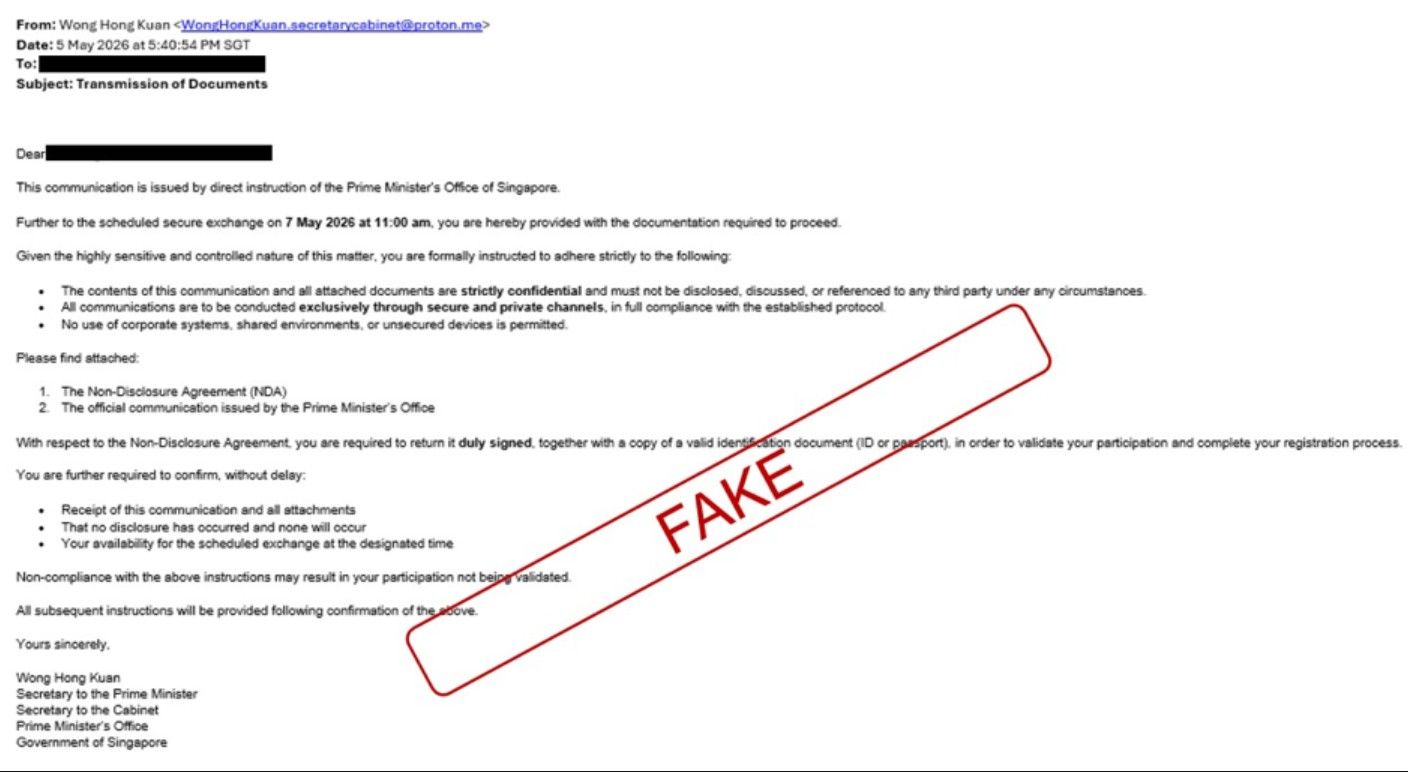
The victims were instructed to provide their email addresses in order to receive a non-disclosure agreement (NDA) linked to the meeting.
Police said the scammers also requested victims to endorse the NDA and submit copies of their identification cards.
Deepfake meeting staged
In one reported case, a victim received a WhatsApp message from a profile using Wong Hong Kuan’s photograph.
The message informed the victim that he had been selected to attend a virtual meeting with Prime Minister Lawrence Wong.
The victim later received an email allegedly sent by the secretary to the Cabinet requesting urgent financial assistance connected to the situation in the Strait of Hormuz.
“The email included what appeared to be an official government-issued letter of guarantee bearing PM Wong’s signature, stating that the funds would be reimbursed by the Singapore government within 15 business days,” police said.
After signing the NDA, the victim was invited to participate in a Zoom video conference that appeared to involve Lawrence Wong and several local and overseas government officials.
Police later confirmed that the conference participants were not genuine.
“In reality, the participants had been fabricated using deepfake (artificial intelligence) technology,” SPF said.
Victim transferred millions
Following the virtual meeting, the victim continued communicating with the scammers through WhatsApp.
Police said the scammers instructed the victim to transfer funds into a corporate bank account.
The victim subsequently transferred at least S$4.9 million through multiple transactions.
Authorities said the victim later became suspicious and contacted the secretary to the Cabinet on Thursday, eventually discovering that he had been deceived.
The case represents one of the more elaborate scams uncovered in Singapore involving the use of artificial intelligence-generated impersonation techniques.
Previous arrests linked to similar cases
Police said the latest case was linked to an earlier series of scams using a similar modus operandi.
Three individuals were arrested and charged on 9 May 2026 for their suspected involvement in SIM card-related offences connected to earlier investigations.
SPF did not disclose whether those arrested were directly involved in the latest S$4.9 million case.
The police added that investigations into the wider scam network were ongoing.
PM Wong warns public
In a Facebook post published on Thursday, Lawrence Wong warned the public against responding to suspicious messages claiming to originate from government officials.
“I have been alerted that some people have received fake messages from someone impersonating the Cabinet Secretary and arranging meetings on my behalf,” Wong wrote.
“These messages are scams. Please exercise caution if you receive unsolicited messages of this nature.”
Wong also urged members of the public to verify questionable communications through official channels before responding.
“If you are unsure whether a message is legitimate, verify it through official channels before responding or sharing any personal information,” he added.
Public urged to stay vigilant
Police reminded the public never to transfer money or disclose identification card details to unknown individuals whose identities had not been independently verified.
SPF also stressed that Singapore government officials would never ask members of the public over the phone to transfer money, reveal online banking credentials, install applications from unofficial app stores or redirect calls to police officers or other officials.
Authorities advised the public to adopt precautionary measures against scams, including downloading the ScamShield mobile application.
Police also encouraged people to verify suspicious calls and messages through the ScamShield app, website and helpline before taking any action.
According to data released in February 2026 by the Singapore Police Force, 37,308 scam cases were reported in 2025, down from 51,501 in 2024.
This contributed to a 24.8 per cent decline in total scam and cybercrime cases, which fell to 41,974.
However, scams remained the primary driver, accounting for 88.9 per cent of cases.
Total financial losses also declined by 17.9 per cent, from S$1.124 billion in 2024 to approximately S$913.1 million in 2025.