Netizens question freshness and food safety of early-prepared central kitchen school meals
CNA’s video on MOE’s central kitchen initiative drew online pushback, with netizens accusing the coverage of being promotional and failing to address concerns over freshness, nutrition and food safety, as centrally prepared school meals expand across Singapore in schools nationwide.

- CNA’s coverage of MOE’s central kitchen initiative drew online pushback, with netizens calling it promotional.
- Concerns persist over food freshness, nutrition and safety of centrally prepared school meals.
- Scrutiny has intensified as more Singapore schools adopt the central kitchen model.

SINGAPORE: Centrally prepared school meals have come under public scrutiny in recent weeks, with netizens raising concerns over freshness, nutrition and food safety amid the expansion of the central kitchen meal model in schools.
Amid the heightened attention, CNA published a video showcasing the Ministry of Education’s (MOE) central kitchen initiative, featuring a visit to Wilmar’s central kitchen in Tuas.
The video documented how meals are prepared, packed and delivered to schools under the new system, highlighting production timelines, quality control measures and delivery logistics.
However, the coverage sparked pushback online, with many netizens describing it as promotional content aimed at convincing the public that the system was working, rather than addressing persistent concerns surrounding centrally prepared school meals.
Wilmar Distribution is one of the central kitchen operators appointed by MOE under the initiative.
It currently manages food services for four of the 13 schools that have adopted the model: Casuarina Primary School, Chongzheng Primary School, Northoaks Primary School, and Outram Secondary School’s new Anchorvale Crescent campus.
Wilmar’s central kitchen director, Ho Shau Foong, said speed and timing are critical to ensuring food freshness.
“Once the food is packed, it is sealed in insulated containers and loaded onto dedicated trucks for direct delivery to schools,” he said.
For schools alone, Wilmar prepares about 300kg to 400kg of cooked food each day, using approximately 500kg of raw ingredients.
Menus are planned four weeks in advance, with schools required to submit orders by noon two days before delivery. Food preparation begins the following day, CNA reported.
Ho added that a comprehensive information system is used to calibrate data, ensuring consistent portion sizes and minimising food wastage.
Expansion of the Central Kitchen Model in Schools
From January 2026, 13 schools will shift from individual canteen stallholders to a central kitchen meal model, where a single operator manages food provision.
The move follows a pilot at Yusof Ishak Secondary School in 2022 and is driven by ongoing difficulties in attracting and retaining canteen stallholders.
Caterers appointed under the scheme include Chang Cheng Mee Wah Food Industries in the west, Gourmetz in the south and at Outram Secondary School’s York Hill campus, and Wilmar Distribution in the north and east.
MOE said operators must cap meal prices at S$2.70 for primary schools and S$3.60 for secondary schools, and comply with Health Promotion Board nutrition guidelines.
The ministry has stressed that the central kitchen model supplements, rather than replaces, the individual stallholder system.
In a written parliamentary reply on 13 January, Minister for Education Desmond Lee assured that the individual stallholder system remains the “primary and predominant” model for school canteens in Singapore.
Netizens Question CNA Coverage
Under CNA’s Facebook post, which garnered more than 1,000 comments, netizens questioned the editorial focus of the report, with several describing it as promotional coverage aimed at persuading the public that the central kitchen system was effective.




Freshness and Food Safety Concerns Persist
Despite assurances from caterers, food freshness emerged as one of the most frequently raised concerns among netizens.
According to CNA’s report, meals are cooked, packed and dispatched as early as 7am to ensure timely delivery to schools across Singapore.
Commenters questioned whether food prepared hours before recess could still be considered freshly cooked by the time students eat.
Many contrasted centrally prepared meals with food cooked on the spot at canteen stalls, arguing that the time gap involved in preparation, transportation and handling inevitably affects freshness.
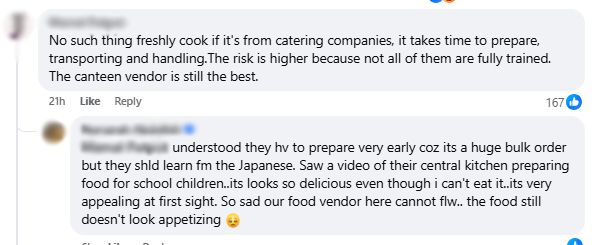


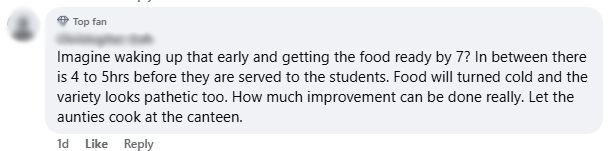
Some said catered meals, regardless of insulation or logistics, could not match the quality of food prepared immediately before consumption.




Food safety was also raised, with several netizens questioning why food poisoning incidents have occurred in catered meal settings despite assurances of freshness.
One user described centrally prepared meals as “another disaster waiting to happen”, citing early cooking times, risks of contamination and uncertainty over food handling standards.




Concerns were amplified by recent cases of gastroenteritis in primary schools.
On 14 January, 60 pupils at River Valley Primary School developed symptoms of gastroenteritis after lunch, prompting investigations by Singapore’s health and food authorities.
The school is among the 13 operating under the Central Kitchen Meal Model (CKMM).
Authorities are also investigating 147 cases of gastroenteritis involving students from North View Primary School, although the school is not among those that adopted the central kitchen model earlier this month.
Broader Public Concern Over Food Quality
Public attention on centrally prepared meals intensified after photos of catered food served to Hwa Chong Institution students circulated widely online.
The images drew sharp criticism, with netizens questioning portion sizes, visual appeal and nutritional value.
Hwa Chong Institution later said the photos did not accurately reflect the overall quality or standards of meals served.
Concerns were also raised in a Mothership report published in early January, which detailed parental feedback on food quality and hygiene issues at several schools served by Gourmetz.
One parent from CHIJ (Kellock) said her daughter found a dead insect in her vegetables on the first day of CKMM service, while others reported delayed meals and food served at room temperature.
Although taste was not widely criticised, parents pointed out that portions of meat and vegetables appeared small relative to the amount of rice provided.