All schools to receive stronger fans and cool paint by 2027: Jasmin Lau
All schools will install stronger fans and apply cool paint by 2027 to combat rising temperatures, said Minister of State for Education Jasmin Lau. MOE is also studying heat’s impact on learning and may introduce additional cooling measures where necessary.
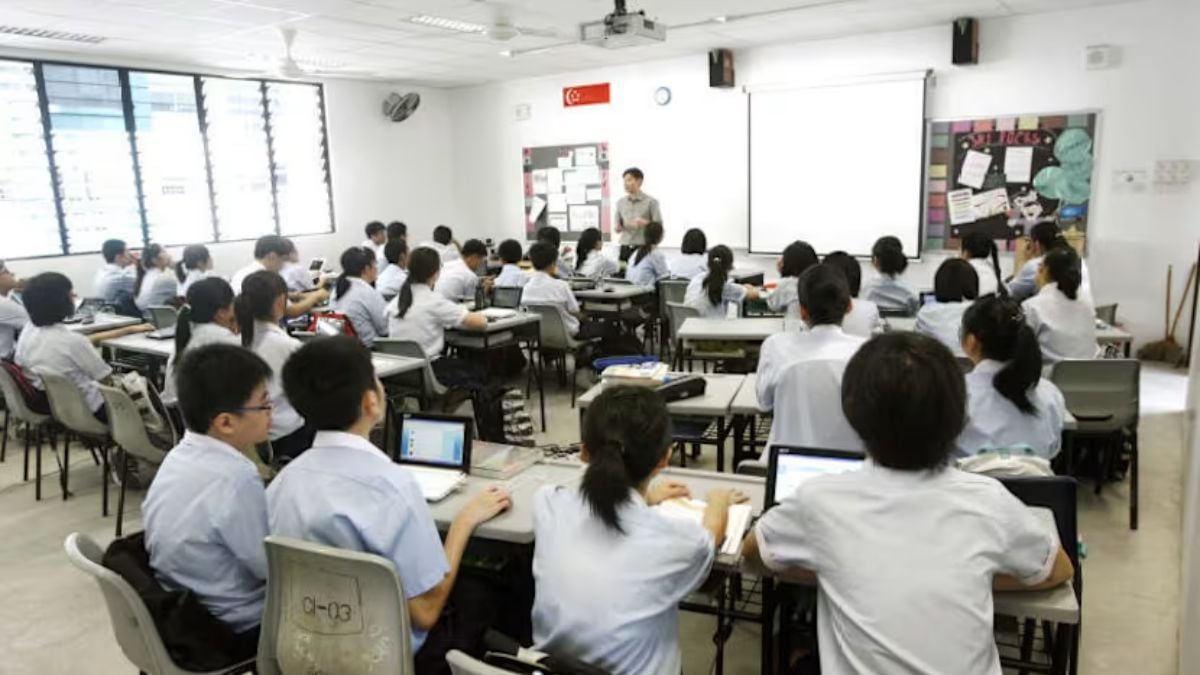
- All schools will install stronger fans and apply cool paint by 2027 to reduce heat.
- MOE may deploy additional cooling, including air-conditioning, where necessary.
- A 2024 NUS study found cognitive performance declines above certain temperature thresholds.

SINGAPORE: All schools will be fitted with additional and more powerful classroom fans by 2027, while the exterior of school buildings will be coated with cool paint to reduce heat absorption, Minister of State for Education Jasmin Lau said in Parliament on 4 March.
Responding to questions from PAP MP Cai Yinzhou on whether schools vulnerable to the urban heat island effect have been identified, Lau said the Ministry of Education (MOE) has been working closely with schools to assess campuses that may experience “pervasive heat build-up due to specific site constraints, conditions or surroundings that impede natural wind flow”.
In cases where existing measures are insufficient, she added, “more cooling measures may be deployed”.
Air-conditioning may also be considered for classrooms that need to be enclosed for prolonged periods due to persistent dust or extreme noise, such as from nearby construction works.
Studies Show Impact of Heat on Cognitive Performance
The issue of rising temperatures and their impact on learning was also raised by other Members of Parliament, including WP MP Kenneth Tiong.
Cai further asked whether studies had been conducted on the relationship between thermal comfort and academic performance.
In response, Lau cited a 2024 study by the National University of Singapore, which found that cognitive performance declines above a certain temperature threshold.
“But this doesn’t mean that all schools may need the same set of cooling measures,” she said.
“We will continue to look across our schools and target the measures at the ones where students may be experiencing more discomfort, and this may be temporary or permanent in nature.”
The study had been commissioned by MOE in 2020 to determine how best to implement mixed-mode cooling in classrooms to achieve optimal thermal comfort while balancing environmental considerations.
MOE Taking Measured Approach to Air-Conditioning
Speaking earlier on 3 March during the debate on the Education Ministry’s budget, Senior Minister of State for Education David Neo said MOE has been cautious about rapidly installing air-conditioning systems, noting that they are not as energy-efficient.
He highlighted efforts made over the years to cool schools, including installing more and faster fans in classrooms, applying cool paint to building exteriors, and adopting uniforms made from moisture-wicking and breathable materials to help students cope with heat and humidity.
The ministry has also introduced mixed-mode cooling in school halls, combining natural ventilation with mechanical cooling systems to achieve target temperatures.
New Schools Designed for Energy Efficiency
Lau added that all new schools are built to achieve Green Mark Platinum Super Low Energy certification, which prioritises passive design strategies to minimise heat gain and reduce reliance on air-conditioning.
For example, school buildings are typically oriented in a north-south direction to enhance natural cross-ventilation. Designs incorporate shading features to limit direct sunlight, as well as large window openings to improve airflow and passive cooling, supported by ceiling fans.
Where feasible, additional shade structures and greenery are integrated to lower ambient temperatures.
Ongoing Research on Heat and Student Well-being
To ensure that schools remain conducive learning environments, Lau said MOE is collaborating with other agencies and researchers to further study the effects of rising temperatures on students’ learning and well-being.
“As we gather more evidence on the local impact of rising temperatures on students, we will continue to refine our approach to achieve optimal thermal comfort across all schools in an environmentally sustainable manner,” she said.
This includes exploring additional heat adaptation strategies and active cooling options, such as mixed-mode air-conditioning, for classrooms where necessary.