Nearly 1 in 7 Singapore resident households earns S$30,000 a month, survey finds
Nearly 1 in 7 Singapore resident households now earns S$30,000 or more a month — up from 1 in 14 in 2020 — as dual-earner couples became the majority and investment income claimed a growing share of total household wealth.
- Median monthly household market income rose to S$12,446, the first time it has crossed S$12,000.
- Dual-earner married couples rose from 52.5 per cent in 2020 to 56.6 per cent in 2025.
- Investment income's share of total household market income grew from 9.6 per cent to 13.5 per cent.

The share of Singapore resident households earning S$30,000 or more per month nearly doubled between 2020 and 2025, while median monthly household income crossed S$12,000 for the first time, according to the General Household Survey (GHS) released on 30 June 2026.
The survey covers Singapore's resident population — comprising Singapore citizens and permanent residents (PRs) — and was conducted by the Department of Statistics (DOS).
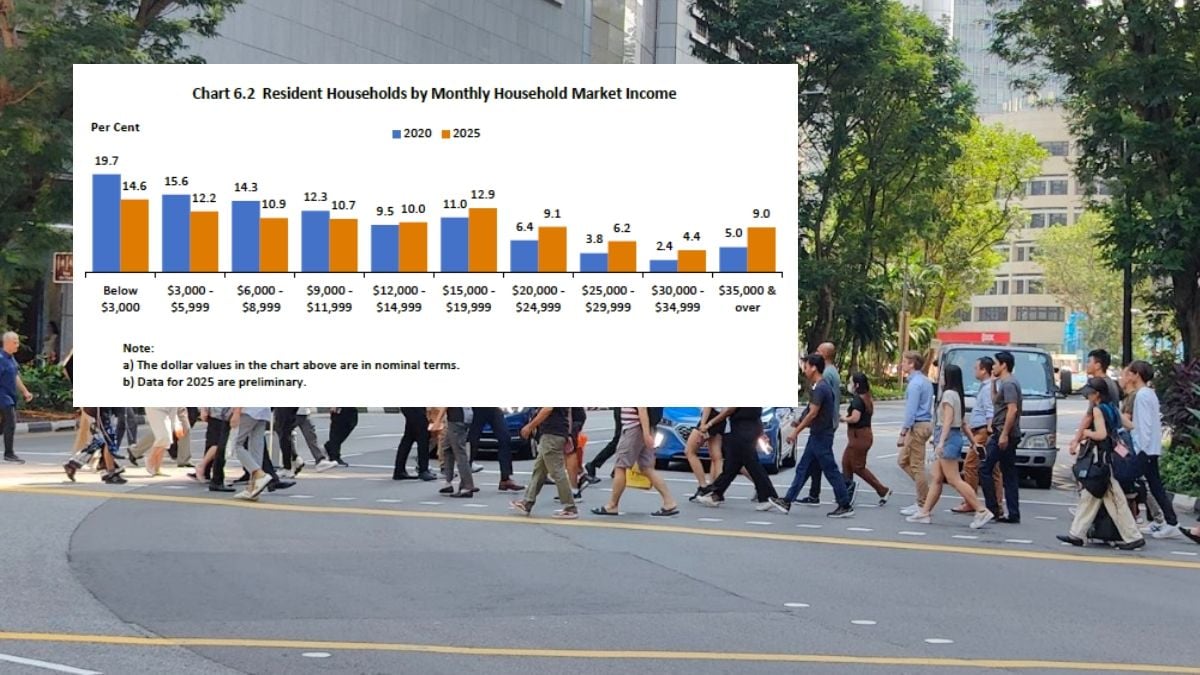
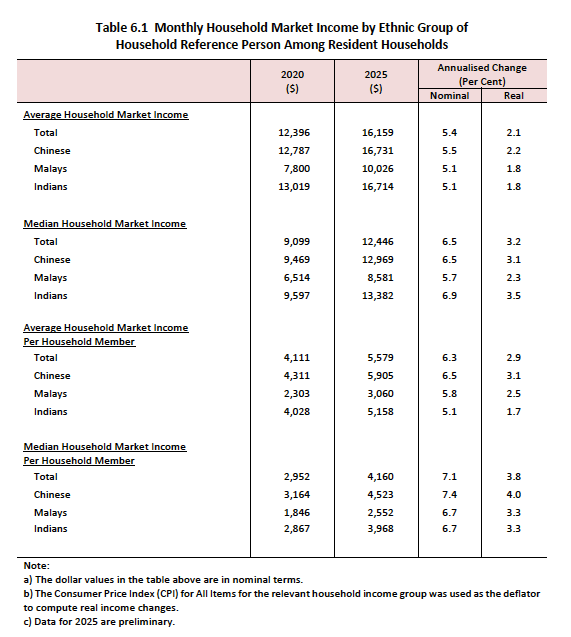
It found that median monthly household market income rose from S$9,099 to S$12,446 over the five-year period. After adjusting for inflation, this represented a real annual growth rate of 3.2 per cent — a significant gain that outpaced the previous inter-survey period.
Rising share of high-income households
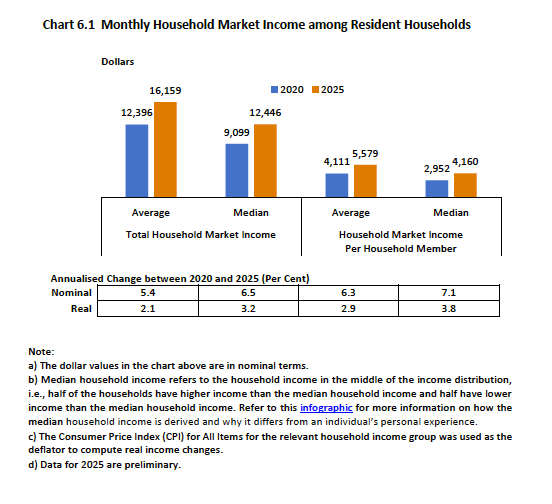
The proportion of households in the upper income brackets expanded substantially. The share of households earning S$30,000 or more per month nearly doubled, rising from 7.4 per cent in 2020 to 13.4 per cent in 2025.
At the same time, the proportion earning S$12,000 or more crossed the halfway mark for the first time, increasing from 38.2 per cent to 51.6 per cent. This means more than half of Singapore households now earn at least S$12,000 a month.
The proportion earning below S$3,000 per month also shrank, falling from 19.7 per cent to 14.6 per cent, suggesting income gains were not confined solely to the top of the distribution.
Ethnic income differences persist, but all groups gained
All three major ethnic groups recorded real income growth over the period, though at differing rates and from differing bases.
Indian households recorded the highest median monthly market income at S$13,382, followed by Chinese households at S$12,969. Malay households recorded a median of S$8,581, substantially lower than the other two groups.
In terms of growth, Indian households saw the strongest real annual gain at 3.5 per cent, followed by Chinese households at 3.1 per cent. Malay households grew at 2.3 per cent annually in real terms — a positive gain, though one that leaves a wide income gap relative to the other groups.
One figure absent from most coverage of the GHS is the median income of the "Others" ethnic group — comprising Eurasians and other minorities — which stood at S$18,158 per month. This is substantially higher than the Indian and Chinese medians.
Shift towards investment income
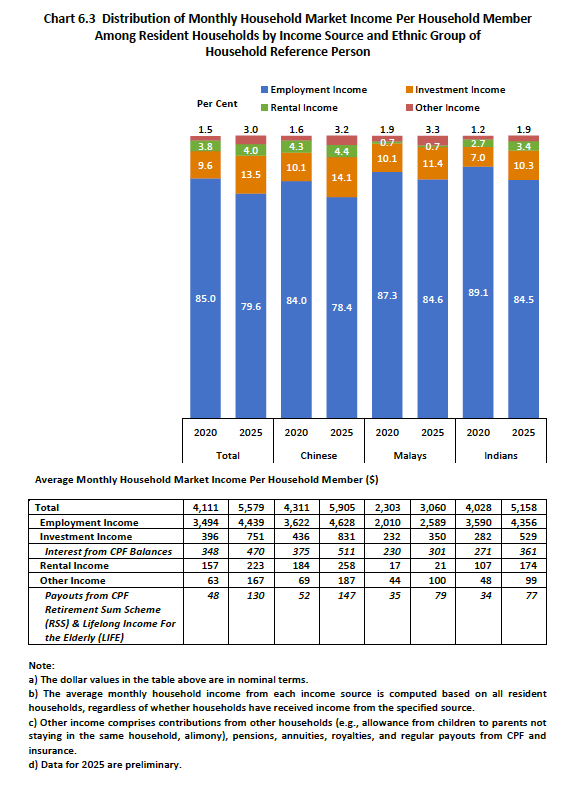
A notable structural change in the GHS is the shifting composition of household market income. Employment income — salaries, wages, and self-employment earnings — fell as a share of total household market income from 85.0 per cent in 2020 to 79.6 per cent in 2025.
Investment income, which includes dividends, rental income, interest, and Central Provident Fund (CPF) interest, rose from 9.6 per cent to 13.5 per cent over the same period. CPF interest income alone averaged S$470 per month per household member in 2025, up from S$348 in 2020, making it a significant driver of the investment income increase.
The shift suggests that as Singapore's population ages and more residents accumulate CPF savings and financial assets, investment income is playing a growing role in household finances alongside wages.
Dual-earner couples now the majority
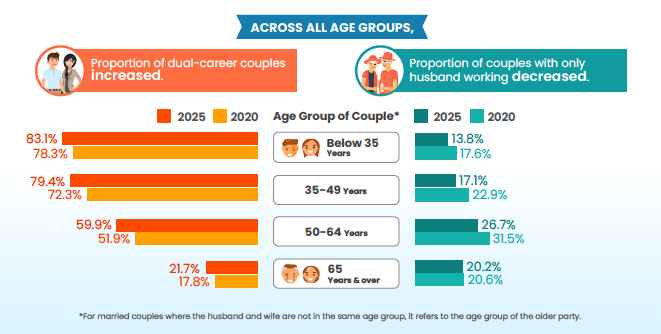
Among married couples, those where both spouses were employed rose from 52.5 per cent in 2020 to 56.6 per cent in 2025. This increase was observed across all age groups.
The proportion of couples where only the husband was employed fell from 24.9 per cent to 21.0 per cent, while the share where only the wife was employed remained broadly stable at 7.5 per cent.
Among couples aged 65 and above, the share where at least one spouse remained employed rose from 50.6 per cent to 55.4 per cent, indicating that a growing proportion of older married residents are staying economically active.
The proportion where both spouses were not employed held roughly steady at about 15 per cent, suggesting this group — largely comprising retirees and caregivers — has not changed materially in size.
Wealth divide wider than median suggests
The gap between median and average income points to significant inequality at the upper end.
Average monthly household market income rose from S$12,396 to S$16,159 between 2020 and 2025 — substantially higher than the median in both years, reflecting a right-skewed distribution pulled upward by very high earners at the top.
When adjusted for household size, the median monthly household market income per household member rose from S$2,952 to S$4,160, reflecting a real annual increase of 3.8 per cent — slightly higher than the overall household figure, owing in part to smaller average household sizes.