Over 1,500 rally at Hong Lim Park for Labour Day as climate and workers' movements unite for the first time
Over 1,500 gathered at Hong Lim Park on 1 May 2026 for Singapore's Labour Day rally — the first jointly organised by Workers Make Possible and SG Climate Rally. Under the theme "Running Out of Time", workers and climate advocates called for shorter hours, living wages, and urgent climate action.
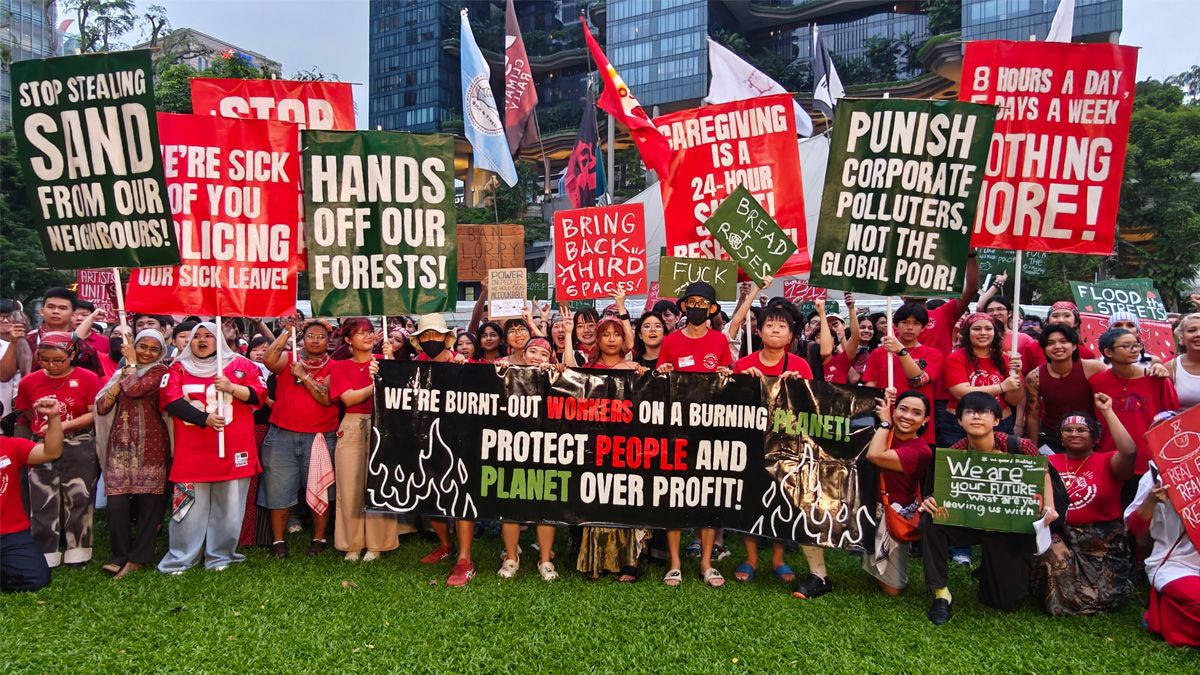

More than 1,500 people gathered at Hong Lim Park on Thursday for Singapore's Labour Day rally, in what organisers described as a landmark occasion — the first time the labour and climate movements have jointly staged an independent public demonstration on May 1.
The event, co-organised by activist groups Workers Make Possible and SG Climate Rally, carried the theme "Running Out of Time", drawing a deliberate parallel between the exhaustion of Singapore's workforce and the accelerating climate crisis.
The rally featured 32 community booths, live performances, speeches from workers across multiple sectors, and a debut set by Satu Jiwa, a newly formed intergenerational people's choir. A light rain fell during the proceedings but did not deter the crowd.
The demands
Emcees opened the programme by laying out a twin set of demands for labour and climate. On the labour front, organisers called for the 8-8-8 framework — eight hours for work, eight hours for rest, and eight hours for personal life — along with a five-day work week for all, a minimum of 15 days of paid annual leave, stronger sick leave entitlements, a universal minimum wage, and a legally enforceable right to disconnect from work communications after hours.
On the climate side, they called for sector-led decarbonisation, legal protections for Singapore's forests and biodiversity, mandatory stop-work orders during extreme outdoor heat for all workers including migrants, an end to sand extraction from neighbouring countries, and a halt to greenwashing by corporations receiving government grants.
Speakers: Workers across sectors share their realities
Carmen, a private-hire vehicle driver of a decade, delivered a precise critique of platform labour economics. Doing the arithmetic on a standard 40-hour week, she demonstrated that after deducting car rental and fuel, a PHV driver would net approximately $2,000 a month — well below a livable income in Singapore.
She noted that to earn a decent living, drivers effectively need to work 60-hour weeks, all while platforms such as Grab take commissions ranging up to 20 to 28 percent and retain algorithmic control over job assignments.
"When platforms take high commissions, costs are rising and your control over your time is reduced," she said. "Flexibility just means you can choose to work any time within the 24 hours in a day."
Qai, an undergraduate and climate activist, spoke on the intersection of labour exploitation and environmental destruction, drawing on her years working at a clothing thrift store where she handled up to 100 kilograms of fashion waste in a single shift.
She highlighted Singapore's position as the world's third largest oil refinery hub, noting that processing fuels for export elsewhere allowed the country to sidestep accountability for the resulting emissions. She urged the crowd to get organised, framing courage as "not just a feeling — it's an act and a choice and a decision."
Nasita, a single mother of five living in a rental flat and a member of the Rental Flat Grassroots Network, gave one of the rally's most personal accounts. She described waking at 5am daily to prepare her children for school, squeezing caregiving and paid work into the same hours, with barely any time remaining for rest.
"Caregiving is not part-time and it's not even full-time. It is 24 hours and we are not paid," she told the crowd. She also contrasted the cramped conditions of rental flat households — sometimes with a single toilet shared among a family — against a minister's residence with a land area of 23,000 square metres, enough, she noted, to house a thousand families.
Roon, speaking alongside workers from 12 Cupcakes, held up that bakery chain's October 2025 wage recovery action as proof that collective organising works. Workers had come together and clawed back more than half of their unpaid wages. Roon also called out Providore, whose owner liquidated the business while leaving staff unpaid, despite continuing to run other enterprises in Singapore. "Owe money, pay money," Roon said.
Yong Feng, a former architect and longstanding SG Climate Rally member, offered a structural analysis, noting that Singapore workers' share of GDP has declined from 49 percent in 2014 to 44 percent in 2024, even as productivity rose. He drew a historical line back to the 1950s, when farmers in kampongs allied with urban workers on strike — bringing food so workers could hold out — before that movement was crushed and labelled communist. "That is the real reason why we have no more kampong spirit in Singapore," he said.
The closing speech came from Megh, a hospitality worker and community organiser, who urged the crowd to get organised as the only meaningful path to change. Citing the 50 percent rise in global CEO pay between 2019 and 2024 against less than one percent growth in average worker wages, and the UOB CEO's $15.9 million pay package in 2023, she challenged the crowd to stop internalising systemic failures as personal shortcomings. "Courage is a practice. And all of us here can do it."
Arts programme and street theatre
The rally opened with a dance performance by Ekta, followed by a street theatre production titled Erosion, written by a former migrant worker in Singapore.
The piece depicted the destruction of riverine communities across the Mekong and Irrawaddy Delta caused by sand dredging — much of it ultimately feeding Singapore's construction and land reclamation.
The emcees pointed to the bitter irony that migrant workers, legally prohibited from participating in Hong Lim Park assemblies, were brought into the rally's voice through the work itself.
Lorry transport campaign
Among the booths and displays at the rally was a campaign calling for stronger action on the safety of transporting construction workers. Singapore has announced a ban on caged lorries for worker transport from 2027, following years of debate over the dangers of the practice.
Advocates at the rally argued the ban, while a step forward, does not go far enough and called for broader reforms to how the industry treats the workers who physically build the country.
Opposition politicians in attendance
Several opposition politicians attended the rally. From the Workers' Party, Members of Parliament Fadli Fawzi and Dennis Tan were present, as were Progress Singapore Party's Leong Mun Wai, and Singapore Democratic Party's Chee Soon Juan, Paul Tambyah, and Ariffin Sha. Former presidential candidate Tan Kin Lian, independent Mountbatten SMC candidate Jeremy Tan from GE2025, Red Dot United's Ravi Philemon, and Samuel Lee of the People's Power Party were also seen at the event. SDP, Red Dot United, and PSP also had booth spaces at the rally.
VIEW THE LIVE STREAM HERE
Organiser's statement
In a joint statement released after the event, Workers Make Possible and SG Climate Rally said they were "incredibly energised by the passionate show of support," describing Thursday's rally as "a landmark rally where climate and labour sectors linked arms in the fight against capitalism's brutal assaults on workers and the environment."
The statement noted that more than 1,500 people had assembled "for a genuine, people's Labour Day rally, recognising the urgency of taking action — many of them signing up to join grassroots organisations." It acknowledged the difficult conditions under which the event came together:
"This turnout was despite the humble resources that organisers had and the many barriers we faced in getting the word out about the rally, given the extreme limits on our freedom of expression and assembly in Singapore."
The organisers also highlighted the structural exclusion of a major segment of the very workforce the rally sought to champion. "The government denies migrant workers, who make up a big part of the workforce in Singapore, the right to take part in such assemblies," the statement read.
It closed with a direct call to action: "It is undeniable that the mass movement for ecosocialism is growing in Singapore. We call on the workers of Singapore to unite and fight for the future we deserve, no matter what sector you are in — and we promise to fight with you."
Public response
Online reaction suggested the rally had struck a chord. On Reddit's r/singapore, where photographs from the event circulated, one of the most upvoted comments noted that the issues raised were "actually what many people want," with particular resonance around the demand for an eight-hour work day and a genuine five-day work week.
Several commenters remarked on the larger turnout compared to previous years, attributed in part to the joint organising between the labour and climate groups.
One attendee wrote that they had "so many great conversations with like-minded Singaporeans" across a wide range of communities, from delivery riders and healthcare workers to birdwatchers and housing advocates.
Another noted that Mothership covered the people's Labour Day rally for the first time this year — a sign, they suggested, of the independent labour movement's growing visibility.
Some commenters also reflected on why such conversations feel overdue.
"We have been conditioned for so long and by design to think that activists, unions, protests are the enemy of the people," one wrote, adding that Singapore was "by design a corporates over citizens nation."
The reflex to dismiss collective action, they suggested, was itself part of the system being protested.
Broader context
Friday's rally took place against the backdrop of Singapore's well-documented status as one of the most overworked populations on the planet.
Research aggregating factors including annual hours worked, screen time, and related metrics ranked Singapore as the most fatigued country in the world, with a fatigue score of 7.20 — ahead of Mexico and Brazil. Singaporeans work an average of 2,238 hours per year, the second highest globally, trailing only Mexico.
The Ministry of Manpower has pushed back against this framing, arguing that usual hours worked among full-time resident employees have declined since the COVID-19 peak, stabilising at around 45.8 hours per week, and that average paid overtime hours have fallen over the past decade to 2.5 hours per week as of 2021.
MOM attributes the improvement partly to flexible working arrangements, telecommuting tools, and a broader shift toward what it describes as working "smarter, not harder" — suggesting that the quality of hours worked, rather than the raw quantity, is the more meaningful measure.
Speakers at the rally, however, offered a different reading of the same reality. Carmen's account of PHV drivers needing 60-hour weeks simply to earn a livable income, Nasita's description of 5am starts with no break in caregiving duties, and Megh's data on CEO pay rising 50 percent against worker wage growth of under one percent in the same period all pointed to a workforce where the flexibility MOM highlights is experienced not as liberation but as the removal of any boundary between work and the rest of life.
The right to disconnect — one of the rally's explicit demands — speaks directly to that gap: the difference between what the official data counts as working hours, and what workers actually live.