Israel intercepts final Gaza-bound flotilla vessels, detains hundreds of activists
Israeli naval forces intercepted the last vessels of the Global Sumud Flotilla on Tuesday, detaining hundreds of activists from over 40 nations who had set sail from Türkiye to challenge Israel's nearly two-decade naval blockade of the Gaza Strip.

- Israeli forces intercepted all Global Sumud Flotilla vessels by Tuesday, detaining hundreds of activists in international waters.
- Foreign ministers of ten countries condemned the operation as a blatant violation of international law.
- Italy demanded clarification after reports that projectiles struck six vessels, including one flying the Italian flag.

Israeli naval forces completed a two-day operation on Tuesday by intercepting the last remaining vessels of the Global Sumud Flotilla, an activist convoy that had set out to challenge Israel's naval blockade of the Gaza Strip.
The Gaza Freedom Flotilla announced on Tuesday evening that six people aboard the Lina al-Nablusi, described as the final boat still sailing towards Gaza, had been seized by Israeli forces in international waters. Organisers demanded their immediate release.
Earlier in the day, a live feed on the Global Sumud Flotilla website showed armed Israeli soldiers on Zodiac boats boarding five vessels — the Andros, Zefiro, Don Juan, Alcyone and Elengi — as activists wearing life vests raised their arms.
According to the flotilla's tracker, the boats were stopped roughly 90 to 100 miles (145 to 160 kilometres) from the Gaza coastline. Israeli soldiers then destroyed cameras mounted on the activists' vessels.
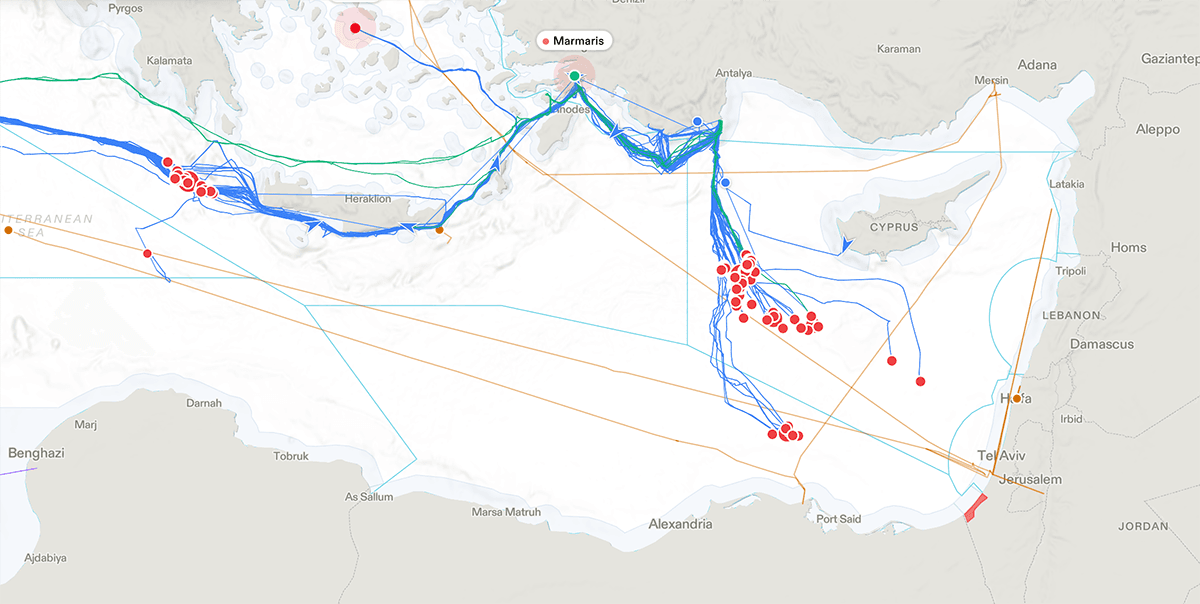
More than 50 vessels had departed on 14 May 2026 from the port of Marmaris, Türkiye, in what organisers described as the final stage of a journey aimed at delivering symbolic humanitarian aid and breaking Israel's nearly two-decade siege.
On Monday, 18 May 2026, the Israeli navy stopped some 41 boats from the flotilla in international waters off Cyprus, detaining those on board. The Global Sumud Flotilla said hundreds of detainees from over 40 nations were being "forcibly transported" by an Israeli naval vessel to an unnamed port.
Italian officials said the boats were expected to be brought to the port of Ashdod. The Italian Foreign Ministry, known as the Farnesina, confirmed that 27 Italian nationals had been detained.
Reports of projectiles fired
Italian Foreign Minister Antonio Tajani called for urgent clarification from Israel after reports emerged that naval forces had used rubber bullets or other projectiles against flotilla vessels, citing conflicting accounts.
Maria Elena Delia, an Italian spokesperson for the flotilla, told the ANSA news agency that Israeli naval ships had fired projectiles of an unidentified type, striking six boats including the Italian-flagged Girolama. She described the situation as "extremely serious", even if non-lethal ammunition had been used.
An Israeli spokesperson countered that non-lethal measures had been deployed only after repeated warnings to the vessels. "At no time were shots fired. After repeated warnings, non-lethal means were used against the vessel, and not against the protesters, as a warning," the statement said.
International condemnation
The foreign ministers of Türkiye, Spain, Jordan, Pakistan, Bangladesh, Brazil, Indonesia, Colombia, Libya and the Maldives issued a joint statement describing the Israeli action as a "blatant violation of international law and international humanitarian law".
The ministers expressed "serious concern regarding the safety and security of the civilian participants of the flotilla" and called for the "immediate release of all detained activists, as well as for full respect for their rights and dignity".
Türkiye and the Palestinian group Hamas separately characterised the interceptions as acts of "piracy". Italy, Spain and Indonesia urged Israel to release all detained activists and ensure their safety and well-being. An estimated 45 Spanish nationals had taken part in the flotilla.
Margaret Connolly, a doctor and sister of Irish President Catherine Connolly, was among those organisers said had been "illegally kidnapped" by Israeli forces.
Speaking in London after talks with King Charles III, President Connolly described the news as "upsetting". "I'm very worried about her, and I'm also very concerned about her colleagues on board," she said, adding she did not have further details.
Irish Prime Minister Micheál Martin on Monday called the Israeli interception of the Gaza-bound boats in international waters "absolutely unacceptable". More than a dozen Irish nationals were aboard the flotilla.
Activists vow to continue
Italian activist Daniele Gallina, who was among seven aboard a sailboat that diverted to the Cypriot town of Paphos due to technical issues, said the flotilla's mission extended beyond the delivery of aid.
"What matters is not only the aid itself, important as it is, but the structural change it represents. It is also about challenging the collaboration of our own governments with these policies," Gallina said in an online interview from Paphos.
He argued that interdictions of civilian vessels in international waters had shown how "governments are tolerating or enabling these actions", adding that international law was now "openly disregarded" despite the flotilla's "entirely pacifist" intent.
"We know we are doing the right thing. We are not heroes. We are ordinary people carrying out a protest mission, just as others protest in the streets," Gallina said, vowing that participants would continue their protests "until Gaza is reached".
The flotilla organisers also raised "grave and immediate concerns" about the safety of detainees, citing testimonies from an interception on 30 April that alleged "patterns of torture, severe physical abuse, and invasive sexual violence" by Israeli forces. Israel has denied these allegations.
Israeli position and aid figures
Israel has characterised the flotilla as "a provocation for the sake of provocation" with no genuine intention to deliver aid, noting that the boats carried only a symbolic quantity of humanitarian supplies.
The Israeli defence body overseeing humanitarian assistance to Gaza maintains that adequate aid is reaching the territory, citing roughly 600 trucks delivering supplies daily — a figure it says is comparable to pre-war levels.
A World Food Programme (WFP) report, however, found that humanitarian and commercial trucks entering Gaza declined sharply in March, with a daily average of 112 trucks compared with 230 in February and 225 in January.
A blockade approaching two decades
Israel has maintained a sea blockade of Gaza since the Palestinian group Hamas took control of the territory in 2007. Authorities intensified the blockade after the Hamas-led attacks on Israel of 7 October 2023, which killed around 1,200 people and saw more than 250 taken hostage.
Critics, including rights groups and humanitarian organisations, describe the blockade as collective punishment imposed on Gaza's roughly two million residents. Israel says the restrictions are necessary to prevent Hamas from arming itself.
Gaza has continued to see near-daily Israeli fire despite a ceasefire that took effect in October, with more than 850 people killed in the territory since, according to Gaza's Health Ministry.
The ministry, part of the Hamas-run administration in Gaza, reports that Israel's retaliatory offensive following the 7 October attacks has killed more than 72,700 people. The figure does not distinguish between civilians and fighters.