Public money, private paper
SPH Media's funding agreement expires in 2027. No minister has defined what success looks like, or what would end the subsidy. By 2026, Josephine Teo was calling it a "PSM entity" — public service media — in the same breath as Mediacorp. If that's what it is, govern it accordingly.
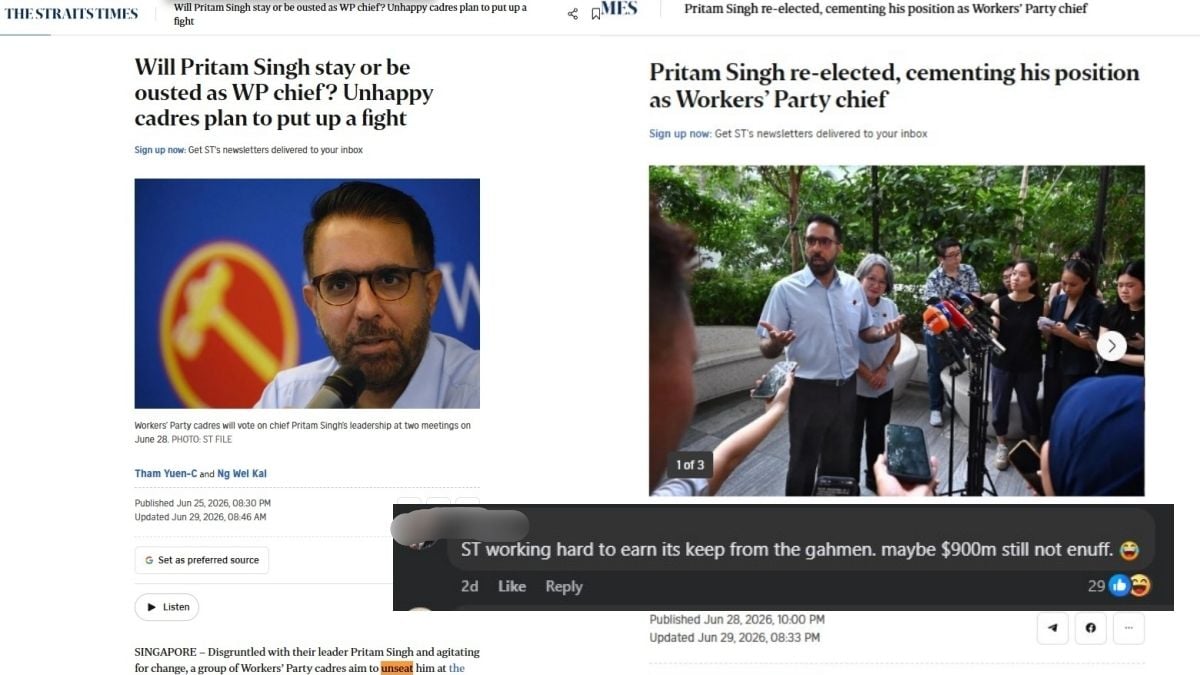

In the days before the Workers' Party cadres members' conference on 28 June, The Straits Times — SPH Media Trust's flagship English-language newspaper — reported that disgruntled cadres were aiming to "unseat" Pritam Singh, that "the search for a challenger has intensified," and that former party chief Low Thia Khiang had ended his support for Singh and might back a rival. It named four sitting WP members as potential challengers.
Channel News Asia (CNA) — Mediacorp's news channel, whose parent organisation receives S$380 million annually in public service broadcasting grants — called the conference "crucial" and reported on "internal calls to step down as party chief, with a potential secret ballot to decide if he retains his post should he not step down voluntarily".
What actually happened: Low Thia Khiang arrived at the venue, was asked whether he still supported Singh, and said yes. No challenger stood. All four named as potential replacements were elected to the new Central Executive Committee (CEC) under Singh's continued leadership. Singh reportedly received approximately 80 per cent of the cadre vote in the confidence ballot. He described the atmosphere as "a normal CMC."
Readers had already drawn their own conclusions. When The Straits Times posted its follow-up coverage after Singh retained his position — after the votes had been counted and the non-event confirmed — the top comments on its own Facebook posts were pointed:
"ST working hard to earn its keep from the gahmen. Maybe $900m still not enuff."

"MSM overdrive. Didn't see the same efforts when covering $88m. Cannot offend their masters."

These comments were sitting at the top, racking up likes. Whether or not those readers have the full institutional picture, the suspicion they're expressing is not irrational — and the question it raises does not go away just because we decline to ask it directly.
Why does SPH Media cover the government's opponents the way it does? The answer is not a phone call from a minister. It is something more structural than that.
What the money is
When Minister for Digital Development and Information Josephine Teo announced in February 2022 that the government would provide "up to $180 million annually" to SPH Media Trust over five years, she was careful to frame it as transformation funding. Not a subsidy. An investment in SPH Media's digital future — new technology, new talent, a sustainable business model that would eventually let the organisation stand on its own feet.
That framing was important because it was the justification for using public money. Funding a one-time transformation is defensible. Permanently subsidising a media company is harder to explain.
SPH Media Trust was formed on 1 December 2021 as a not-for-profit Company Limited by Guarantee (CLG) to take over the media operations of Singapore Press Holdings. Former Cabinet Minister Khaw Boon Wan came out of retirement to chair the newly formed entity. That the organisation charged with editorial independence from government was placed under the chairmanship of a former senior government figure is itself part of the institutional picture — and worth keeping in mind as the governance questions that follow are considered.
The transformation framing has not aged well. By financial year 2024, the government had disbursed S$260.6 million to SPH Media Trust — nearly 45 per cent above the S$180 million ceiling that Ministers cited when seeking public support for the restructuring. No public explanation has been offered for the gap. Add the $320 million disbursed across the first two financial years and total funding over three years already stands at around $580 million.
That pace is not what carefully managed transformation funding looks like. It is what keeping an organisation running looks like.
The KPI that wasn't
To its credit, the government set up Key Performance Indicators to measure whether SPH Media was delivering. These tracked digital reach, youth engagement, vernacular readership and time spent on its platforms.
In 2024, SPH Media failed to meet all of them.
Here is where the accountability mechanism matters. The KPIs do not govern whether SPH Media gets funded. They govern a top-up payment — the Performance-Linked Incentive — worth up to about $28.9 million. The base funding, which for FY2024 was $260.6 million, flows regardless of whether targets are met.
So when SPH Media missed across the board, the financial consequence was potentially losing roughly 10 per cent of the total disbursement. The other 90 per cent was guaranteed.
When asked about this in Parliament, the Minister said the KPIs "are important but they are not the only ways for us to assess the performance and the effectiveness of PSM entities." One might fairly ask: what, then, are the KPIs for?
This is not a trivial question. The KPI framework was presented to Parliament and to the public as the safeguard — the mechanism that ensures accountability and prevents this from becoming a blank cheque. If the targets don't determine what SPH Media receives, the safeguard is a decoration.
The structural problem
No editor needs to receive a phone call. No journalist needs to be told what not to write. Organisations don't need instructions to adapt to the preferences of whoever controls the resources they depend on.
Consider what SPH Media Trust's structure actually means in practice. It has no shareholders — it is a Company Limited by Guarantee (CLG), structured as a not-for-profit. It does not pay dividends. It is not answerable to a market. Its commercial revenue — advertising and subscriptions — covers only a fraction of its operating costs. The government makes up the rest. In that sense, SPH Media is already, in all practical terms, a publicly funded institution.
But here is the critical difference between what SPH Media is and what a genuine public broadcaster would be. A properly constituted public broadcaster — think the BBC, or the ABC in Australia — typically has its editorial independence protected by statute or charter. The funding flows through an arms-length mechanism. Journalists know that what they write does not determine whether next year's budget arrives. The institutional protection is built into the architecture.
SPH Media has no equivalent statutory or charter-based protections.
The closest parallel in Singapore is Mediacorp, which receives $380 million annually in public service broadcasting grants. Mediacorp is government-owned; CNA is acknowledged as a public broadcaster; its funding flows through the Ministry's budget.
When Progress Singapore Party (PSP) Non-Constituency MP Leong Mun Wai pressed Josephine Teo in March 2022 on why SPH Media's funding required separate parliamentary justification, Teo replied that it was "precisely because it is not Government-owned."
If it were, the money would simply be "part of how other arms of the Government are funded." But the rationale she offered for funding SPH Media — multilingual reach, trusted journalism, public good — is the same rationale that justifies Mediacorp's grant. If that logic makes CNA a public broadcaster, it is difficult to explain why the same logic applied to The Straits Times produces a different institutional classification.
SPH Media is publicly funded in practice but accountable to no one in the way a public broadcaster would be. The government uses the "not Government-owned" distinction to avoid the governance obligations that public ownership would impose, while simultaneously providing the level of funding that only a public institution would require. Its funding is not statutory — it is disbursed at the Ministry's discretion, based on periodic assessments of whether SMT has made satisfactory progress.
Where long-term funding depends on periodic ministerial review rather than statutory entitlement, that dependency becomes part of the editorial environment regardless of how any individual editor approaches their work. The executive branch that determines the future funding arrangement is also the executive branch whose policies and conduct the newsroom is expected to scrutinise.
The government's own direction of travel makes the classification question harder to defer. During the March 2025 Committee of Supply debate, Teo told Parliament that MDDI is studying regulatory moves in the UK and Australia, where legislation now requires Connected TVs to pre-load public service media apps — ensuring BBC iPlayer and ABC iview remain prominent regardless of what platform algorithms prioritise. Singapore, she said, must ensure PSM content stays "visible and easily accessible." That is not the policy posture of a government managing a time-limited transformation grant. It is the regulatory architecture of a permanent public media institution.
By February 2026, the Government had effectively settled the question itself. When asked in Parliament about information resilience, Teo described both Mediacorp and SPH Media as Singapore's "PSM entities" — public service media — providing "quality journalism in our four official languages" as a "critical pillar of our society's infrastructure of fact." Not a private company in transformation.
Not a commercial media group receiving bridging support. A public service media entity, named in the same institutional category as Mediacorp. The Government had made the argument for us. The question that remains is why the governance structure — the CLG, the ministerial discretion, the absence of statutory editorial independence — has not been updated to match.
What the government needs to answer
The funding agreement expires in 2027. Whether it is renewed — and on what terms, with what justification — is the question that has not yet been publicly posed, let alone answered.
When then-Communications Minister S Iswaran addressed Parliament in May 2021, he was specific about what the funding was for. The Government, he said, was "willing to help fund the proposed CLG...in areas like digital innovation and capability development, as part of a long-term sustainable business plan." The new entity "must have a long-term, sustainable business model with different revenue sources, including traditional advertising and subscription revenues, complemented by Government funding."
The word "complemented" is doing a lot of work there. The implication was that Government money was a bridge to commercial sustainability — not a permanent substitute for it.
When Josephine Teo confirmed the quantum in February 2022, the framing shifted slightly. The funding would give SMT "more capital to invest in the future while ensuring that they are able to sustain their current operations during this critical transition period."
Forty per cent, she said, was expected to go towards technology and digital talent. The remainder would go towards "newsroom capability building and training." And at the end of the five years: "We will also review the funding quantum after the first five years, based on the progress that SMT has made."
Progress towards what, exactly? That question was also put to Teo in the same debate. Leong asked: "Do we have an exit plan, or will we keep funding SPH Media Trust for many more years beyond the first five years?"
Teo did not provide one. Instead, she reframed the question. "Is up to $180 million a year to support trusted local media an excessive amount," she asked, "given the size of our economy — for our people and our businesses to be able to see the world through our own unique lens?" She went further, suggesting that if the PSP did not agree with supporting local media, she would "urge him to reconsider the position, whether it is wise for Singapore to do so."
That is a response to a different question. Leong asked when the funding ends. Teo answered whether the funding is justified. The gap between those two questions is precisely where the accountability falls away. What level of digital revenue, what commercial self-sufficiency ratio, what reduction in Government dependency would constitute "transformation complete"? The review mechanism was described; the standard that would make the review favourable — or unfavourable — was never defined.
That ambiguity is not incidental. It means the 2027 renewal question will be answered not by reference to a predetermined benchmark, but by a Government assessment of whether continued funding remains worthwhile. That is a very different kind of accountability.
If SPH Media cannot transform after nearly a billion dollars and five years, the government faces a question it has not answered: on what basis would a second tranche be justified?
The original case rested on a defined purpose with an implied end point. That purpose has not been achieved. If the government's position is now that SPH Media is a permanent PSM entity — as its own parliamentary record confirms — then it needs to say so plainly and accept what follows from that: the statutory framework, the arms-length governance, and the editorial independence protections that a permanent public media mandate requires.
Don't dress a permanent institution in the language of transformation and then call the arrangement a success when the transformation hasn't happened.
Those commenters on Facebook have already worked out the basic shape of the problem. They're putting it as a joke about value for money — $900 million, and for what?
That is, in fact, the right question. The government just hasn't been asked to answer it properly yet.