Eight medals, one borrowed sweater, and 22 years: the making of Destroyer Dharma
He was the skinny kid not allowed at the cool table. At 39, Danie Dharma walked out of a competition in Johor Bahru carrying eight gold medals and a borrowed Team Singapore sweater — self-funded, unrecognised, and entirely unbothered.

- Danie Dharma overcame childhood bullying and anxiety through bodybuilding, which transformed his confidence and life trajectory.
- Despite receiving no official funding or recognition, he has self-financed 22 years of competition and remains a proud ambassador for Singapore.
- In May 2026, the three-time Mr Singapore won eight gold medals in Johor Bahru and is now targeting an IFBB Pro Card.

By the time Danie Dharma sat down to speak with TOC online, the competition in Johor Bahru was already a few weeks behind him.
The medals were put away. The tan had faded. The weight was back to normal.
What remained was the memory of someone stopping him on the exhibition floor and asking, with genuine curiosity, whether he was from Singapore.
He was carrying eight gold medals at the time.
He said yes. He said it proudly. He had earned that right himself, without any institution authorising it, and he knew exactly what it had cost him to stand there.
"I felt I did my best for Singapore and got aptly rewarded that day," he said.
That answer — measured, warm, and entirely without bitterness — tells you something important about the man. Danie Dharma has spent 22 years competing in a sport that Singapore stopped formally recognising more than a decade ago.
He has funded every flight, every entry fee, every training block, and every peak week out of his own pocket. He holds no official mandate to represent anyone.
He does it anyway, and he does it in a sweater that does not technically belong to him.
To understand why, you have to go back to a secondary school canteen, and a boy who was not allowed at the cool table.
The boy at the wrong table
Danie Dharma grew up skinny. Not athlete-lean, not naturally slight — skinny in the way that makes you a target, the kind of frame that announces itself as vulnerable before you have said a single word.
He was bullied throughout his secondary school years. Persistently, comprehensively bullied, in the way that leaves marks that do not show on the outside.
By his own description, he was the school's reject — excluded from the social architecture that secondary school students build and defend with a particular kind of cruelty.
The anxiety that came with those years did not disappear when school ended.
It followed him into adulthood, a quiet passenger he had not asked to carry.
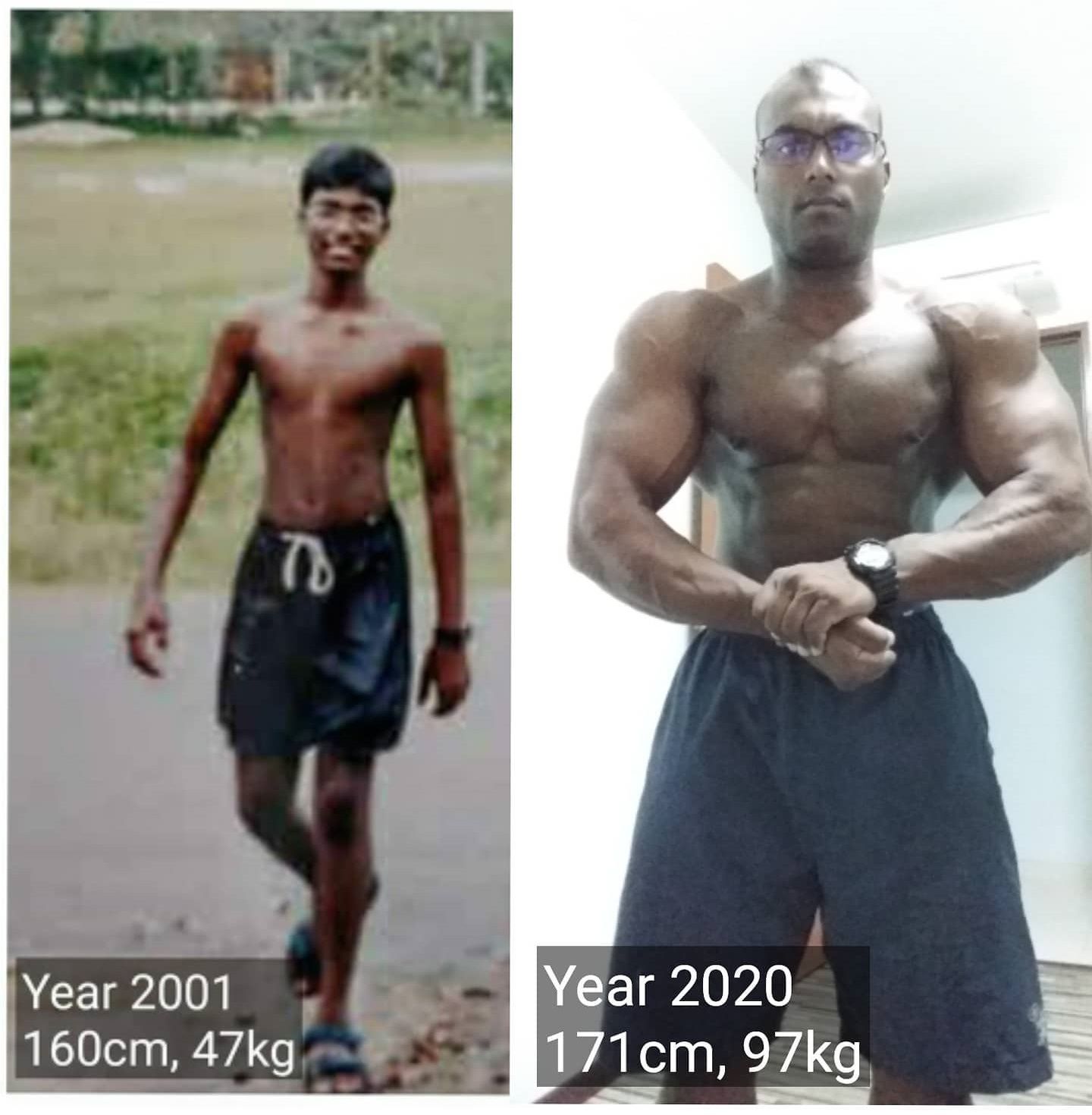
What changed was the gym.
He found bodybuilding in the way that people find things that save them — not by looking, but by stumbling in and recognising something.
The physical transformation was the most visible part: the skinny frame slowly filling out, the posture shifting, the body becoming something he could be proud of rather than ashamed of.
But the physical change was almost secondary to what came with it.
"Bodybuilding gave me a new life. The improved physical look also improved many other aspects of my life — my self-love, self-esteem — and helped me overcome anxiety from the bullying days."
He first competed in 2004 at the age of 17, entering the Junior/Tertiary category for athletes under 21.
The nervous teenager who had spent years being told he did not belong walked on stage and was judged, and the judgment, for the first time, went in his favour.
He has not stopped competing since. Twenty-two years. More than half his life.
"Prior to bodybuilding, I was very skinny, bullied throughout secondary school, and also the school's reject who wasn't allowed at the cool table," he said. "Bodybuilding changed my life."
Enter The Destroyer
Most people who follow competitive bodybuilding in Singapore assume that The Destroyer is a stage name — something constructed to project intimidation under the competition lights, a persona worn like posing trunks and spray tan. It is not.
For ten years, Danie Dharma competed in Singapore Pro Wrestling under the ring name Destroyer Dharma.
He was, for a full decade, a professional wrestler.
The character had a specific origin. When he described it, weeks after Johor Bahru, there was nothing performative about how he framed it.
"Destroyer Dharma is actually my pro wrestling name. I guess my wrestling alter ego represents the Dark Force my inner child evolved into as a result of all the bullying."
There is something almost cathartic in that explanation. The boy who could not sit at the cool table spent ten years performing dominance in a wrestling ring, embodying a version of himself that the bullies from secondary school could never have predicted.
The Dark Force is not a fabrication. It is a transformation — the same energy that drove him through the gym, channelled into a character who never loses.
And yet the man who carries that name, in daily life, is something quite different. He works full time as a personal trainer, applying years of accumulated science to the fitness goals of others. He takes acting roles when they come — commercials, small parts, occasional modelling work.
He is a trained stunt actor. He is methodical, considered, and by most accounts, quietly analytical about everything he does.
"The Destroyer and myself are completely different people in real life," he said. Then, with the kind of pause that suggests he has thought about this more than once: "Well, at least most of the time. We'll never know."
That ambiguity is not false modesty. It is the honest answer of someone who has lived inside an alter ego long enough to know where the lines blur.
The federation that disappeared
To compete in bodybuilding in Singapore today is to operate without a safety net that once existed.
Understanding that requires a brief look at what used to be there.
The Singapore Bodybuilding Federation (SBBF), affiliated with the Singapore Sports Council, ran competitive bodybuilding in Singapore with institutional seriousness.
It fielded a national team. It paid full-time athletes to compete. For those outside the main squad who qualified for international competitions, it covered entry fees, flights, and accommodation. The sport had a home, a structure, and a pathway.
Names who came through that structure — Azman Abdullah, Halim Haron, Simon Chua, Amir Zainal — competed internationally and won gold medals representing Singapore in a sport that the state formally recognised as worth supporting.
That ended in 2012, when the SBBF dissolved.
Dharma was already competing when it happened.
The immediate impact, he says, was not dramatic.
There was no single catastrophic moment. But the consequences of removing government funding from a sport's infrastructure are not always visible right away — they accumulate, steadily and quietly, until the sport looks unrecognisable from what it once was.
Without government support, competition organisers were left to cover venues, equipment, judging panels, and all associated overheads independently.
Registration fees rose sharply and have stayed there. Athletes who had once been able to compete with partial institutional backing found themselves covering everything out of pocket, in a sport that offers no prize money at the amateur level and no sponsorship pipeline for most competitors.
"The cost of signing up for competitions skyrocketed," Dharma said.
"Organizers have to pay for venues and other overheads, unlike when competitions had government funding."
He also described something that the official record of the SBBF's dissolution does not capture — a less visible problem with the old structure that he witnessed directly.
"There were issues like bias and dictatorship back in the day. If you were on the bad books, you won't get selected to compete even if you were the best."
Selection, in his experience, did not always reflect merit. Athletes who had fallen out of favour with those making decisions found themselves passed over regardless of their competitive standing. The dissolution of the federation removed that gate, even as it removed the funding that made the sport more accessible.
"These days anyone can sign up for any international competition," he said.
Whether that represents progress depends on where you are standing. For athletes who benefited from institutional support, 2012 was a loss. For athletes who were talented enough to survive independently but found the old system working against them, it was something else.
A borrowed sweater
The story of the Team Singapore sweater is not a grand gesture.
It is something much more ordinary, which is precisely what makes it resonant.
The sweater originally belonged to a physiotherapist who had accompanied the Singapore national team to a SEA Games — in which sport, Dharma is genuinely unsure.
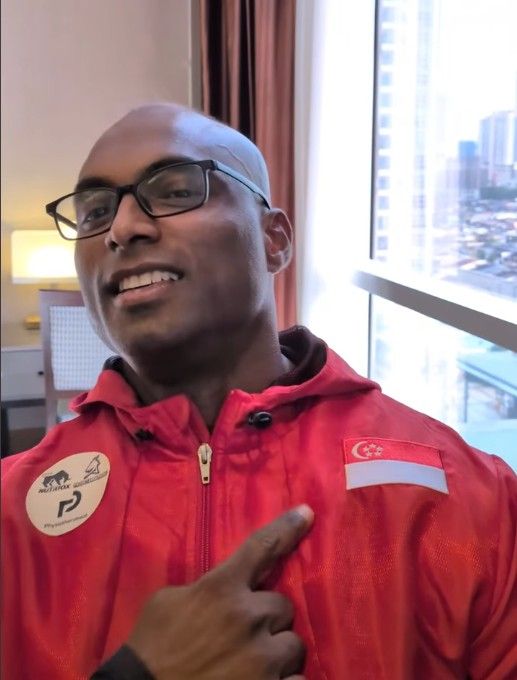
It came to him in 2023, when he was preparing to fly to Taiwan to represent Singapore at an international bodybuilding competition.
He asked to borrow it. She let him keep it.
He has worn it at every international competition since.
No sporting body has instructed him to. No national committee has endorsed it.
He simply packs it because he is Singaporean, and because representing Singapore — even without a mandate — is something he considers part of what he does.
This is not an uncomplicated patriotism. He served ten years in the Singapore Navy, and he carries the discipline and institutional loyalty that a decade of military service tends to leave behind.
He also told TOC directly that he does not agree with aspects of how Singapore is governed today. He is not a man performing nationalism for an audience.
What he is, he says, is someone shaped by a specific Singapore — the country of the 1980s and 1990s, the HDB corridors and the neighbourhood schools and the National Day Parades that made a particular kind of pride in a generation that grew up inside them.
"Growing up in the 80s and 90s, I am actually a very proud Singaporean. I've always felt proud serving Singapore, like when I served 10 years in the Navy."
The absence of institutional recognition, he says, does not change the fact of what he is.
"I don't represent any official bodies in Singapore, but I do represent the people of Singapore, and also the Singapore bodybuilding scene as the current Mr Singapore title holder."
He holds that title three times over — in 2016, 2023, and 2025.
Mr Singapore is not an informal distinction. It is the highest competitive ranking in bodybuilding in the country, awarded at the FM Singapore National Bodybuilding Championships, and the man who holds it is, by any reasonable measure, the best competitive bodybuilder Singapore currently produces.
He competes wearing a borrowed sweater, paying his own way, because in the absence of any official structure willing to send him, he sends himself.
Twenty-eight days
The eight gold medals in Johor Bahru were the product of the shortest preparation window of Dharma's competitive career.
Four weeks. Twenty-eight days from start line to stage.
On 9 April 2026, a fasted DEXA scan — conducted in the morning without food or fluid, for the highest accuracy reading — confirmed his body fat at 12%, with a competition weight of 91.5kg.
He stepped on stage on 10 May at 83kg, at an estimated 5% body fat. That is 8.5kg of body weight and seven percentage points of body fat shed in a single month.
The numbers look clean on a report.
The daily reality of achieving them is something else entirely — a sustained, months-compressed biological negotiation between performance and depletion, conducted in training sessions, weighed meals, and the particular mental discipline required to maintain both without one undermining the other.
What made it possible, Dharma says, is not willpower alone. It is two decades of investment in understanding what his body actually responds to.
He holds a diploma in sports science.
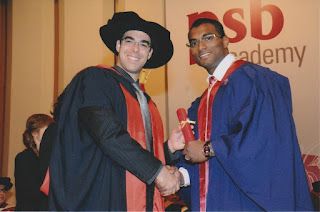
His preparation is methodical and evidence-based — not an intuitive process built on feel, but a structured approach in which every variable is accounted for and adjusted.
The years he spent in professional wrestling, demanding a different relationship with his body than bodybuilding does, contributed to the physical literacy he now applies to competition prep.
"Staying consistent all along with my training and diet did give me quite a headstart," he wrote after the competition. "I worked really hard over those four weeks, and I'm really happy with the outcome."
Perhaps the most striking detail is not the transformation itself, but when it happened.
Dharma turns 40 in 2026.
By the physiology of competitive sport, a 39-year-old body should be making preparation harder, not easier.
Recovery takes longer. The margins are smaller. Most competitors from his 2004 cohort have long since retired.
"Despite me turning 40 this year, my body is at its best ever," he said.
"All these years of progressive training, plus my science-based approach — my body is responding so much better to my training and diet than before. I would say I am in the best shape of my life, even compared to my 20s."
Eight golds
The NPC Worldwide Regional Championship in Johor Bahru on 10 May 2026 was structured around two divisions — Men's Bodybuilding and Classic Physique — with competitors divided by weight, age, and height classes.
Class winners advanced to compete for Overall titles in their respective divisions.
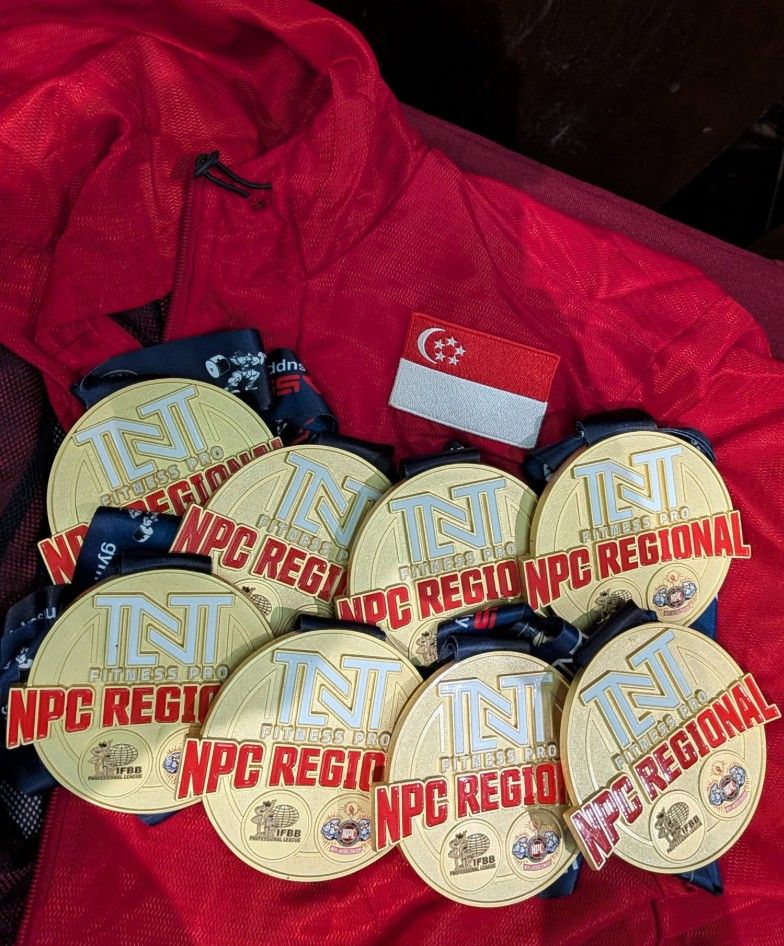
NPC Worldwide is the international arm of the US-based National Physique Committee, which organises qualifying events globally for athletes seeking entry to the IFBB Pro League — competitive bodybuilding's professional tier.
Competing at an NPC Championship is a mandatory step before an athlete may enter a Pro Qualifier, where an Overall title earns an IFBB Pro Card.
Dharma entered eight categories and won every one.
In Men's Bodybuilding, he won the Masters 35+ title and the Light Heavyweight title.
In Classic Physique, he won the Nationals (Singapore) category, the Nationals Singapore/Malaysia Overall, the Masters 35+, the Masters Overall, Open Class B, and the Open Overall.
The Nationals categories were structured as a Singapore versus Malaysia competition, each country's class champion advancing to compete for the combined Overall title.
Most Overall finals had two to three competitors — the respective class winners. The Masters 35+ divisions, his most contested, each had six competitors.
His previous single-show record was five gold medals, set at the FM Singapore National Bodybuilding Championships in 2023 — the event at which he claimed Mr Singapore for the second time.
His previous annual record was seven golds, also from 2023, combining those five with two more at a separate NPC event in Singapore later that year.
Eight golds in a single day surpassed both marks simultaneously.
Winning the Nationals Singapore/Malaysia Classic Physique Overall also earned him a specific prize: a free entry to the Kuala Lumpur Pro Qualifier, an officially sanctioned IFBB Pro League event.
The crowd
He had collected all eight medals across the course of the day, each category run one after another.
When the final medal was placed around his neck, he went backstage, changed into the Team Singapore sweater, and walked back out.
The medals created a stir as he moved through the crowd — the spectators who had been at the exhibits, the families waiting for their own competitors, the people simply passing through.
Eight medals on one person drew a particular kind of attention.
Someone stopped him.
"Wow, are you from Singapore?"
"Yes," he said. "I am Singaporean."
"I felt really proud," he reflected, weeks later.
"Perhaps I don't represent any official bodies in Singapore, but I do represent the people of Singapore. So it was all good. I felt I did my best for Singapore and got aptly rewarded that day."
Sleeping peacefully
The next target — the target that has defined the second half of Dharma's competitive calendar for 2026 — is an IFBB Pro Card.
Fewer than one percent of competitive bodybuilders globally ever earn one.
It is awarded at a Pro Qualifier, in a direct competition between class Overall champions, where a single card is given and there are no second places.
An athlete does not just need to win their division — they need to beat every other divisional champion in the room.
Dharma is targeting either the Hong Kong Pro Qualifier in July 2026 or the Kuala Lumpur Pro Qualifier in October. He holds a free entry to the latter, earned in Johor Bahru.
The former would require him to self-fund the trip, as he has funded every other trip in his career.
Beyond the Pro Card sits something much larger.
The IFBB Mr Olympia is bodybuilding's equivalent of the Olympic Games — the stage against which every serious competitive bodybuilder ultimately measures themselves.
Winning a Pro Card unlocks entry to professional competitions with cash prizes. Excelling at those opens the door to the Olympia. Winning the Olympia is the kind of achievement that defines a career and outlasts it.
Dharma has thought clearly about what getting there would mean in the country whose name he wears on a borrowed sweater.
"I can't expect people outside the fitness industry to understand the ins and outs of bodybuilding, or what it means for one to actually make it to the Olympia," he said.
"If some kind of mainstream media doesn't inform the public, there are not many other ways they would know about it besides social media."
He is not naive about the recognition gap.
He has watched it operate for the entirety of his adult life.
He draws the comparison to Joseph Schooling deliberately — not to position himself as the next Schooling, but to name a pattern that he and every other self-funded Singaporean athlete who has competed internationally knows by experience.
Schooling was self-funded for years before he stood on a podium at the Rio Olympics and made the country stop.
Recognition, when it came, was overwhelming. Before the victory, there was silence.
"It would be really nice if us self-funded athletes got similar recognition to the foreign athletes being paid by the state to compete," Dharma said.
That sentence carries the weight of two decades of competitions funded on a personal trainer's income — flights booked, hotels arranged, peak week logistics managed, entry fees paid — in a sport whose institutional home disappeared when he was still building his career.
But it is not a sentence delivered in bitterness.
There is a clarity to how he holds it, a sense of someone who has long since made peace with the terms of his own journey and found, within those terms, something worth continuing for.
"A victory would still be a victory nonetheless," he said.
"And I will sleep peacefully at night knowing I did my part for Singapore."
The borrowed sweater will be packed again for Hong Kong or Kuala Lumpur.
Nobody asked him to bring it. No committee has approved it. No funding will cover the trip.
He will bring it anyway.