Chongqing animal abuse protests spark clashes, exposing gaps in China's animal protection laws
A suspected animal abuse case involving a man accused of obtaining pets through false adoption claims has triggered days of protests in Chongqing, leading to clashes with police and renewed calls for animal protection legislation in China.
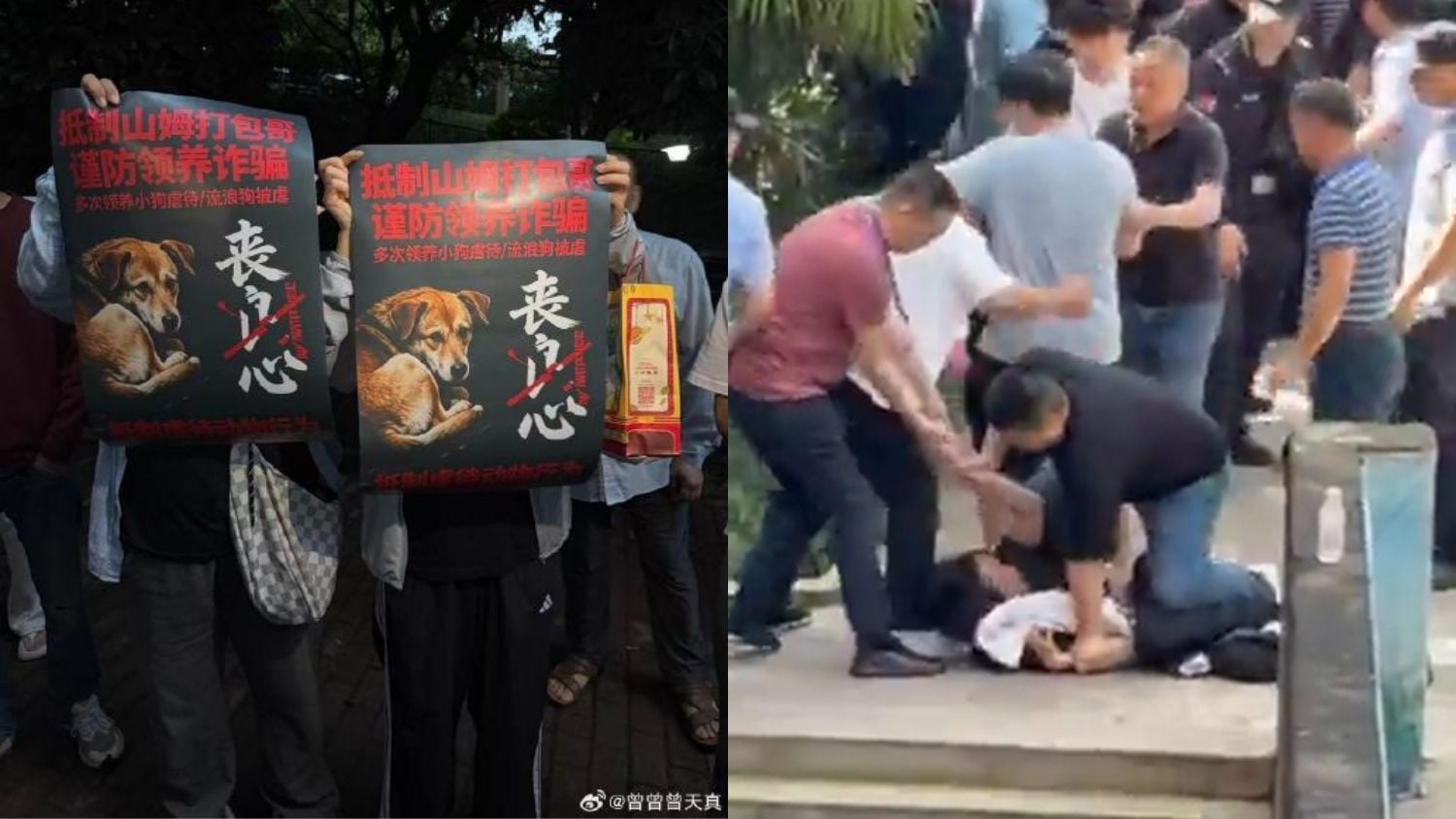
- Police cleared protesters on 9 June after three days of demonstrations outside a Chongqing residential compound.
- Authorities confirmed a criminal case had been opened against suspect Li Meng and investigations remain ongoing.
- The case has intensified public debate over China's lack of a national animal protection law.

Hundreds of animal welfare volunteers, pet owners and residents gathered for several days outside a residential compound in Chongqing after allegations emerged that a man had posed as a caring adopter to obtain dogs and cats before abusing and killing some of them.
The protests culminated on 9 June when police moved to clear the crowd, with footage circulating online showing physical altercations, detentions and people being carried away by officers, fuelling public anger and renewed calls for a national animal protection law in China.
Police clear compound; dozens detained
On 9 June, police vehicles began massing around the Zhonghai Beibinhuating compound in Jiangbei district from noon. A man in a white shirt addressed the assembled crowd, saying authorities would consider the public's views on animal legislation but that a residential compound was "not the place to raise issues," according to HK01.
More than 50 officers subsequently moved to clear the area. Footage circulated online showed physical altercations, individuals being carried away by officers and loaded onto police vehicles, and several people reported injured and taken to hospital.
One widely circulated clip showed a young man apparently being struck by police before being detained. The man's mother told HK01 through tears: "Police said they [those who had gathered in support] were provoking a disturbance, and that they had reason to beat people."
An animal welfare volunteer who provided footage to HK01 said: "These are someone's children. Is this really how they are treated for asking for justice for a dog?"
According to unverified accounts cited by HK01, approximately 30 people were taken away during the afternoon operation, with no official statement issued about their status. That evening, crowds remained outside the compound shouting for their release. Ruibao News noted that authorities had not provided a full public account of the operation.
HK01 reported that many of those detained were young people who had seen videos circulating online and travelled to the compound independently to show support. Animal welfare volunteers and the original complainants were also said to be among those summoned or detained by police.
A local volunteer identified as Xiao Wan said that the original demands had been straightforward. "But their anger was not responded to, and the Chongqing police pushed them step by step onto the streets," she said.
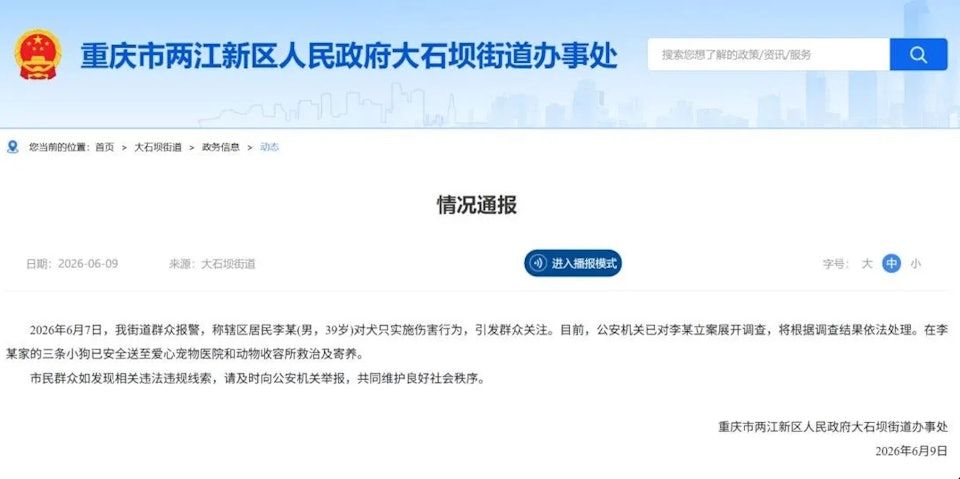
In a statement released on the evening of 9 June, the Dashiba street office confirmed police had formally opened a case against the suspect, identified as Li Meng, that three puppies found at his home had been transferred to a veterinary clinic and rescue shelter, and that the investigation was ongoing.
Three days of protests preceded the crackdown
The 9 June dispersal was the culmination of three days of escalating public pressure. By the evening of 7 June, nearly 100 people had gathered outside Li's compound. By 8 June, the crowd had grown to several hundred, with demonstrators maintaining an overnight vigil. Participants held banners reading "Beware adoption fraud; oppose animal abuse" and called for animal protection legislation, according to HK01. Supporters were reported to have organised supply deliveries and brought mobile charging stations to sustain those keeping watch.
Under mounting public pressure, the head of Dashiba police station said on the evening of 8 June that police had opened an investigation and taken coercive measures against Li. He said the charges were "throwing objects from height" and intentional damage to public property — the strongest charges available under existing law given current evidence. He added that the whereabouts of other missing animals remained under investigation.
Who is 'the Sam's Club packer'
At the centre of the case is Li Meng, a man from Zibo in Shandong province residing in Chongqing, identified in reports by mainland outlets Fengmian News and Da He Bao, Li is widely known online by the nickname "Shan Mu Da Bao Ge" — roughly, "the Sam's Club packer" — a moniker acquired after a 2024 incident in which he was filmed taking home large quantities of food samples from a Sam's Club supermarket and clashing with staff.
Li and his wife had for some time been active in Chongqing pet rescue and adoption groups on social media platforms including Douyin, presenting themselves as experienced and caring owners.
He reportedly claimed to work at a petrol station with a stable income, a housewife spouse, and two children who loved animals — details designed to reassure donors handing over puppies and kittens free of charge.
Volunteers told HK01 that Li appeared knowledgeable about pet care and convincingly framed each adoption, making warning signs difficult to detect.
The events that triggered the protests
The case came to public attention on 4 June 2026. A cat rescue volunteer, identified only by her surname Wang, gave Li a white female puppy at no charge. Li then asked to view the mother dog and accompanied Wang to a storage facility. That afternoon, Wang returned to find the mother had been beaten to death.
CCTV footage reviewed afterwards showed Li returning to the facility after leaving with the puppy. Wang uploaded the footage online, and users quickly identified the man as the "Sam's Club packer." After reviewing CCTV footage, she became concerned that the puppy might also be harmed.
On 5 June, volunteers and former donors went to the Dashiba police station to file a report. According to HK01, officers characterised the matter as a "civil dispute," told the parties to negotiate privately, and stated that "killing a dog is not against the law." One officer reportedly asked why complainants did not concern themselves instead with dog meat festivals, and directed them to file a civil lawsuit independently.
In the early hours of 6 June, Li was allegedly filmed by a neighbour abusing a dog on his balcony. That report also received no police response. Volunteers who subsequently went to the compound discovered a puppy, named Dongdong by rescuers, abandoned and close to death in a stairwell. Veterinary examination found the two-month-old puppy had multiple limb fractures, sawn-down teeth, a severed tail and head swelling.
On 7 June, volunteers recovered two unidentified black puppies from Li's possession. The original white puppy taken from Wang remains missing. Wang, overwhelmed by guilt over the fate of the animals she had given away, was reported by HK01 to have attempted suicide.
The protests also followed an earlier, unresolved incident from March 2026, in which neighbours and volunteers had witnessed Li allegedly using a dog clamp to abuse a puppy named Xing Xing outside the building.
When confronted, Li reportedly threw the dog to the ground and said, as quoted by HK01: "This is my dog, it's none of your business. I can kill it and you can't do anything about it. I'm just rebellious." Li produced vaccination records showing the dog was legally registered in his name; police declined to intervene further. Xing Xing subsequently died.
The legal vacuum: no animal cruelty law in China
The case has drawn renewed attention to the absence of a national animal protection law in China. As reported by Ruibao News, abuse of companion animals is not a standalone criminal offence; investigators must instead identify applicable provisions in other laws, such as prohibitions on throwing objects from height, damage to property, or disturbing public order.
Xiao Wan, an animal welfare volunteer who spoke to HK01, said the case highlighted the limited legal avenues available under current Chinese law. An adoption agreement constitutes a conditional contract; Li's killing of the animals could constitute wilful damage to another person's property, allowing original owners to pursue civil claims.
His concealment of intent when obtaining animals may constitute fraud under the Public Security Administration Punishments Law. His conduct could also fall under Chongqing's municipal regulations on dog management, which explicitly prohibit cruelty and allow penalties including detention and fines.
Ruibao News noted that in cases where animals have already been transferred through adoption arrangements, or where they are strays without a clearly identified owner, even the property damage avenue becomes difficult to apply.
On the wider legislative question, Xiao Wan told HK01: "Cases of animal abuse and killing happen every day on the mainland... I hope this can push for the introduction of an animal protection law or corresponding restrictive regulations, so that such harm to animals and to the feelings of ordinary, decent people does not happen again."
Multiple former donors told mainland media their core demands were the recovery of any surviving animals and legal consequences for Li's conduct. Widespread online commentary, cited by HK01, expressed hope that the case might serve as the catalyst for national legislation — what some described as "firing the first shot" for an animal protection law in China.