Transformative Justice Collective receives documentation award at global anti-death penalty congress in Paris
Singapore civil society group Transformative Justice Collective received the Documentation Award at the 9th World Congress Against the Death Penalty in Paris. The recognition comes as the group continues to face restrictions under Singapore's POFMA regime.
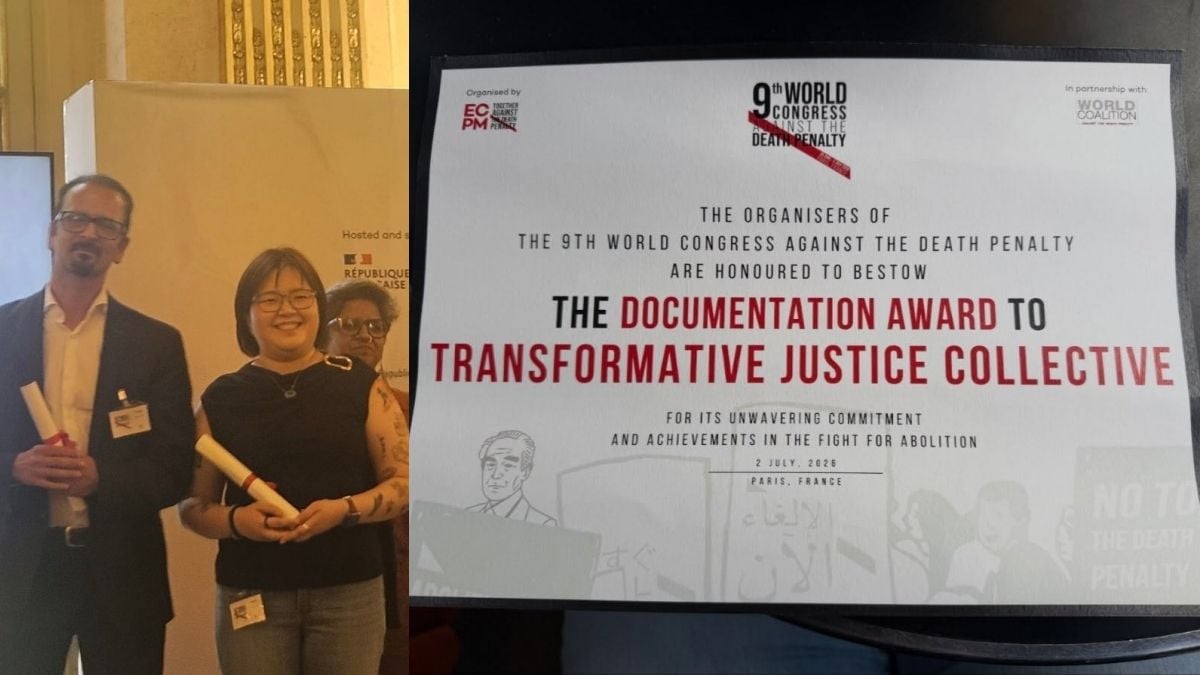
- Transformative Justice Collective received the Documentation Award at the 9th World Congress Against the Death Penalty in Paris.
- Kirsten Han said the recognition affirmed TJC's documentation work despite ongoing restrictions under POFMA.
- The award comes as several TJC activists continue to face investigations and legal action linked to POFMA.

Singapore civil society group Transformative Justice Collective (TJC) has been presented with the Documentation Award at the 9th World Congress Against the Death Penalty in Paris, receiving international recognition for its work documenting issues surrounding capital punishment despite ongoing restrictions imposed under Singapore's Protection from Online Falsehoods and Manipulation Act (POFMA).
The congress, organised by Paris-based Together Against the Death Penalty (Ensemble contre la peine de mort – ECPM), was held from 30 June to 2 July 2026.
The event brought together politicians, judges, lawyers, diplomats, international experts, civil society organisations, academics, artists and witnesses to the death penalty to discuss contemporary challenges surrounding capital punishment.
Singapore freelance journalist and activist Kirsten Han shared the news in an Instagram post on 3 July, describing the award as an important moment for TJC and its international recognition.
Han attended the congress on behalf of TJC alongside activists Mossammad Sobikun Nahar and Elijah Tay.
At the closing ceremony, TJC was one of two organisations to receive the Documentation Award. The other recipient was Iran Human Rights, which documents executions in Iran.
"I’m so proud of TJC as a collective for what we have done over the years, and what we continue to do together," Han wrote.
"It hasn’t been easy in so many ways, but we’ve been able to achieve more together than any of us could have done alone."
Han said she was proud and grateful that TJC's work had been recognised by allies and fellow campaigners in the global movement seeking the abolition of the death penalty.
She also said the recognition carried particular significance because the award acknowledged TJC's documentation efforts at a time when the organisation had been forced to give up its website and multiple social media platforms following POFMA-related measures.
According to Han, the affected platforms will remain inactive until the group's Declared Online Location (DOL) designation expires in December 2026.
Recognition for documentation work
Han stressed that documenting executions and the experiences of those affected remains essential in challenging capital punishment.
"The death penalty thrives when there is silence and erasure," she wrote.
"Governments are able to kill without political cost when their violence is hidden from public view. The retention of capital punishment requires dehumanisation."
She added that campaigners have a responsibility to continue exposing injustice despite attempts to suppress information.
"The more the powerful try to hide their cruelty, the more we must shine a light on them."
"We must restore humanity to discourse on the death penalty; remind everyone that these are real, complex human lives that are on the line."
She said the stories and information shared by campaigners not only expose injustice but also encourage society to consider the broader implications of capital punishment and the type of society people wish to build.
Han also said she had been invited to moderate a congress session examining the socio-economic realities behind the death penalty and the importance of intersectional abolitionist work.
She also participated in the Anti-Death Penalty Asia Network (ADPAN) side event, where she spoke about developments relating to capital punishment in Singapore and across the region.
Singapore's crackdown on anti-death penalty activists
The award comes as TJC continues to face restrictions imposed by Singapore authorities under POFMA.
POFMA, enacted in 2019, grants the government powers to issue correction directions and restrict online content considered to contain falsehoods. The law has been used against activists, critics and independent media outlets.
On 20 December 2024, the Ministry of Digital Development and Information (MDDI) declared Transformative Justice Collective's (TJC) website and social media platforms a DOL, preventing them from receiving financial or material benefits for two years.
Between April 2023 and December 2024, TJC received six Protection from Online Falsehoods and Manipulation Act (POFMA) Correction Directions over statements relating to Singapore's use of the death penalty and executions.
MDDI said five of those directions, issued between August and December 2024, concerned alleged falsehoods about the treatment of prisoners awaiting capital punishment, while authorities maintained that the death penalty deters drug-related crimes and is administered with full due process.
Facing potential criminal liability under POFMA, TJC suspended its website and social media operations on 21 January 2025.
The organisation said the restrictions posed a threat to freedom of expression while reaffirming its commitment to continue advocacy through alternative channels.
Eleven civil society organisations, including CIVICUS, subsequently criticised the measures, arguing that they restricted debate on human rights issues, particularly discussions relating to the death penalty.
TJC activist Kokila charged on 23 April
Several TJC activists, including Kokila Annamalai, Rocky Howe and Mossammad Sobikun Nahar, have also been summoned for investigations under POFMA.
Annamalai, who declined to comply with a correction direction issued in October 2024, was charged on 23 April 2026 with failing to comply with a correction direction issued under the law.
According to ECPM, the congress was organised under the patronage of France, the European Union and Switzerland.
Over three days, delegates examined issues including the resurgence of executions, drug trafficking, discrimination, justice, socio-economic impacts and the role of the judiciary, while placing particular emphasis on personal testimonies, culture and the role of young people in the global movement against capital punishment.