TikToker questions father's 14-hour CGH wait as doctor explains bed shortages and admission delays
A TikTok video by F&B operator Jason Chua about his father's 14-hour wait for a ward at Changi General Hospital has ignited discussion over bed shortages, emergency department congestion and communication with patients, prompting responses from doctors, healthcare workers and the public.

- Jason Chua's account of his father's prolonged wait at CGH reignited debate over emergency department congestion and ward bed shortages.
- Doctors said long waits reflect hospital capacity constraints rather than shortcomings by frontline healthcare workers.
- Many members of the public called for clearer communication and alternative care arrangements for medically stable patients.

A TikTok video by F&B operator Jason Chua describing his father's prolonged stay in the Accident and Emergency (A&E) department at Changi General Hospital (CGH) has sparked widespread online discussion about hospital bed shortages, emergency department congestion and communication with patients' families.
Chua posted the video on 7 July 2026 after accompanying his father to CGH earlier that day.
According to Chua, his father arrived at about 7am, completed registration, triage and medical assessments, but remained in the A&E department for more than 14 hours before being admitted to a ward.
He said his father was suffering from shortness of breath and cold sweats, yet by around 9pm was still waiting in the emergency department because no inpatient bed was available.
According to Chua, hospital staff repeatedly informed the family that they were waiting for doctors' rounds before ward admission could proceed.
Frustrated by the lengthy delay, Chua suggested taking his father home temporarily before returning the following morning if necessary.
However, he claimed hospital staff did not allow the arrangement.
At one point, Chua said he even suggested that they could "just plug out the IV" and leave, reasoning that they could call an ambulance if his father's condition deteriorated. His father ultimately decided to remain in hospital.
Chua also recounted a previous experience at CGH about six months earlier, when his family allegedly waited around nine hours before discovering a doctor had forgotten to update them after test results became available.
In a follow-up video, Chua said his father was finally admitted to a ward at 11.36pm on 7 July, adding that he was relieved the episode had ended.
Chua calls for greater flexibility and clearer communication
Despite criticising the waiting time, Chua repeatedly stressed that his frustration was not directed at doctors or nurses.
"We all know you all overwork," he said, adding that healthcare workers "really work damn hard" and that many people continue to respect the profession, particularly after witnessing their sacrifices during the COVID-19 pandemic.
Instead, Chua said he hoped the experience would encourage discussion about possible improvements to the healthcare system.
Among his suggestions was allowing medically stable patients to return home temporarily after signing an indemnity form acknowledging the risks should their condition worsen before a ward became available.
He argued that patients would be more comfortable resting at home than remaining seated in the emergency department for extended periods.
Chua also questioned whether hospitals could improve coordination by transferring patients to facilities with available beds, saying his family would have been willing to drive his father elsewhere if that option had existed.
Chua: Possible 72-hour ward wait is “a very scary thing for worrying kids”
Responding to criticism online, Chua said many people overlooked the anxiety experienced by family members unfamiliar with hospital procedures.
He said hearing that the wait for a ward could stretch to as long as 72 hours was "a very scary thing for worrying kids", adding that any son or daughter would naturally panic in such circumstances.
"You not kanchiong meh?" he asked.
Chua said respectful explanations from healthcare professionals had helped ordinary members of the public better understand why prolonged waits occur, insisting his intention had never been to blame frontline staff.
@bengwhocooks Replying to @Vegetable spring roll ♬ original sound - BengWhoCooks
Doctor says bed shortages are a system-wide challenge
Gastroenterologist Dr Desmond Wai later responded to Chua's videos, saying he does not work at CGH but wanted to explain why patients can spend many hours in A&E after doctors have decided they require admission.
Dr Wai said prolonged waits generally reflect wider hospital capacity constraints rather than shortcomings by doctors or nurses working in emergency departments.
"If the A&E is full house, it implies that the hospital is also full," he said.
He explained that when inpatient wards reach capacity, patients requiring admission remain under observation and treatment in A&E until beds become available.
"A&E does not reject sick patients," he said, adding that healthcare workers often face even greater workloads when patient numbers surge.
"Please don't blame the worker working at A&E because it's not their fault."
Dr Wai acknowledged that there is no simple solution to the issue, saying hospitals continue managing growing patient demand while coping with limited bed capacity.
@drdesmondwai https://vt.tiktok.com/ZSCTMTsmP/ pls dont blame the dr or nurses at CGH www.drdesmondwai.com #drdesmondwai #韦俊韬 #Emergencydepartment #urgentcarecenter #admission @bengwhocooks ♬ original sound - Dr Wai Chun Tao, Desmond
Why patients cannot simply return home
In another video, Dr Wai described Chua as a caring son who remained by his father's side throughout the ordeal.
"He banged the table but he was courteous," Dr Wai said, adding that Chua's actions reflected concern for his father's wellbeing rather than hostility towards healthcare staff.
Addressing Chua's suggestion of transferring patients elsewhere, Dr Wai said hospitals already communicate with one another when urgent cases require available beds.
However, he noted that if one public hospital is experiencing severe bed shortages, others are often facing similar pressures.
Based on Chua's description, Dr Wai suggested his father's condition was likely serious enough to require admission but sufficiently stable for doctors to continue monitoring him safely within the emergency department while awaiting a ward.
He also explained why patients who have already been assessed for admission are generally discouraged from leaving hospital.
According to Dr Wai, once doctors determine admission is medically necessary, they remain professionally responsible for the patient's care until treatment is completed or the patient chooses to leave against medical advice.
Patients may sign discharge against medical advice documents accepting responsibility for leaving voluntarily, he said, but doctors generally discourage doing so because of the potential risks should complications arise.
@drdesmondwai https://vt.tiktok.com/ZSCTMTsmP/ www.drdesmondwai.com #drdesmondwai #韦俊韬 #Emergencydepartment #urgentcarecenter #admission ♬ original sound - Dr Wai Chun Tao, Desmond
Medical treatment begins immediately upon arrival
Dr Wai also sought to reassure members of the public that waiting for a ward does not mean treatment has been delayed.
"The moment your father stepped into the hospital, medical care started immediately," he said.
He explained that patients continue receiving assessment, monitoring and treatment in the emergency department while awaiting an available inpatient bed.
Although acknowledging that extended waits are stressful for both patients and relatives, he said patients are not simply left unattended because ward admission has been delayed.
He concluded by wishing Chua's father a speedy recovery while encouraging greater understanding of the pressures facing hospitals during periods of exceptionally high demand.
Public reactions reflected divided perspectives
Chua later thanked healthcare professionals who responded respectfully to his videos, saying their explanations had improved public understanding of hospital procedures.
He recalled that his father had spent around 14 hours sitting in a chair despite suffering severe back pain, making the experience particularly distressing for the family.
Chua maintained that he never criticised doctors or nurses and continued to hold deep respect for healthcare workers because of their commitment during the pandemic.
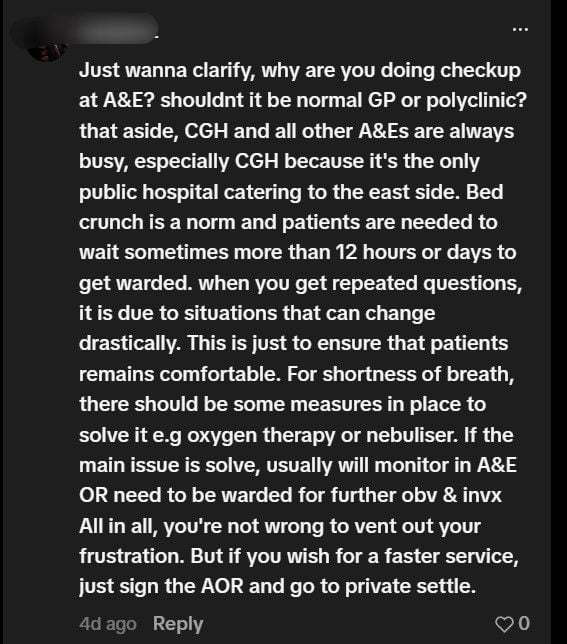
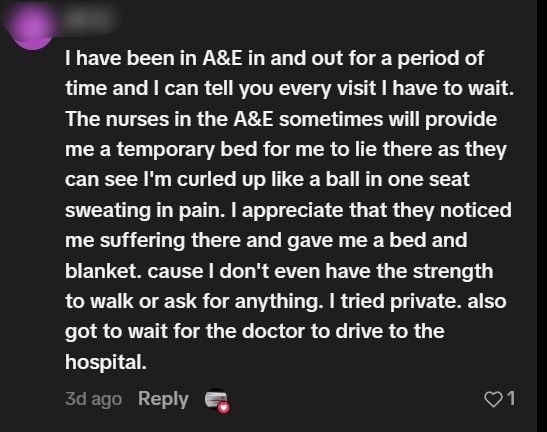
Public shares similar experiences of long hospital waits, but says healthcare workers remain committed
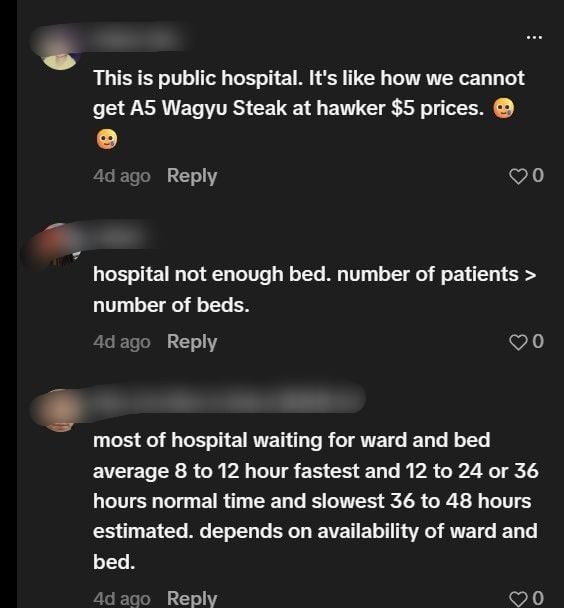
Many members of the public said his experience resonated with their own encounters in Singapore's public hospitals.
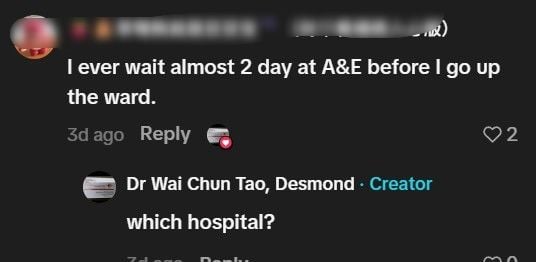
Several commenters shared experiences of waiting between 20 hours and almost two days before receiving ward beds.
One wrote: "I ever wait almost 2 day at A&E before I go up the ward."
Another said their father waited "one and a half day" before admission.
Others stressed that although beds were unavailable, doctors and nurses continued treating patients throughout the waiting period.
One commenter said a 40-hour wait had been the shortest experienced by their parents, yet medical staff remained attentive despite the delays.
Another recalled waiting about 20 hours in observation before being admitted, adding that although frustrating, the situation was not the fault of frontline healthcare workers.
Calls for better communication and alternative options
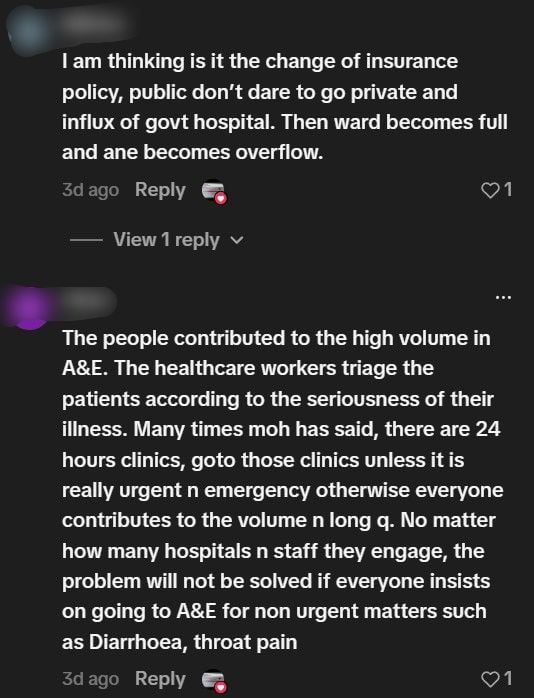
Some commenters argued that clearer communication could reduce anxiety among patients and relatives.
They suggested hospitals should explain expected waiting times, bed availability and admission priorities from the outset so families better understand the process.
Others proposed expanding options for medically stable patients, including transfers to other hospitals or private facilities where capacity exists.
Some pointed to hospital-at-home programmes that allow suitable patients to receive treatment and monitoring remotely while remaining in familiar surroundings.
Healthcare workers and former patients also noted that Singapore's ageing population and sustained demand for acute care continue placing significant pressure on public hospitals and available inpatient beds.
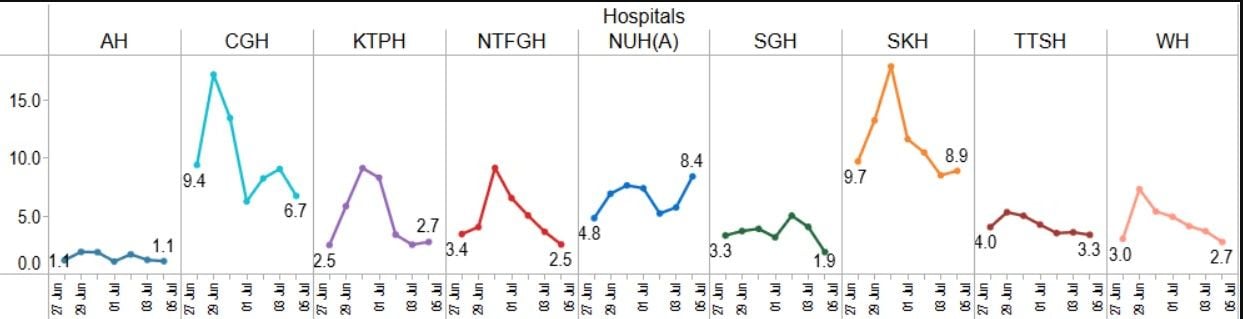
A check of Ministry of Health statistics showed CGH's emergency department waiting times ranged from approximately 6.7 hours to more than 15 hours during the first week of July.
On 8 July, CGH also posted on Facebook that its Emergency Department was experiencing high patient volumes and warned that longer waiting times should be expected.