Court of Appeal dismisses mandatory death penalty challenge over lack of standing; applicants ordered to pay S$25,000 costs
Singapore's Court of Appeal has dismissed a constitutional appeal challenging the mandatory death penalty, ruling that the applicants lacked legal standing. The court ordered the applicants to pay S$25,000 in costs, with its written grounds of decision to be issued later.

- The Court of Appeal dismissed the constitutional appeal, finding the applicants lacked legal standing.
- The applicants were ordered to pay S$25,000 in costs despite the Attorney-General seeking S$53,500 plus disbursements.
- The appeal stemmed from a constitutional challenge against Singapore's mandatory death penalty under the Misuse of Drugs Act.

Singapore's Court of Appeal on Friday, 10 July 2026, dismissed a constitutional appeal brought by seven civil society activists and relatives of executed drug offenders, ruling that the applicants lacked the legal standing to challenge the country's mandatory death penalty regime.
The court upheld the High Court's earlier finding that none of the applicants had shown they were directly and presently affected by the provisions they sought to strike down. A written judgment will be issued in due course.
The Attorney-General's Chambers (AGC) had sought S$50,000 in costs plus S$3,500 in disbursements, amounting to S$53,500 in total. The applicants had offered S$10,000, arguing that a larger sum would be unduly crushing. The Court of Appeal ordered costs of S$25,000, all in.
Freelance journalist and activist Han Li Ying, known publicly as Kirsten Han, confirmed the outcome in a Facebook post shortly after the hearing, quoting the court's finding that the applicants lacked standing.
Hearing details
About ten representatives from European Union missions observed proceedings, according to the Swiss Embassy in Singapore. Appellant Nazira Lajim Hertslet, whose brother was executed, was unable to attend after her husband suffered a stroke; fellow appellant Howe Wen Khong, known as Rocky, confirmed to the court that she was content for the hearing to proceed without her.
The seven appellants, representing themselves, consolidated their arguments over a 75-minute session, with Howe presenting for about 50 minutes before Rockey Sharmila made additional submissions.
Appellants argued standing on two grounds
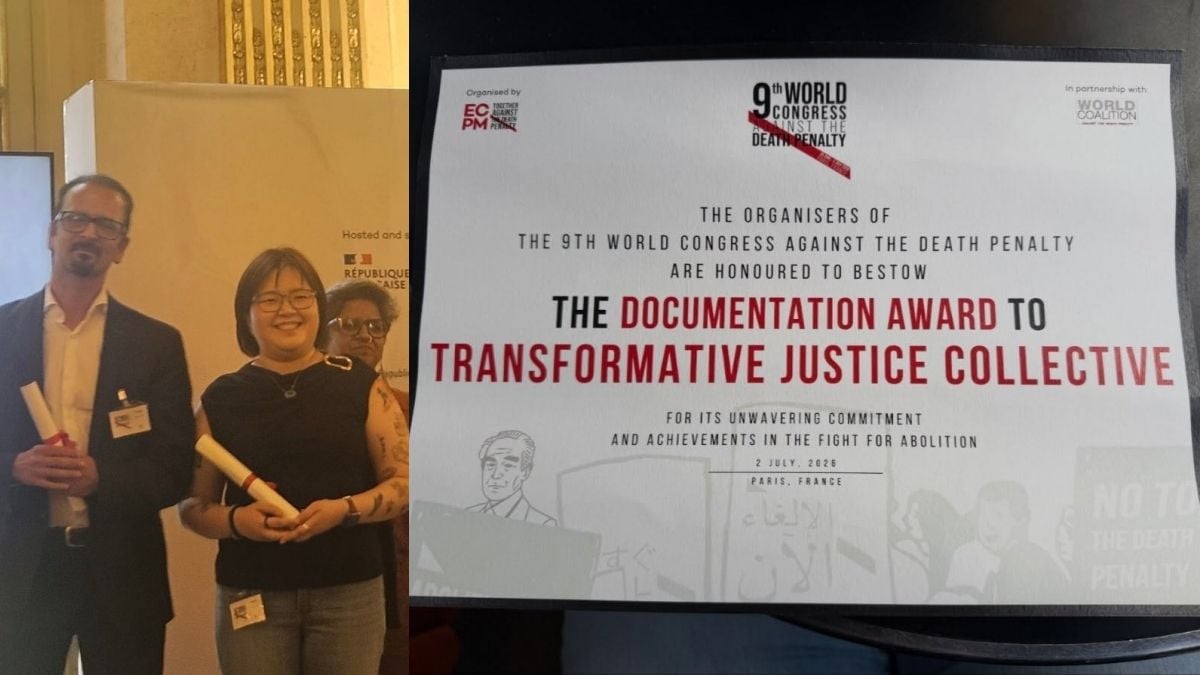
The application, filed on 28 October 2025 under Order 4, Rule 7 of the Rules of Court 2021, named seven applicants: Howe Wen Khong (Rocky), Annamalai Kokila Parvathi (Kokila), Han Li Ying (Kirsten Han) and Wham Kok Han (Jolovan Wham), all founding members of the Transformative Justice Collective (TJC); together with Leelavathy d/o Suppiah, Rockey Sharmila and Nazira Lajim Hertslet, whose brothers were executed for drug offences. The application cited Articles 4, 9, 12 and 93 of the Constitution.
Rockey Sharmila, whose brother was executed, expanded on the "special damage" argument raised by Howe. Addressing the court by prepared script as a self-represented litigant, she asked leave to read a short statement, noting she was not legally trained.
She cited a report tendered to the United Nations Human Rights Council the previous month on the death penalty and the prohibition of torture, which found that relatives consistently describe the death penalty "as a long process of repeated trauma rather than a single legal event," rather than a single legal event.
Family members spoke of "counting the days" before a scheduled execution, with one relative quoted asking, "What do you say to someone when they say it's your last call?" and another describing a condemned person after reprieve as someone who had "seen death."
The report concluded that capital punishment functions as "a relational punishment imposed on families," with one mother anticipating her son's execution stating, "If my son leaves, I'm just going to go ahead and leave with him," and found that families "do not merely witness punishment from the margins; they absorb it over time through sustained uncertainty, helplessness and grief."
Sharmila argued that while the mandatory death penalty is justified by the deterrent effect it may have on drug-related deaths, that benefit is speculative, whereas the harm inflicted on relatives of those facing execution is immediate and documented.
Howe told the court that family members had suffered trauma and stigma, while activists' standing arose from their direct support work with death row prisoners and their families, rather than from TJC membership itself.
The appellants argued that a constitutional violation could be established even without a pending prosecution, submitting that the psychological, reputational and emotional effects of the mandatory death penalty on relatives amounted to recognised harms in law.
As a fallback, they argued the court retained jurisdiction to hear the case on public interest grounds regardless of standing.
Constitutional arguments under Articles 9 and 12
On the substantive challenge, the appellants argued that the mandatory death penalty violates Article 9(1) of the Constitution, which protects the right to a fair trial, on two grounds: that sentencing is part and parcel of that right, and that punishment must be proportionate.
They submitted that a mandatory sentence denies an accused person any opportunity to be heard on punishment, and that the finding of guilt exists for the purpose of imposing punishment, so fair trial protections cannot logically stop at conviction.
They traced the principle that punishment must be proportionate to its common law origins in the Magna Carta, arguing that it has constitutional force in its own right and is distinct from the separate proportionality test that argued also arises under Article 12, though the two are related.
Under questioning from the bench, Howe clarified that the challenge was confined to the mandatory nature of the death penalty for drug offences, not to capital punishment generally or its application to murder, and that the appellants were not arguing that all mandatory sentences are unconstitutional — only that mandatory sentencing becomes disproportionate when combined with the severity of a death sentence.
On equality under Article 12, the appellants argued that grouping offenders of widely varying culpability, from couriers acting on instruction to organisers directing the trade, for the purposes of a single mandatory punishment of death was not a reasonable classification, since it left no room for courts to weigh mitigating circumstances.
Pressed by the bench on whether drug weight was itself an intelligible differentiating factor already set by Parliament, the appellants argued that trafficking covers too broad a range of conduct for weight alone to justify grouping offenders together, and maintained that no single criterion could justify a mandatory, undifferentiated punishment for a class this diverse.
They further argued that requiring the court to review the mandatory death penalty for proportionality does not turn it into a "mini-legislature," since assessing constitutionality is a core judicial function distinct from setting policy.
AGC defended standing rules
Counsel for the Attorney-General of Singapore urged the court to dispose of the case on standing alone. Counsel set out three rationales for the standing requirement: preserving the judicial function by avoiding abstract or hypothetical disputes, ensuring parties have sufficient stake to argue cases fully, and guaranteeing that constitutional questions are resolved on real, rather than academic, facts.
The AGC argued that the constitutional right to a fair trial ends at conviction and does not extend to a right to be heard on sentencing, and that Parliament, not the courts, bears constitutional responsibility for setting sentencing ranges.
Counsel further submitted that granting standing in this case would leave the mandatory death penalty perpetually open to challenge by any similarly situated applicant.
AGC's response on the merits
Beyond disputing standing, the AGC also contested the appellants' constitutional arguments directly. Counsel submitted that the constitutional right to a fair trial ends at conviction, and that no case law establishes a constitutional right to be heard on sentencing — noting that this allocation reflects a long-standing division in which Parliament sets sentencing ranges and courts exercise discretion within them, rather than a division that itself raises a constitutional defect.
Justice Ang Cheng Hock appeared unpersuaded by this position, pressing the AGC on whether the same reasoning meant that the right to a fair trial offers no protection whatsoever at the sentencing stage even outside mandatory-sentence cases, where courts retain discretion.
Counsel did not directly answer the question, saying that put in historical perspective sentencing discretion was relatively modern phenomenonCounsel also argued that the case was a poor vehicle for a proportionality analysis in any event, since there were no specific facts before the court — an offender's actual conduct or culpability — against which proportionality could be tested.
The bench noted some tension in this, observing that the appellants' argument was precisely that no facts could make the mandatory death penalty proportionate, which is a different claim from lacking evidence to weigh proportionality in an individual case.
Appeal followed December 2025 High Court ruling
The appeal arose from a High Court decision delivered on 16 December 2025, which dismissed the same constitutional application. In that judgment, Justice Hoo Sheau Peng ruled that although the applicants had expressed deeply held opposition to capital punishment, none had shown that their own constitutional rights had been infringed.
Standing principle reaffirmed
The High Court's reasoning followed theon constitutional challenges to Section 377A of the Penal Code, which held that applicants lacked standing where there was no real and credible risk of prosecution.
Friday's ruling reaffirmed that applicants must show they are directly and presently affected by the law they seek to challenge.