What the GRC scheme actually guarantees: Marine Parade-Braddell Heights as a case study
Faishal Ibrahim's resignation left Marine Parade-Braddell Heights GRC without its designated minority MP. The scheme's 1988 rationale and its 2019 legal mechanics point in different directions.
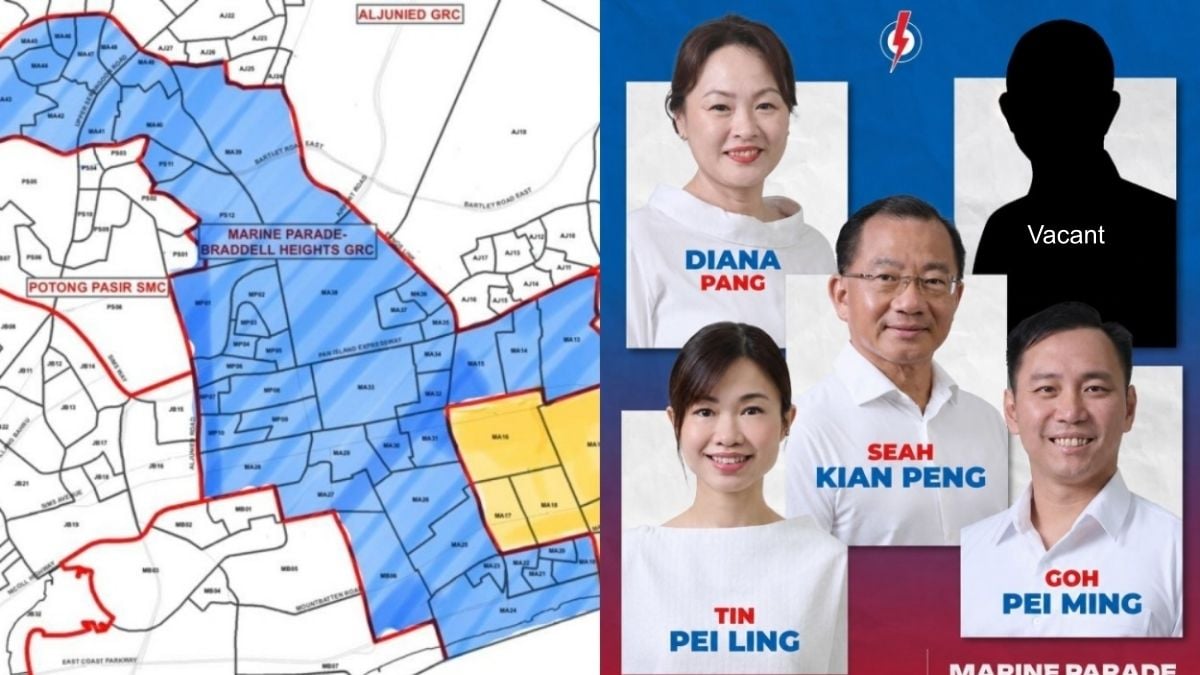

Associate Professor Muhammad Faishal Ibrahim's resignation from Marine Parade-Braddell Heights Group Representation Constituency (GRC) on 20 July has left the constituency without its designated Malay-community MP.
Under the Parliamentary Elections (Declaration and Designation of Group Representation Constituencies) Order 2025, Marine Parade-Braddell Heights is one of ten GRCs designated to require a Malay-community candidate on its contesting team.
Education Minister Desmond Lee confirmed on the day of the resignation that no by-election would be held.
That outcome is consistent with settled law.
But it sits against a stated purpose for the GRC scheme that was, from its introduction in 1988, framed in terms of continuous representation, not a one-time guarantee at the ballot box.
Examining the gap between those two things does not require asking whether any community has been treated fairly.
It requires only comparing what the scheme's designers said it would do against what the law, as later interpreted, actually requires it to do.
What the scheme was designed to prevent
The GRC scheme originated from a concern then-Prime Minister Lee Kuan Yew raised in July 1982: that younger voters, without direct experience of Singapore's 1960s race riots, might increasingly choose candidates on personal merit rather than voting for a racially balanced slate, and that this trend could leave Malay and other minority communities under-represented in Parliament over time.
Then-First Deputy Prime Minister Goh Chok Tong, moving the Parliamentary Elections (Amendment) Bill in Parliament on 11 January 1988, framed the objective explicitly as a standing safeguard against a Parliament losing minority representation "in the 1990s" and beyond, not as a mechanism confined to the moment of election.
The scheme that resulted required every GRC team to include at least one candidate from the Malay, Indian, or other minority community, certified by the Malay Community Committee or the Indian and Other Minority Communities Committee under what is now section 27A-27C of the Parliamentary Elections Act. That requirement remains unchanged in the 2025 designation order governing the current Parliament.
What the law says once a seat is vacated
The scheme's continuity, however, was never legally extended past the point of election. In his reply closing the second reading debate on 12 January 1988, Goh addressed directly what should happen if a minority MP's seat became vacant mid-term.
He said Parliament would not require a by-election to fill it, explaining that a compulsory by-election trigger would let one MP "hold the other two to ransom," since a resignation would force the remaining team members to resign too. Section 24(2A) of the Parliamentary Elections Act accordingly bars a by-election writ for a GRC "unless all the Members for that constituency have vacated their seats."
That provision was tested in 2019, when the Court of Appeal ruled in Wong Souk Yee v Attorney-General that Article 49(1) of the Constitution does not require a by-election for a single vacant GRC seat, only once every seat in the team has been vacated. The case arose from Halimah Yacob's 2017 resignation from Marsiling-Yew Tee GRC, then designated a Malay-community constituency, to contest the presidency.
Subsequent cases followed the same pattern regardless of party, seat designation, or the reason for departure. Raeesah Khan's 2021 resignation from Sengkang GRC, Tharman Shanmugaratnam's 2023 resignation from Jurong GRC, and S Iswaran's 2024 resignation from West Coast GRC each involved that GRC's designated minority seat, and none produced a by-election.
The same rule applied identically to vacancies that did not involve a designated minority seat: Tan Chuan-Jin and Cheng Li Hui's 2023 resignations from Marine Parade and Tampines GRCs respectively, and Leon Perera's 2023 resignation from Aljunied GRC, none of which involved the minority-designated seat in their respective teams, also produced no by-election. Section 24(2A) draws no distinction between the two categories: once enacted, it has applied uniformly to every GRC vacancy, whatever the seat's designation.
Faishal's resignation is now the sixth involving a designated minority seat, and the eighth GRC vacancy overall to be resolved without a by-election since Halimah's case in 2017.
A gap flagged, and set aside, in 1988
The distance between the scheme's stated purpose, continuous minority representation, and its legal guarantee, a minority candidate at the point of election only, was not a later discovery. It was raised in the same debate that produced the law.
Thomson MP Leong Horn Kee, speaking in the 12 January 1988 sitting immediately after Goh's proposal was outlined, flagged the scenario directly.
He noted the Bill provided that a GRC "will continue to function until all the three MPs are no longer holding office," and argued that where only one MP remained, "this one single MP can no longer represent the GRC in which he is voted."
He suggested Parliament "consider whether we should allow a by-election to take place automatically in the case where two out of three MPs are not holding office," a graduated threshold rather than the strict all-or-nothing rule that was ultimately adopted.
That proposal was not taken up. The Bill passed with the all-seats-vacated threshold Goh had proposed, and that threshold, unchanged in substance, is what governed the outcome in Marine Parade-Braddell Heights in July 2026.
The mechanism, used once
The all-seats-vacated threshold is not merely a theoretical bar. It has been cleared exactly once. On 1 December 1992, Goh himself, together with his three fellow Marine Parade GRC MPs, resigned simultaneously, deliberately triggering the only GRC by-election in Singapore's history.
His stated reasons, drawn from contemporaneous reporting, were securing a fresh electoral mandate after the PAP's losses in the 1991 general election and concern that both deputy prime ministers were then being treated for cancer.
In a later account in his authorised biography, Tall Order: The Goh Chok Tong Story, Goh added that the by-election was also intended to enable "political succession," bringing in candidates of "ministerial calibre" such as Teo Chee Hean, then Chief of Navy, who had no prior electoral experience.
The by-election became a four-cornered contest, the first multi-party fight held inside a GRC, which the PAP team won with 72.9% of the vote against the Singapore Democratic Party, National Solidarity Party, and Singapore Justice Party.
The 1992 case demonstrates that the barrier section 24(2A) creates is not insurmountable, only that clearing it requires every sitting MP in a GRC to resign together. In the one instance this has happened, it was initiated entirely by the governing party's own leadership, for reasons of political renewal, not in response to any misconduct, crisis, or minority-representation concern. In each of the eight vacancies examined below, no comparable decision was made; the remaining MPs continued to serve rather than resign alongside their departing colleague.
What this does, and does not, show
None of this establishes that any community has been poorly served by Faishal's departure specifically, a question about constituency service that is separate from the legal mechanics examined here, and one the GRC's remaining MPs have addressed directly in their own public statements.
What the record does show is a specific, documented gap between two things: the continuity-focused language Singapore's government used to justify the GRC scheme in 1982 and 1988, and the point-in-time guarantee that section 24(2A) and the Court of Appeal's 2019 ruling actually enforce.
The government's own reasoning for that gap, set out by Goh in 1988, was a considered trade-off rather than an oversight. He warned that a compulsory by-election would let a minority MP "hold the other two to ransom," using the threat of resignation to extract concessions from teammates who had done nothing wrong. Parliament weighed that risk against the cost of allowing minority representation to lapse mid-term, and accepted the latter as the lesser harm.
What is notable, examining all eight cases in which this provision has been applied since 1988, is not that the ransom scenario was proven impossible, since the rule's very existence may have removed any incentive to attempt it, but that none of the eight departures were caused by the specific risk the rule was built around in the first place.
Goh's reasoning anticipated a minority MP using a threatened resignation as leverage over teammates who had done nothing wrong.
What has actually triggered every vacancy since is something else entirely: two presidential bids, an admission of lying in Parliament, a corruption charge, three personal relationships, and Faishal's own acknowledged conduct lapse.
In each case, the MP's departure arose from circumstances outside the team's control, and in each case, section 24(2A) applied identically regardless of which of these categories the resignation fell into.
That is the actual gap worth naming. The rule was designed and defended around a specific, hypothetical form of misconduct, an MP weaponising their own resignation against colleagues. In thirty-eight years of application, it has never once been triggered by that scenario. It has instead been applied, unmodified, to a run of cases the original debate never really contemplated, presidential candidacies, corruption charges, personal relationships, none of which carry the coercive character Goh's "ransom" language was meant to guard against.
Whether a rule justified by one risk should continue to govern a pattern of departures that risk has never actually produced is a fair question for Parliament to revisit, independent of whether the rule successfully deterred the risk it was built for or that risk was simply never going to materialise regardless.
Leong Horn Kee's alternative, a graduated by-election trigger rather than an all-or-nothing threshold, was raised in the same 1988 debate and not adopted, precisely because of the ransom scenario Goh described. Thirty-eight years on, that scenario remains untested by the record, since every actual vacancy has arisen from a different cause entirely.
What the record does show is that a rule designed around one specific risk has since been applied, without modification, to a run of departures, presidential candidacies, a corruption charge, personal relationships, an admitted conduct lapse, that the 1988 debate did not anticipate and that carry none of the coercive character Goh's reasoning addressed.
Whether a rule built for one scenario should continue to govern outcomes it was never actually designed around is a fair question for Parliament to weigh again, independent of whether the rule has also, incidentally, deterred the scenario it was built for.
The Progress Singapore Party has already proposed one version of an alternative mechanism in its own statement following Faishal's resignation. Whether the pattern of the last decade is enough to bring Leong Horn Kee's 1988 proposal back onto the table is, at minimum, a question the current run of cases makes newly relevant.