David Neo faces criticism as netizens say “no more jokes” response failed to address concerns
Newly promoted Minister for Culture, Community, and Youth David Neo faced renewed criticism after saying he should “just not tell any more jokes” in response to backlash over his parliamentary remark that ministers had no time to watch movies.
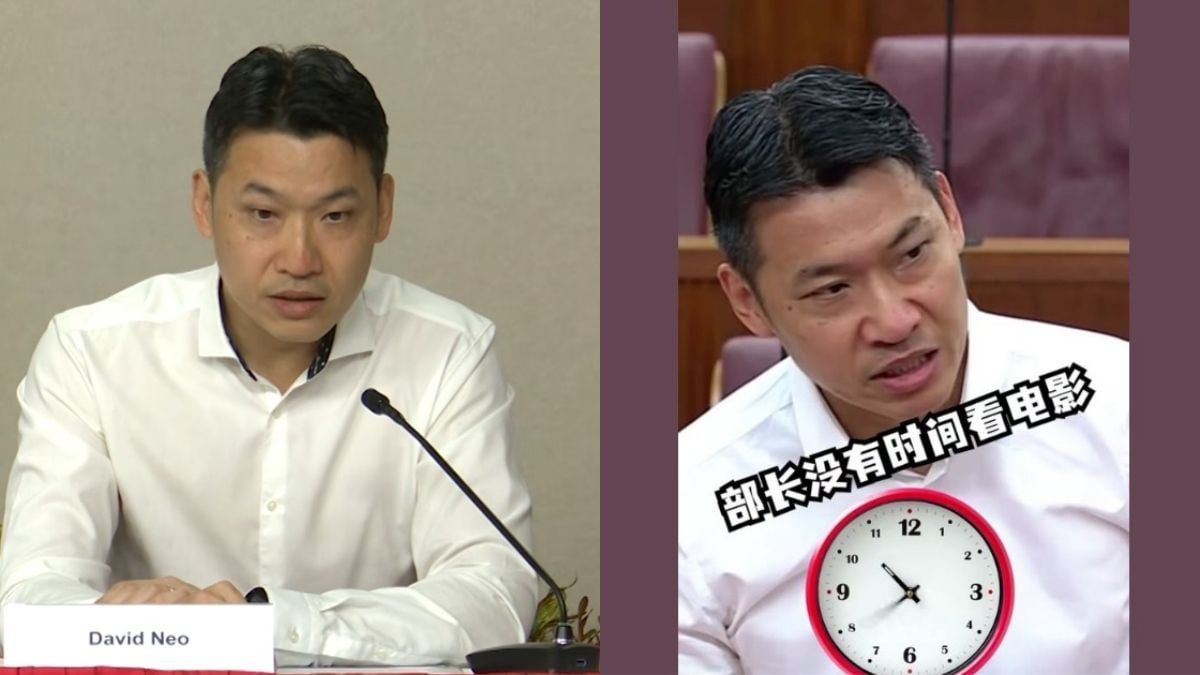
- David Neo said he should “just not tell any more jokes” after backlash over his parliamentary movie remark.
- Critics said the issue was the remark’s appropriateness during a serious debate, rather than whether ministers could joke.
- Some defended humour in Parliament but urged political leaders to exercise greater sensitivity and judgement.

Newly promoted Minister for Culture, Community, and Youth David Neo has faced renewed criticism from netizens after responding to backlash over a parliamentary remark by saying he should “just not tell any more jokes”.
The response came on 22 July at a press conference where Prime Minister Lawrence Wong announced changes to the Cabinet line-up.
Neo was responding to a question about his earlier comment that “ministers had no time to watch movies”.
The question was put by a Lianhe Zaobao reporter and was the last of several questions directed at the panel.
Neo had been promoted from acting minister to full minister in the reshuffle, while retaining the Culture, Community, and Youth portfolio he had held since the previous reshuffle in May 2025.
Asked for his view on the criticism, particularly in light of the discussion about the demands placed on ministers’ time, Neo replied: “Well, I should just not tell any more jokes.”
He then chuckled before continuing with his response.
“But as all things, we all learn. And every time there is criticism, I take it positively as feedback, and it is just a matter of how things are experienced by different people,” Neo said.
He added that he would consider the criticism and ask himself how he could do better in future.
“And that, I think, is the spirit in which I keep taking in feedback and keep improving,” he said.
That was the entirety of Neo’s response to the question about his parliamentary remark.
David Neo's 'no time to watch movies' remark draws backlash
The remark that prompted the question was made in Parliament on 7 July, during a debate on the Government’s approach to dialect-language films.
Workers’ Party MP for Aljunied GRC Kenneth Tiong, speaking in Mandarin, said Teochew-speaking residents in his constituency had asked him in dialect why they were not allowed to watch Teochew films.
Tiong questioned whether the Government’s objective was to promote Mandarin or restrict dialects, arguing that the two represented different policy goals.
He asked whether the Government would review measures that existed purely to restrict dialects, including those relating to films and broadcasting, and remove restrictions that were no longer necessary.
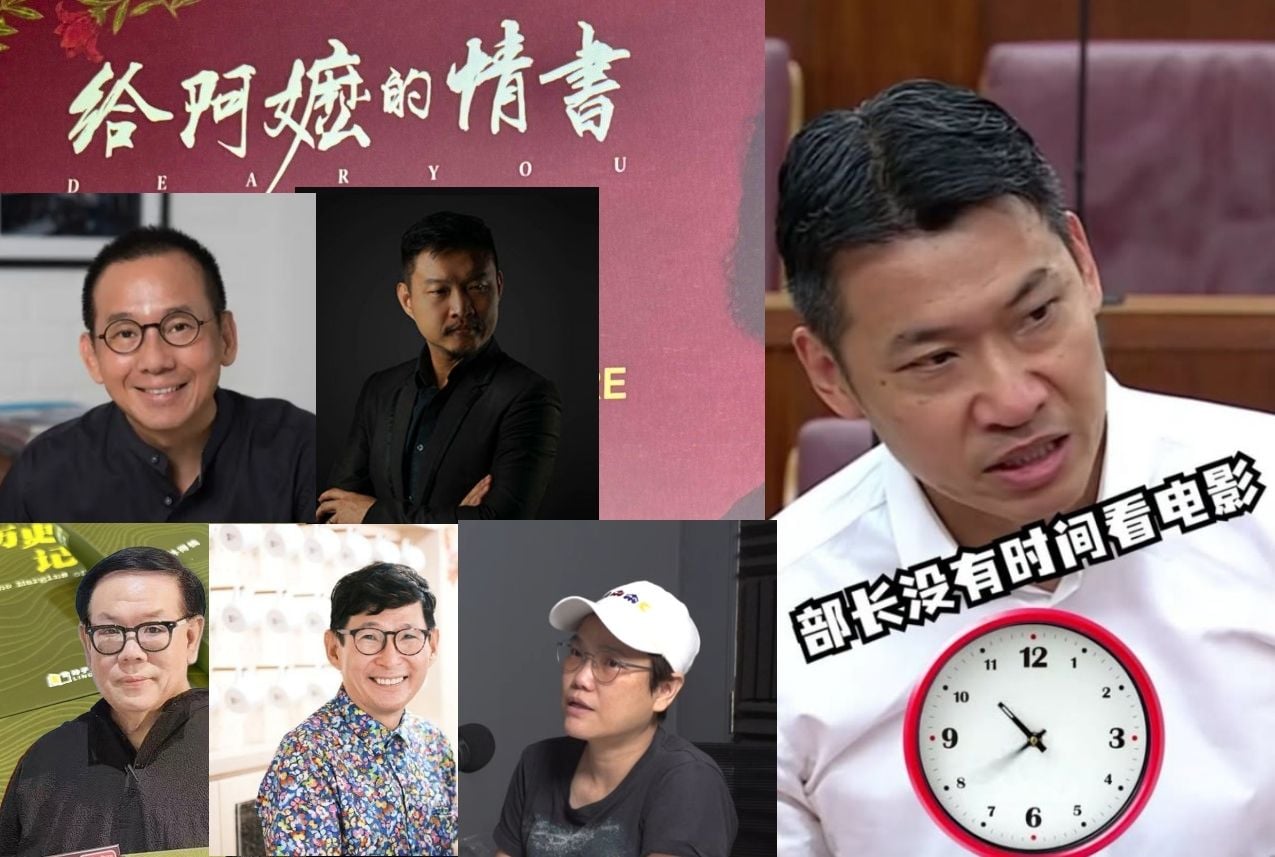
Tiong also asked ministers which version of the film Dear You they had watched: the original Teochew version or the Mandarin-dubbed release.
Responding in Mandarin, Neo quipped that "ministers had no time to watch movies (部长没有时间看电影)."
He went on to say that the Government recognised that dialects made a distinctive contribution to Singapore Chinese culture.
Neo also said the Government worked frequently with clan associations to promote dialects.
The Government told Parliament that the Infocomm Media Development Authority (IMDA) was reviewing the film classification framework relating to the use of dialects in films.
However, it stopped short of committing to remove the existing restriction governing dialect-language cinema releases.
Dear You opened in Singapore on 18 June, with Mandarin-dubbed screenings available to the general public. The original Teochew version was initially confined to festivals and selected niche screenings.
The film’s release prompted public debate over the place of Chinese dialects in Singapore.
IMDA subsequently indicated that it would adopt a more flexible approach towards future applications for dialect-language films in cinemas.
Netizens say response missed the main concern
Online comments on the Mothership Facebook page and a Reddit discussion about Neo’s 22 July response showed criticism of his handling of the backlash.
Some commenters said Neo had missed the central point of the criticism.
They argued that no one was suggesting politicians could never make jokes.
Instead, they said the question was whether the remark was appropriate in the context in which it was made.
Several commenters said the backlash was not simply about a minister making a joke, but about the remark being made during a serious parliamentary discussion involving dialect-language films and cultural policies.
Some stressed that humour could be acceptable in the right setting, while questioning whether Parliament was an appropriate place for such comments.
One netizen wrote: “No one is saying politicians cannot joke. The issue is whether the remarks were appropriate in the context.”
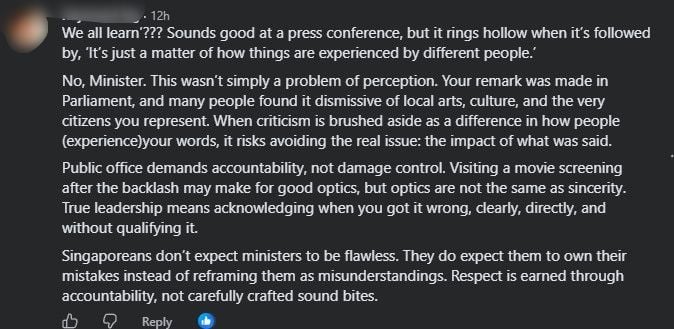
Some commenters also criticised Neo’s decision to describe the incident as a joke that had been interpreted differently by different people.
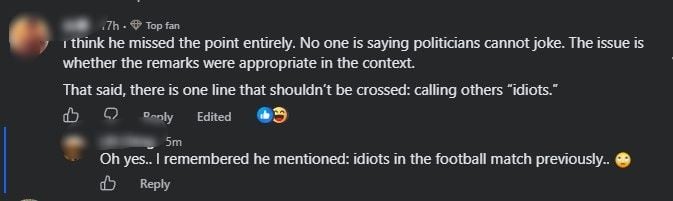
They argued that saying he should “just not tell any more jokes” did not directly acknowledge why the remark had upset some members of the public.
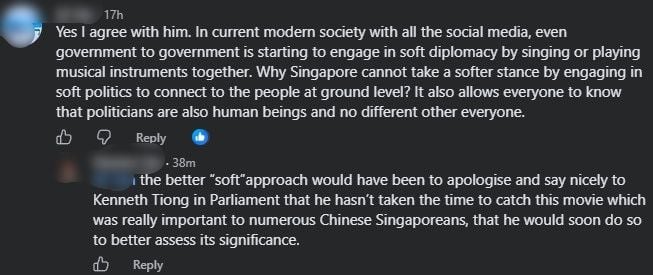
One commenter wrote that Neo could have acknowledged that his comments caused offence, apologised briefly and moved on.

Another said the issue was not simply one of perception, arguing that the remark had been made in Parliament and was viewed by some as dismissive of local arts, culture and the citizens represented by lawmakers.
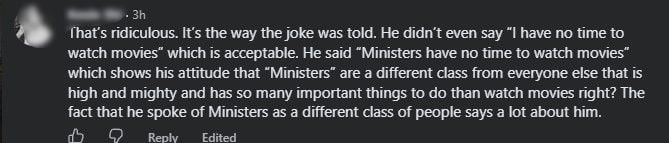
A comment further criticised Neo’s choice of words, saying the issue was not simply the joke itself but how it was delivered.
The commenter said saying “I have no time to watch movies” would have been acceptable, but stating “ministers have no time to watch movies” created the impression that politicians were a separate class above ordinary people.
Critics question whether the remark was a joke
Some netizens also disputed Neo’s characterisation of the original comment as a joke.
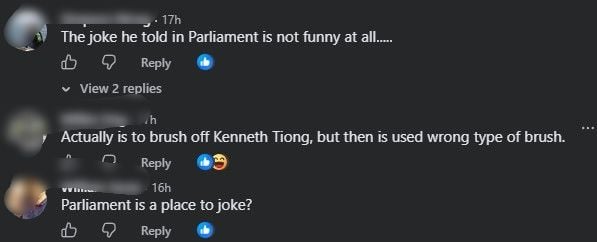
They said the remark sounded more like sarcasm or a dismissive response to the question raised by Tiong.
Some commenters argued that a joke should produce humour, while noting that many people had instead reacted with offence or discomfort.
One commenter wrote: “It’s only a joke if it’s funny.”
Another said: “Jokes are meant to contain humour.”
Others suggested that the remark appeared to have been intended to brush aside Tiong’s question rather than entertain the audience.
Questions over Neo’s handling of criticism
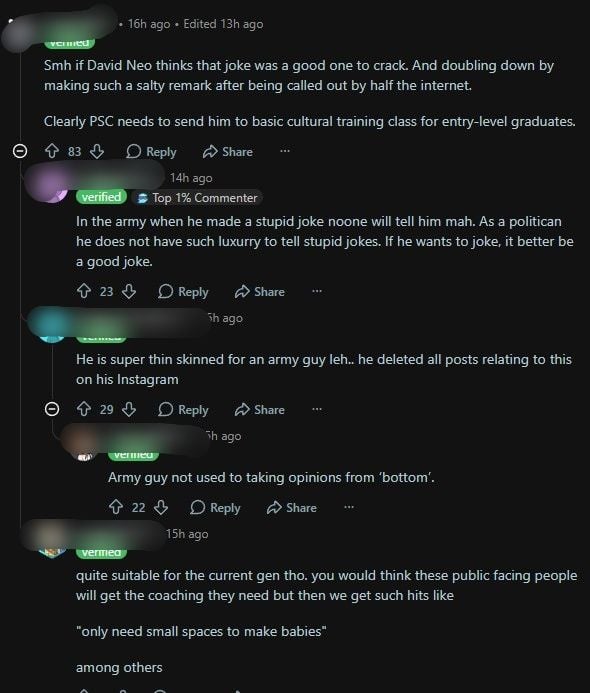
Some netizens questioned Neo’s judgement and his response to the criticism.
They argued that public figures should exercise greater care when making jokes and be prepared to face criticism when their remarks are poorly received.
One commenter suggested that Neo might have been accustomed to a more protected environment during his military career, where people may not have challenged his remarks openly.
Some defended humour and said leaders should remain relatable
Despite the criticism, some netizens defended Neo’s ability to use humour.
They argued that politicians should not become overly cautious or humourless, and that appropriate levity could have a place in public life.
One commenter wrote: “We should not become a humorless society. A little levity in parliament is not a bad thing.”
Another supported Neo’s response, saying: “Taking criticism constructively is a quality that every leader should have.”


Some argued that humour could make political leaders appear more human and approachable.
They cited examples of politicians using music, jokes and informal engagement as part of public communication.
However, even some commenters who defended humour stressed that context and delivery mattered.
One commenter said politicians could joke but needed to understand “when you can joke, when you can’t, because at different situations people will take what you said seriously”.
Questions raised over Neo’s promotion
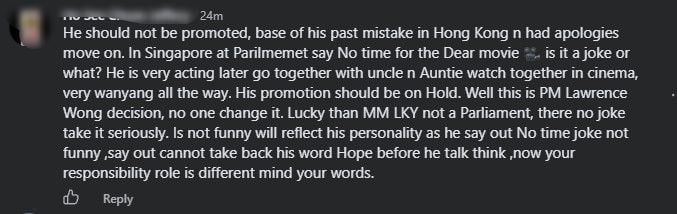
Some netizens also questioned whether Neo’s promotion to full minister should have proceeded.
They cited his previous controversies as well as the “no time for movies” remark made during the parliamentary debate.
One commenter described the comment as “not funny” and said it showed why ministers needed to be more mindful of their words because public statements could not simply be taken back.
Netizens compare Parliament humour with UK lawmakers
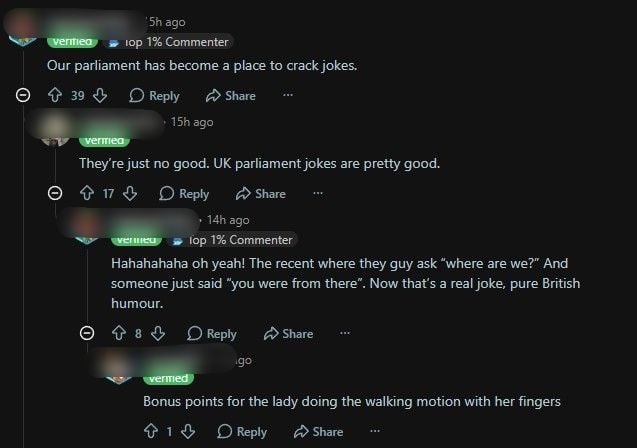
Some commenters compared the debate over parliamentary humour in Singapore with political exchanges in the UK.
One netizen sarcastically suggested that the problem was not that Singapore’s Parliament could not accommodate jokes, but that ministers were simply not effective at delivering them.
The commenter said British lawmakers were better at using humour, describing their exchanges as examples of “real jokes” and “pure British humour”.
Calls for accountability and sensitivity
Beyond the original remark, some commenters raised broader concerns about leadership standards and public communication.
They argued that ministers should exercise greater care with their words because statements made by political leaders carry greater weight.
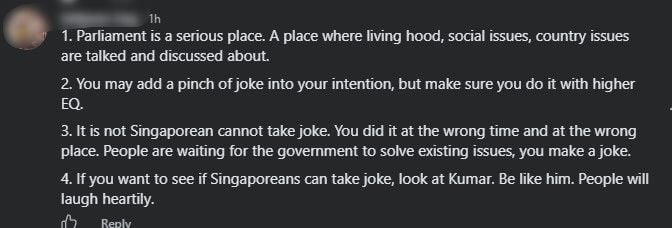
One netizen wrote: “Parliament is a serious place. A place where livelihoods, social issues and country issues are talked and discussed about.”
The commenter added that jokes could be made, but they needed to be delivered with “higher EQ”.
Others questioned whether Neo had fully reflected on the criticism.
They argued that accepting feedback should involve acknowledging mistakes where appropriate, rather than simply saying that people had experienced the same words differently.
Some commenters also returned to the original debate over dialect-language films.
They said the controversy surrounding Neo’s remark should not distract from the broader policy question of whether restrictions on dialect-language content should be reviewed.