When growth no longer guarantees jobs: revisiting Singapore’s 6.9 million bargain
As 2030 approaches, Singapore’s leaders now say growth can no longer be assumed to generate jobs, even as the country sits above 6 million people after a decade of steady immigration. This marks a sharp turn from the 2013 Population White Paper, which asked citizens to accept rapid population growth for a “dynamic economy” that would “steadily create good jobs and opportunities”.


As Singapore inches towards 2030, the shadow of the 2013 Population White Paper looms larger than ever.
For over a decade, the People’s Action Party (PAP) has asked citizens to accept a fundamental trade-off.
Endure crowded trains, rising housing prices and a changing cultural landscape in exchange for a “dynamic economy” that would “steadily create good jobs and opportunities to meet Singaporeans’ hopes and aspirations”.
Today, that bargain is being quietly rewritten.
At the Economic Strategy Review (ESR) midterm update in January 2026, Deputy Prime Minister Gan Kim Yong warned that Singapore can no longer assume that economic growth will automatically generate jobs.
It was more than an economic line.
It sounded like an attempt to reshape expectations well before a likely general election around 2030.
The 2013 promise: more people, more growth, more jobs
In 2013, the message from Government was clear and confident.
The Population White Paper projected that by 2030, Singapore’s total population “could range between 6.5 and 6.9 million”, supported by a calibrated inflow of new citizens, permanent residents and foreign workers.
This was framed as necessary to sustain growth and keep the economy “vibrant” so that jobs would be created “steadily” for Singaporeans.
Ministers repeatedly reassured the House that immigration and foreign manpower would complement, not displace, locals.
The idea was that a bigger workforce would help companies thrive, expand abroad and, in turn, “create good jobs for Singaporeans”.
The promise was not abstract.
By 2030, two-thirds of Singaporeans were expected to be in PMET roles, up from about half, supported by a growing economy and a sufficient labour pool.
The 6.9 million planning figure thus became shorthand for a growth-for-jobs bargain: more people → more GDP → more and better jobs.
Then-Prime Minister Lee Hsien Loong said during the closing of the parliamentary debate in 2013, "This White Paper proposes a compromise between economic growth and giving Singaporeans a high quality of life. Our solution is two-pronged: to encourage more births and raise productivity, and at the same time, bring in an appropriate number of immigrants and foreign workers."
He added, "Actually, this is a three-pronged approach. A specific suggestion in the White Paper is to reduce the influx of foreign workers from now to 2020. This is in line with public expectations and would help reduce congestion and the sense of unease. At the same time, it will also help us maintain economic stability and create good job opportunities."
In other words, Singaporeans were told that a carefully calibrated population plan – fewer low-skilled foreign workers, more productivity, more births, and a steady inflow of immigrants and PRs – would preserve quality of life *and* secure good jobs. The 6.9 million figure was presented not as a worst-case scenario, but as a managed outcome of this “three-pronged” compromise.
Why 6.9 million may not be reached – and what that really says
A decade on, it looks increasingly unlikely that Singapore will actually hit 6.9 million by 2030.
But this is not because immigration has dried up.
In recent years, Singapore has granted roughly 20,000–23,000 new citizenships and about 30,000–35,000 new PRs annually, broadly in line with White Paper “steady inflow” parameters.
At the same time, Singapore’s total population has grown from roughly 5.4 million in 2013 to 6.11 million as at June 2025, with recent growth “mainly due to the increase in the non-resident population”.
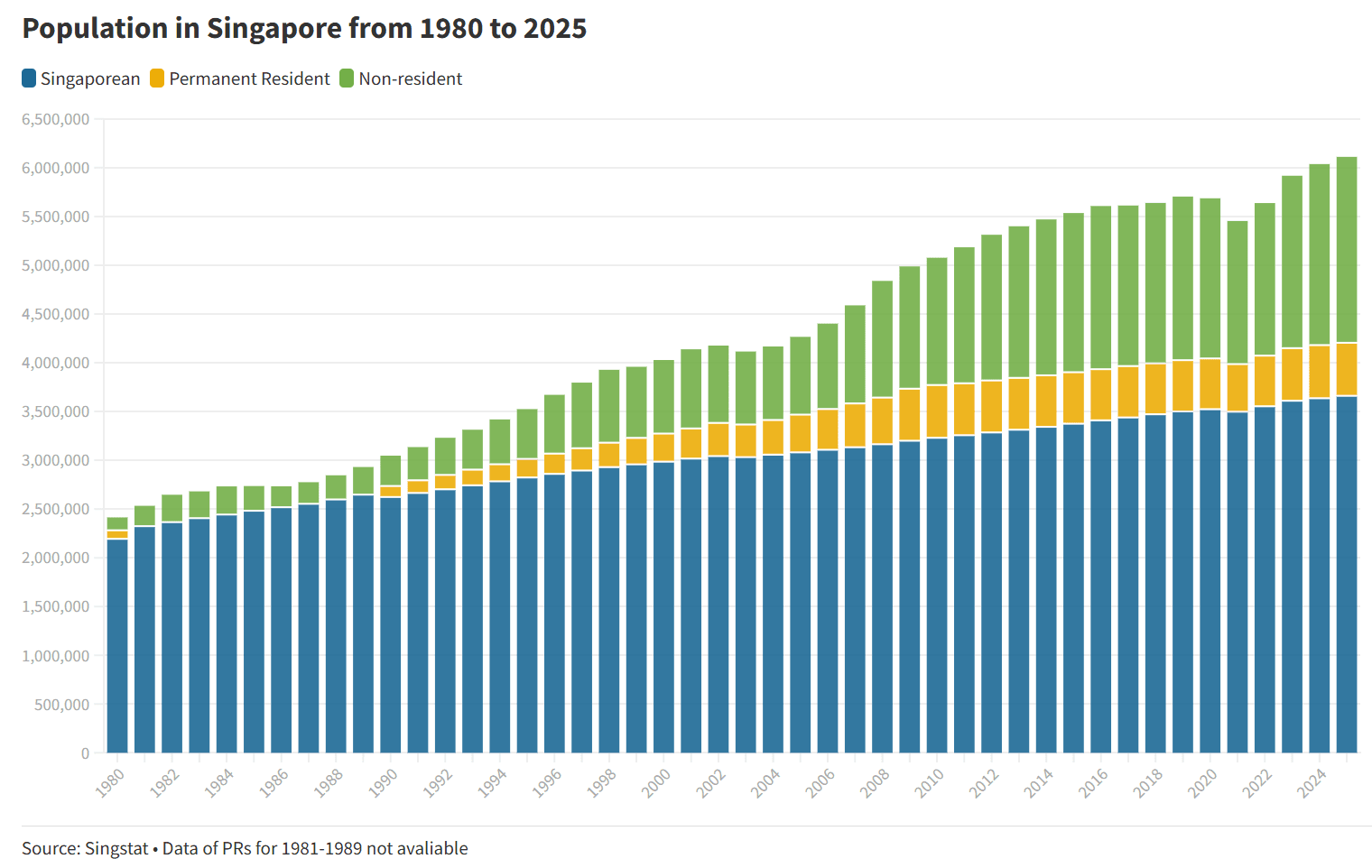
If the 6.9 million upper band is missed, it is not because the tap has been firmly turned off.
It is because other forces are pulling in the opposite direction.
First, residents are leaving.
Official reports note that citizens and PRs who register foreign addresses or stay overseas for 12 months or more are no longer counted in the resident population.
Net migration remains positive overall, but there is churn as some families and professionals relocate abroad each year, even as new arrivals are granted PR or citizenship.
Second, fertility has collapsed to historic lows, despite repeated exhortations from Singapore’s political leaders.
The resident total fertility rate fell to 0.97 in 2023 and stayed at 0.97 in 2024 – the first time it has dropped below 1.0.
After more than a decade of successive “Marriage and Parenthood” packages, fertility has slipped from about 1.19 in 2013 to 0.97 today, hovering at roughly half of replacement level.
In simple terms, each new cohort of locally born Singaporeans is now significantly smaller than the one before.
This raises an awkward possibility: that the “crowded island” side effects of the White Paper – from housing costs to daily stress – may themselves have depressed fertility, creating a self-fulfilling cycle in which more immigration is deemed “necessary” because the environment has become less conducive to families.
If these trends continue – ultra-low births, an ageing citizenry and continued immigration – then over time local-born Singaporeans could shrink as a share of the population, especially as older cohorts pass on and inflows do not magically stop in 2030.
The demographic direction is structural, not a temporary blip.
Labour market reality and the “resident” blur
The employment picture adds another layer.
Total employment has grown strongly since Covid-19, but much of the rebound has been driven by non-resident hiring. In 2023, for example, 83,500 of the 88,400 jobs added went to non-residents.
Yet the Ministry of Manpower’s headline figures aggregate Singapore citizens and PRs into a single “resident” category, with no routine public split.
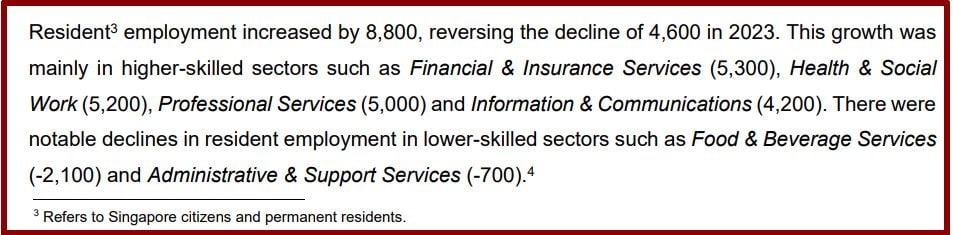
This makes it difficult to tell, from official tables alone, how local-born citizens have fared relative to newly minted PRs and foreign workers.
Critics argue that this statistical choice conveniently blurs who is actually benefiting from employment growth, particularly after a decade of stepped-up immigration.
On the ground, online forums and anecdotal accounts suggest that many Singaporeans do not feel they are enjoying the fruits of headline GDP growth, especially in white-collar and mid-career segments.
Furthermore, when the Government grants around 22,000 citizenships and some 34,000 PRs annually, it is not merely “replacing” people; it also creates a revolving door in the statistics, where “non-residents” become “residents”.
“Resident job growth” can therefore be boosted simply through administrative reclassification – a foreigner receiving a blue NRIC – rather than a Singapore-born citizen taking up a new job.
From “growth brings jobs” to “growth without guarantees”
Against this background, Gan’s ESR line, delivered almost 13 years after Parliament passed the motion on Singapore’s population policy roadmap, lands with particular force.
He describes a world of geopolitical tensions, protectionism, climate pressures and rapid AI advances, in which higher value-added sectors “will not need as many workers”.
The conclusion: growth will be harder to achieve, and even if achieved, “we can no longer assume that economic growth will generate jobs”.
Acting Minister David Neo echoes this, stressing that while good jobs remain central to the agenda, growth “may not necessarily translate into good jobs” without deliberate intervention on skills, redesign and restructuring.
Substantively, this acknowledges something economists have warned about for years: in a capital-intensive, automated economy, GDP can rise without a matching rise in employment.
But that only sharpens the political question.
If growth no longer guarantees jobs, what does that say about the 2013 justification for pushing population and immigration so hard in the first place?
Disruption is not new – so why were the risks underplayed?
Ministers now point to AI, global fragmentation and climate change as reasons why the old growth-equals-jobs model has broken down.
Those headwinds are real. Yet disruptive technologies and global shocks are not new phenomena.
Singapore has been through waves of automation, offshoring, the Asian Financial Crisis, the Global Financial Crisis and repeated technological shifts.
The uncomfortable question is whether the PAP in 2013 underestimated how quickly its growth model might run into the limits of demography, automation and political tolerance for crowding – or whether those uncertainties were downplayed when selling the White Paper.
If technology now allows the economy to grow with fewer workers, the aggressive population expansion of the past 13 years risks looking, in hindsight, like a demographic overshoot.
Singapore is left with the social costs of density and housing pressure, and with a cohort of immigrants who arrived in their 30s and 40s and are ageing without necessarily having children here – but without the same long-term economic necessity that was once invoked to justify their numbers.
At the same time, Singaporeans are repeatedly urged to “integrate” these new citizens and PRs, to treat them as family and to adjust to the new social mix.
For many locals, this feels like a one-way obligation: they bear the crowding and competition, even as the original economic rationale for large-scale inflows is quietly weakened.
Either way, the policy has long since been executed.
Hundreds of thousands of new citizens and PRs have settled here, and nearly two million non-residents now live and work in Singapore.
They cannot simply be “sent back” if assumptions prove overly optimistic.
Faced with a reality that no longer fits the old script, critics see the new rhetoric – blaming global conditions and technology – as a way to distract from earlier misjudgements. In their view, voters are now being nudged to accept a more modest outcome and lower expectations.
From 5Cs to “meaning and purpose”: another recalibration
This pattern is not confined to population and jobs.
In the 1990s and early 2000s, then Prime Minister Goh Chok Tong invoked the “5Cs” – cash, credit card, car, condominium and country club – as shorthand for the material success Singaporeans could aspire to if the country continued to prosper.
Today, Prime Minister Lawrence Wong explicitly urges Singaporeans to “no longer talk so much about the 5Cs”, and to define the Singapore Dream beyond material markers, towards “fulfilment, meaning and purpose”.
There is a legitimate case for broadening the definition of success. But to some, it reveals a consistent pattern of governance of retreat.
When material benchmarks—Swiss standard of living, 5Cs, population-for-growth-for-jobs—become political liabilities, the PAP pivots the definition of success toward 'meaning' and 'resilience,' effectively asking the citizenry to pay for the policy failure with their own lowered expectations.
2030: a reckoning on the population-for-growth model
By the time the next election is due, Singapore will have spent nearly two decades living under the shadow of the 6.9 million population planning scenario.
The population may come in below that headline number.
But immigration has remained steady, fertility has sunk below replacement, and many citizens feel that job security and upward mobility are less assured than they were told a decade ago.
The core question for 2030 is not just whether the old projection was numerically accurate.
It is whether the bargain that justified it remains defensible.
If the story in 2013 was “more people for more growth for more jobs”, and the story in 2026 is “more people and more growth, but jobs are no longer guaranteed”, then Singaporeans are entitled to ask what went wrong in between.
Real accountability would mean:
-
publishing clear, citizen-only data on employment and wages over the past decade;
-
assessing honestly how far the promised uplift in “good jobs” has materialised for Singaporeans; and
-
explaining, in plain terms, how the earlier assumptions have been overtaken, and how future immigration policy will be constrained by job outcomes, not just headline GDP.
Singaporeans understand that the world has changed.
They also know that population and immigration decisions cannot simply be undone.
What they can reasonably insist on, as 2030 approaches, is that when the terms of the social compact shift, the Government acknowledges it openly – and does not ask them to shoulder both the costs of past bets and the lowered expectations of the future.