TikTok creator’s ‘toxic city’ remarks ignite debate in Singapore
A TikTok creator living in Singapore has sparked intense online debate after calling the city “the most toxic city to live in in the world,” prompting discussions about social norms, work culture and how newcomers experience life here.

- A TikTok creator who has lived in Singapore for six months described it as “the most toxic city” she has experienced.
- She cited social control, emotional coldness and professional pressures as key concerns.
- The viral posts triggered polarised reactions, highlighting tensions between local self-perception and newcomer experiences.

SINGAPORE: A TikTok content creator known as “ur trustfund daughter” (@brbcatchingflights) has ignited widespread debate after describing Singapore as “the most toxic city to live in in the world”.
The Iranian creator, who said she has been living in Singapore for about six months, shared her views in a video that quickly gained tens of thousands of views and extensive engagement.
In the original clip, she said the city feels emotionally “cold” and “toxic”, contrasting her experience here with five other cities she has previously lived in.
She suggested that day-to-day interactions and the broader social climate have left her feeling unwelcome, isolated and emotionally drained.
Expanded criticisms in follow-up post
In her TikTok post, she elaborated on why she considers Singapore “the most societally and professionally toxic city to live in the world.” She framed her comments as the perspective of someone who has lived in six cities globally.
Among her criticisms was what she described as an atmosphere of constant control.
“Everything is about control. Socially, culturally, emotionally,” she wrote, adding that there is a persistent sense of being “watched, judged, corrected, measured”.
She argued that while interactions may appear polite on the surface, they often lack emotional warmth.
“People are obsessed with rules but lack warmth,” she wrote, suggesting that behaviour is technically courteous but emotionally distant.
Concerns about conformity and individuality
The creator also criticised what she perceives as a strong emphasis on compliance over individuality.
According to her post, people who are “different, expressive, sensitive, ambitious, or non-linear” are “quietly punished” by social norms.
She claimed that vulnerability is seen as weakness, and that there is pressure to “shrink yourself to fit a narrow idea of ‘acceptable’”.
She described what she called a culture of passive aggression, where “people don’t say what they mean”, and argued that comparison culture creates constant pressure to stay ahead.
“If you’re not ahead, you feel behind. If you pause, you feel guilty,” she wrote.
Professional and emotional pressures
Beyond social interactions, she criticised what she described as a “brutal but purposeless” pace of life.
In her view, busyness becomes an end in itself rather than a path to fulfilment.
She also questioned how mental health is addressed, stating that it is “talked about but not truly held”, with sympathy offered but limited structural support.
Creativity, she argued, is undervalued if it is not practical or economically driven.
In one of her more pointed remarks, she wrote: “Everything is safe except your nervous system.”
She concluded by saying Singapore “is not a bad place”, but “not a humane one for certain souls”, particularly those who are “intuitive, emotional, creative, feminine, or deeply feeling”.
Polarised reactions from locals
The posts quickly drew a wide spectrum of responses from Singapore-based users.
Some commenters agreed that aspects of life in the city — including intense work culture, academic pressure and social reserve — can feel harsh, particularly for newcomers.
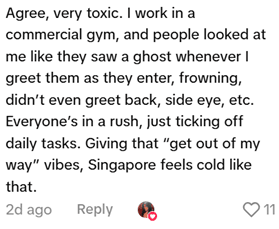
Several users shared personal anecdotes about burnout, competitiveness and the emotional toll of high expectations.
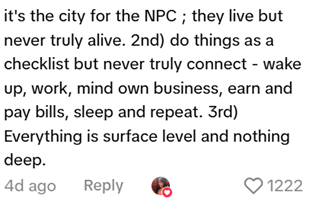
Others strongly rejected her characterisation, arguing that Singaporeans are generally reserved and pragmatic rather than hostile.
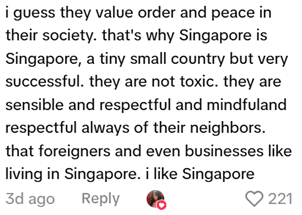
They said that minding one’s own business is often interpreted as coldness by those from more expressive cultures.
A number of commenters highlighted the realities of dense urban living, where efficiency and personal space are prioritised in crowded public environments.
However, some reactions were overtly critical, with a minority of users telling her to “go back to where you came from”, comments that drew further debate about tolerance and inclusivity.

Clash of expectations and lived experience
The controversy has underscored a recurring tension in global cities: the gap between internal self-image and external perception.
Singapore is frequently recognised internationally for safety, infrastructure, economic competitiveness and low crime rates.
At the same time, public conversations in recent years have increasingly touched on stress, mental health and work-life balance.
For some residents, the city’s orderliness and rule-based systems provide stability and opportunity.
For others, particularly those accustomed to more emotionally expressive environments, the same traits may feel restrictive.
Cultural norms, including indirect communication styles and emphasis on social harmony, can also be interpreted differently depending on personal background.
A broader conversation about warmth and resilience
The viral exchange illustrates how personal experiences shared on social media can quickly evolve into national conversations.
While many defended Singapore’s social fabric, others suggested that criticism, even when bluntly expressed, can serve as an opportunity for reflection.
The debate raises a broader question: how can a city remain safe, efficient and high-performing while also fostering a greater sense of warmth and belonging?
As global mobility increases and more people relocate across borders, differences in social expectations are likely to remain a source of friction.
Whether one agrees with her characterisation or not, the discussion reflects the complexity of urban life — where a place can feel like home to some and alienating to others at the same time.