Singapore MRT reliability improves in February as North East Line doubles performance, LTA reports

Singapore's MRT reliability rose in February 2026, averaging 1.74 million km between delays. The North East Line emerged as the top performer, doubling its reliability figures, while overall network punctuality reached 99.46 per cent.

TRAIN1.jpg
AI-Generated Summary
  • The MRT network averaged 1.74 million train-km between delays of more than five minutes, maintaining performance above the national target of one million train-km.
  • The North East Line recorded a 100 per cent improvement in its reliability metric, rising from 2.21 million to 4.42 million train-km between failures.
  • Overall network punctuality improved to 99.46 per cent in February, supported by stronger performances on the North East and Circle lines.
Comments
Google News

The reliability of Singapore's MRT network saw an upward trend in February 2026, according to the latest figures released by the Land Transport Authority (LTA) on 13 March 2026.

This improvement was highlighted by the North East Line (NEL), which doubled its performance from the previous month.

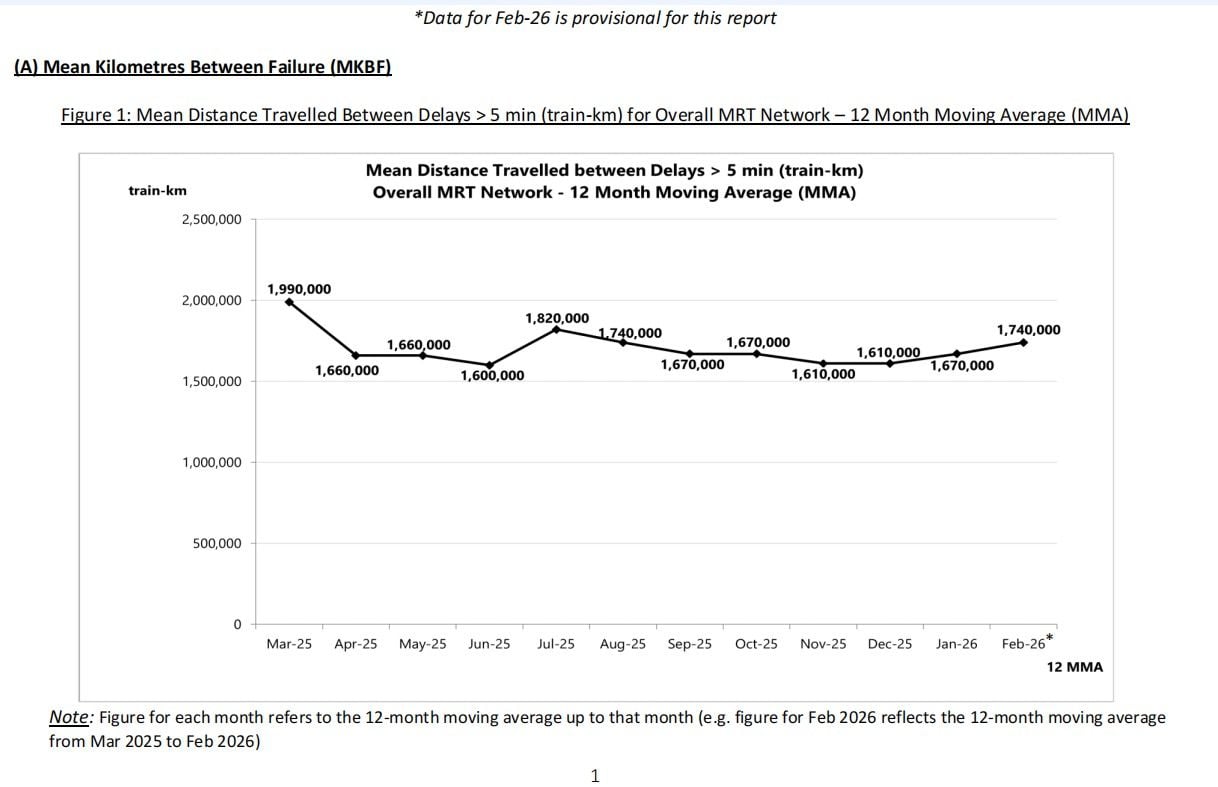
On average, trains across the national network clocked 1.74 million train-km between delays lasting longer than five minutes for the period between March 2025 and February 2026.

This marks an increase from the 1.67 million train-km average recorded between February 2025 and January 2026.

MKBF2.jpg

These figures indicate that the rail system remains significantly above the national reliability target.

The benchmark, measured by mean kilometres between failure (MKBF), is set at one million train-km.

MKBF is a standard engineering indicator that measures the distance travelled before a service delay occurs.

MKBF FEB 2026.jpg

Punctuality rates also rise

Punctuality across the network also saw gains during February.

LTA reported that 99.46 per cent of trips were completed within two minutes of their scheduled arrival time.

This represents an increase from the 99.24 per cent punctuality rate recorded in January.

The proportion of services operating according to the scheduled timetable also improved.

Network-wide performance rose from 99.87 per cent in January to 99.98 per cent in February.

All five mature MRT lines showed improvement in this area of operations.

North East Line leads reliability rankings

The SBS Transit-operated NEL emerged as the most reliable line in the network during the month.

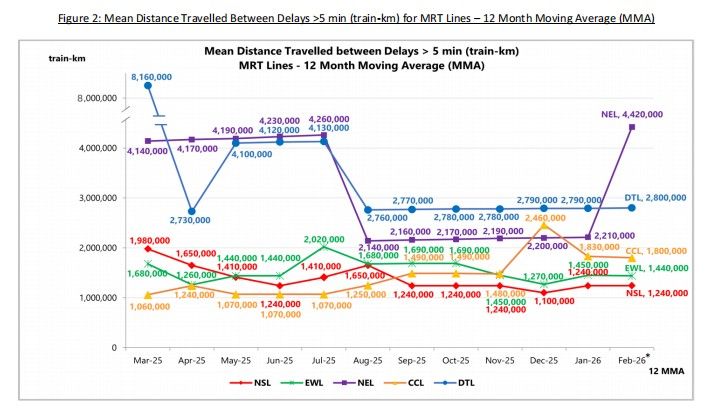
It achieved 4.42 million train-km between delays in February, doubling its moving average of 2.21 million train-km recorded in January.

This performance placed the line ahead of all other operational routes.

The Downtown Line (DTL), also managed by SBS Transit, ranked second in reliability performance.

The DTL averaged 2.8 million train-km between failures, slightly improving from the 2.79 million train-km recorded in the previous month.

Circle Line sees minor decline amid works

In contrast, the SMRT-operated Circle Line (CCL) experienced a slight decline in its reliability metric.

Its figure fell to 1.8 million train-km between delays, compared with 1.83 million in January.

The line had earlier dropped from 2.46 million train-km in December 2025 to 1.83 million in January 2026.

These fluctuations followed a reported delay between Bishan and Buona Vista stations during the evening peak hour on 13 January 2026.

The line also entered a three-month planned service disruption beginning 19 January 2026 to facilitate essential tunnel strengthening works.

Mature lines record stable performance

The East-West Line, another route operated by SMRT, recorded 1.44 million train-km between delays.

This represented a marginal decrease from 1.45 million train-km in January.

The North-South Line remained the least reliable among the mature lines.

However, its performance remained stable at 1.24 million train-km between delays, unchanged from the previous month.

Thomson-East Coast Line excluded from comparison

Performance data for the Thomson-East Coast Line (TEL) was excluded from the overall reliability comparison.

LTA explained that new lines often record lower mileage due to lower ridership and reduced service frequency during early operations.

The TEL averaged 415,000 train-km between delays in February.

The final stage of the line is scheduled to open in the second half of 2026.

This phase will include the addition of Bedok South and Sungei Bedok stations.

LTA said the TEL will be included in full reliability comparisons once operations stabilise following the completion of the line.

No major disruptions recorded in February

No major delays exceeding 30 minutes were recorded across the entire rail network during February.

Reliability also improved across Singapore’s LRT systems.

Trains averaged 410,000 car-km between delays, up from 408,000 in January.

The Sengkang-Punggol LRT recorded an increase to 866,000 car-km from 860,000.

Meanwhile, the Bukit Panjang LRT maintained its performance at 200,000 car-km between delays, unchanged from the previous month.

Monthly updates introduced after disruptions

LTA has been issuing monthly reliability updates since August 2025 to provide commuters with greater transparency on the rail network.

Prior to this change, reliability statistics had been released on a quarterly basis.

The shift followed a series of rail disruptions that increased public scrutiny of Singapore’s train system.

Share This

Support independent citizen media on Patreon