Singapore MRT reliability rises in January 2026, Circle Line dips amid tunnel strengthening works
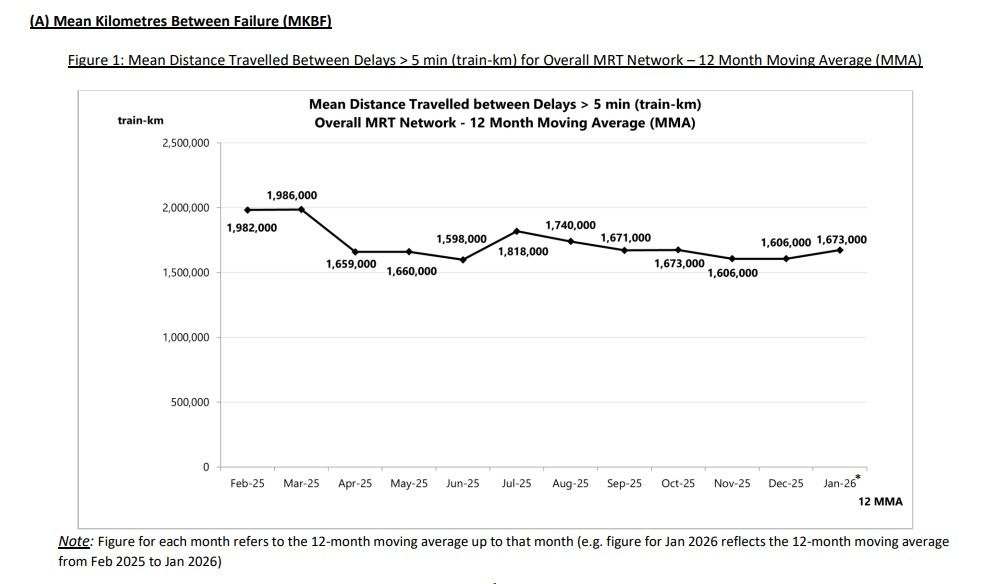
Singapore’s MRT network recorded improved reliability in January 2026, with overall mean kilometres between failures rising to 1.673 million train-km. Most lines saw gains, though the Circle Line registered a decline amid a peak-hour delay and planned works.

- Overall MRT reliability rose to 1,673,000 train-km in January 2026.
- Most lines improved, but the Circle Line recorded a decline.
- All lines met LTA’s 1 million train-km reliability target.

SINGAPORE: Rail reliability across Singapore’s MRT network improved in January 2026, with most lines recording higher performance, according to the Land Transport Authority’s first monthly report of the year released on 13 February 2026.
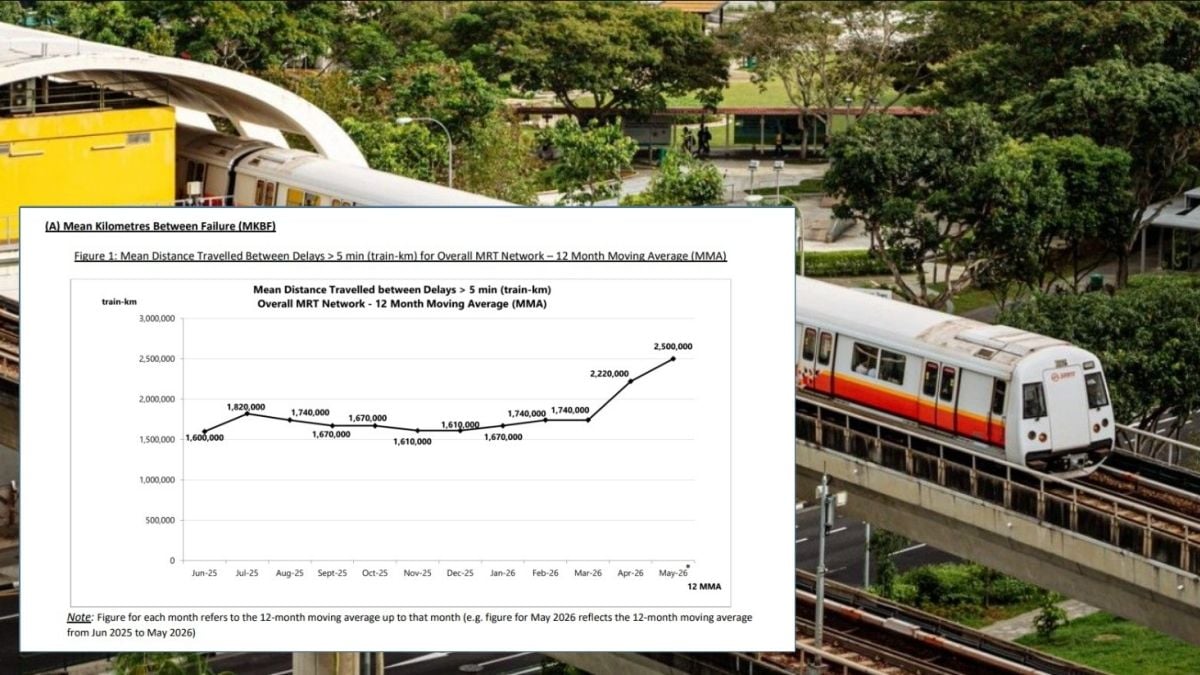
The overall network’s mean kilometres between failures (MKBF) rose from 1,606,000 train-km in December 2025 to 1,673,000 train-km in January 2026. MKBF measures the average distance travelled before a delay exceeding five minutes occurs.
LTA publishes its reliability figures using a 12-month moving average of MKBF, providing a longer-term view of performance trends rather than month-to-month fluctuations.
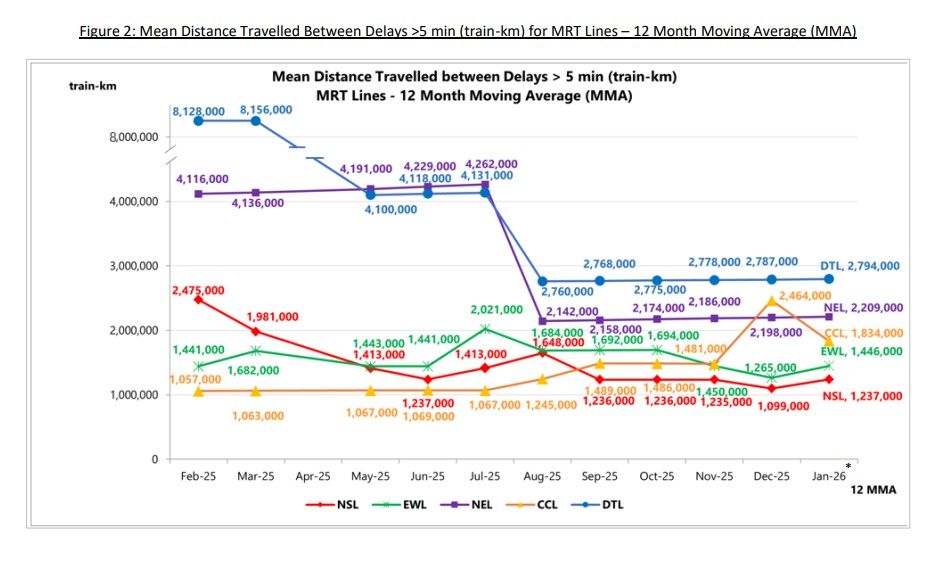
Most MRT lines registered improvements in January. The North-South Line’s MKBF increased from 1,099,000 train-km in December to 1,237,000 train-km in January.
The East-West Line also improved, rising from 1,265,000 train-km to 1,446,000 train-km over the same period.
The North-East Line recorded a marginal increase from 2,198,000 train-km to 2,209,000 train-km.
The Downtown Line posted a slight rise as well, climbing from 2,787,000 train-km to 2,794,000 train-km.
However, the Circle Line was the only line to see a drop in reliability.
Its MKBF fell from 2,464,000 train-km in December to 1,834,000 train-km in January.
On 13 January 2026, the Circle Line experienced a delay between Bishan and Buona Vista during the evening peak hour, affecting commuters.
On 19 January 2026, the line began a three-month planned service disruption to facilitate tunnel strengthening works. Some commuters reported that their travel times were extended by about 20 minutes.
Despite the dip, all individual MRT lines achieved LTA’s target of at least 1 million train-km MKBF for the network.
In addition to MKBF, LTA tracks train service delivery (TSD), which measures whether trains operated according to schedule. TSD is calculated by comparing the actual distance travelled by trains with the scheduled distance and is expressed as a percentage.
Train punctuality is another metric used to assess performance. It measures the percentage of train trips that are completed on time at the end of each line, within two minutes of schedule.
Punctuality can be affected by service disruptions and operational issues that do not result in a complete stoppage. Lower punctuality indicates less regular train intervals, potentially leading to longer waiting times and increased crowding.
LTA has issued monthly updates since August 2025 to provide greater transparency on rail performance, following a series of disruptions last year. Prior to August 2025, reliability updates were released quarterly.
Thomson-East Coast Line excluded from network reliability results
The reliability performance of the Thomson-East Coast Line was not included in the January report.
LTA said newer lines typically operate lower mileage because of comparatively lower ridership and less frequent train operations compared with more mature lines.
Separately, LTA confirmed last month that the Ministry of Transport is reviewing recommendations from the Rail Reliability Taskforce and will issue a full response by the first quarter of 2026.
LTA reviewing Rail Reliability Taskforce's recommendation, to provide response by 1Q2026
The taskforce was formed in September 2025 after at least 15 disruptions across MRT and LRT lines between July and September 2025. It submitted its recommendations on 30 December 2025 to Acting Transport Minister Jeffrey Siow.
Following technical audits of operations, maintenance and incident response, the taskforce identified gaps in backup systems, asset renewal, workforce capabilities and commuter management.
Its recommendations include accelerating the renewal of core systems, expanding the use of data, automation and robotics, strengthening engineering training and certification, and improving service recovery and passenger communication during disruptions.