Why POFMA's structure made success in TOC's appeals difficult from the start
In January 2017, the Court of Appeal told the government it could not compel corrections from online publishers. The Ministry of Law said it would study the judgment and consider what further steps to take. Twenty-nine months later, POFMA came into force. This is a documented account of those further steps.


There is a question that has followed The Online Citizen through every POFMA direction issued against it: why don’t you just appeal?
The answer is that we did.
Three times. And three times the appeals failed — not because the courts determined the reporting to be false, but because the framework places the initial burden on the publisher to establish a basis for setting aside the minister’s assessment, and because the courts’ review is confined to three statutory grounds which do not include any proportionality or fairness assessment.
This is not an accusation. It is a finding that emerges from reading the judgments themselves, tracing the statutory provisions that governed each challenge, and placing them alongside a case that predates POFMA by two years — a case the government lost, and a judgment the Ministry of Law said it would study and consider what further steps to take.
What follows is an explanation of why each of the legal protections that had previously been available to a publisher in TOC’s position had been removed before the first direction was ever issued — and that the ministers who moved the legislation through Parliament were among those who would go on to use it most frequently.
On 16 January 2017, the Court of Appeal (CA) ruled that the government could not invoke Section 15 of the Protection from Harassment Act (POHA) to compel corrections of false statements from online publishers. Section 15 was designed for natural persons — human beings capable of emotional and psychological harm. The government, as a non-natural legal entity, had no standing to use it.
The case involved two consolidated appeals. One concerned Dr Ting Choon Meng, whose patent allegations against MINDEF had prompted the government's application. The other named five respondents — directors and editors of The Online Citizen, including Terry Xu.
The government had sought to compel corrections from a volunteer-run socio-political website by naming its directors and editors.
The court found that unjustified. MINDEF had the resources and media access to put its own version of events on the record. TOC had already published its response in full.
The Ministry of Law's response was on the public record within hours. A spokesperson told CNA that the government would "study the judgment, and consider what further steps it should take." The spokesperson added that the spreading of false and misleading information had become a major problem destructive of democratic institutions.
The government studied the judgment. It considered what further steps to take. Twenty-nine months later, POFMA came into force.
What POHA Section 15 Could Not Do
The background to the case is important. In 2015, TOC published an interview with MobileStats co-founder Dr Ting Choon Meng. Dr Ting alleged that MINDEF had been aware of his patent before procuring similar vehicles through a contractor without obtaining a licence — pointing to a documented conversation with a senior SAF Medical Corps officer in 2005 who had told him the vehicle concept could perhaps be developed independently, and to a letter from the contractor to MINDEF indicating awareness of the patent question.
He also alleged that MINDEF had conducted the subsequent litigation as a war of attrition — claiming its expert witness was unavailable for two years while legal costs mounted — forcing him to abandon the case. When he offered settlement terms allowing MINDEF royalty-free use of existing vehicles, MINDEF counter-offered with a demand that he pay their legal costs and surrender his patent rights globally.
TOC published MINDEF's response in full alongside Dr Ting's account.
When TOC and Dr Ting refused to remove the statements upon request, the Attorney-General applied for a court order under Section 15 of POHA to compel correction.
A district court granted the order. The High Court overturned it. The CA upheld the High Court.
The CA majority was precise about why. Section 15 gave individuals a lower-tier self-help remedy — a way to require correction of false statements without proving damages or seeking criminal sanctions. The Minister for Law had described it in Parliament as a remedy for victims who simply wanted the truth out without escalating to civil or criminal proceedings. Because the provision was designed around the emotional and psychological impact of false statements on human beings, it could not extend to government entities.
But the CA went further. Even if Section 15 could be extended to entities, the order could not be granted in this case. TOC had already published MINDEF's response in full and provided a prominent link to it. The court found that TOC had taken significant steps to present both sides of the story. MINDEF was by no means a helpless victim — it was a government agency with significant resources and media access to put forward its own version of events.
The just and equitable test had defeated the government. Prior judicial oversight had been required throughout. The court was the gatekeeper at every stage. And the court had ruled against the government on both the standing question and the merits.
The Ministry of Law said it would consider what further steps to take. Those further steps required a new instrument.
The Select Committee as Legitimising Mechanism
Before new legislation could be introduced, it needed democratic cover. In 2018, Parliament convened a Select Committee on deliberate online falsehoods. It received 169 written representations from a broad cross-section of society, held public hearings, and produced a 279-page report. The process had the appearance of open deliberation.
But the terms of reference did not ask whether new legislation was needed. They framed the inquiry around four broad questions about the nature of the problem and how Singapore should respond — assuming throughout that a response was necessary and that legislation was part of it. The foundational question — whether existing laws, including POHA with a targeted amendment, could achieve the same ends — was not part of the formal inquiry. The framing assumed a legislative gap existed and asked what should fill it.
This pattern is not without precedent in Singapore's legislative history. The Constitutional Commission on the elected presidency, convened in 2016, similarly asked not whether the elected presidency should be reformed but how three specific aspects of it should be changed. Its terms of reference presupposed the continuation of the institution and asked for recommendations within that frame. The commission's recommendations produced the reserved election mechanism.
In both cases, a process with the appearance of public deliberation produced an outcome that served a specific institutional need that predated the process itself. The select committee received genuine representations and heard genuine evidence. The threat of foreign disinformation was real and documented. But the instrument that emerged from the process also — and the chronology suggests —addressed a specific gap the CA had identified seventeen months before the committee was convened.
The Select Committee process produced the democratic legitimacy that preceded the instrument's introduction — regardless of whether that was its primary function.
What POFMA Does Differently
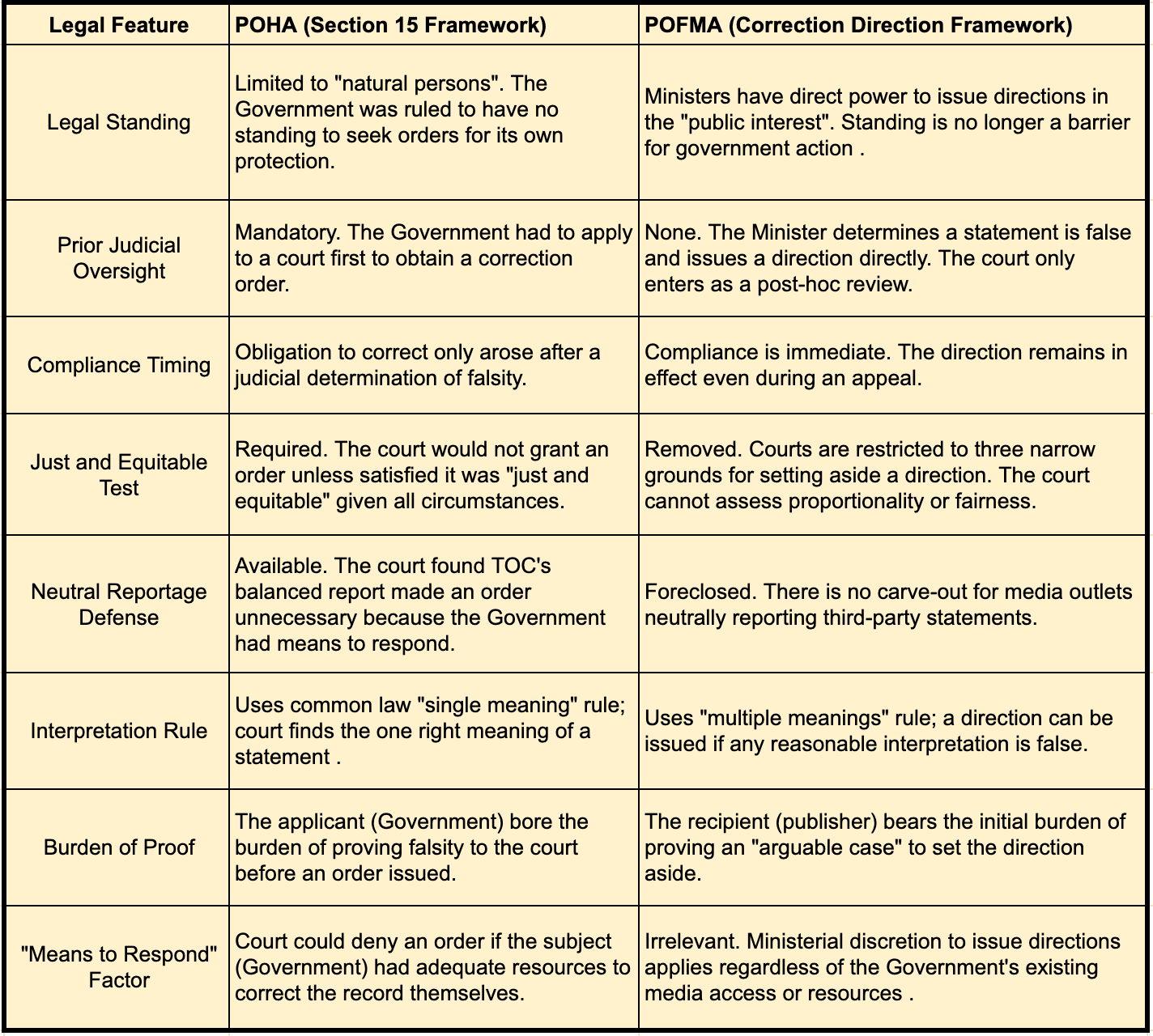
POFMA did not merely create new powers. It addressed, with architectural precision, every limitation the CA had identified in POHA Section 15. True to the spokesperson's word on the day of the judgment, the following nine dimensions document what those further steps produced.
Legal standing. Under POHA, standing to seek a correction order was limited to natural persons — human beings capable of emotional and psychological harm. The CA majority held in Ting Choon Meng that the government, as a non-natural legal entity, had no standing to invoke s15. Under POFMA, standing is no longer a question. Ministers have direct power to issue directions in the public interest. The barrier the CA identified no longer exists.
Prior judicial oversight. Under POHA, the government had to apply to a court. A district court, a High Court, and CA were each involved before the matter concluded in January 2017. Under POFMA, the minister decides. No court application is required before the direction issues. The court only enters the picture after the direction is already in effect, if the subject chooses to appeal — and only after first appealing to the same minister who issued the direction.
Compliance timing. Under POHA, the obligation to correct arose only after a court had determined the statement to be false on a balance of probabilities. Under POFMA, compliance is immediate. Section 17(6) is explicit: the direction remains in force during any appeal and only ceases to have effect if set aside by a court. A pending challenge provides no protection from criminal consequences for non-compliance. The recipient must comply before any court has assessed whether the direction was properly issued.
The just and equitable test. This was the specific test the CA majority applied in 2017 to rule against the government even on the merits — even assuming, for argument's sake, that the government had standing. The court weighed the circumstances and found the order unjustified. Under POFMA, there is no just and equitable test. The 2021 Court of Appeal confirmed that the court's powers are expressly confined to three narrow grounds with no proportionality or fairness assessment available. The test that defeated the government in 2017 was not modified. It was removed.
The neutral reportage defence. The 2017 court found that TOC's balanced reporting — publishing MINDEF's response in full and providing a prominent link — made an order unnecessary. TOC had not endorsed the statements; it had reported them and presented the government's rebuttal. Under POFMA, that distinction is foreclosed. The 2022 High Court confirmed at paragraph 40 that there is no carve-out for media outlets neutrally reporting third-party statements. A publication that accurately reports what someone else said, presents the other side, and links to the official response can still be directed for communicating the statement.
The interpretation rule. Common law defamation has applied the single meaning rule for centuries — a court determines the one correct meaning of the material and assesses liability on that basis alone. Under POFMA, the multiple meanings rule applies instead. The 2021 Court of Appeal held at paragraphs 141-152 that if any reasonable interpretation of the material amounts to a false statement of fact, the direction can issue on that basis. A publisher cannot defend on the ground that the most natural reading of their material was true if some appreciable segment of readers might have drawn a false inference from it.
Burden of proof. Under POHA, the government bore the burden of proving falsity to the court before any order could issue. The applicant carried the weight throughout. Under POFMA, the burden is reversed. The first two POFMA appeals — SDP's challenge and TOC's challenge, filed within weeks of each other in early 2020 — produced contradictory High Court judgments on this very question. The conflict required a full CA ruling to resolve. The 2021 CA held at paragraphs 180-183 that the burden lies from the outset on the recipient of the direction. The publisher must establish a prima facie case before the evidential burden shifts to the minister. The presumption of legality attaches to the direction, not to the speech.
The fault requirement. Under common law, liability generally requires some element of fault — knowledge, recklessness, or at minimum negligence. Section 11(4) of POFMA explicitly removes this entirely. A direction can issue even if the person does not know or has no reason to believe that the statement is false. This was confirmed by the 2020 High Court at paragraphs 14-15 and applied consistently in every subsequent judgment. A publisher who accurately reproduces a third party's statement, has no means of verifying it, and genuinely believes it to be true can still be directed. Innocence is not a defence.
The "means to respond" factor. This was the most concrete finding that saved TOC in 2017. At paragraphs 44-45 of Ting Choon Meng [2017] SGCA 6, the CA majority held that MINDEF was not a helpless victim — it was a government agency with significant resources and media access to put forward its own version of events. That finding, combined with TOC's own efforts to present both sides, made a correction order unjustified under POHA's just and equitable test.
Under POFMA, no equivalent consideration exists. The 2021 Court of Appeal confirmed at paragraph 176 that the court's powers are confined to three narrow grounds with no proportionality or fairness assessment available, and at paragraph 112 explicitly rejected any requirement that the minister use the least restrictive means available.
The 2023 High Court in The Inquiry Pte Ltd v Attorney-General [2023] SGHC 247 proceeded entirely within those three grounds without any consideration of the government's own resources or media access. No judgment under POFMA has applied anything resembling the factor that protected TOC in 2017, because the framework the judgments collectively establish has no structural mechanism for it.
Every procedural gap the CA identified was closed. Every safeguard the court applied was removed.
What Parliament Was Told
During the Second Reading of the POFMA Bill on 7 May 2019, then-Senior Minister of State for Law Edwin Tong told Parliament that the large majority of the Bill's toolkit was designed for platforms and coordinated bad actors, not individual publishers. Then-Law Minister K Shanmugam described the Bill's primary targets as foreign state actors using information warfare, profit-driven disinformation operations, and coordinated fake account networks operating at industrial scale. He spoke at length about the Gerasimov Doctrine, Brexit disinformation, the 2016 US elections, and the dangers of bot amplification.
The speeches were not false. Foreign disinformation is a real and documented threat. The Select Committee heard genuine evidence of it. But the instrument built to address that threat also addressed something else — the specific gap the CA had identified in a case involving a socio-political website that had refused to remove statements upon government request. Neither minister volunteered that connection.
The bots and fake accounts Shanmugam described to Parliament did not need POFMA specifically to be addressed. The government's own subsequent conduct has demonstrated this. In 2026, when nearly 300 AI-generated YouTube videos fabricating narratives about Prime Minister Lawrence Wong accumulated millions of views, the government declined to invoke POFMA.
Minister for Digital Development and Information Josephine Teo explained in Parliament that YouTube's independent removal of most offending accounts made formal directions unnecessary. The government instead relied on platform enforcement and public discernment. The threat profile Shanmugam described in 2019 materialised in 2026. The government chose not to use the instrument against it.
What POFMA was uniquely needed for — what no existing instrument could do and what the CA had specifically said POHA could not do — was compelling corrections from individual online publishers who refused to correct voluntarily. That is the gap POFMA fills. That is the gap the CA identified in January 2017. That is the gap the Ministry of Law said it would consider how to fill on the same day the judgment came down.
The 2017 judgment was not entirely absent from the debate. former Workers' Party chief Low Thia Khiang raised it directly. The government, he said, had previously tried to use POHA to protect government agencies — an attempt the court had rejected because the government was not a natural person. The case had dragged on for years, Low noted, creating a burden that any individual with limited resources would struggle to bear.
Near the end of the debate, Shanmugam called the characterisation "inaccurate and seriously inaccurate" and "most unfair."
His rebuttal was technical: POHA had two distinct parts. The harassment provisions in sections 3 to 7 could never have applied to the government — it would have been absurd to suggest otherwise. What the government had attempted to invoke was section 15, which concerned false statements rather than harassment, and which the government believed applied to it on the basis that the Interpretation Act defined "person" broadly enough to include government entities.
The CA was divided. Two judges held that section 15 did not cover the government. The Chief Justice dissented, agreeing with the government's position. The government accepted the 2-1 ruling. Rule of law. That was that.
Workers' Party MP Sylvia Lim then pressed further, and with greater legal precision. Her intervention went to the heart of how the court had actually reached its conclusion. The CA, she noted, had not simply ruled against the government on a technical reading of the word "person." It had examined the Hansard from the Second Reading of the original POHA Bill — the record of what Shanmugam himself had said in Parliament when moving that legislation in 2014.
The court found that in those speeches, Shanmugam had referred only to scenarios involving vulnerable individual victims. On the basis of what he had told Parliament when POHA was passed, the court concluded the government was not a proper applicant under section 15. It was Shanmugam's own parliamentary record that the court had used to rule against the government.
The implication was pointed but carefully stated. The Hansard being created that day — Shanmugam's speeches about POFMA's purpose and targets — would similarly form the interpretive record for any future court called upon to assess the instrument's scope and intent.
Shanmugam's response was notably hedged. He said he had not looked at the judgment recently. He maintained he had told Parliament that "persons" should be interpreted according to the Interpretation Act. The court took a different view from what he had intended. That was that.
Lim also raised the proportionality question directly. Shanmugam had suggested during his roundup that proportionality would be considered on appeal. She noted that looking at the grounds of appeal, the High Court did not appear to have any power to assess proportionality. Was proportionality in fact a matter for judicial review rather than the statutory appeal? Shanmugam confirmed she was correct. Proportionality related to the exercise of government powers and would be judicial review. The appeal under section 17 was purely on the question of fact or falsehood.
That exchange confirmed in the parliamentary record what the 2021 Court of Appeal would later establish in its judgment: the three narrow grounds in section 17(5) are exhaustive, no proportionality assessment is available on appeal, and the just and equitable test that had protected TOC in 2017 has no equivalent under POFMA. Lim had identified the gap in the debate itself. Shanmugam had confirmed it.
The parliamentary record of that debate does not expressly address the relationship between the instrument being introduced and the specific limitations the CA had identified two years earlier. The framework introduced in 2019 provided correction directions without prior judicial oversight, without a just and equitable test, and without any assessment of whether the government had adequate means to respond on its own. The CA had held that POHA section 15 did not extend that far. The parliamentary debates did not explicitly link the new framework to the specific limitations identified by the CA in 2017.
Low's response to Shanmugam captured the operational architecture more plainly than any legal formulation. In Chinese, he said, it is called 先斩后奏 — you execute first, then report. The minister decides. The action is effected. The person must comply. The appeal comes after. Low drew the parallel to the Internal Security Act: in both cases, the executive decides, the action is taken without prior court involvement, and the court enters only afterward. Shanmugam's reply was that the ISA comparison was wrong because under the ISA you cannot go to court. Under POFMA, you can.
That response is technically correct. It is also precisely the point. The court enters only after the direction has issued, after compliance has been compelled, and — as TOC's own litigation history documents — often after separate enforcement action has rendered the question academic. 先斩后奏. The sequence Low described in Parliament in 2019 is the sequence the judgments document in the years that followed.
The Promise and the Record
Shanmugam told Parliament the process for challenging a correction direction would be fast, simplified, and inexpensive. A person aggrieved by a direction could have their case heard in the High Court as early as nine working days after initiating a challenge. Simple standard forms. Low court fees. The minister responds within two working days. The court fixes a hearing date no earlier than six working days after the application is filed — a statutory minimum interval governing when a hearing may occur, not how quickly the matter will be resolved.
In TOC’s appeals, the minister’s reply was typically filed on the second working day, and the hearing date was fixed at the earliest point permitted by the statutory notice period. The nine working days therefore describe the minimum procedural sequence prescribed by the framework. They indicate when a hearing may be scheduled, not when a determination will be delivered.
In one documented instance, the statutory process operated without direct ministerial involvement. Two directions were issued on 4 and 5 July 2020, during the dissolution of Parliament ahead of the 10 July general election. TOC’s cancellation applications, submitted on 17 July, were rejected not by ministers but by officials: one response signed by a civil servant on behalf of the caretaker Minister for National Development, the other issued by the Ministry of Manpower’s Corporate Communications Department. During the Second Reading debate, Shanmugam said ministers would bear personal responsibility for each direction issued. During the election period, the responses were issued through authorised officials acting on behalf of the office.
The first two appeals filed under the Act exposed the limits of that promise immediately. SDP’s challenge was the first POFMA appeal ever heard. TOC’s was the second. Between them they produced contradictory High Court judgments on the most fundamental question in the entire framework: who bears the burden of proof. One court held it lay on the minister. The other held it lay on the publisher. The instrument had been in force for months and its most basic procedural question was already contradicted between two sitting judges.
That conflict required a full CA judgment to resolve. The CA judgment, delivered in October 2021, runs to hundreds of paragraphs setting out the interpretive framework, the burden of proof, the multiple meanings rule, the irrelevance of the publisher's subjective intention, and the constitutional status of speech pending judicial determination.
The legal architecture of the instrument was sufficiently unsettled that a subsequent High Court proceeding — involving a direction issued against TOC in January 2020 — was deferred at the AGC's request until the CA had first established what framework would govern it. A direction had already issued. TOC was already bound to comply. The applicable interpretive framework could not be settled until the Court of Appeal had resolved foundational questions left open in the instrument’s early application.
Once the CA judgment was delivered, the deferred High Court proceeding finally proceeded. It required two hearings, additional video evidence obtained only after the court's intervention, competing Hokkien transcripts and translations, constitutional arguments, Evidence Act disputes over adverse inferences, and a reserved judgment delivered months after the second hearing.
A separate direction issued on 21 May 2021 documents the compliance gap most starkly. TOC complied with that direction. It then pursued the statutory challenge the instrument provides. The reserved judgment arrived on 25 July 2022 — fourteen months after the direction issued. The obligation to comply had fallen due within days.
The judicial determination of whether the speech targeted by that direction was constitutionally protected arrived fourteen months later. And when it arrived, it did not rule on the merits. TOC's broadcasting licence had been cancelled in October 2021. The court held that any order would be of no practical effect and dismissed the appeal as moot. The process from direction to judgment took fourteen months and concluded without any determination of whether the direction had been validly issued.
The 9-day promise described when a hearing might be scheduled. It said nothing about when a decision would arrive, whether the framework governing that decision would itself be settled, or what would happen if separate enforcement action rendered the question academic before the court could rule.
The 2023 High Court judgment involving the online magazine Jom illustrates how far from simple the substantive exercise has travelled. The court was required to determine whether the word "pithy" was used sardonically, whether a five-word sentence transformed a partial parliamentary quote into an assertion that a minister had no other answer, and whether a series of speculative associations about an Instagram geo-block amounted to a factual claim that the government had caused it.
These are not questions of true or false. They are questions of literary interpretation — of tone, implication, rhetorical structure, and logical inference. Jom had explicitly added addenda to its articles stating that it did not intend to make the subject statements. The court held those addenda were insufficient disavowals because they did not neutralise the slant of the original material.
The costs of pursuing the statutory challenge the instrument provides are documented in TOC's own records. The CA proceedings in CA/CA 47/2020 resulted in a costs order of S$10,000 payable to AGC. The subsequent High Court proceeding in HC/OS 563/2021 — dismissed as moot before any merits ruling — resulted in a further costs order of S$8,000 and disbursements of S$943.10.
In 2023, AGC applied for security for costs against Terry Xu personally — a step that, if successful, would have required him to deposit money before the appeal could proceed. Submissions were filed contesting the application on the basis that Rule 15(1) of the Supreme Court of Judicature (Protection from Online Falsehoods and Manipulation) Rules 2019 expressly prohibits costs orders against individual appellants, subject only to two narrow exceptions: abuse of process or extravagant and unnecessary conduct. Neither had been established. The court dismissed the application and awarded S$2,500 in costs to Terry Xu instead
Compliance Before Constitutional Assessment
The constitutional dimension of the instrument's architecture is not incidental. It is structural.
The CA held in 2021 that speech targeted by a correction direction remains constitutionally protected speech until judicially determined to be false. The direction issues on the minister's assessment, not the court's. The recipient is required to comply before any court has assessed whether that assessment is correct.
Section 17(6) of POFMA is explicit: a direction remains in effect during any appeal and only ceases to have effect if set aside by the court. A pending challenge provides no protection from criminal consequences for non-compliance. The instrument is designed so that compliance must precede constitutional assessment.
The present direction invokes Section 11(3)(b) of POFMA — what we believe to be the first time this provision has been used in the Act's history — requiring publication of a correction notice in a Singapore newspaper at our expense within days of service.
The bill for that publication came to S$10,400. TOC had two days to raise the funds to meet the publication deadline. The compliance window does not wait for a hearing. It does not wait for a reader to assess whether the direction was validly issued. It does not wait for any court to determine whether the speech it targets is constitutionally protected.
The theoretical minimum of nine working days from initiating the ministerial application to a hearing already exceeds that window. The judicial determination of whether the speech is or is not constitutionally protected arrives, at best, weeks after the compliance obligation has already fallen due. In practice, as TOC's own litigation history demonstrates, it arrives in weeks or months — if it arrives at all before intervening enforcement renders the question academic.
The architecture is not a procedural inconvenience. It is the instrument's design. Compliance comes first. The constitutional question comes later, if it comes at all.
The Pattern the Data Reveals
The pattern of POFMA's application tells a story the government's public statements do not. Of the entities that received directions since the Act came into force, the majority have ceased or significantly reduced publication.
Economist Yeoh Lam Keong, whose financial analysis once offered one of the few independent critiques of Singapore's fiscal policy, has stopped publishing commentary. Political Sophistry, a blog that engaged seriously with Singapore's political landscape, went quiet after its direction. Jom, after navigating the High Court and experiencing firsthand how narrowly confined the appellate process is, now operates with an acute awareness of exactly where the legal boundaries lie.
The instrument does not need to win in court to succeed. It succeeds when recipients calculate that the cumulative cost of continued publication — compliance burdens, legal exposure, reputational damage, the sheer attrition of fighting a process designed to be won before it begins — exceeds whatever purpose the publication serves. Most made that calculation quietly. The silence that followed is not compliance. It is the instrument producing its documented effect.
TOC did not go quiet. Which makes the government's characterisation of TOC as "persistent" an inadvertent admission: the practical effect of the framework has often been cessation.
On the evidence of the pattern documented here, persistence is only a problem if stopping was the natural consequence of its design.
The direction to publish a correction notice in the Straits Times at TOC's expense is not a misinformation mitigation measure. It is the final escalation in a chain designed to produce one of two outcomes — financial attrition or non-compliance. That chain began earlier.
A Declared Online Location designation under POFMA explicitly cuts off sources of financial or other material benefit to the operator — advertising, donations, commercial arrangements. TOC has been designated twice, in July 2023 and July 2025. Gutzy Asia, TOC's regional publication, was designated in June 2024.
The section 11(3)(b) direction now imposes a cost on a publication that has already been stripped of its primary means of meeting one. A correction notice in a national newspaper carries a cost that a website correction does not. Non-compliance carries criminal liability. There is no third option the instrument provides.
The section 11(3)(b) direction does not ask whether TOC's readers need to be reached through print. The economic effect of the direction is to test whether TOC can afford to keep publishing — and it asks that question of a publication the instrument has already worked to render unable to answer yes.
The Bones of the Instrument
Strip away the select committee process. Strip away the parliamentary speeches about foreign disinformation and bot networks. Strip away the 279-page report and the evidence from international experts about coordinated inauthentic behaviour.
What remains is this.
In January 2017, the CA held that the government could not use POHA Section 15 to compel corrections from online publishers. The case involved two consolidated appeals. One concerned Dr Ting Choon Meng, whose patent allegations against MINDEF had prompted the government's application. The other named five respondents — all affiliated with The Online Citizen, including its editor Xu Yuan Chen. The Ministry of Law's spokesperson had said it would consider what further steps to take. The chronology permits the inference that POFMA represents those further steps.
In May 2019, POFMA came into force. It gives the government what the CA denied it — ministerial correction directions without prior judicial oversight, with criminal penalties for non-compliance, applicable to any online publisher regardless of size, resources, or existing ability to access the government's response. It removes each of the common law protections that moderated that power under POHA. It requires compliance before any court assesses whether the direction was properly issued. And it ensures that by the time judicial determination arrives, if it arrives at all, the compliance obligation has long since attached.
The two ministers who led POFMA through Parliament in 2019 have between them issued more directions than any other ministers under the Act. Shanmugam, who moved the Bill and made the promises about a fast, inexpensive, simplified process, has issued 20 directions — the highest of any minister. Edwin Tong, who told Parliament the toolkit was designed for platforms and coordinated bad actors rather than individual publishers, has issued 13. Of Tong's 13 directions, at least 10 concerned reporting on 26 Ridout Road — the property leased to Shanmugam that was the subject of the 2023 parliamentary controversy.
Those directions were issued against Kenneth Jeyaretnam, Jom, Lee Hsien Yang, Gutzy Asia and The Online Citizen. The Online Citizen is the single most directed entity in the dataset — 19 directions, more than any other individual or organisation. The pattern of who issues directions, against whom, and on what subject matter raises a question the parliamentary debates did not address.
The instrument's architecture is not incidental to that history. It is the product of it.
No layman navigates this. Parliament was told they would.
Primary Sources and Citations
Judgments
Parliamentary Debates
Singapore Parliamentary Debates, Official Report (7 May 2019) vol 94, Second Reading of the Protection from Online Falsehoods and Manipulation Bill (No 10/2019), Minister for Law K Shanmugam; Senior Minister of State for Law Edwin Tong.
Singapore Parliamentary Debates, Official Report (7 May 2019) vol 94, Second Reading of the Protection from Online Falsehoods and Manipulation Bill (No 10/2019), WP MP Low Thia Khiang