Global employee engagement falls to five year low as manager support hinders artificial intelligence adoption
The Gallup State of the Global Workplace 2026 Report reveals that global employee engagement has dropped to 20 per cent, while manager indifference is stalling the return on investment for artificial intelligence technologies across major economies including Singapore.

- Global employee engagement declined for a second consecutive year to 20 per cent in 2025.
- Manager engagement dropped by five points last year, directly impacting the successful adoption of workplace AI technology.
- Southeast Asian workers report the highest job market optimism globally at 64 per cent despite rising automation.

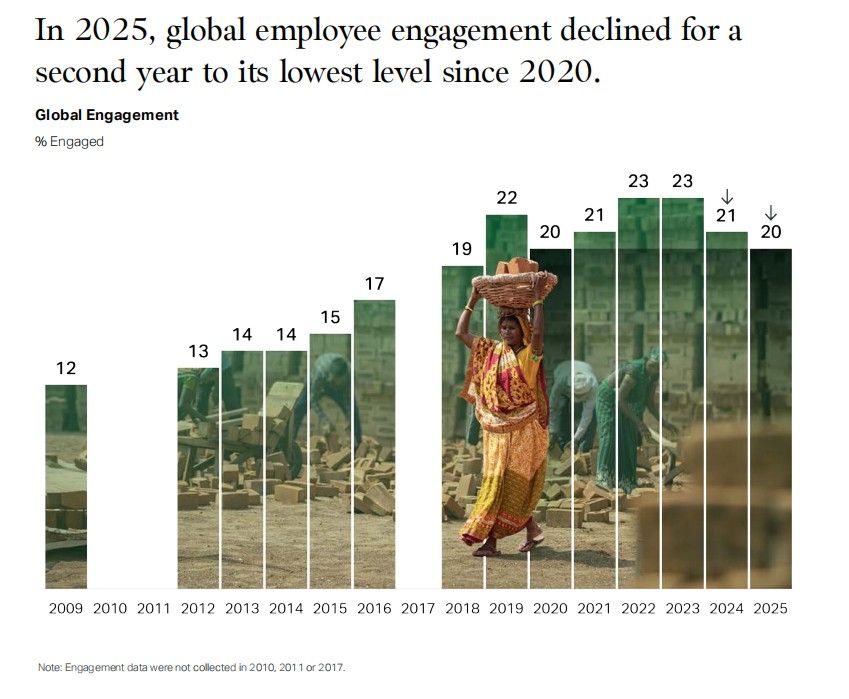
Global employee engagement has declined for the second consecutive year, reaching its lowest level since 2020.
According to the State of the Global Workplace 2026 Report published by Gallup, only 20 per cent of employees worldwide are currently engaged at work.
This downturn is a significant reversal from the peak engagement rate of 23 per cent recorded in 2022.
Gallup researchers estimate that this slump in engagement cost the global economy approximately US$10 trillion (approximately S$13.4 trillion) in lost productivity over the last year.
This loss represents 9 per cent of global gross domestic product (GDP). The report underscores a critical disconnect: while technology is advancing, the human element of the workplace is fracturing.
The report highlights that large language models can now draft legal contracts and write code at speeds no human team can match.
However, these technical gains are not translating into financial results.
An MIT study cited by Gallup found that despite US$40 billion in enterprise investment, 95 per cent of organisations have seen zero measurable impact on profits.
Furthermore, an NBER survey of nearly 6,000 global executives found that 89 per cent saw no effect on labor productivity from artificial intelligence (AI).
Gallup identifies the direct manager as the primary reason for this failure.
Aside from technical integration, the strongest predictor of whether an employee adopts AI is whether their direct manager actively champions it. The report asserts that even the most sophisticated neural network cannot overcome an indifferent team leader.
The challenge is compounded by a global collapse in manager engagement.
Since 2022, manager engagement has dropped by nine percentage points globally.
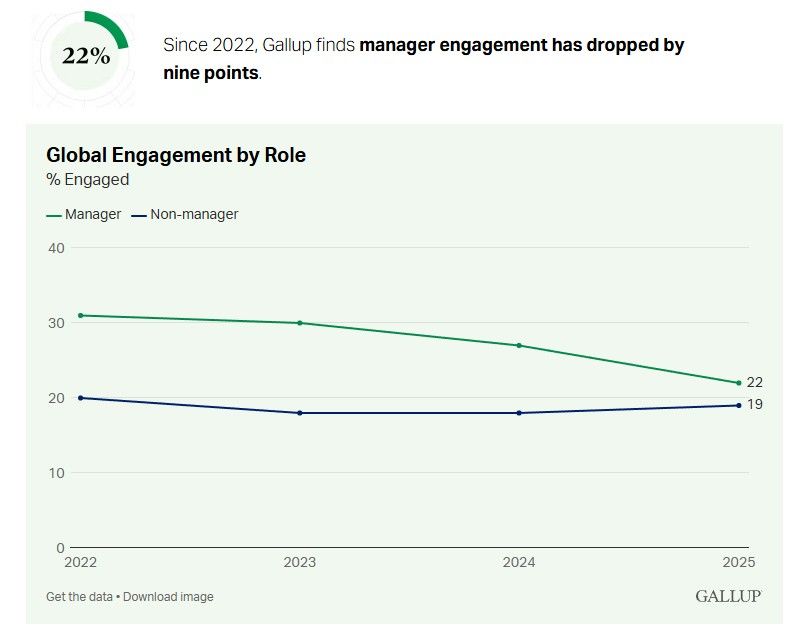
The most severe decline occurred between 2024 and 2025, when manager engagement fell from 27 per cent to 22 per cent.
This indicates that managers, who previously enjoyed an engagement premium, are now only as engaged as the staff they lead.
In Southeast Asia, a region that includes Singapore, the job climate remains the most optimistic in the world.
Approximately 64 per cent of employees in this region believe it is a good time to find a job, representing a one-point increase over the previous year.
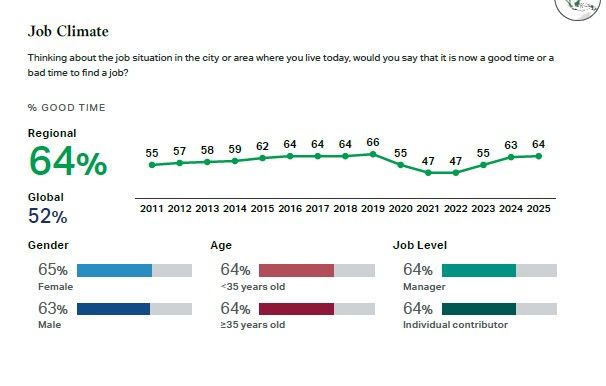
Southeast Asia has now overtaken Australia and New Zealand for the top spot globally.
Regional job market confidence elsewhere has plummeted.
Optimism in Australia and New Zealand fell by 12 percentage points to 60 per cent.
The United States and Canada region saw a 10-point drop to 47 per cent, leaving it second-to-last in global rankings. Gallup attributes the Southeast Asian resilience partly to a growth in on-site job opportunities compared to remote-capable roles.
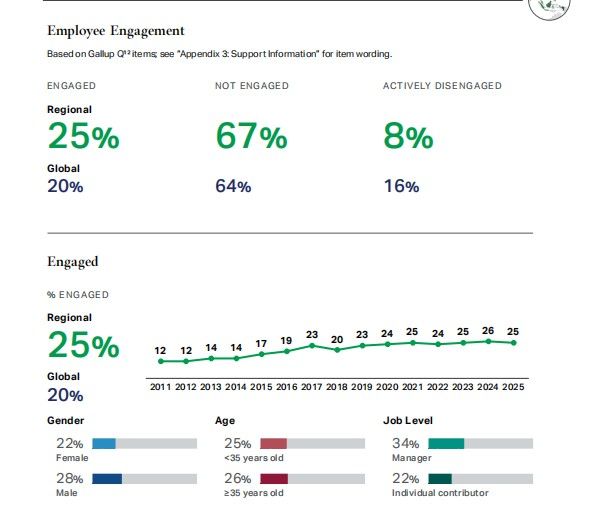
Despite high job optimism, engagement in Southeast Asia has remained flat at 25 per cent.
While this is five points above the global average, it suggests that regional workplaces are not fully capitalising on their strong economic position.
The region does report lower daily stress levels (25 per cent) compared to the global average of 40 per cent.
For Singaporean organisations, the impact of AI on workforce size is becoming evident.
Gallup's data shows that large employers (10,000+ staff) are more likely to reduce headcount after implementing AI, with 33 per cent reporting reductions.
In contrast, smaller employers (5,000 to 10,000 staff) are more likely to expand their workforce (38 per cent) following AI adoption.
Fear of displacement is a rising trend among workers. In Q1 of 2026, 18 per cent of U.S. employees felt it was likely their job would be eliminated by technology within five years.
In organisations where AI is already implemented, this fear rises to 22 per cent.
The anxiety is highest in finance (32 per cent), insurance (32 per cent), and technology (31 per cent).
The report provides a stark warning regarding the emotional burden of leadership.
Leaders report higher life evaluations but significantly worse daily experiences than those they lead.
Compared to individual contributors, leaders are more likely to report daily stress (+7 points), anger (+12), sadness (+11), and loneliness (+10).
Leadership offers almost no upside in terms of positive emotions, as leaders are less likely to laugh or smile daily than their employees.
Gallup finds that engagement is the only effective buffer against this emotional strain.
Engaged managers report experiencing negative emotions at lower rates than disengaged individual contributors and are 14 points more likely to be thriving overall.
Organisational flattening is also cited as a potential cause for declining manager morale. In South Asia, manager engagement dropped by eight points in 2025, the largest regional decline.
Evidence from India's IT sector suggests a freeze in hiring and cuts to mid-level roles have increased the "span of control" for remaining managers, which directly erodes their engagement.
To resolve the AI productivity gap, Gallup suggests that leaders must move beyond technical tooling.
Research indicates that employees who feel their manager supports AI use are 8.7 times more likely to say AI has transformed their work. They are also 7.4 times more likely to feel AI gives them opportunities to do what they do best every day.
However, active support remains rare. Less than one-third of employees in AI-integrated organisations strongly agree their manager supports their use of the technology. In Germany, this figure is as low as 21 per cent.
The report concludes that AI itself may provide the solution to the management crisis. AI tools have the potential to provide real-time, personalised coaching for managers based on management science.
This could improve management practices at scale, effectively upskilling the "human side" of the digital revolution.
For Singaporean business leaders, the baseline is clear: technological investment will continue to see zero measurable impact on profits unless manager engagement is prioritised as a core business strategy.