Singapore corruption cases fall in 2025 as conviction rate rises to 91 per cent: CPIB
Singapore recorded 68 corruption cases in 2025, down from 2024, while conviction rates increased. CPIB reported strong enforcement outcomes and sustained low corruption levels, supported by public confidence and international rankings.

- Singapore registered 68 corruption cases in 2025, seven fewer than the previous year.
- The conviction rate rose to 91 per cent when withdrawal cases were included.
- Most cases involved the private sector, with strong public confidence in anti-corruption efforts.

Singapore recorded a decline in corruption cases in 2025 while achieving a higher conviction rate, according to the Corrupt Practices Investigation Bureau (CPIB) on 28 April 2026.
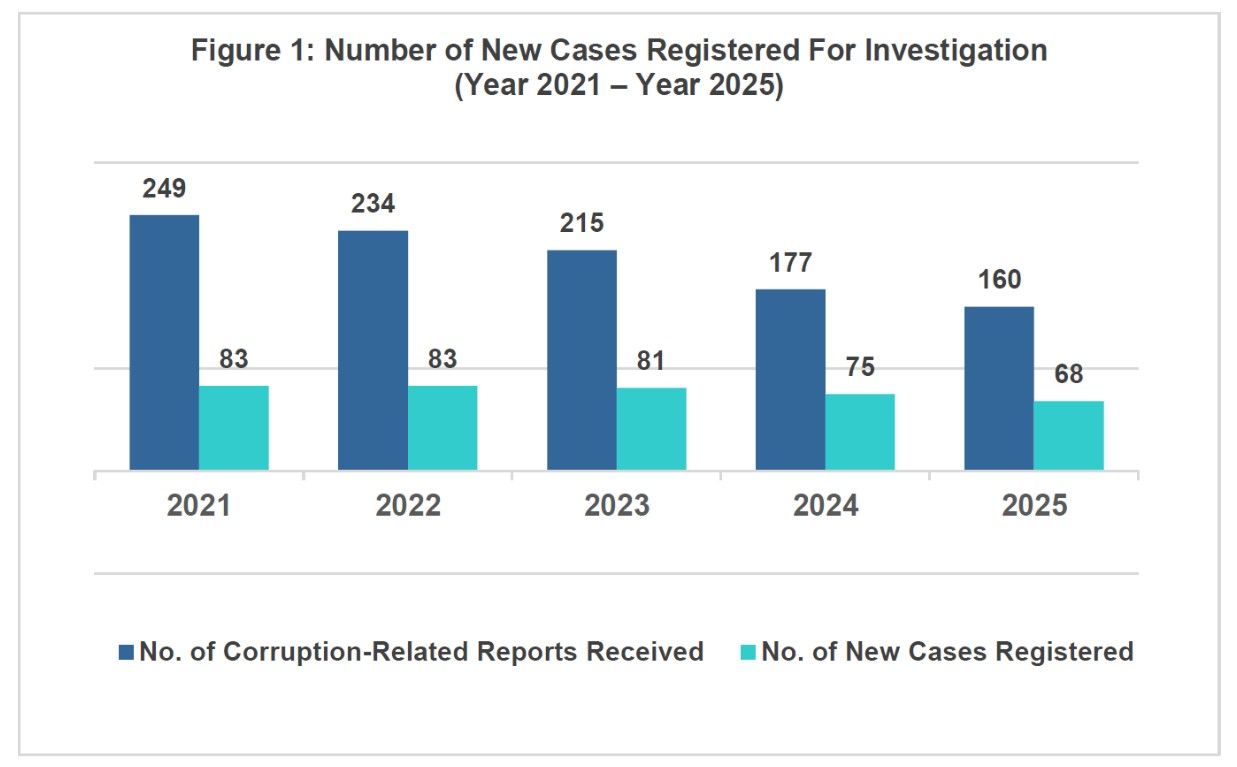
The agency reported 68 new cases registered for investigation in 2025, a decrease of seven cases compared with 2024.
It also received 160 corruption-related reports, down from 177 in the previous year.
A report is registered for investigation when the information received is considered pursuable. CPIB stated that “this is determined by the quality of the relevant information provided”.
Investigative enquiries and intelligence probes contributed to uncovering further information, enabling a higher percentage of reports to be formally registered for investigation.
Anonymous reports and case breakdown
Of the 160 corruption-related reports received in 2025, 56 were submitted anonymously. Sixteen of the 68 cases registered for investigation also originated from anonymous sources.
“CPIB treats all reports received seriously regardless of whether the complainant is named or anonymous,” the agency said.
The majority of cases investigated during the year involved the private sector. Only one case involved the public sector.
Prosecution figures and sector trends
In 2025, 90 individuals were prosecuted in court for offences investigated by CPIB. Among them, 84 were from the private sector, while six were public sector employees.
The public sector employees came from various organisations, including the National Environment Agency, the Singapore Armed Forces, the Singapore Civil Defence Force, the Singapore Prison Service, St Anthony's Canossian Secondary School and St Joseph's Institution.
CPIB noted that, over the past decade, corruption cases involving private sector employees were most prevalent in construction, manufacturing, transportation and storage industries.
The report also highlighted 22 cases in 2025 where public sector employees rejected bribes.
These involved officers from the Immigration and Checkpoints Authority, the Land Transport Authority, the National Environment Agency and the Singapore Police Force, as well as an officer from Certis Cisco Aviation Security performing a public function.
Conviction rate rises
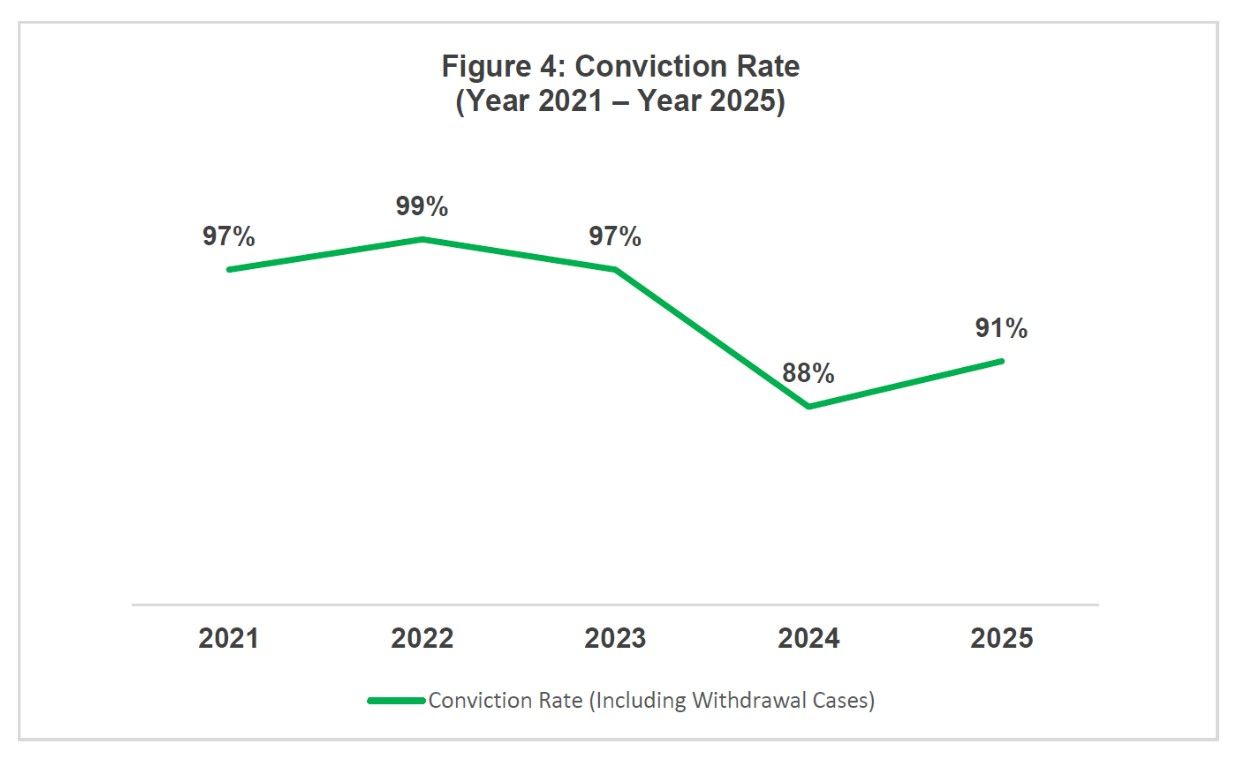
CPIB recorded a conviction rate of 100 per cent for cases in 2025 when excluding withdrawal cases.
When withdrawal cases were included, the conviction rate stood at 91 per cent, an increase from 88 per cent in 2024. Withdrawal cases refer to those discontinued after charges were filed but before a court decision was reached.
The agency stated that it will now report conviction rates including withdrawal cases to provide “a more accurate representation of its success in securing convictions”.
Corruption situation remains controlled
“The corruption situation in Singapore remains firmly under control,” CPIB said.
It added that both the number of reports received and cases registered for investigation remained low.
The bureau conducts an annual public perception survey to assess views on corruption levels, public understanding and perceptions of its effectiveness.
The 2025 survey, conducted by an independent research company with 1,000 respondents representative of the population, found that 98 per cent rated the corruption situation as good, very good or excellent.
“Political will to keep corruption under control, a zero-tolerance culture for corruption, and effective anti-corruption laws were cited as the top three factors contributing to the low corruption rate in Singapore,” CPIB said.
International rankings and continued efforts
CPIB defended that Singapore’s anti-corruption framework continued to receive strong international recognition.
In the 2025 Corruption Perceptions Index by Transparency International, Singapore ranked as the world’s third least corrupt country, with a score of 84 out of 100, unchanged from the previous year.
It was also the highest-ranked country in the Asia-Pacific region.
A separate 2025 report by the Political and Economic Risk Consultancy ranked Singapore as the best-performing among 16 economies across Asia, the United States and Australia.
In the World Justice Project Rule of Law Index 2025, Singapore improved its ranking from third to second out of 143 countries for the absence of corruption in government.
CPIB stated that its enforcement actions reinforce a zero-tolerance approach to corruption and help maintain a level playing field for businesses and the wider community.
The bureau added that a collective approach remains key to preventing corruption, noting that it has intensified its efforts over the past year.
CPIB reaffirmed its mission to fight corruption and keep Singapore among the least corrupt countries in the world, stating that while the situation remains firmly under control, recent cases show corruption can take root if vigilance wanes.