Woman told to sit after singing and playing guitar on upper deck of public bus in Singapore
A woman known for posting videos of herself singing on Singapore buses was told by a bus captain that she was only allowed to sit and sing after she was seen perched on a narrow ledge on the upper deck of a double-decker bus during a performance.

- A bus captain told a woman she was only allowed to sit and sing during a bus performance.
- She was seen singing and playing guitar while perched on a narrow ledge on the upper deck.
- The incident sparked online debate over commuter behaviour, safety, and public transport etiquette.

A woman known for posting videos of herself singing on public buses in Singapore was recently told by a bus captain to sit down while performing on the upper deck of a double-decker bus.
The incident was shared in a TikTok video uploaded on 29 April by content creator Kira Peace, who regularly posts clips of herself singing and playing guitar during bus rides across Singapore.
In the video, the bus captain, who was wearing an SMRT vest, approached the upper deck and reminded her that she was “only allowed to sit and sing”.
She apologised immediately before moving to an empty seat and continuing the performance while seated.
Videos show bus performances
In the video, the woman was seen perched on a narrow ledge near the railing of the bus’s upper deck while speaking to nearby passengers before beginning a song performance.
Several passengers seated nearby appeared to watch the performance while travelling.
The TikToker has uploaded multiple similar videos showing herself singing on buses and interacting with commuters during journeys.
In the latest clip, another passenger identified as “Louis” briefly joined the performance by playing the guitar while Kira sang.
Another commuter was also seen clapping along during the session.
A bus captain later approached the upper deck and intervened.
He instructed her that she was only allowed to sit and sing, after which she apologised and moved to a seat.
The video later showed the pair continuing to perform.
Mixed reactions online
The videos generated widespread discussion online, with commenters divided over whether such performances were appropriate on public transport.
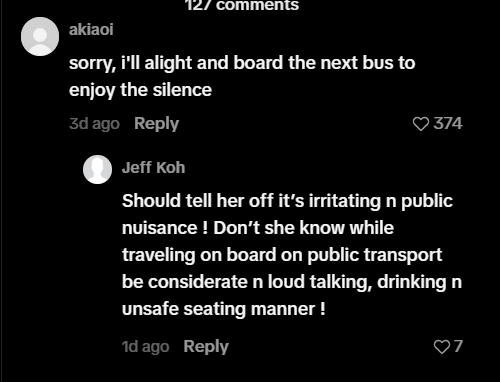
Some users said they would have found the singing disruptive after a long day at work, with several describing buses as one of the few quiet spaces commuters have during daily travel.

Others joked that they would rather board another bus than continue listening to live music during their journey.
One user commented, “Sorry, I’ll alight and board the next bus to enjoy the silence,” highlighting a preference for a quieter ride.
Several commenters compared the situation to public transport etiquette in countries such as Japan, where commuters are generally expected to keep noise levels low and avoid disturbing others.
One noted, “In Japan if she do this, I think she will get kicked out,” suggesting stricter social expectations elsewhere.

A number of users acknowledged that Kira Peace appeared talented and well-intentioned, but argued that buses were not a suitable venue for public performances due to the confined shared environment.
One comment stated, “Making noise on a bus is not appropriate, your voice so good but maybe wrong place,” while another added that while her voice was appreciated, the setting was not ideal for public performance.

Privacy concerns were also raised by some commenters, who said passengers may not be comfortable appearing in social media videos or being filmed without prior consent while travelling.
One user advised that although her singing was appreciated, she should consider performing in more suitable spaces such as home or outdoor locations to respect others’ privacy and comfort.

Safety and transport regulations highlighted
Many commenters defended the bus captain’s actions, saying he was enforcing safety regulations designed to protect passengers on moving vehicles.
One comment stated, “Driver: ‘You only allowed to sit and sing ah’,” while another added that the intervention was a reminder of safety rather than an attempt to stop the performance.
Several users pointed out that notices on double-decker buses state passengers on the upper deck are required to remain seated.

Others noted that sudden braking or traffic incidents could place standing passengers at risk of injury, with one user explaining that in such situations, drivers could also face serious consequences.
Some commenters also said bus captains could face consequences if accidents occurred while passengers were not following safety rules.

One noted that in other countries, similar behaviour might lead to stricter enforcement or penalties due to liability concern
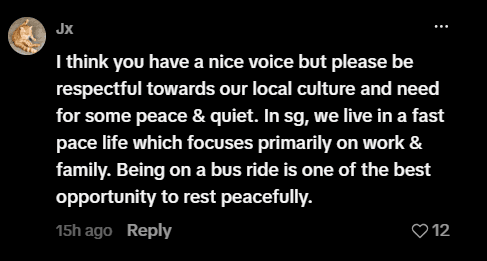
A number of users described the singing and music as a potential nuisance in a public transport setting, especially for commuters seeking a quiet journey.



However, not all reactions were negative.
Some commenters praised Kira Peace’s singing ability and said the impromptu performance helped create a cheerful atmosphere onboard the bus.
One user said it was a “good move to motivate everyone’s mood after a long day of work,” while still acknowledging that bus rules must be followed.
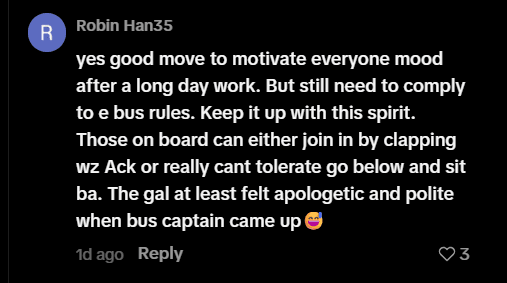
Several supportive users also noted that she apologised politely and complied immediately when instructed by the bus captain.
Public transport nuisance laws
According to Singapore’s Conditions of Carriage for Public Buses, passengers are not permitted to stand on the upper deck of double-decker buses.
In 2025, Parliament passed legislation allowing authorities to take action against commuters who create nuisance or annoyance on public transport, including through loud audio or disruptive behaviour.
The law was introduced as part of broader efforts to improve commuter experiences and address disruptive conduct on public transport networks.