Malaysian man jailed for life over heroin and methamphetamine importation at Woodlands Checkpoint
Singapore's High Court has sentenced a 29-year-old Malaysian man to life imprisonment and 24 strokes of the cane after finding him guilty of importing heroin and methamphetamine into Singapore in December 2020.
- Thina Vengades Rao, 29, convicted of importing heroin and methamphetamine across Woodlands Checkpoint in December 2020.
- Court rejected his claim of believing the black-taped bundles contained chemicals, citing contradictions and obstructive conduct.
- Sentenced to life imprisonment and 24 strokes of the cane after prosecutors confirmed his role was limited to that of a courier.

A Malaysian lorry attendant has been convicted and sentenced to life imprisonment by Singapore's General Division of the High Court after being found guilty of importing heroin and methamphetamine into Singapore in December 2020.
Thina Vengades Rao, 29, was sentenced on 23 June 2026 by Justice Christopher Tan following a ten-day trial.
Thina faced two charges under section 7 of the Misuse of Drugs Act. The first pertained to not less than 42.18 grammes of diamorphine found across ten packets. The second involved a single packet containing not less than 330.8 grammes of methamphetamine.
Both offences carry a mandatory death sentence, though the court exercised its discretion under section 33B of the Misuse of Drugs Act to impose life imprisonment instead.
The Public Prosecutor had confirmed that Thina received a certificate of substantive assistance for cooperating with the Central Narcotics Bureau (CNB) in disrupting drug trafficking activities. His role was also assessed as limited to that of a courier.
Drugs concealed behind lorry passenger seat
At the time of the offence, Thina was employed as a lorry attendant by Dickson Agro Trading, a Malaysian company based in Johor Bahru that delivers bean sprouts to Singapore. On 18 December 2020, he accompanied a company lorry across the Causeway.
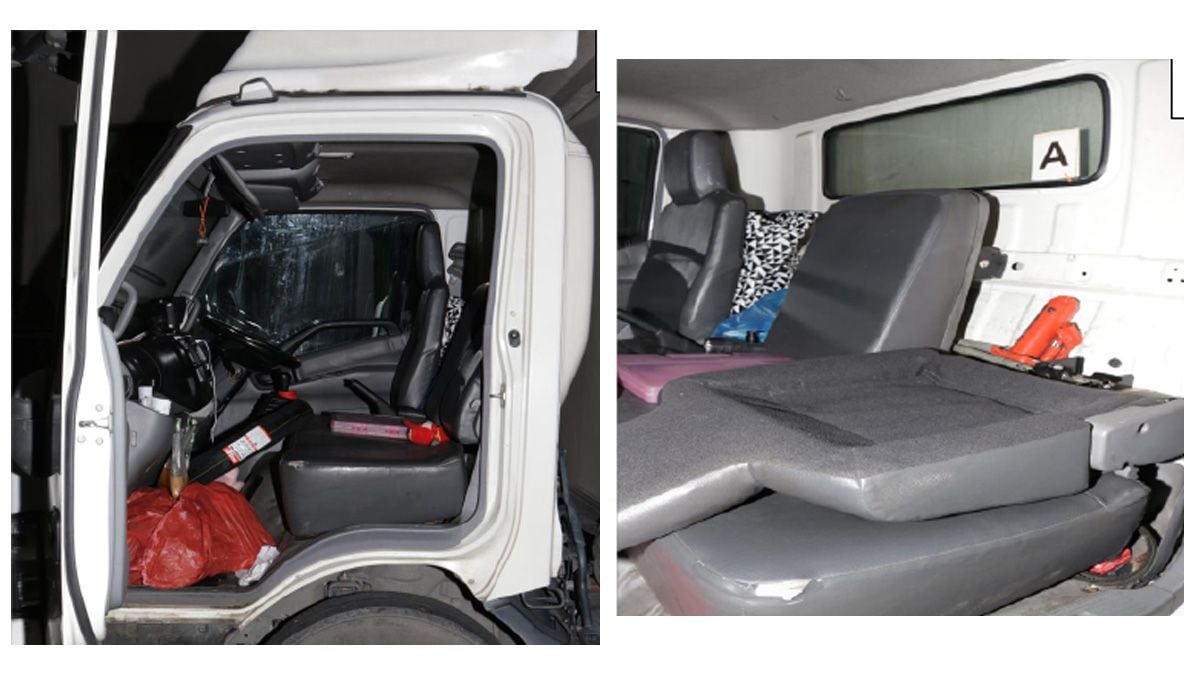
Upon arrival at Woodlands Checkpoint at approximately 5.43pm, police directed the lorry for inspection at the Cargo Clearance Centre (CCC). Singapore Immigration and Checkpoints Authority officer Checkpoint Inspector 2 R Subramaniam conducted checks on Thina and discovered a dark blue Nike bag wedged behind the front passenger seat.
Thina initially told the officer the bag was too heavy to retrieve, and took several minutes to bring it down. According to the officer's conditioned statement — admitted as hearsay evidence after his death before the trial — the bag was empty when handed over. The officer then shone his torch into the space behind the seat and found several black-taped bundles.
CNB officers who subsequently arrived recovered a total of seven black-taped bundles from the lorry cabin. One officer used a scalpel to cut open a bundle and found a brownish granular substance inside. When asked what the bundles contained, Thina replied: "chemical."
The bundles were transported to CNB headquarters for processing and subsequently sent to the Health Sciences Authority (HSA) for analysis. The HSA confirmed the presence of diamorphine and methamphetamine. A urine sample taken from Thina also tested positive for methamphetamine.
Defence: chemicals for cleaning toilets
At trial, Thina denied knowing the bundles contained drugs. He claimed a man known to him as "Deva" had handed him the Nike bag at his workplace in Johor Bahru at around 4pm on the day of his arrest, asking him to deliver it to Deva's brother "Mages" at Kranji MRT station.
Thina said Deva had told him the bundles contained dangerous chemicals that could transmit a virus if touched, and that customs authorities would at most discard the items if found. In a later statement to CNB, Thina added that Deva had told him the chemicals were for washing toilets — an account he retracted at trial, saying he had himself assumed this purpose.
The defence also argued that Thina suffered from mild intellectual disability (ID), which made him more susceptible to manipulation. Two expert witnesses — psychiatrist Dr Jacob Rajesh and clinical psychologist Ms Pearlene Lim — were called to support this contention.
Court rejects defence on all grounds
Justice Tan found that Thina had failed to rebut the statutory presumption of knowledge under section 18(2) of the Misuse of Drugs Act on any of the grounds advanced.
On Thina's conduct at the checkpoint, the court found that his delay in retrieving the bag and its empty state when handed to the officer were consistent with a deliberate attempt to empty the bundles from the bag before surrendering it. The court also found that Thina had inexplicably failed to mention the existence of any spilled bundles to the officer, behaviour inconsistent with innocence.
The court found that Thina had also lied materially about his relationship with Deva. In multiple statements to CNB, Thina had said he met Deva for the first time at a party on 17 December 2020, the night before his arrest.
Phone records obtained by the Criminal Investigation Department's Technology Crime Forensic Branch showed over 100 calls between the two men's numbers from the beginning of December 2020. Messages retrieved from his phone showed the two men were already communicating in a familiar manner hours before the party allegedly took place.
The court also found Thina's account of the bundles' contents to be wholly inconsistent. He initially denied knowing what the bundles were, then described them as chemicals, and only mentioned the cleaning purpose in a third statement recorded ten days after his arrest. He subsequently retracted even that.
A further factor was Deva's response when CNB officers, using Thina as a conduit, sent a fabricated cover story after his arrest. Rather than maintaining the chemicals narrative Thina attributed to him, Deva referred to the items as "motor parts" — a reference the court found difficult to reconcile with the defence's account that Deva had deliberately deceived Thina using the chemicals story.
Intellectual disability claim dismissed
Justice Tan rejected the mild ID diagnosis advanced by the defence, preferring the evidence of prosecution experts Dr Koh Wun Wu Kenneth Gerard, a senior consultant at the Institute of Mental Health (IMH), and Dr Jackki Yim, a principal clinical psychologist at the IMH.
On the core question of intellectual functioning, the court accepted the results of the Leiter International Performance Scale Third Edition, administered by Dr Yim, under which Thina scored 95 — within the average range. The court preferred these results over those of the Comprehensive Test of Nonverbal Intelligence administered by the defence's psychologist, under which Thina scored 72, noting expert evidence that it is far easier for a test subject to underperform than to achieve an artificially elevated score.
On adaptive functioning, the court found that Thina's difficulties in reading, writing and self-management could be explained by limited education and language difficulties, rather than cognitive impairment. The court accepted that his apparent lapses in daily habits were more consistent with attitude and a dislike of being directed than with any clinical deficit.
The court also rejected the defence's characterisation of Thina as gullible, noting that he had demonstrated the capacity to reflect on consequences and that his conduct when discovered — attempting to conceal the bundles, falsely denying knowledge, and lying about Deva — was inconsistent with someone who had naively accepted a stranger's assurances.
Sentence
Having convicted Thina on both charges, Justice Tan sentenced him to life imprisonment and 15 strokes of the cane on each charge. As the total caning could not exceed 24 strokes under section 328 of the Criminal Procedure Code 2010, the aggregate sentence of caning was 24 strokes.