Starbucks Singapore clarifies pet policy after East Coast Park outlet sign sparks online backlash
Starbucks Singapore has clarified that pets remain welcome at its stores after a sign at its East Coast Park outlet suggested animals would be banned from 25 May amid halal-certification plans.

- Starbucks Singapore said pets remain welcome despite signage suggesting a ban from 25 May.
- The notice linked the proposed restriction to the outlet’s halal-certification transition.
- Online reactions were divided over business priorities, inclusivity and pet-friendly dining policies.

Starbucks Singapore has clarified that pets will continue to be allowed at its outlets after a sign outside its East Coast Park branch triggered widespread online criticism over an alleged pet ban linked to halal-certification plans.
The controversy began after a Facebook user shared a photograph of a notice displayed outside the outlet.
The sign stated that pets would no longer be allowed in both indoor and outdoor seating areas from 25 May as part of the franchise’s transition towards halal-certified operations.
The notice added that guide dogs would still be permitted.
The image quickly circulated online, sparking debate among pet owners, Muslim customers and other social media users over whether the move reflected broader tensions surrounding pet-friendly spaces and halal requirements in Singapore.
In response to queries from Singapore media outlet 8days.sg following the backlash, Starbucks Singapore said there were “no changes” to existing store operations.
A Starbucks spokesperson said pets would continue to be welcomed on its premises.
“We apologise for any confusion caused by our earlier communication and thank our customers for their understanding,” the spokesperson said.
The company, however, stopped short of confirming whether the specific notice mentioning the 25 May implementation date would still take effect.
Instead, Starbucks said it was “currently reviewing certain aspects” of its store operations.
“As we explore how best to serve our community, we will share updates as they become available,” the spokesperson added.
Viral post fuels debate
Earlier on 11 May 2025, Facebook user Ian Lin shared the image of the Starbucks sign and criticised the proposed policy.
Lin described the alleged pet ban as “absolutely ridiculous”, arguing that dogs visiting the outdoor seating area had merely been “minding their own business”.
While acknowledging in the comments section that the decision was ultimately “a business decision” and within Starbucks’ rights as a company, Lin questioned whether the move could negatively affect the outlet’s sales.
He argued that many customers specifically visited the East Coast Park branch because of its reputation as a pet-friendly location.
Lin also suggested that while companies naturally prioritised profitability, “not everything should be about the bottom line”.
He added that large corporations should also focus on “principles” and “doing the right thing”.
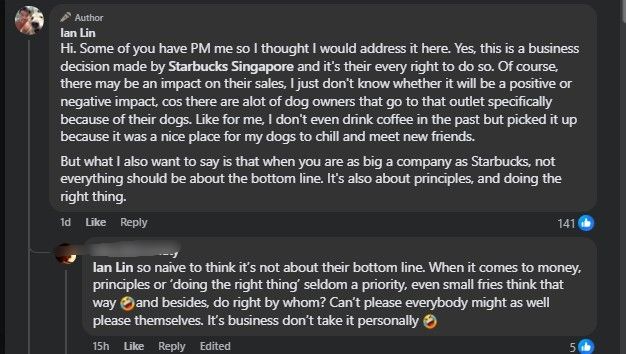
The Facebook post quickly attracted numerous responses from users with sharply differing views.
Some commenters defended the move, arguing that the decision was commercially motivated and aimed at attracting more Muslim customers through halal certification.
Several users questioned whether dog owners or Muslim patrons represented the outlet’s larger customer base.
Others suggested halal certification could help Starbucks expand both its hiring opportunities and overall market reach.
Mixed reactions from netizens
Not all commenters supported the proposed restriction.
Some users criticised the policy and pledged to stop patronising Starbucks if pets were eventually barred from outdoor seating areas.
Several claimed that pet owners formed part of Starbucks’ “premium” customer base and warned competitors such as Luckin Coffee could benefit from customer dissatisfaction.
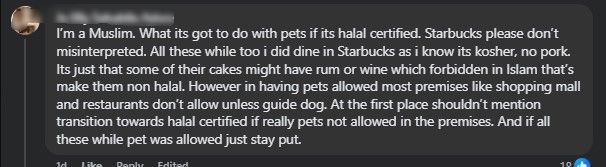
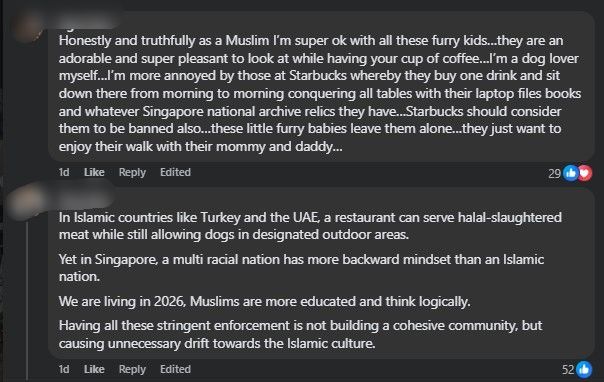
Other commenters, including some Muslims, urged social media users not to conflate halal certification with hostility towards dogs.
Some stressed that “halal is the food not the place”, arguing many Muslims were personally comfortable around dogs and warning against attempts to “spread hate towards Islam”.
A number of users also called for mutual respect within Singapore’s multi-racial society.
They argued that coexistence should not require excluding either pets or dog owners from public spaces.
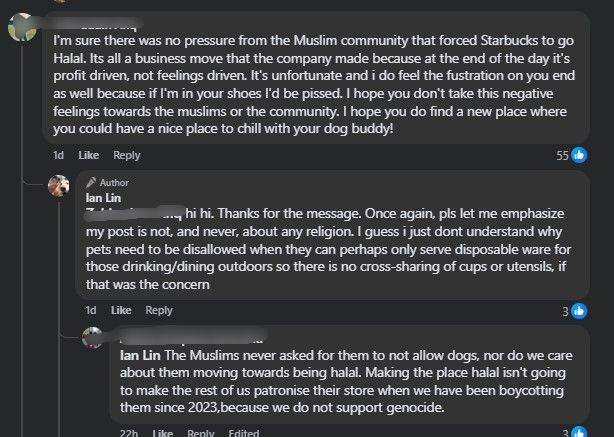
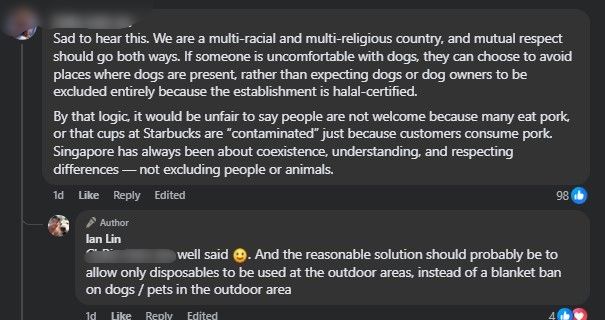
Several Muslim netizens said they understood why pet owners were upset over the proposed policy but believed the company’s decision was likely “profit driven, not feelings driven”.
Others emphasised that the move should not be interpreted as pressure from the Muslim community.
Some users pointed to countries such as Turkey and the United Arab Emirates, where dogs are still allowed in designated outdoor dining areas despite halal food being served.
Others argued Singapore should adopt a more flexible and open-minded approach towards balancing halal requirements and pet-friendly dining arrangements.
Some proposed maintaining designated “pet-friendly zones” in outdoor areas as long as animals were properly controlled and did not climb onto tables or chairs.
Others suggested Muslim customers uncomfortable around dogs could choose indoor seating areas instead.

From 1 January 2025, businesses in Singapore have been allowed greater flexibility in permitting pet dogs within outdoor dining spaces.
Under the revised rules, food and beverage outlets no longer need to apply for a pet café licence if customers bring pet dogs into outdoor dining areas, provided the businesses do not simultaneously provide food specifically for pets.
However, halal-certified establishments and restaurants remain prohibited from allowing pets into their premises, including outdoor dining sections.