Ravi Philemon urges Govt to address immigration and jobs concerns behind anti-Indian narratives
Ravi Philemon has urged the Government to address immigration and employment concerns amid debates on anti-Indian narratives online, following the blocking of 14 posts under OCHA targeting Singapore’s Indian community.

- Philemon urged Government to address immigration and jobs concerns behind online tensions.
- Authorities blocked 14 posts under OCHA targeting Singapore’s Indian community.
- Debate intensified over foreign influence, employment pressures and social cohesion concerns.

SINGAPORE: Red Dot United (RDU) secretary-general Ravi Philemon has raised criticisms and questioned Law and Second Minister for Home Affairs Edwin Tong, urging the Government to address immigration and employment concerns that he said are fuelling the spread of anti-Indian narratives online.
His remarks came in response to recent government action to block 14 online posts under the Online Criminal Harms Act (OCHA), which authorities said contained inflammatory content targeting Singapore’s Indian community.
Online posts blocked under OCHA
Singapore authorities moved to block 14 online posts assessed as containing inflammatory narratives targeting the Indian community, following directions issued under the OCHA.
The content originated from a China-based platform before spreading across multiple social media services.
The Singapore Police Force issued Disabling Directions requiring platforms including Google, Meta and X to restrict access for users in Singapore.
The intervention marked one of the latest enforcement actions against content deemed capable of inciting ethnic discord.
The Ministry of Home Affairs (MHA) said the posts included claims that Singapore’s multiracial identity was a façade and that ethnic tensions were being deliberately suppressed.
Some posts also used selectively chosen images of crowded urban areas and public events to suggest demographic displacement narratives.
According to MHA, the content escalated into assertions that Singapore was being “overrun” and relied on stereotypes and derogatory framing of Indian communities. Authorities said the material risked inflaming tensions in a multiracial society.
Government position on foreign influence
Law and Second Minister for Home Affairs Edwin Tong said there was “currently no evidence to suggest the content formed part of a coordinated campaign by any foreign government.”
He added that investigations indicated the posts were “likely generated organically by various foreign netizens,” but noted deliberate attempts to circulate them within Singapore.
“These are malicious efforts to sow discord,” he said, warning that authorities would take further action if similar content continued to spread.
Tong stressed that Singapore’s multiracial framework must not be undermined by external actors. He said social cohesion remained a foundational principle that required active protection in the digital space.
Ravi Philemon’s response on social fault lines
RDU Chief Ravi Philemon responded to the developments in a Facebook post dated 7 June, acknowledging the need to block harmful content while raising broader concerns about underlying grievances.
“We should never allow foreign forces to divide us as a society. Period,” he wrote, supporting the Government’s position on foreign interference.
However, he argued that authorities must also examine why such narratives found traction among some Singaporeans. He said, “there is no smoke without fire,” pointing to what he described as real grievances within society.
Philemon stated that these grievances were “not created by the malicious posts of foreign actors, but by what the Government itself has allowed to happen.”
He linked these concerns to perceived pressures in employment, wages, and opportunities, arguing that such issues were contributing to unease among segments of the population.
Employment pass and workforce composition concerns
Philemon cited figures suggesting that the share of Indian Employment Pass holders increased from about 14 per cent in 2005 to about 25 per cent in 2020.
He added that perceptions of rising numbers of Indian expatriates had contributed to concerns among Singaporeans regarding job competition and workplace conditions.
According to his remarks, these perceptions were shaping how people interpreted daily experiences in offices, public transport, and residential spaces.
Anecdotal accounts of social pressure
Philemon described observations from everyday environments, including crowded public transport and changing neighbourhoods, which he said some Singaporeans associated with broader economic anxieties.
He said individuals notice such shifts “when they walk through a neighbourhood they have known for twenty years” or when commuting during peak hours.
He also referred to employment insecurity, noting sentiments of workers facing retrenchment and later returning to different roles within the same organisations or industries.
“These experiences all add up,” he stated, arguing that accumulated perceptions influenced how online narratives were received.
Public reaction and comment divisions
Responses to the issue on social media reflected divided views on immigration, integration and racial identity.
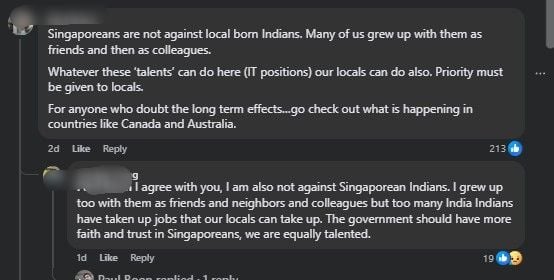
Some commenters agreed with the need to distinguish between foreign actors and local communities, emphasising that Singapore-born Indians were not the target of criticism.
Several users described long-standing relationships across ethnic groups, citing shared schooling, National Service, and workplace experiences as evidence of social cohesion.
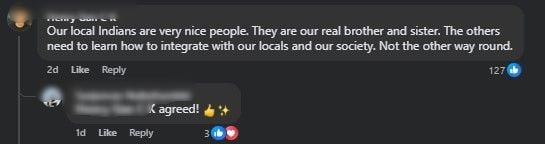
Others argued that concerns were rooted in employment competition rather than race, calling for priority to be given to citizens in hiring practices.
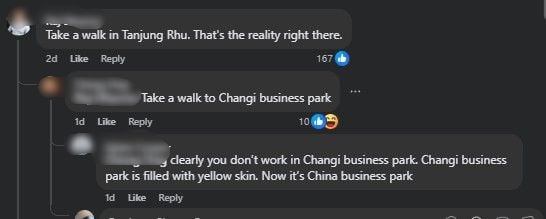
A number of comments pointed to specific districts and business hubs as examples of demographic and workplace changes over time.
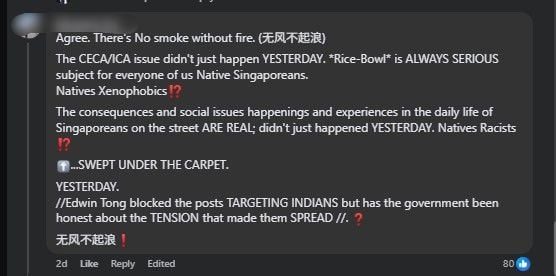
Some participants in the discussion warned against conflating policy concerns with racism, stating that immigration issues should be debated without ethnic generalisation.
Philemon’s clarification on racism concerns
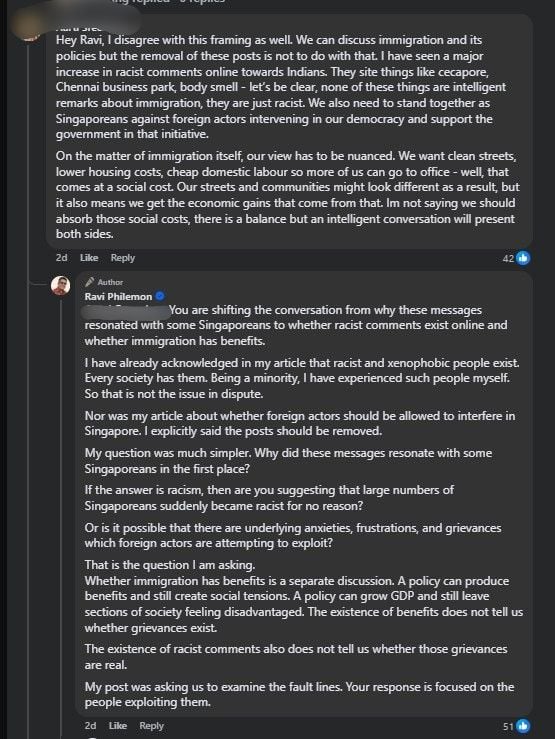
A netizen challenged Philemon, arguing that the removal of the posts was primarily about combating racism rather than debating immigration policy.
The comment pointed to a rise in derogatory remarks about Indians online and said Singaporeans should unite against foreign actors seeking to interfere in the country's social cohesion.
The commenter also argued that immigration brings both benefits and costs.
While demographic changes may create social discomfort, they also contribute to economic gains such as lower costs and labour availability, requiring a balanced and nuanced discussion.
Philemon responded that he was not disputing the existence of racism or opposing the removal of the posts.
As a minority, he said he had personally experienced racism and had already acknowledged that racist and xenophobic individuals exist in every society.
Instead, he argued that the key question was why the messages resonated with some Singaporeans.
He suggested that foreign actors were exploiting existing anxieties and grievances, and stressed that examining those underlying "fault lines" was separate from discussing the benefits of immigration or condemning racism.
Ongoing tensions in public discourse
Further comments continued to reflect differing interpretations of the issue, with some attributing concerns to policy design and others emphasising social harmony.
A segment of users argued that frustration over jobs and integration should be directed at policy frameworks rather than individuals or communities.
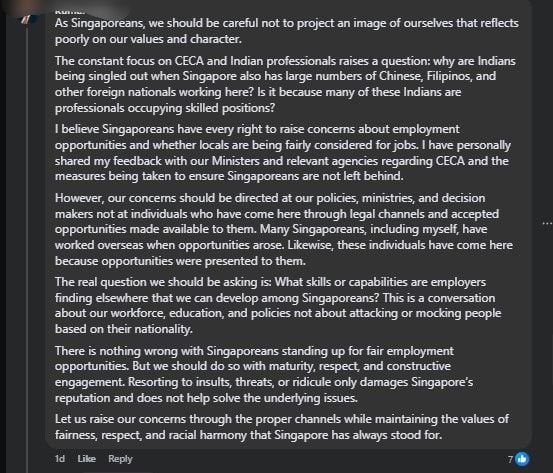
Others warned that failing to address public sentiment openly could erode trust and deepen divisions over time.