'We were heard, but were we listened to?' Petition organiser questions 17 July Maju Forest engagement session
The organiser of the Save Maju Forest petition has questioned whether residents' concerns will influence HDB's proposed Sunset Way housing plans after a nearly three-hour engagement session, calling for greater transparency, independent studies of alternatives and a pause on irreversible works.
- Residents questioned whether feedback on the proposed Maju Forest redevelopment would meaningfully influence HDB's planning decisions.
- Petition organiser Raymond Ong called for greater transparency, independent studies and a Human Impact Assessment alongside environmental assessments.
- HDB maintained that the Sunset Way housing proposal is not final and said public feedback will help shape the eventual plans.

SINGAPORE: The organiser of the "Save Maju Forest" online petition has expressed scepticism over whether residents' opposition to HDB's proposed redevelopment of Maju Forest was genuinely considered during a nearly three-hour engagement session on 17 July, arguing that participants were "heard, but were we listened to?"
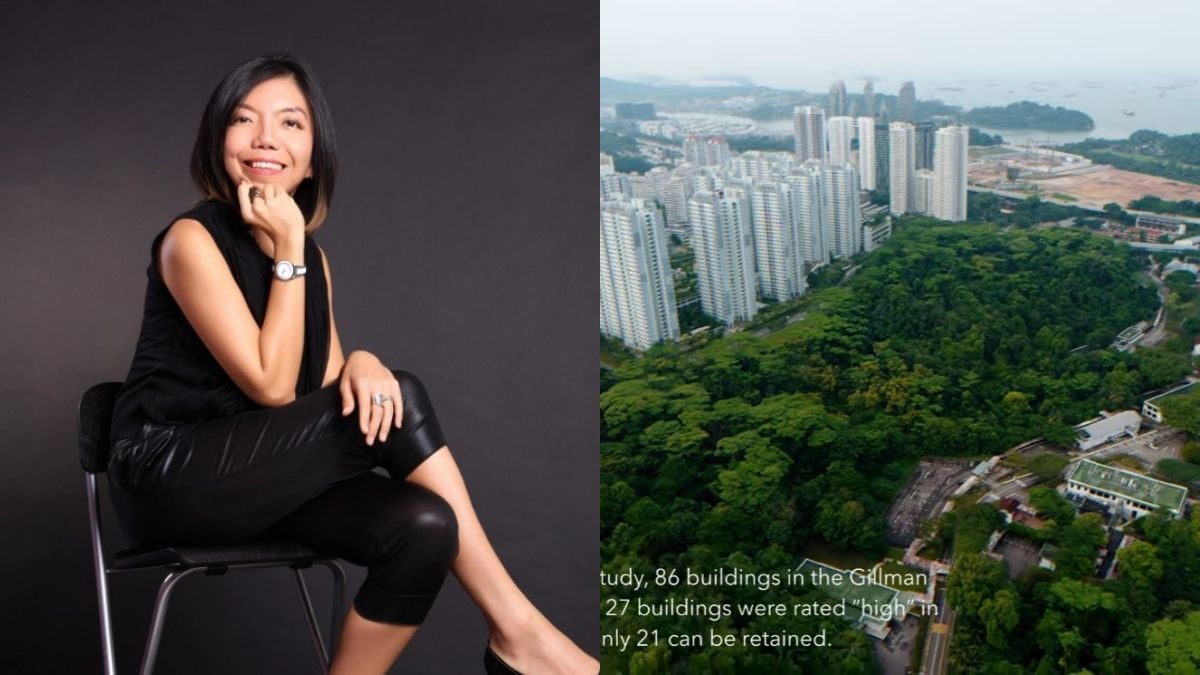
Raymond Ong, who said he attended the closed-door dialogue, also questioned the pace of the proposed redevelopment and called on HDB to publish residents' feedback alongside its responses, commission an independent study on alternative development options and the project's human impacts, and pause irreversible works until the findings are completed and made public.
The session, held at Bukit Timah Community Club, brought together representatives from the Housing & Development Board (HDB) and Members of Parliament from Holland-Bukit Timah GRC to address residents before opening the floor for questions.
The engagement came a week after HDB announced its proposed housing plans for the Sunset Way site and released an Environmental Impact Assessment (EIA) for public consultation.
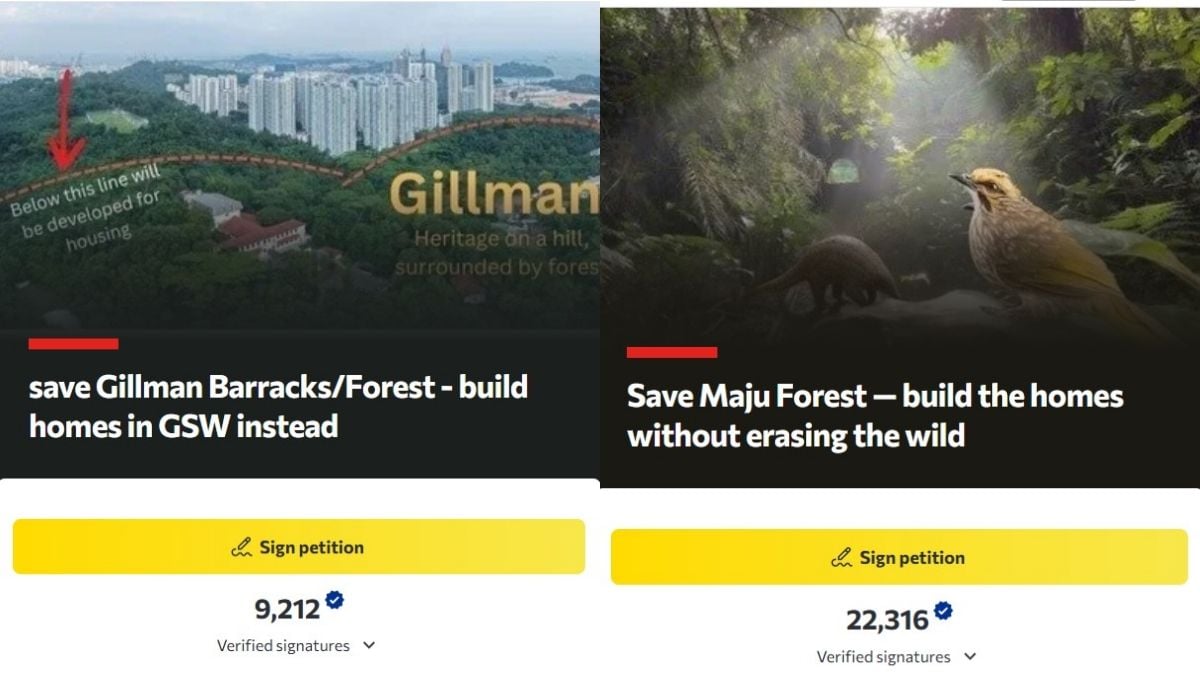
As of 4pm on 20 July, the "Save Maju Forest" online petition had attracted more than 22,200 signatures, reflecting growing public concern over the proposed redevelopment.
'We were heard, but were we listened to?'
In an update accompanying the petition, Ong said he attended the dialogue hoping HDB had drawn lessons from previous debates surrounding Dover Forest, where environmental groups and residents similarly objected to forest clearance.
"Instead, the same playbook was deployed. The plans felt already decided and the session felt like a final item on a checklist before the first tree fell," he wrote.
Ong questioned whether residents had been invited to participate in decision-making or simply to observe a process already underway.
"Were we invited to influence a decision or simply to witness one?" he asked.
He said residents arrived prepared to discuss issues extending beyond biodiversity, including education, recreation, public health, heritage and community identity.
"For three hours, my neighbours shared thoughtful concerns—environmental, educational, recreational, health, heritage, community," Ong wrote.
He added that residents spoke "with respect and love for this place" and wanted to contribute constructively to the planning process.
Despite that, he said many attendees left uncertain whether their concerns would ultimately influence HDB's plans.
"Yet a sinking feeling would not leave me: we were heard, but were we listened to? There is a difference and everyone in the room felt it," he wrote.
Calls for a Human Impact Assessment
Ong acknowledged HDB's longstanding role in providing public housing and recognised the complexity of Singapore's land use planning process.
He said residents understood that land allocation involved multiple government agencies and competing national priorities.
However, he questioned whether sufficient consideration had been given to the effects redevelopment could have on people living around Maju Forest.
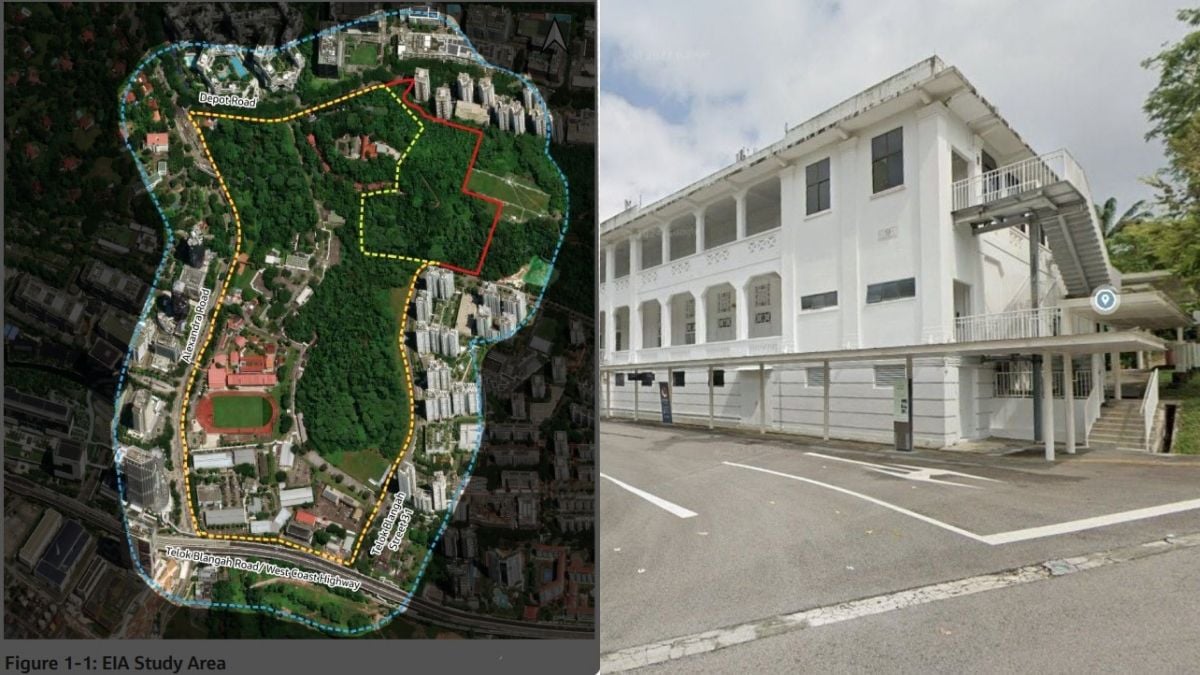
Much of the engagement session focused on the Environmental Impact Assessment, which evaluates biodiversity and ecological considerations before development.
Ong said such studies were necessary but argued they should be complemented by a Human Impact Assessment examining how redevelopment could affect residents' daily lives and emotional well-being.
He said the loss of a forest cannot be measured solely through environmental indicators.
"For the resident whose daily walk among the trees is his anchor, his peace, his medicine? For a community whose memories live in a landscape about to be cleared?" he wrote.
"Well-being, identity, belonging—these are harder to measure than flora and fauna, but no less real."
Concerns over lessons for future generations
Ong also highlighted comments made during the engagement session by an educator, who questioned what message redevelopment could send to children learning about environmental stewardship.
He noted that schools encourage students to embrace sustainability, conservation and active citizenship while teaching them that community participation can influence public decisions.
According to Ong, one question raised during the session remained particularly significant.
"How do we answer our children when they ask, 'Why did we cut down the forest?'"
He argued Singapore should ensure its actions remain consistent with environmental values promoted through education and international commitments.
Ong noted that Singapore is among more than 130 countries that have pledged to end deforestation by 2030.
He warned that if younger Singaporeans perceive public participation as symbolic rather than meaningful, they could conclude that "participation is a performance and caring is naive".
Residents question redevelopment timeline
Residents also questioned the pace of the proposed development during the engagement session.
According to Ong, some attendees asked whether the redevelopment timetable was linked to the planned opening of Maju MRT station in 2032.
Others questioned aspects of the Environmental Impact Assessment, including observations contained within the report itself and the speed at which studies had been conducted.
Ong argued that planning decisions affecting future generations should prioritise careful consideration over speed.
"The pace of development should never outweigh getting the planning right," he wrote.
"Taking time to study alternatives and weigh human impact alongside environmental impact is not delay—it is good planning."
He also argued that meaningful public engagement should occur before planning reaches a stage where major decisions become difficult to change.
"To be invited in only at the end is to be asked to say goodbye, not to decide," he said.
Residents seek greater transparency
Ong stressed that residents were not opposed to housing development but wanted greater transparency before irreversible decisions were taken.
"Good town planning is not only about optimising land, it is about the texture of human lives," he wrote.
"People are not an obstacle to planning—we are the reason for it."
He argued the central planning question should extend beyond whether development is technically possible.
"The question should not only be 'Can we build here?' but also 'Should we?'"
Ong proposed three requests for HDB.
The first was for HDB to publish all feedback collected during engagement sessions together with detailed explanations of which suggestions were accepted, which were rejected and the reasons behind those decisions.
Secondly, he called for an independent study examining alternative development options, including partial retention of Maju Forest and a Human Impact Assessment conducted alongside biodiversity assessments.
Thirdly, he urged HDB to pause irreversible works until those reviews had been completed and publicly shared.
"None of this stops development," Ong wrote.
"It simply ensures that when the first tree falls—if it must—we will know the decision was made carefully, transparently and with the people it affects."
He ended his statement by writing: "No one will care about what they have never experienced."
HDB maintains proposal remains under review
HDB has maintained that the proposed Sunset Way housing development has not been finalised and that public consultation remains part of the planning process.
Speaking to CNA on 17 July, HDB chief town planner and Group Director for Urban Planning, Dr Chong Fook Loong, said the agency continued balancing environmental concerns with Singapore's growing housing needs.
"We have to make trade-offs. We have to understand how to balance housing and nature to bring about the best plan, as we always do wherever we go," Dr Chong said.
He said strong demand for public housing required HDB to consider sites beyond previously developed land.
Pointing to the recent Clementi Build-to-Order exercise, he said applications exceeded available flats by more than four times, demonstrating continuing housing demand.
Dr Chong said HDB had prioritised brownfield sites wherever possible but noted that suitable land within Clementi and neighbouring areas had become increasingly limited.
"So, we have to now focus on Sunset Way site to see how that can help to enhance the supply," he said.
He added that planning for the site had been guided by the Environmental Impact Assessment, which identified biodiversity features to help shape development decisions.
"That plan is not final. We are working on it... through these plans and through these trade-offs, we hope to work further with residents and stakeholders," Dr Chong said.
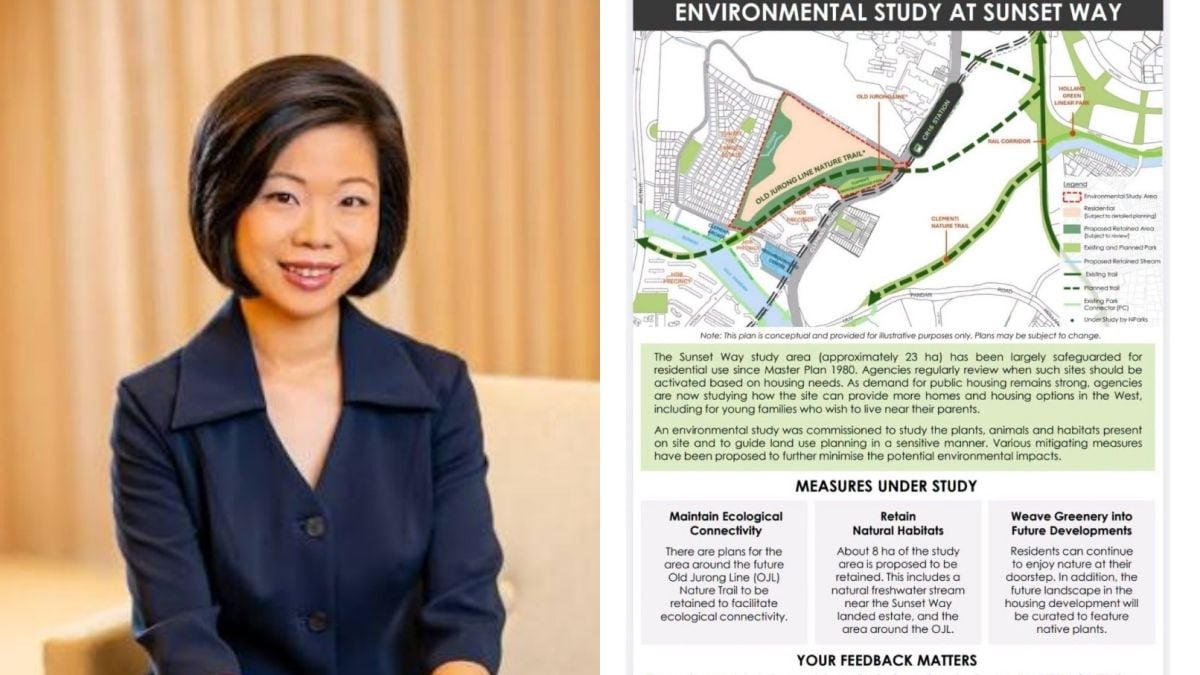
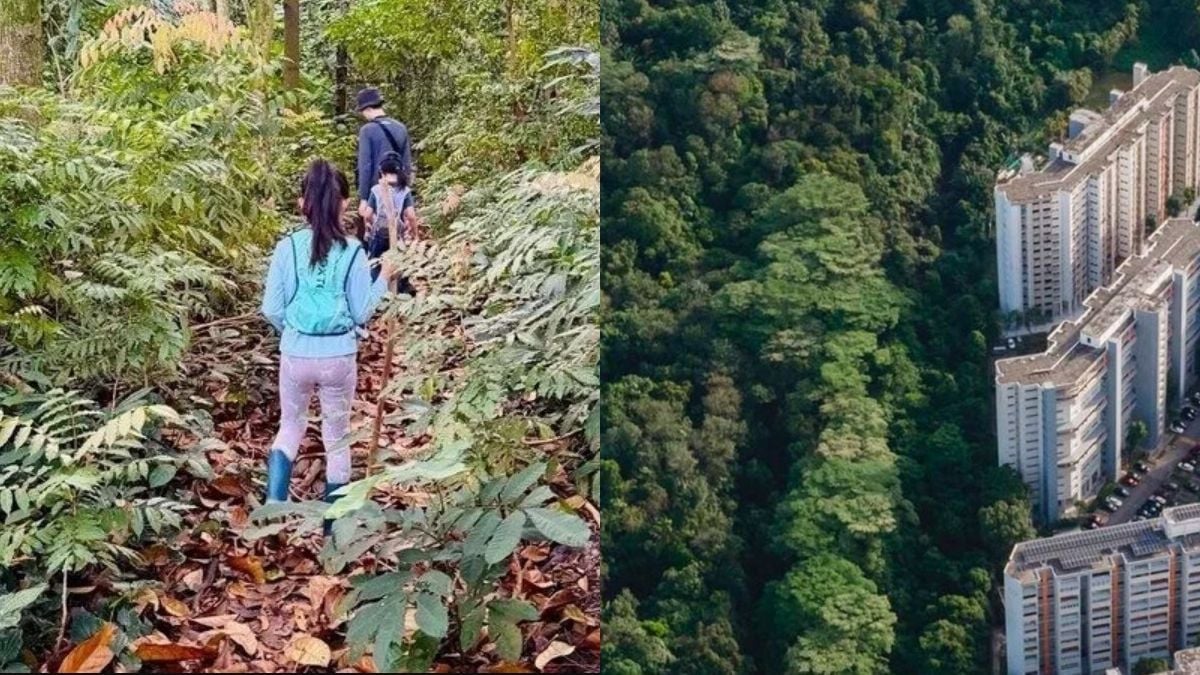
Under HDB's current proposal, about eight hectares of the 23-hectare study area, primarily along the forest edges, would be retained while the remaining land would be developed for housing.
Residents raise concerns over greenery, traffic and development
According to CNA, Senior Minister of State Sim Ann, who is also a Holland-Bukit Timah GRC MP, said the engagement session allowed residents to raise their concerns directly with government agencies.
She said residents expressed concerns over the possible loss of greenery, future traffic congestion, construction noise and the amenities that might accompany the proposed development.
CNA also reported that some residents described Maju Forest as a rare opportunity to live close to wildlife within an urban environment and urged greater protection of the forest.
Others argued brownfield sites should be prioritised before forests were cleared.
Some residents, however, supported the proposal, citing Singapore's land constraints and continuing demand for housing, although concerns about traffic remained.
Online commenters question impact of public consultation
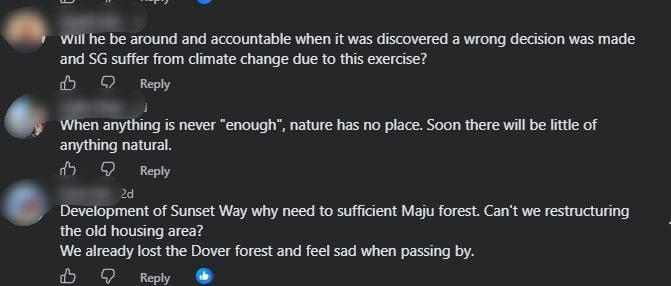
Comments posted on CNA and Mothership's social media platforms showed widespread scepticism over whether public consultation would substantially influence the final outcome.
Some commenters questioned whether the consultation exercise would result in meaningful changes, while others compared the situation with previous forest clearance cases.
One commenter wrote sarcastically: "Of course it's not final. Still deciding on what paint colour to use."
Another commented: "What they said is FINAL... whatever FEEDBACK remained as FEEDBACK.



Others called for redevelopment of older estates, taller housing blocks and greater use of already-developed land before considering forest clearance.
Environmental concerns also featured prominently, with commenters highlighting forests' role in reducing urban heat, supporting biodiversity and contributing to mental well-being.
At the same time, others acknowledged Singapore's limited land resources, arguing that policymakers faced difficult decisions balancing environmental conservation with the need to provide homes for future generations.
The Save Maju Forest petition continues encouraging members of the public to submit feedback before the consultation closes on 6 August 2026 and to write to their Members of Parliament urging greater transparency, consideration of alternative sites and protection of Maju and Clementi Forests as a connected ecological corridor while addressing housing needs.