Tan Kin Lian's grass-cutting question sparks fierce online debate over wages and dignity
A Facebook post by former presidential candidate Tan Kin Lian questioning why locals do not cut grass drew over 2,100 reactions and 1,400 comments, with most blaming low wages and social stigma.
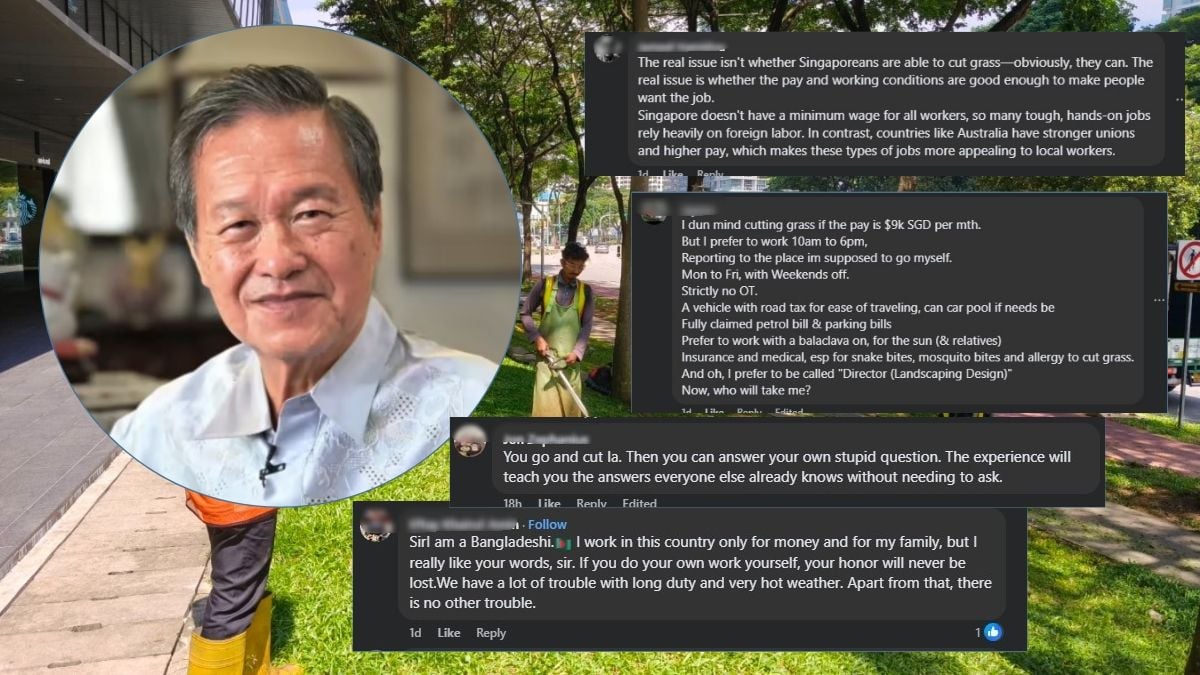
- Tan Kin Lian's post on grass-cutting jobs drew over 2,100 reactions and 1,400 comments.\
- Most commenters cited low wages, long hours and social stigma as reasons locals avoid such work.
- Some pointed to Singapore's Progressive Wage Model, which mandates wage increases for landscape workers.

A Facebook post by former presidential candidate Tan Kin Lian questioning why locals do not take up grass-cutting work has sparked a heated online debate, drawing over 2,100 reactions and more than 1,400 comments.
In the post, published on 13 June 2026, Tan shared a photograph of foreign workers trimming grass outside Aperia Mall. He asked why locals could not do the same work, and whether the reluctance stemmed from low wages, dislike of the sun, long hours or social esteem.
Tan, a former chief executive of NTUC Income, has twice contested the presidential election. His earlier social media posts have previously attracted public attention and debate.
The post quickly attracted a large volume of responses.
A significant proportion took the form of a rhetorical counter-question, with commenters suggesting that Tan, his children or his grandchildren should attempt the job themselves before asking why others would not.
One commenter wrote: "You go and cut la. Then you can answer your own stupid question. The experience will teach you the answers everyone else already knows without needing to ask."

Beyond this recurring deflection, a substantial number of commenters engaged with the question directly, and most pointed to wages as the central issue rather than an unwillingness to work.
One commenter set out a detailed list of conditions under which he would take the job, writing: "I dun mind cutting grass if the pay is $9k SGD per mth. But I prefer to work 10am to 6pm... Mon to Fri, with Weekends off. Strictly no OT... And oh, I prefer to be called 'Director (Landscaping Design)'. Now, who will take me?"

Other commenters pointed to wages they understood to be currently paid to foreign landscape workers, with figures cited ranging from around S$700 to S$1,800 a month, often alongside long hours under direct sun and limited rest days.
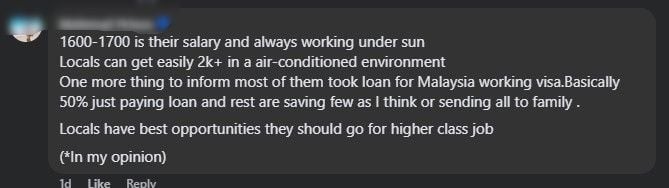



A recurring theme was that retitling such roles, combined with higher pay, would make them more attractive locally.
One commenter wrote: "Change the work title! Call it 'environmental engineer'! Title is very important! When friends ask, then at least can say he is an 'engineer'."

Education, career paths and changing expectations
Several commenters framed the issue less as a simple question of pay, and more as a consequence of how Singapore's education system and labour market have evolved.
One commenter wrote: "Our education system didn't train Singaporean to be grass cutters, factory workers, construction workers, plumbers, cooks and all the low class jobs. Even our ITE train students to be car workshop managers and not mechanic."

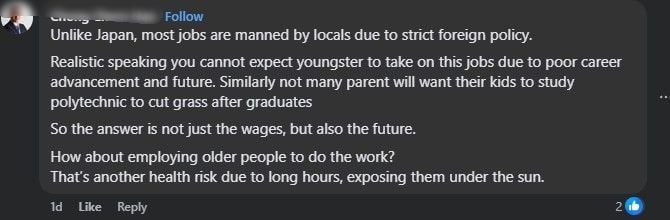
Another commenter linked this to longer-term prospects rather than wages alone, writing: "Realistic speaking you cannot expect youngster to take on this jobs due to poor career advancement and future... So the answer is not just the wages, but also the future. How about employing older people to do the work? That's another health risk due to long hours, exposing them under the sun."
A further commenter described the dynamic in more general terms, writing: "When there are better choices, you choose one that gives you maximum leverage with minimal investment. Even if these jobs are paid better, S'porean who are conscious of social stigma will still avoid it."
One commenter offered a more measured view of the trade-offs involved, writing: "Low wages and physically intensive. If there are other similarly low wage jobs but less physical, like clerk or e-hailing, people will choose those. It's just human psychology. But there are locals who cut grass or do landscaping as a business, subcontracting for local councils."
Another commenter argued that changing this would take generations, writing: "Because the Government didn't grow the community to respect these jobs. It's too late now. Probably need three generations to change the mindset."
How contracts and costs are structured
Several commenters focused on the economics faced by employers and contractors, rather than on workers' choices.
One commenter set out a cost breakdown for hiring a foreign general worker, writing that a basic salary of S$600 a month, combined with overtime, lodging, a foreign worker levy, transport and insurance, brought the total cost to a company to roughly S$3,000 a month, or around S$2,600 with a relevant skills certification.
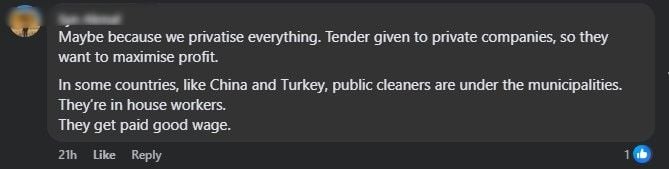
Another commenter linked this back to how public contracts are awarded, writing: "Maybe because we privatise everything. Tender given to private companies, so they want to maximise profit. In some countries, like China and Turkey, public cleaners are under the municipalities. They're in-house workers. They get paid a good wage."
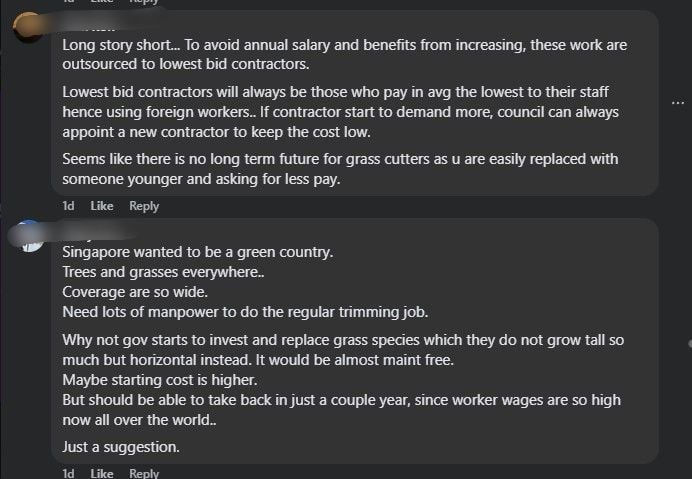
A further commenter described how landscape maintenance contracts are typically awarded, writing: "these work are outsourced to lowest bid contractors. Lowest bid contractors will always be those who pay in avg the lowest to their staff hence using foreign workers... Seems like there is no long term future for grass cutters as u are easily replaced with someone younger and asking for less pay."
One commenter offered a cross-country comparison, writing: "In many developed countries such as Australia, Canada, and United States, construction workers, landscapers, garbage collectors, electricians, and other physically demanding jobs are often done by locals because the pay is relatively high... When wages are higher and foreign labour is more restricted, more locals take those jobs."
Another commenter recalled conditions in Australia decades ago, writing that "the waste disposal worker (garbo) who comes once or twice a week to empty your bin gets paid more than a graduate doing an entry level desk job. And they work significantly fewer hours per day compared to office workers."

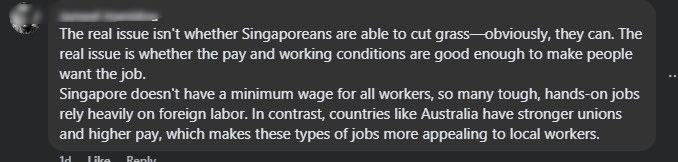
One commenter argued that the framing of the question itself was flawed, writing: "The real issue isn't whether Singaporeans are able to cut grass — obviously, they can. The real issue is whether the pay and working conditions are good enough to make people want the job. Singapore doesn't have a minimum wage for all workers, so many tough, hands-on jobs rely heavily on foreign labour."
Cultural attitudes towards manual work
A separate cluster of comments focused on social attitudes rather than wages or contracting structures.
One commenter argued that the issue ran deeper than pay, writing: "Parents push their children into university because they believe it's the path to success... The result is that around 94 per cent of young people now enter tertiary education... The problem isn't that young people are lazy. The problem is that many were given poor guidance and unrealistic expectations."
Foreign workers' perspectives
A small number of commenters identifying themselves as foreign workers also responded to the post.
One, who described himself as working in Singapore from Bangladesh, wrote: "I work in this country only for money and for my family, but I really like your words, sir. If you do your own work yourself, your honour will never be lost. We have a lot of trouble with long duty and very hot weather."

Reactions to Tan and calls for automation
Some commenters were critical of Tan personally. One wrote: "Talk is cheap and before you start commenting and do you ask yourself will you do it too." Others took a more measured tone, with one commenter writing that Tan should "rethink your content before posting it on social media", arguing it did not reflect well on him.
A number of commenters also raised automation as a longer-term solution, suggesting mechanical or robotic mowers could reduce reliance on manual labour, though others noted cost had so far limited adoption of such equipment.

Tan has not issued a further public response to the comments at the time of writing.

Background on landscape sector wages
Separately, Singapore's landscape maintenance sector is covered by the Progressive Wage Model, a framework developed by the Tripartite Cluster for Landscape Industry that sets minimum monthly basic wages and training requirements for workers in the sector.
The Progressive Wage Model is mandatory for Singapore citizens and permanent residents employed in outsourced landscape maintenance roles by companies on the National Parks Board's Landscape Company Register, as well as for in-house landscape staff at firms that also employ foreign workers.
Under the published schedule, the minimum monthly basic wage for a landscape worker rises from S$1,750 in the period from 1 July 2023 to 30 June 2024, to S$2,385 by 1 July 2028.
For landscape technicians, the minimum wage over the same period rises from S$2,010 to S$2,810. For assistant landscape supervisors and landscape specialists, it rises from S$2,215 to S$2,965, and for landscape supervisors and senior landscape specialists, from S$2,600 to S$3,380.
These mandatory wage floors apply only to Singapore citizens and permanent residents. Employers are encouraged, but not required, to extend similar wage progression to migrant workers performing the same landscape maintenance roles.
The gap this can create has been documented by the migrant worker advocacy group Transient Workers Count Too (TWC2). In a 2023 account, TWC2 reported that a migrant gardener working at the Singapore Botanic Gardens, a UNESCO World Heritage site, was paid a basic rate of S$14 a day, equivalent to S$1.75 an hour, plus a S$7 daily allowance.
TWC2 attributed this to a tendering system in which landscape maintenance contracts are typically awarded based on the lowest bid, which it said places downward pressure on wages for migrant workers employed by contractors. TOC was unable to independently verify whether these specific rates remain current.
Separately, the median monthly household income in Singapore rose to S$12,446 last year, up from S$11,558 the previous year, an increase of 6.8 per cent in real terms, according to the Singapore Department of Statistics.
After adjusting for household size, median income per household member rose by 7.5 per cent, from S$3,837 to S$4,160.