Social media overtakes news websites globally as trust falls to record low, Reuters Institute finds
The Reuters Institute's 2026 Digital News Report finds social media and video networks have overtaken news websites and apps as the most widely used source of online news globally, while trust in news has dropped to its lowest level since 2015.
- Social media and video networks now top news sources globally, used by 54% of audiences.
- Trust in news has fallen to 37%, the lowest level recorded since 2015.
- AI chatbot use for news has risen to 10%, concentrated among younger, engaged audiences.

For the first time, social media and video networks have overtaken news organisations' own websites and apps as the most widely used way of accessing online news globally, according to the Reuters Institute for the Study of Journalism's 2026 Digital News Report.
The report, published on Tuesday, 16 June 2026, draws on survey data averaged across 48 markets. It found that social media and video networks were used for news by 54% of respondents, ahead of news websites and apps at 51%. Television news stood at 52%. Adding AI chatbots brings the combined third-party total to 56%.
The report's authors describe the development as a significant milestone in the long-running drift of news consumption away from traditional sources towards platforms. They note it is better understood as a gradual drift rather than an abrupt shift, but an important moment nonetheless.
Use of both television news and news websites and apps has fallen by 13 and 12 percentage points respectively since 2020. The report observes that while the relative decline of television is well recognised across the industry, the comparable decline in the use of news websites and apps is less widely acknowledged.
The shift is occurring across all age groups, though it is most pronounced among the young. Globally, 52% of respondents aged 18 to 24 now say social media, video networks, and AI chatbots are their main way of getting news, 32 percentage points ahead of the next most popular source.
According to the report, social media and video networks are now the main source of news for 30% of people globally, up from 22% five years ago. The proportion relying only on these platforms for news has doubled since 2020 to 12%.
The authors caution that not all of this growth is demand-led. They note that Meta publicly stated in 2025 that it would increase the volume of news content on Facebook, which is likely to have affected reported usage levels.
The report situates these findings within a wider mood of unease as audiences react to political, economic, and technological turbulence. The authors note that assumptions about the international order are being questioned even as artificial intelligence spreads rapidly through everyday life and the effects of climate change are increasingly felt.
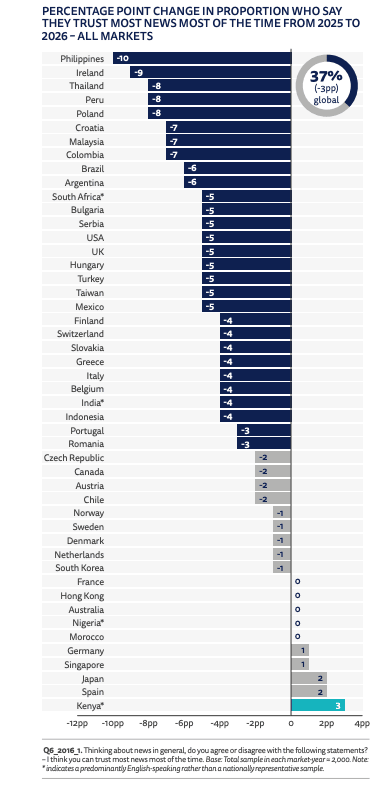
Trust in news fell in 29 of the 48 markets surveyed, dropping by five percentage points or more in 19 of them. Overall trust fell to 37%, the lowest level recorded since the institute began measuring it in 2015. In the United States, only a quarter of people now say they trust the news most of the time, and trust among right-leaning Americans sits at just 15%.
The report attributes part of this decline to wider scepticism about political and social institutions, alongside direct attacks on journalists by high-profile politicians. It cites the Edelman Trust Barometer, which reported a 16-percentage-point net fall in trust in national government leaders this year.
Countries with some of the largest drops in trust, including the Philippines, Thailand, Peru, and Poland, share characteristics of political instability, divisive elections, and fragmented information environments. The authors note that trust in the most widely used individual news brands is holding up better than trust in news overall.
The report also identifies a "trust gap": news consumed via social media and AI chatbots is trusted at 22% and 20% respectively, well below trust in news overall. As consumption drifts towards these less-trusted platforms, the report suggests overall trust is likely to fall further.
Respondents in 26 markets were asked how influential they considered various groups to be on the news. Politicians and government officials were seen as the most influential, but the owners of news media companies were also considered to have significant influence. In the United States and Australia, the influence of media owners was felt to be more significant than that of any other group.
Concerns about false or misleading information rose by four percentage points to 62% globally. Every Western European market recorded an increase of at least four percentage points, with the largest rises in Belgium at nine points, the Netherlands at eight points, and Norway at seven points. Worries remained highest in Nigeria and Kenya.
The use of AI chatbots such as ChatGPT, Perplexity, and Google Gemini for news grew from 7% to 10% year on year. Usage is concentrated among younger audiences, with 16% of under-35s reporting use. South Korea, Greece, and Spain saw use double, while the United States, the United Kingdom, France, and Germany reported no increase. Usage in the United Kingdom was the lowest of any market at 4%.
The report characterises AI chatbot users as a highly engaged, digitally sophisticated segment, with 38% falling into its "news lover" category compared with 22% of respondents overall. The most popular feature, cited by 42% of users, was the ability to ask follow-up questions. Overall, 42% of chatbot users said they always or often click through to original news sources.
Online video consumption continued to expand. The report found that 77% of people globally now consume online news video each week, with a majority watching online news video in all 48 markets for the first time. In 45 markets, more people now watch online news video than broadcast television news. The Netherlands, Denmark, and Germany were the only exceptions.
This growth is concentrated on third-party platforms. Video consumption on news organisations' own sites and apps fell by five percentage points to 23%. Facebook remained the largest platform overall for news at 43%, reversing recent declines, followed by YouTube at 34% and Instagram at 26%. TikTok, growing fastest from a small base, was used for news by 20% globally.
The report notes a new role for news on the television set, with 27% of respondents across 27 markets watching on-demand news via apps such as YouTube on their smart televisions.
Independent news creators and influencers featured prominently in this year's report. Around 27% of respondents said they obtained some news from news-focused creators, rising to 46% for creators of any type. Audiences described creators as more entertaining, easier to understand, and more relatable, but less trustworthy and less impartial than established outlets.
Most people who follow creators do so alongside traditional media rather than instead of it, the report found. Of the 27% who consume news from news-focused creators, 47% said most or all of their news needs were met by them, equating to 13% of people globally. Only 3% of respondents rely solely on creators for their news.
The report observes that the creator sector is professionalising, with the most successful operators evolving from sole operators into media businesses. It cites the sale of Bari Weiss's The Free Press to CBS for an estimated US$150 million as an illustration of the blurring line between alternative and established media.
The report identified four Asian markets where news websites and apps still lead social media and video networks: Singapore, Taiwan, South Korea, and Japan. The remaining markets with this pattern are all in Europe. Creator use was also lowest in Europe and Japan, though usage in line with the global average was noted in European markets with press freedom challenges such as Hungary and Serbia.
Interest in news continued its decline. The proportion of people saying they are extremely or very interested in news has fallen by 13 percentage points across surveyed markets since 2021, from 59% to just under 46%. A quarter of respondents are now described as casual or passive news users, up from 16% in 2021. News avoidance was essentially flat at 42%.
The report also raised concerns about referral traffic. Citing data from the analytics company Chartbeat, it reported that Google traffic from organic search to over 2,500 sites fell by a third globally between November 2024 and November 2025, and by 38% in the United States. Publishers expect traffic from search engines to almost halve over the next three years.
On paying for news, the report found little change, with 17% of people across a basket of 20 tracked countries paying for online news. Norway and Sweden remained outliers at 40% and 32% respectively. Ireland and Australia were the only countries outside the Nordics where more than 20% of people pay, and the two markets where paying has grown most since 2020.
The report found that 46% of those who pay cited social or values-based motivations, such as supporting journalism because of its importance to society, alongside more direct, transactional reasons. Finland and Canada sat at opposite ends of this spectrum, with payment understood largely as a functional transaction in Finland and as a more values-laden choice in Canada.
Despite these pressures, the report found enduring support for impartiality. Almost half of respondents, 45%, said they prefer news that does not take sides, outnumbering those who prefer news aligned with their views by more than two to one. A similar share said consuming non-partisan news was best for others in society.
The report also examined attitudes towards public service media across 26 countries with established providers. Overall sentiment was favourable, with 37% considering public service news to have a positive effect against 22% who saw it as negative.
Net positivity was strongest in the Nordic markets and Portugal, while France and Slovakia recorded net negative attitudes. Political leaning emerged as a key dividing line, with right-leaning respondents generally most likely to take a negative view.
The Digital News Report, now in its fifteenth year, is produced by the Reuters Institute for the Study of Journalism, based at the University of Oxford. The report concludes that audiences continue to value journalism and core news values even amid falling trust, and that the opportunity for news organisations lies in helping people make sense of rapid global change rather than in producing ever more content.