‘Please do it at home first’: Japan gender advocate challenges World Cup clean-up praise
Japanese football supporters earned widespread praise for cleaning stadium stands after a World Cup match in Texas, but the viral celebration has triggered a wider debate about gender equality and the unequal distribution of household labour in Japan.
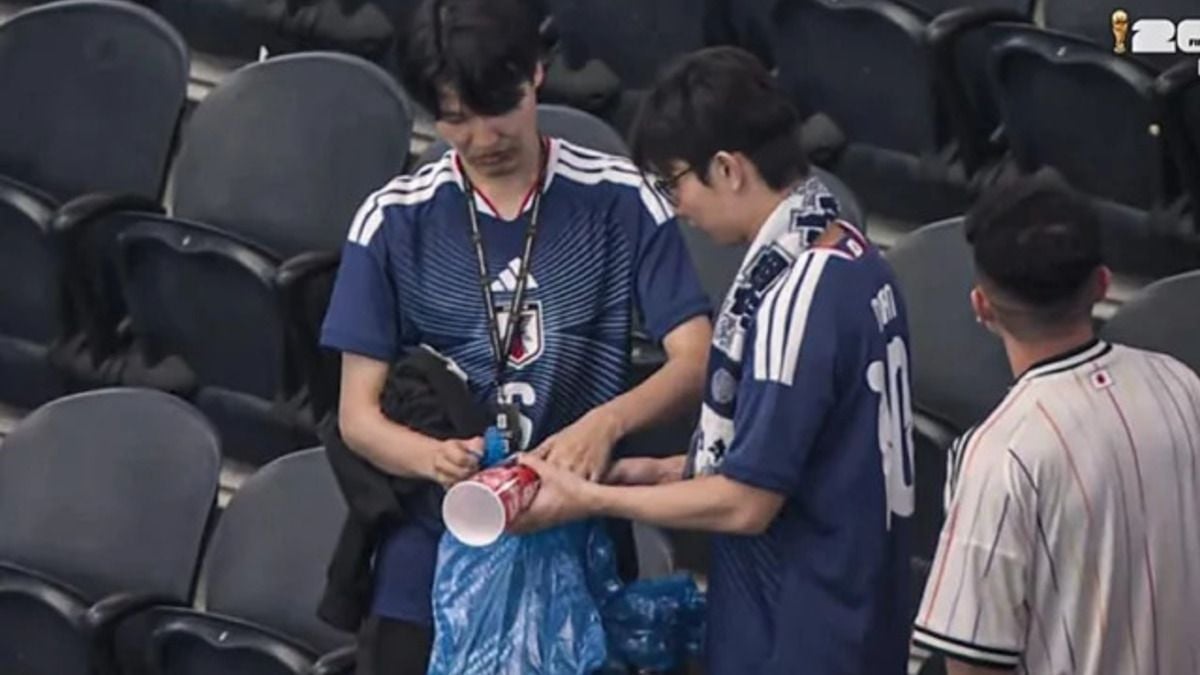
- Japanese supporters received international praise for cleaning stadium stands after a World Cup match.
- A viral social media post linked the celebration to concerns about unequal domestic labour in Japan.
- The debate highlighted longstanding concerns over household and childcare responsibilities.

Japanese football supporters have once again won international praise for cleaning up stadium stands after a World Cup match, but this time the feel-good story has evolved into a wider debate about gender equality and domestic labour in Japan.
The discussion began after Japan’s supporters were filmed collecting rubbish following their national team's 2-2 draw against the Netherlands in a FIFA World Cup 2026 group-stage match in Arlington, Texas, on June 14.
Videos and photographs of fans filling blue rubbish bags and leaving the stadium spotless quickly spread across social media, drawing admiration from football fans around the world.
The practice has become a familiar feature of Japanese participation at major international tournaments and is often cited as an example of civic responsibility and respect for public spaces.
Many online users praised the supporters' actions.
On social media, comments described Japanese fans as “the best in the game” and a model for other football supporters.
Similar sentiments appeared across Reddit and X, where users applauded the fans for leaving venues cleaner than they found them.
However, the praise was soon met with criticism from some Japanese social media users, who argued that the stadium clean-up narrative overlooks inequalities inside many households.
The backlash gained traction after Japanese commentator and gender equality advocate Atsuko Tamada shared an AI-generated parody of Tokyo Metro’s etiquette posters.
The image showed a Japanese football supporter relaxing on a sofa while a woman washed dishes in the background. Accompanying text urged men to “do it at home first,” suggesting that public displays of cleanliness do not necessarily translate into an equal sharing of domestic responsibilities.
According to reports summarising the viral post and ensuing discussion, Tamada argued that many of the men celebrated online for cleaning football stadiums contribute little to household chores or childcare at home. Her post quickly accumulated hundreds of thousands of views and prompted a broader conversation about performative public behaviour versus private responsibilities.
The criticism resonated with comments already appearing beneath videos celebrating the clean-up effort.
One widely shared response beneath a World Cup-related post bluntly stated: “Most of them don’t do that at their own home,” reflecting a view that public acts of civic-mindedness can coexist with traditional gender expectations within families. Similar comments questioned whether the behaviour reflected genuine social progress or simply adherence to public norms.
The debate also spread to online forums. While many users continued to praise the tradition, others argued that Japan’s image as a highly orderly society can sometimes mask deeper social issues.
In one discussion thread, a commenter who claimed to have lived in Japan for a decade argued that the country's emphasis on maintaining a positive public image should not be confused with broader social equality.
Another user noted that while public spaces are often kept tidy, litter and other problems can still be found in less visible areas.
Others pushed back against the criticism, arguing that cleaning stadiums remains a positive act regardless of broader social shortcomings.
“Leaving a stadium cleaner than you found it is hard to criticize,” one Reddit user wrote, suggesting that a good public habit should not automatically be dismissed because other problems persist.
Another observed that the tradition has become such a recognisable part of Japan’s World Cup identity that it now attracts scrutiny alongside admiration.
The controversy comes against the backdrop of longstanding concerns about the unequal distribution of unpaid labour in Japan.
Data from the Organization for Economic Co-operation and Development (OECD) shows Japanese men spend among the least time on unpaid domestic and care work among developed nations.
Government surveys have similarly found that women continue to shoulder the overwhelming majority of housework and childcare responsibilities.
As a result, what began as another viral celebration of Japanese football fans has evolved into a broader conversation about whether public courtesy should also be reflected in private life.
For some observers, the stadium clean-up remains a commendable example of collective responsibility.
For others, the attention it receives highlights an uncomfortable contrast between the image of civic-minded men tidying football stands and the reality of domestic labour that many Japanese women say remains disproportionately their responsibility.