Singapore among top destinations as wealthy Americans seek residency and citizenship abroad in 2026
A growing number of wealthy Americans are seeking residency and citizenship abroad as geopolitical uncertainty, tax concerns and global instability fuel demand for international diversification. Singapore, Italy and New Zealand are among the leading destinations identified in a new report.
- Applications from US citizens for residency and citizenship-by-investment programmes doubled in 2025 and remain high in 2026.
- Singapore and New Zealand rank among the world's most competitive destinations for internationally mobile wealth.
- Wealthy individuals are increasingly building multi-country “sovereign portfolios” instead of relocating to a single nation.

SINGAPORE: Affluent Americans are increasingly seeking residency and citizenship opportunities overseas as political uncertainty, global conflicts and long-term wealth preservation concerns drive demand for international diversification, according to a new global wealth mobility report released on 16 June 2026.
The Henley Private Wealth Migration Report 2026 found that demand for additional citizenship, residency and investment opportunities abroad has reached unprecedented levels among wealthy US citizens, reflecting a broader shift in how high-net-worth individuals manage their personal and financial affairs.
According to the report, internationally mobile investors are no longer focused on relocating to a single destination.
Instead, they are constructing what researchers describe as “sovereign portfolios” consisting of residence rights, citizenships, investments and business interests spread across multiple jurisdictions.
A new approach to global mobility
The report identified the United States as one of the most significant wealth mobility flashpoints in 2026.
While the country remains the world's largest creator of private wealth, it is also generating record demand for residence and citizenship alternatives as affluent Americans seek greater flexibility and international access.
Dr Parag Khanna, founder and chief executive of data analytics firm AlphaGeo, which contributed to the research, said wealthy individuals are increasingly adopting a portfolio approach to residency and citizenship.
“The wealthy individual of 2026 is no longer selecting a single country; they are constructing a portfolio of jurisdictions,” Dr Khanna said.
The trend reflects a growing desire among wealthy families to reduce concentration risk by diversifying where they live, invest and conduct business.
According to Henley & Partners, applications from US citizens for residence and citizenship-by-investment programmes, often referred to as “golden visas” and “golden passports”, doubled in 2025.
Demand has remained elevated throughout 2026.
The report noted that only 7% of applications submitted by US citizens originated from Americans already living abroad, indicating that interest is overwhelmingly being driven by residents within the United States rather than expatriates.
Leading destinations for mobile wealth
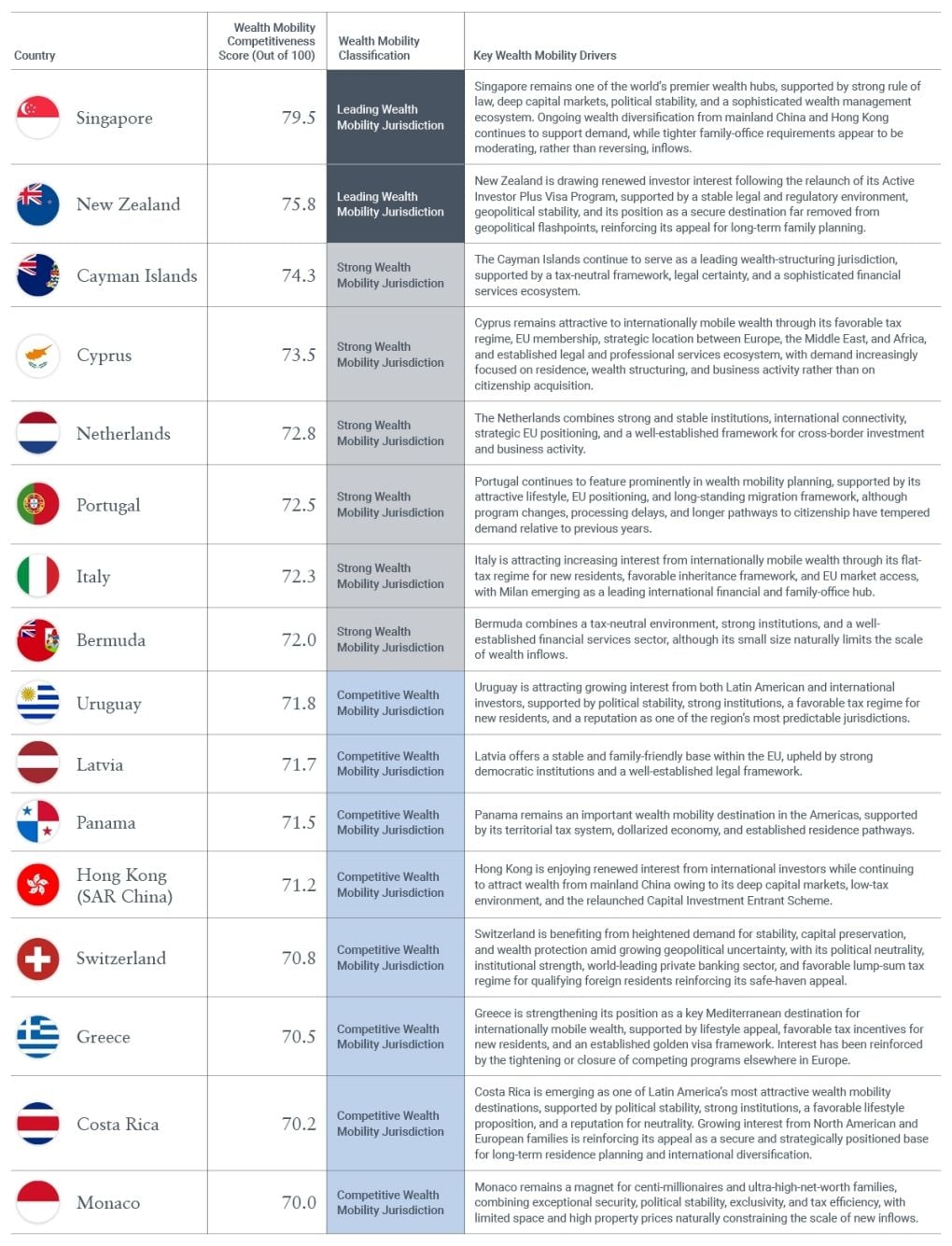
Singapore emerged as one of the strongest-performing jurisdictions in the report, recording a Wealth Mobility Competitiveness Score of 79.5 out of 100.
The city-state continues to strengthen its position as a major global wealth hub despite introducing stricter entry requirements and higher thresholds for family offices.
According to the report, Singapore's appeal is underpinned by political stability, strong institutions, sophisticated financial infrastructure and deep capital markets.
Researchers also highlighted its neutral geopolitical stance and continued inflows of wealth from Hong Kong, mainland China and Indonesia.
Although tighter family office regulations have reduced emphasis on volume growth, the report noted that the measures have encouraged higher-quality and longer-term capital commitments.
Despite challenges including limited physical capacity and tax rates that are competitive rather than among the world's lowest, Singapore remains Asia's preferred destination for multi-generational wealth planning.
New Zealand ranked second among the report's standout performers with a score of 75.8.
The country has attracted renewed investor attention following reforms to its Active Investor Plus Visa Programme.
Researchers cited New Zealand's strong rule of law, political stability and attractiveness for long-term family planning as key drivers of interest.
Europe remains a major draw
Europe continues to dominate preferences among wealthy Americans seeking alternative residency and citizenship options.
Almost half of all applications submitted by US nationals are directed towards European programmes, according to the report.
Portugal and Italy emerged as the two most popular destinations among American applicants.
Italy was highlighted as one of Europe's strongest wealth mobility success stories in 2026.
Interest has been supported by the country's flat-tax regime for new residents, favourable inheritance tax framework and access to the European Union market.
The report also pointed to Milan's growing importance as an international financial centre and a hub for family offices.
Other highly competitive destinations identified in the report included Cyprus, the Netherlands, Portugal, Switzerland, Greece, Monaco, Latvia and Hong Kong.
Switzerland has benefited from growing demand for wealth preservation and stability amid heightened geopolitical uncertainty.
Hong Kong is also experiencing renewed momentum as investor migration demand and family office activity recover.
Greece has emerged as a notable beneficiary of recent changes to Europe's investment migration landscape following Spain's closure of its golden visa programme and Portugal's withdrawal of its real estate-linked investment route.
The report suggested that when governments restrict established migration pathways, demand often shifts to alternative jurisdictions rather than disappearing altogether.
Beyond Europe
While Europe remains the preferred destination for many Americans, interest is also growing elsewhere.
More than a quarter of applications from US citizens target programmes in Latin America and the Caribbean.
Meanwhile, jurisdictions such as Uruguay, Panama and Costa Rica are increasingly competing for globally mobile investors seeking alternative options.
The report also identified the Cayman Islands and Bermuda among strong performers in attracting international wealth.
Global demand continues to broaden
Demand for investment migration programmes is not limited to Americans.
During the first half of 2026, Henley & Partners received applications representing 86 nationalities across 47 investment migration programmes worldwide.
Basil Mohr-Elzeki, managing partner and head of private clients Americas at Henley & Partners, said wealthy families are increasingly seeking structures that reduce dependence on any single government or jurisdiction.
“The objective is to ensure that no single government holds the whole of a family’s life and capital,” Mohr-Elzeki said.
He added that the combination of political tensions in the United States and ongoing international conflicts has encouraged many affluent individuals to consider additional residency and citizenship options.
For many families, overseas residence rights provide a sense of security and continuity in an increasingly unpredictable world.
“What used to be a simple precaution, a single spare passport set aside for emergencies, has become a deliberate discipline,” Mohr-Elzeki said.
As geopolitical uncertainty, fiscal reforms and economic competition reshape migration patterns, the report suggests that wealthy individuals are becoming increasingly strategic in how they structure their global presence.
Rather than choosing one destination, they are building diversified international portfolios designed to provide flexibility, resilience and long-term access across multiple jurisdictions.