Why must a Teochew film be dubbed? Singapore's dialect rule and the threat that is now hard to find
A Teochew blockbuster sold out 4,800 tickets in two hours, yet its general release here is dubbed into Mandarin — and two of Singapore's best-known filmmakers have asked why. We examine the history, the linguistic science and the comparative record, and ask what threat the rule still answers in 2026.


When the Teochew-dialect film Dear You opened in Singapore, the response was immediate. According to The Straits Times, all 4,800 tickets for eight original-dialect sessions at VivoCity sold out within two hours of going on sale on 16 June 2026.
Some fans said they would cross the Causeway to Johor Bahru to watch the original cut rather than the version showing in local cinemas.
That is because the general release here, which opened on 18 June 2026, is dubbed into Mandarin. The Teochew version was permitted at the premiere and is to be made available at subsequent festival and niche screenings only.
The film itself is an unlikely flashpoint. Made on a modest budget with a largely non-professional cast, it has grossed more than 1.6 billion yuan in China. Its narrative thread is qiaopi, the remittance letters that Chinese migrants once mailed home alongside money, often taking a month or more to travel each way.
It is a film about the connective tissue of a diaspora. And in Singapore, the language that carries that story must, for the general public, be overwritten.
The decision has drawn a notably prominent intervention. In a letter to The Straits Times Forum on 19 June 2026, two of Singapore's best-known filmmakers, Eric Khoo and Jack Neo, urged the authorities to relax the rule. They argued that screening a dialect film is now no different from screening a French or Malay one, that dialect content is freely available on streaming platforms, home video and even in-flight, and that cinemas alone should not bear an outdated policy.
Their case was made largely on commercial and industry grounds, and it accepted that the Speak Mandarin Campaign had succeeded. Our concern here is narrower and more basic: not whether the rule should be relaxed as a reward for success, but what policy problem the rule is still solving.
Singapore's application of the policy has never been entirely absolute. Dialect dialogue has appeared in local productions, and exceptions have been granted in defined contexts. The question raised by Dear You is therefore not whether dialect can ever be shown, but why a fully dialect film intended for general commercial release continues to attract different treatment.
The Online Citizen has tried to understand the reasoning behind this requirement. We set out below what we found, and we say plainly where we remain unable to follow the premise.
What IMDA said
Responding to queries from The Straits Times, an Infocomm Media Development Authority (IMDA) spokesperson said the Teochew version could screen at the premiere and at festival or niche events, providing access for those who wish to view the film in its original language.
The authority said this "continues to support the bilingual policy which aims to promote Mandarin as the main language among Chinese Singaporeans". It added that films featuring dialect content are allowed only on a case-by-case basis.
We have read this response closely. It tells us what the policy is and that decisions are made case by case. It does not tell us what a ticketed, opt-in dialect screening for a general audience is feared to cause.
The bilingual policy aims to promote Mandarin; that is the stated purpose. But the question we were asking is the mechanism: how does a member of the public choosing to watch a Teochew film undermine that purpose in 2026? On this, the explanation does not shed light.
Where the rule comes from
The framework is set out in the broadcasting codes. The free-to-air code provides that all Chinese programmes, except operas or other programmes specifically approved by the authority, must be in Mandarin.
The subscription television code is more granular. It requires all content on Chinese services to be in Mandarin, with limited exceptions: operatic performances, one dialect art-house film per week per channel, up to 30 per cent of songs in a music hour, and incidental dialogue where context justifies it.
The theatrical position IMDA described to The Straits Times follows the same logic: dialect permitted in confined, defined settings; Mandarin required for the general release.
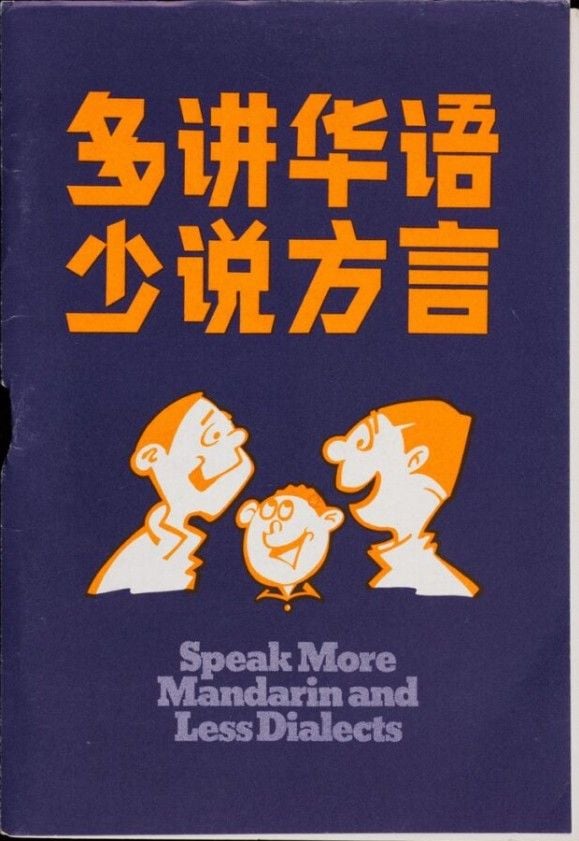
These rules trace to 1979 and the Speak Mandarin Campaign. The campaign restricted dialect in film, television and radio. By 1981, dialect programming had largely been removed from broadcast.
The architect's own reasoning
The clearest statement of why comes from the campaign's architect. At its 1984 launch, then Prime Minister Lee Kuan Yew set out a cognitive premise.
"Few children can successfully master two languages plus a dialect," he said. "Indeed very few can speak two languages equally well. The reason why most societies are monolingual is simple: most human beings are equipped by nature to cope with only one language."
The argument was that a dialect imposed a load that displaced Mandarin and English. Lee returned to this idea decades later, describing dialect in 2009 as data occupying mental capacity that should be reserved for the official languages.
This is the premise on which the rule rests. It is worth testing, because much follows from whether it holds.
What the evidence suggests
Modern linguistics offers little support for a simple fixed-capacity model in which a dialect necessarily crowds out Mandarin and English. The difficulty of acquiring a language depends heavily on how closely it relates to languages already known.
This matters for the specific combination Singapore chose. The two languages it mandates — English and Mandarin — are about as distant as two languages can be. One is Indo-European with inflection and articles; the other is Sino-Tibetan, analytic and tonal. They share neither grammar nor script.
Teochew, by contrast, shares Mandarin's broad grammatical structure, its writing system and a large body of vocabulary. As an addition for a Mandarin speaker, it is reasonably regarded as cheaper to carry than English.
The European parallel is useful here. To tell a German speaker that German plus Mandarin is manageable, but German plus Dutch is too much, would seem odd. Dutch and German are close West Germanic relatives, and the second can scaffold the first as readily as it competes with it.
The picture is not entirely one-sided. Closely related varieties can also produce interference and code-mixing, and multilingual acquisition does involve real trade-offs in vocabulary, exposure and outcomes that vary with environment. The matter is more mixed than a simple capacity claim allows.
But that cuts against the original premise rather than for it. If the science is genuinely mixed, then the confident 1984 assertion that the mind is "equipped by nature to cope with only one language" reads today as considerably more categorical than the evidence supports.
There is a further point that the capacity debate tends to obscure. Teochew exists overwhelmingly as a spoken vernacular. A written form exists but is little used in daily life. It was never a serious candidate to displace Mandarin in the literate, official domains, because it does not function there.
A common language and a living vernacular
Set the capacity claim aside and a stronger version of the policy's logic remains: that Mandarin had to be installed as the common working language of Chinese Singaporeans, and that an entrenched dialect would obstruct this.
Here it is important to be fair to the original concern. In the late 1970s, Mandarin had limited social penetration.
Hokkien functioned as the everyday bridge between dialect groups, and a young Singaporean was far more likely to hear it in the street than Mandarin. Lee's worry that, left alone, the common Chinese tongue would settle into a Hokkien-inflected vernacular rather than Mandarin was not irrational in its time.
Nor is it true that a vernacular can never hold such a role. Cantonese did so in Hong Kong and holds it still; Hokkien dominated much of Taiwanese society for long periods despite Mandarin's official status. Language equilibria can be sticky, and a widely shared dialect can occupy ground a planner might wish to reserve for a standard.
So the strongest case is not that the threat never existed. It is that the threat was plausible in 1979 and is difficult to identify in 2026. A working common language tends to settle on whichever tongue reaches the most people across group lines, for school, administration and commerce — and on that measure Mandarin's position today is not seriously contested by any Singapore dialect.
This is also where the policy's reach becomes the live question. Even granting the working-language concern of 1979, that concern speaks to the official and inter-group register. It does not obviously extend to the home and the playground.
Was it only ever about language?
There is a third rationale, and it is the most substantial of the three. The Speak Mandarin Campaign was never solely concerned with cognitive load or examination results. It also sought to dissolve the divisions between dialect groups and to build a single Chinese-Singaporean identity.
This concern was real in its time. Chinese Singapore was historically organised along dialect lines — separate clan associations, schools and networks, and, at the sharper end of the colonial era, rivalries that ran partly along those same lines. A shared tongue did genuine work in knitting these groups together.
Lee said as much in 1984. Mandarin, he argued, "unites the different dialect groups." In the same speech he read significance into how parents registered their children's names, treating a dialect surname as identification with one's own group and the adoption of Pinyin as a concession to a wider Chinese identity. The campaign was, in part, an identity project.
Granting that, the same question returns with equal force. Dialect-group identity has weakened markedly. Inter-dialect and inter-racial marriage is common, and few younger Singaporeans define themselves socially or politically by whether their forebears were Teochew or Hokkien.
Much of the integrative work, moreover, was ultimately done not by Mandarin but by English, which became the common language across all races, not merely within the Chinese community. On the government's own account, English is the shared tongue that binds a multiracial Singapore; Mandarin's unifying role sits within one community, beneath that.
So if the worry was that dialect identities would keep Chinese Singaporeans apart, that worry has largely been overtaken — by intermarriage, by a generation that inherits neither strong dialect identity nor dialect fluency, and by English doing the broader work of common identity. What residual division a single Teochew film is now thought to reintroduce is, again, difficult to identify.
What the campaign targeted
Whatever the merits of those three aims, Lee's 1984 speech is explicit about how far the campaign reached in pursuing them — and the candour is striking.
Its purpose, he said, was "to keep Mandarin as the social language of Chinese Singaporeans". He named the settings: "food centres, streets, shops, buses, playgrounds." To continue using dialect there, he said, "is to interfere with the process of getting our young to use Mandarin as their social language."
The intervention was aimed not only at the official register, where a common language has a clear function, but at the social and intimate one — the everyday speech of ordinary life.
Lee was candid about the cost. He recounted that in 1981 several MPs asked him to restore dialect television programmes because elderly Singaporeans missed them. He felt that "would be wrong and refused."
He was also candid that the policy worked partly because no single dialect was dominant here. Singapore was "fortunate", he said, that no dialect held the position Cantonese holds in Hong Kong; otherwise Mandarin would have struggled to displace it. That observation, set beside Hong Kong's experience, suggests how much the outcome turned on local conditions rather than on the rule alone.
How others handled the same problem
Singapore was not alone in needing a common language. How others approached it is instructive.
Japan offers the closest parallel: a developed democracy that built a national standard, hyojungo, based on Tokyo speech and spread through schools and national broadcasting. It is the language of formal life and media across the country.
Yet Japan did not remove its regional dialects from cultural life. Kansai-ben, the speech of Osaka and Kyoto, is central to Japanese comedy and is freely used in film, television and drama to signal a character's origins. The standard prevailed through the official tier while the dialects continued in the cultural one.
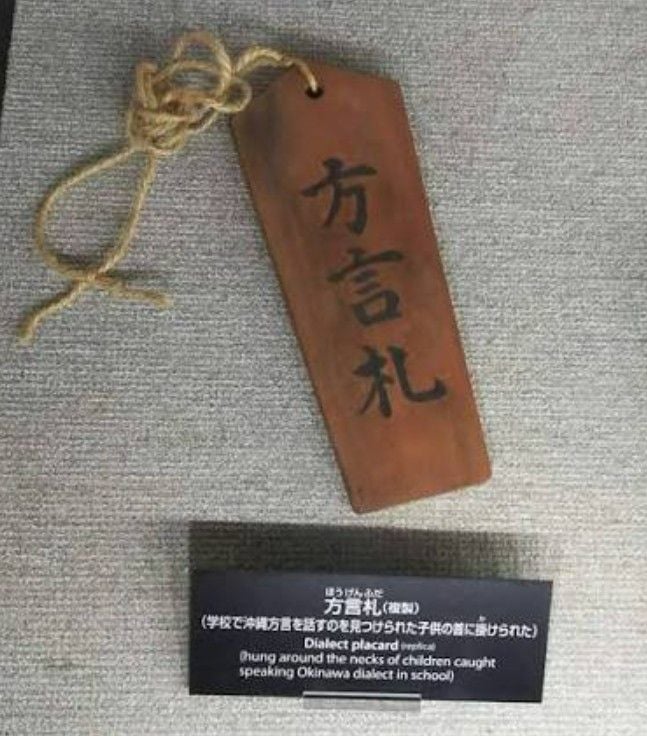
Japan's history is not free of coercion. In the Meiji era, schoolchildren caught speaking dialect were made to wear a placard of shame, the hogen fuda, and this fell hardest on the Ryukyuan languages of Okinawa, now classified as endangered. But this was school enforcement and assimilation of a distinct language group, not a standing ban on dialect across all media.
China is the more surprising case. Mandarin, or Putonghua, is promoted through the force of law. The 2001 Law on the Standard Spoken and Written Chinese Language requires Putonghua in broadcasting, film, television, public signage and advertising — the infrastructure registers.
But that same law affirms the spoken and written languages of all ethnic groups as "valuable cultural resources" to be protected, and only encourages, rather than mandates, Putonghua in services. The enforcement falls on the official stream; the cultural and social stream is left substantially open.
The result is visible. Dear You screened across mainland Chinese cinemas in its original Teochew. Cantonese remains a living language in Guangdong and dominant in Hong Kong. Cantopop is an industry. The state mandates Putonghua in official domains while leaving substantial room for dialect film and dialect music.
The comparison is uncomfortable. China and Japan each secured a national common language without removing dialect from cinema, song and daily speech. Singapore, by extending the rule into those registers, accompanied a steeper decline: dialect as a main household language fell from 76 per cent in 1980 to 8.7 per cent in 2020.
An advantage that may have been forgone
What follows is a counterfactual, and we put it as such at the outset; it cannot be proven, and reasonable people will read it differently.
Lee valued language by usefulness, and measured usefulness by reach. But in a market where everyone speaks Mandarin, speaking Mandarin confers no particular edge. It is the baseline. Advantage tends to belong to whoever holds something others lack.
Dialect was arguably that scarcer asset. The Hokkien, Teochew, Cantonese and Hainanese networks that Singaporeans inherited were living connections to the specific coastal regions — Fujian, Chaoshan, Guangdong — that would later drive much of China's growth.
In Chinese business culture, trust and affinity are often built in the native tongue rather than in formal Mandarin. A foreign partner who can meet a Shanghainese counterpart in Shanghainese, or share Teochew roots with a Chaoshan family firm, may reach a layer that Mandarin alone does not open.
The counterarguments are real and should be stated. China's business environment has itself become heavily Mandarinised; many dialect-speaking regions experienced their own dialect decline; and Singaporeans who gave up dialect may have gained stronger, more usable Mandarin in exchange. The advantage, if it existed, may not have survived in any case.
But the question is worth posing on the policy's own terms. If usefulness is the measure, did the calculus undercount the usefulness of being different? The qiaopi networks dramatised in Dear You were built on exactly those dialect-based bonds of kinship and commerce.
Why the cinema, and not everything else?
There is a more immediate inconsistency, and it may be the most practical question of all.
Singapore today permits dialect in a great many places. Books are published in dialect. Podcasts, YouTube channels and social media carry it freely. Since 2022, public-safety announcements at MRT stations have been made in Hokkien, Teochew and Cantonese, and dialect featured in Pioneer Generation outreach. Conversation in dialect is, of course, unrestricted.
Against that backdrop, the cinema stands out as uniquely constrained. A member of the public can watch unlimited dialect content on a phone, but the same dialect film, shown on a cinema screen for a paying audience, must be dubbed.
It is notable that Eric Khoo and Jack Neo, writing from the film industry rather than from policy analysis, identified the same anomaly, comparing a dialect film to a French or Malay one and pointing to streaming, home video and in-flight content. When commercial practitioners and a structural reading of the policy arrive at the same point, the anomaly is not easily dismissed as agitation.
Even if one accepted every historical rationale in full, this is hard to account for. In an era of streaming platforms, short-video apps and user-generated media, the assumption that a single cinema screening can shape language habits in a way that the entire open internet cannot appears increasingly difficult to sustain.
The same logic exposes a tension in the state's own conduct. If public dialect exposure genuinely endangered Mandarin, the dialect announcements piped through every affected MRT station each day would be self-defeating. The government does not appear to treat dialect as dangerous in those settings. It is not obvious why the cinema should be the exception.
A threat increasingly hard to discern
The policy has not been quietly forgotten and left to lapse. It has been maintained. As recently as 2014, then Prime Minister Lee Hsien Loong addressed the argument that Mandarin had won and the stance could relax, and rejected it, framing dialect restraint as a continuing trade-off.
So we are left with the rule applied to Dear You, and with IMDA's account of it. The bilingual policy aims to promote Mandarin. Mandarin is, by every available indicator, secure. Dialect as a household language has fallen to single figures. The comparative record shows that a common language need not require a suppressed vernacular, and the state permits dialect almost everywhere else.
What, then, does dubbing a ticketed heritage film protect in 2026? We have examined the three rationales the policy has rested on — cognitive, working-language and integrative — and found each one resting on conditions that appear substantially changed since 1979.
We have asked, and read IMDA's answer, and we are no closer to identifying the threat the requirement is meant to meet. Whatever danger the rule once addressed appears greatly diminished — and on the evidence before us, increasingly difficult to discern.