When accountability became a leadership crisis: how Singapore's mainstream media framed the Workers' Party conference
Singapore's mainstream media framed the Workers' Party conference as a leadership crisis. What actually occurred was a confidence process that returned an 80 per cent mandate, without a challenger and without drama. An accountability mechanism and a leadership contest are different things. The coverage consistently treated them as the same.
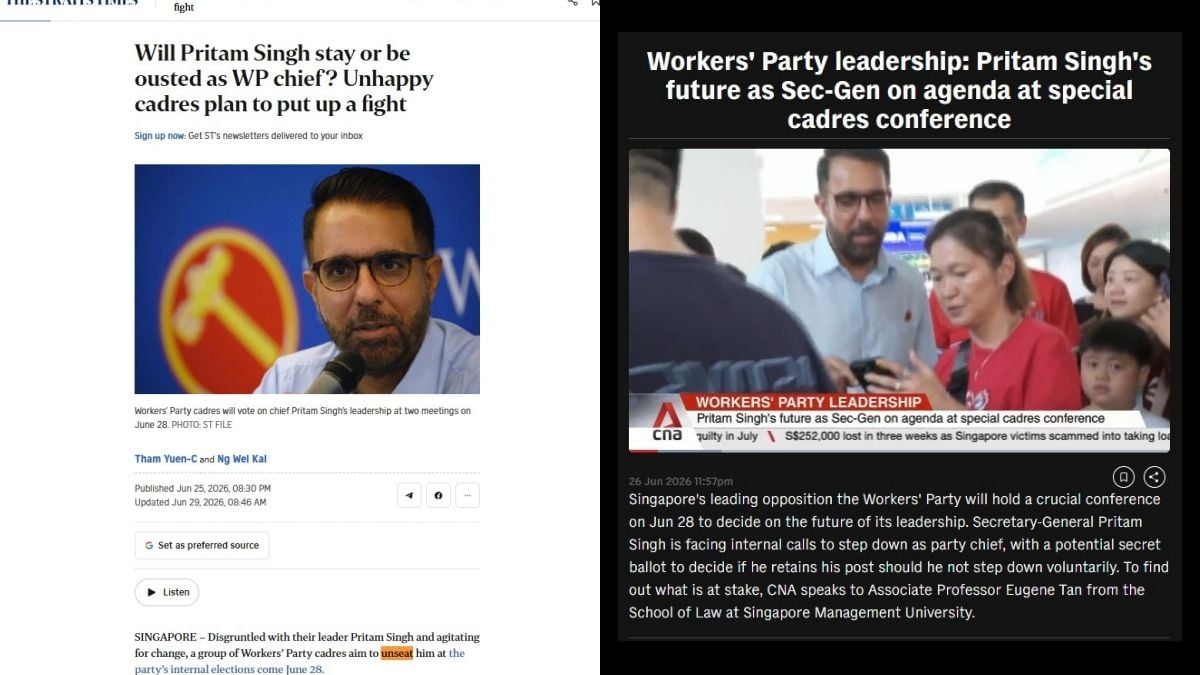

The pre-conference coverage of the Workers' Party's cadres conference on 28 June 2026 presented an accountability mechanism provided for under the party's constitution as a leadership crisis.
What actually occurred was a confidence process that returned an overwhelming mandate, conducted without drama and without a challenger. Those are not the same event — and the gap between how the event was framed and what it actually was deserves examination.
In the days leading up to the conference, Singapore's mainstream media presented the event as a looming leadership crisis. The Straits Times reported that disgruntled cadres were aiming to "unseat" Singh and that "the search for a challenger has intensified."
It named Gerald Giam, Dennis Tan, He Ting Ru, and Jamus Lim as figures whose names had "come up in discussion" as potential challengers. It reported that former party chief Low Thia Khiang had ended his support for Singh and might back a rival candidate, suggesting that if Low threw his weight behind another candidate "there may be enough votes to unseat Singh." CNA described the conference as a "crucial" gathering that would "decide on the future of its leadership," with a "potential secret ballot to decide his fate."
The central premise of that coverage, however, did not materialise. No challenger emerged. Giam chaired the special conference. All four named as potential challengers were elected to the new Central Executive Committee under Singh's continued leadership. Low Thia Khiang was re-elected to the same CEC. Singh reportedly secured approximately 80 per cent of the cadre vote.
Singh himself, when asked about the atmosphere at the two sessions, put it plainly: "As much as the media sometimes makes it look very dramatic, it was a normal CMC."
That observation points to something worth examining — not whether the wrong winner was predicted, but whether the event was consistently framed through the wrong institutional lens. An accountability mechanism asks whether a leader retains the confidence of the party. A leadership contest asks who should replace that leader. Those are related but institutionally distinct questions.
Associate Professor Eugene Tan of SMU, Singapore's most reliably platformed political commentator, characterised the conference on CNA as Singh's "first challenge to his leadership." Across three days the conference moved in the coverage from impending leadership battle to outcome that was never really in doubt — but the underlying assumption, that this was fundamentally about succession rather than accountability, never changed.
A framing that shrank after the fact
CNA's broadcast on 26 June set the scene with language that implied a genuine contest: "crucial conference," "decide on the future of its leadership," "potential secret ballot," "facing internal calls to step down." Tan's response matched and reinforced that framing. He called the conference "unprecedented" and assessed whether Singh "had the numbers" — language that presupposes a count worth taking seriously.
Yet his post-conference written commentary declared that Singh "was never really at risk." The shift leaves the conference having been presented first as a consequential test of Singh's leadership and then, after the result, as an outcome that had never really been in doubt. If that was always the case, the earlier framing of the event as a looming leadership crisis becomes harder to sustain — for the coverage that produced it as much as for the analyst who endorsed it.
What the Straits Times' own live coverage revealed
The Straits Times' live coverage of the conference on 28 June inadvertently documented how far its own pre-conference reporting had diverged from reality.
The most striking example concerned Low Thia Khiang.
The 25 June article had reported that Low had ended his support for Singh and might back a rival candidate, suggesting this could tip the balance against Singh.
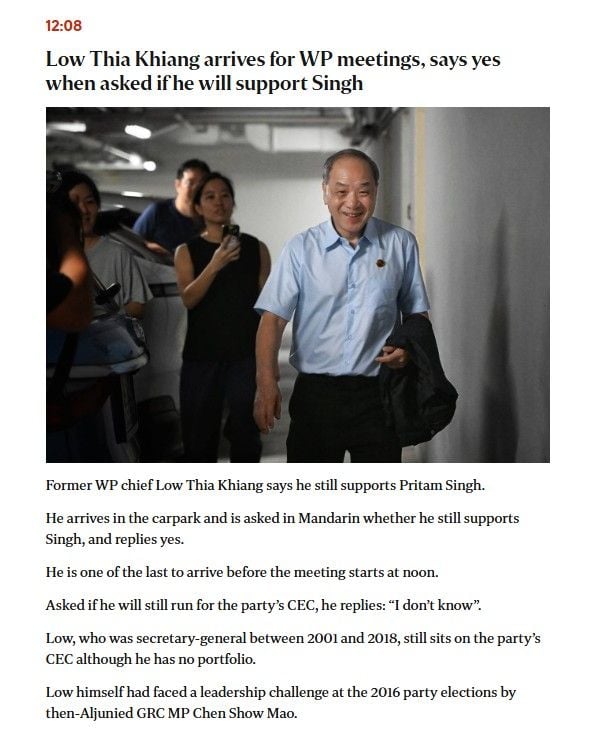
At 12:08 on the day of the conference, Low arrived at the venue and was asked in Mandarin whether he still supported Singh. He replied yes.
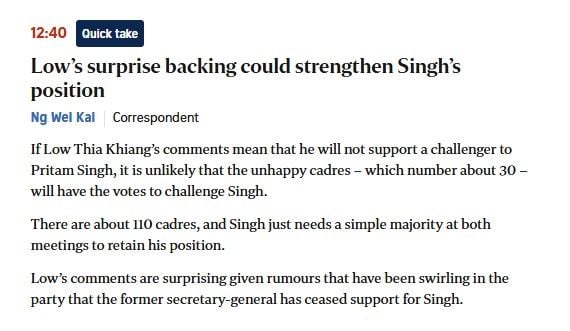
ST's own correspondent noted in a quick take at 12:40 that Low's comments were "surprising given rumours that have been swirling in the party" — highlighting the gap between the speculation surrounding the conference and what Low himself was now saying publicly. Low was subsequently re-elected to the new CEC.
The named challengers fared no better.
ST's 25 June article had identified Giam, Dennis Tan, He Ting Ru, and Jamus Lim as figures whose names had "come up in discussion."
The live feed then reported their arrivals with the same framing intact — He Ting Ru at 11:33 was still described as "one option being considered by unhappy cadres searching for a challenger."
Giam, meanwhile, was chairing the meeting. By the end of the day, all four had been elected to the new CEC under Singh's continued leadership.
On the scale of dissent, ST had described "about 30 unhappy cadres" out of approximately 110.
Even taking that estimate at face value, the numbers suggested a minority faction rather than one approaching majority support. The eventual result — approximately 80 per cent for Singh — indicates that the balance of support lay overwhelmingly elsewhere.
The LO inconsistency
This is the more significant problem with Tan's analysis specifically, and it rests entirely on his own words.
In the pre-conference interview, asked who had the political stature to replace Singh should he be voted out, Tan said plainly: "I don't think any one of them has that sort of broad appeal. Any one of them would have the sort of track record in politics that Mr Pritam Singh has." He went further: "Asking him to account is actually quite different from suggesting the time is right for a new leader."
Then, in his post-conference written piece, Tan wrote that it would be "a wasted opportunity" for the WP not to nominate another leader as Leader of the Opposition — with Singh remaining as secretary-general.
Before the conference: nobody suitable exists to replace Singh. After the conference: someone else should nevertheless occupy the country's most prominent opposition office.
If no current WP figure commands Singh's appeal or track record, then placing another figure in the Leader of the Opposition role — one that carries a dedicated parliamentary office, institutional resources, and the right of first response to legislation — while Singh remains party chief risks creating overlapping centres of authority, without explaining what institutional purpose such a split would serve.
Leadership structures exist to concentrate authority. Recommending their deliberate fragmentation requires a clearer institutional rationale than Tan provides.
Not a challenge — a confidence mechanism under the party's constitution
Tan also wrote that Singh adopted "a conciliatory, even contrite, posture — rather than a combative one — to an internal audience." Unless Tan had access to information beyond the public record, that characterisation reflects his own interpretation rather than an observable fact. He was not in the room. The party described proceedings as civil discussion; Singh himself said it was a "normal CMC." Civil conduct and firm resolve are not mutually exclusive.
What makes this particularly striking is that Tan himself, in the same interview, drew precisely the distinction that his framing then collapsed. He said: "Asking him to account is actually quite different from suggesting the time is right for a new leader."
That is an accurate institutional observation. Yet he also described the conference as "Mr Pritam Singh's first challenge to his leadership" — a framing the presenter later echoed. Those two positions sit awkwardly together. Tan recognised that accountability and leadership succession are different things, yet his overall characterisation of the conference still treated it as a leadership challenge.
Dissent, accountability mechanisms, confidence votes, and leadership contests are different institutional processes. They are not interchangeable. A leadership challenge requires someone seeking to replace the incumbent — someone willing to assume the office.
On 28 June, nobody was. Twenty-five cadres invoked a mechanism provided for under the party's constitution to call a meeting and request a vote. No one sought the secretary-general position. No alternative candidate was nominated. No one campaigned. Even had Singh lost the confidence vote, the conference would not itself have produced a new secretary-general. The question of succession would still have remained open.
The comparison with 2016 makes this plain. When Chen Show Mao stood against Low Thia Khiang for the secretary-general position — contesting directly, putting his name forward, and losing — that was a leadership challenge. Low won approximately 58 per cent of the vote against a named opponent.
On 28 June, Singh reportedly received approximately 80 per cent of the vote, with no challenger standing against him. Although the contexts differ, the reported margin suggests Singh retained overwhelming support despite months of sustained public controversy. Framing the 2026 proceedings as a leadership challenge comparable in character to the 2016 contest obscures an important institutional distinction — and turns an internal safeguard provided for under the party's own constitution into evidence of instability, when it was functioning exactly as intended.
The structural question the coverage largely sets aside
Tan's framing throughout treats the entire saga as an internal WP governance matter that has now been resolved. "This matter is now once and for all over within the party," he wrote. He described the cadres conference as "the last piece of the jigsaw" — the natural conclusion of a process that began with Raeesah Khan's admitted lies and ran through the Committee of Privileges, the criminal conviction, and now the internal vote.
Another limitation of the coverage is that it largely sets aside the institutional pathway by which the issue reached the courts. The Committee of Privileges that referred Singh to the Public Prosecutor was a parliamentary body with a PAP majority. At Singh's trial, one of the prosecution's own witnesses testified that in his view the COP had been primarily focused on WP leadership conduct rather than on Khan's admitted parliamentary lies. Treating the conviction as simply an internal party management matter to be resolved frames the episode without accounting for the mechanism that initiated it.
That Singapore's mainstream media — from its reporting to its most prominent political commentator — consistently framed the conference as a leadership crisis rather than as the exercise of a party constitutional confidence mechanism is not a minor editorial question.
Accountability mechanisms exist precisely because parties sometimes need to test confidence in a leader. Treating every exercise of such a mechanism as evidence of imminent collapse risks misunderstanding the very institutions that make political parties resilient — and shapes how the public understands what opposition politics in Singapore actually looks like, and what the party's own democratic processes are designed to do.