Singapore "should not abandon dialects", Tommy Koh backs relaxed use of dialects in arts and cultural memories
Professor Tommy Koh has said Singapore should not abandon dialects, supporting views that heritage languages can coexist with Mandarin while preserving cultural memory, family connections and artistic expression.
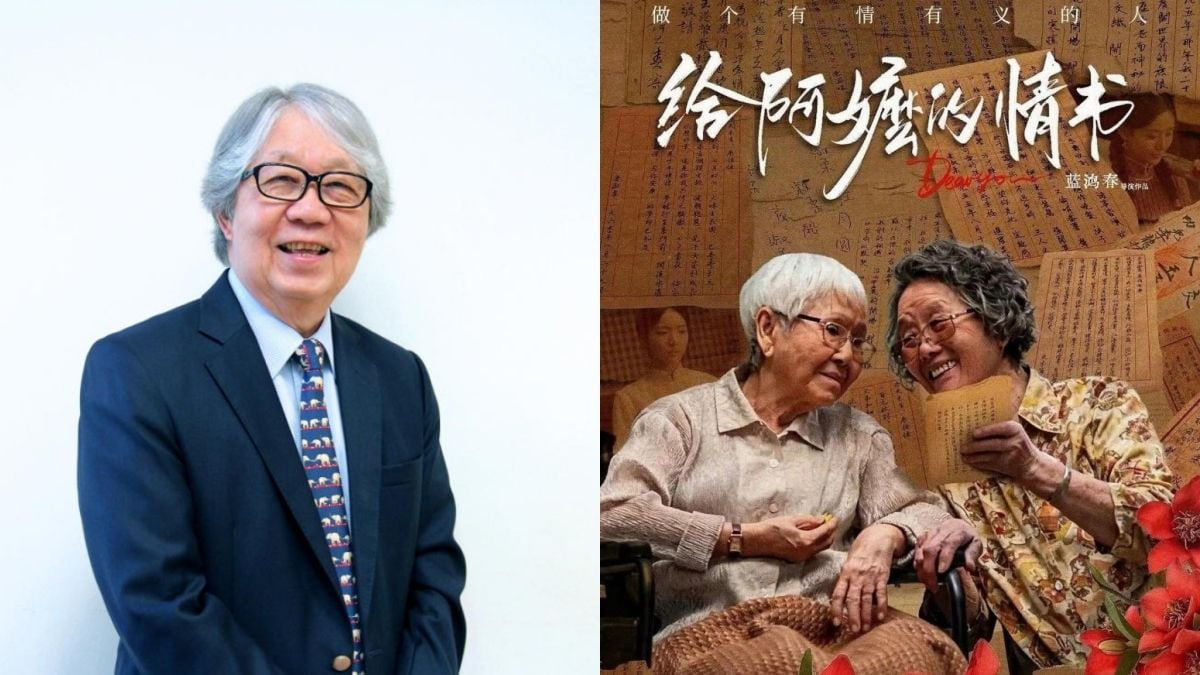
- Professor Tommy Koh said Singapore should not abandon dialects and supported their cultural role.
- Lily Kong argued heritage languages should complement, not weaken, Singapore’s bilingual policy.
- Public responses highlighted emotional links between dialects, family memories and cultural identity.

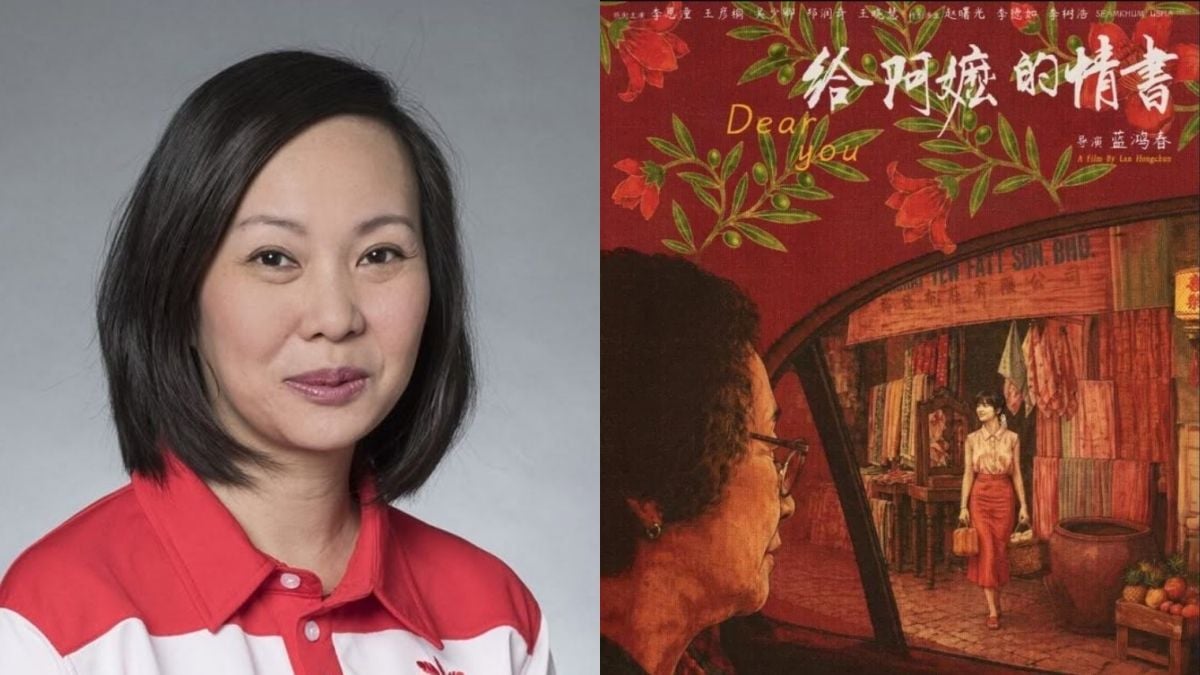
Professor Tommy Koh, special adviser to the Institute of Policy Studies at the National University of Singapore (NUS), has said Singapore should not abandon dialects, joining renewed discussion over the role of heritage languages following the release of the Teochew-language film Dear You.
In a Facebook post on 29 June 2026, Koh responded to an opinion piece by Lily Kong, president of Singapore Management University, which examined questions surrounding language policy, cultural expression and identity after the film’s release.
Koh said he agreed with four points raised by Kong, including the view that there is genuine demand for cultural expressions in dialects and a desire among Singaporeans to reconnect with the languages spoken by their parents and grandparents.
He also said Singapore could be more relaxed about the use of dialects in artistic expressions and cultural memories, while maintaining that the use of Mandarin among Chinese Singaporeans has been successful and should continue.
“The place of Mandarin in Singapore is secure and under no threat from the dialects,” Koh said.
Language policy questions after Dear You
The discussion followed Kong’s opinion article published on 29 June titled From bilingualism to multilingual confidence: What the Dear You debate is telling us.
In the article, Kong argued that the response to Dear You reflected broader questions about identity, memory and Singapore’s evolving approach to language.
The Chinese blockbuster was filmed largely in Teochew but was initially released in Singapore mainly in a Mandarin-dubbed version. Screenings of the original Teochew-language version were limited.
“The response was immediate,” Kong wrote, noting that tickets for Teochew screenings quickly sold out and led to public discussion over why the original-language version could be shown commercially in Johor Bahru but was not widely available in Singapore.
She said the issue was “not simply whether one film should be shown in Teochew or Mandarin”, but whether a language framework created for an earlier period “now needs recalibration for another”.
Bilingualism remains a foundation
Kong stressed that she was not arguing against bilingualism, describing Singapore’s bilingual policy as “one of the most consequential and successful pillars” of nation-building.
She said English had become Singapore’s common working language, while official mother tongues provided “cultural ballast and civilisational rootedness”.
However, she argued that policies created for specific historical circumstances must remain open to renewal as society changes.
“The concern today is no longer that dialects will overwhelm English or undermine Mandarin learning,” Kong wrote.
Instead, she said the concern was that heritage languages could disappear so completely that Singapore might lose “cultural memory, intergenerational connection and part of the texture of Singapore’s plural past”.
Moving from bilingual discipline to multilingual confidence
Kong argued that Singapore should distinguish more clearly between language policy in schools and cultural expression in the arts.
“A Teochew film screened in Teochew does not weaken the teaching of Mandarin in schools,” she wrote, adding that heritage languages should be regarded as “cultural assets” rather than “a problem to be managed”.
She called for wider support for heritage-language films, oral history projects and community initiatives across different ethnic groups.
“The foundations remain sound, but the superstructure needs renewal,” Kong said.
She concluded that Singapore’s next step should not be abandoning bilingualism, but “moving from bilingual discipline to multilingual confidence”.
Koh highlights practical value of dialects
In his response, Koh used personal experiences in China to illustrate what he described as the practical value of dialect knowledge.
He recalled arriving at a famous restaurant in Shanghai where, despite having a reservation, the manager told him the restaurant was full.
Koh said he then spoke in “poor Shanghainese”, explaining that he was from Singapore and that his mother was Shanghainese.
Shortly afterwards, a table was found for him and his companions.
On another occasion in Xiamen, Koh said he asked a deputy party secretary whether she spoke the local dialect.
After she confirmed that she could, they continued their conversation in Hokkien, leaving his Beijing guide unable to understand what they were discussing.
Public responses highlight cultural connections
Comments on Koh’s Facebook page reflected personal experiences with dialects and heritage.
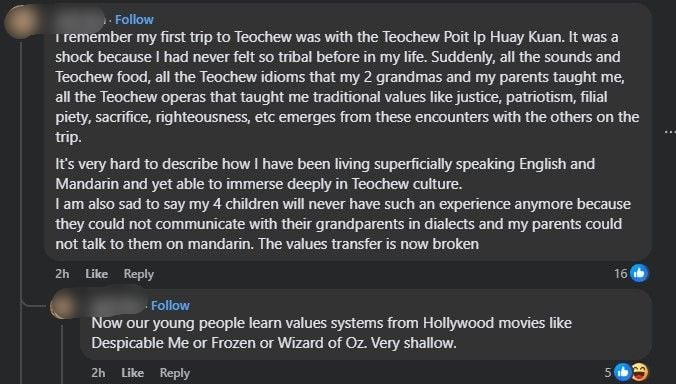
One user described a trip to Teochew with the Teochew Poit Ip Huay Kuan, saying it was the first time he had deeply experienced their dialect heritage.
The user said familiar sounds, food, idioms and Teochew opera revived memories of values taught by grandparents, including filial piety and righteousness.
Although the person had grown up speaking mainly English and Mandarin, the user said the experience revealed a deeper cultural connection.
The commenter also expressed sadness that their children could no longer communicate with grandparents in dialect, saying “the values transfer is now broken”.
Other commenters shared similar views about the relationship between dialects and identity.
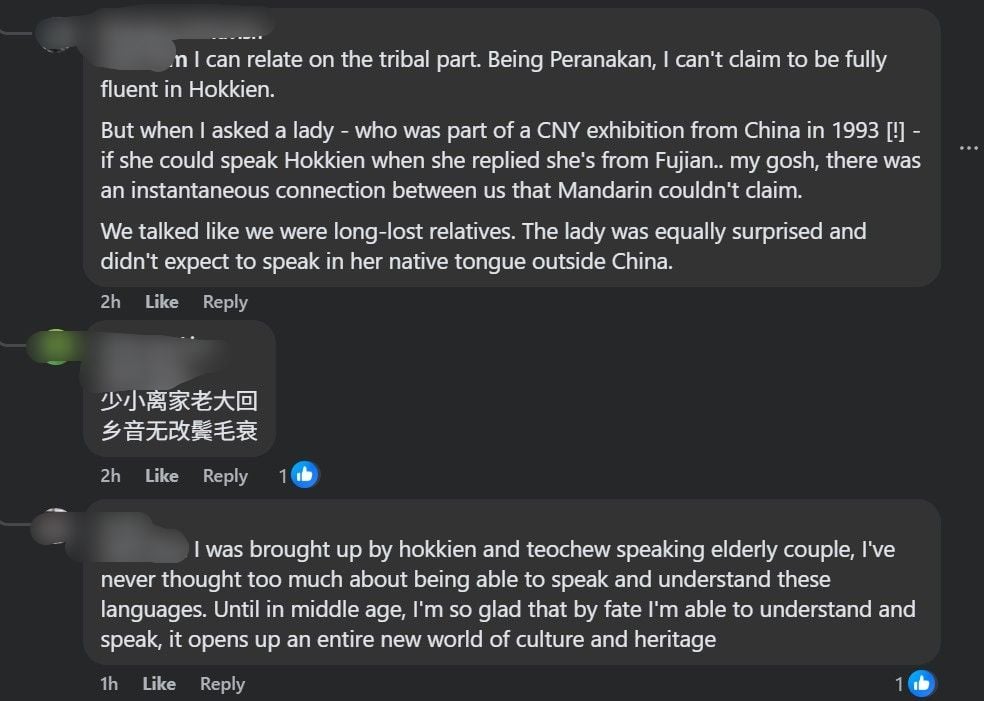
A Peranakan user said speaking Hokkien with a woman from Fujian created “an instantaneous connection” that Mandarin could not replicate, adding that they “talked like long-lost relatives”.
Another commenter said growing up around Hokkien- and Teochew-speaking elders later opened “an entire new world of culture and heritage”.
Some argued dialects could return more prominently now that the Speak Mandarin Campaign had already achieved its goals.
Travel experiences and emotional ties
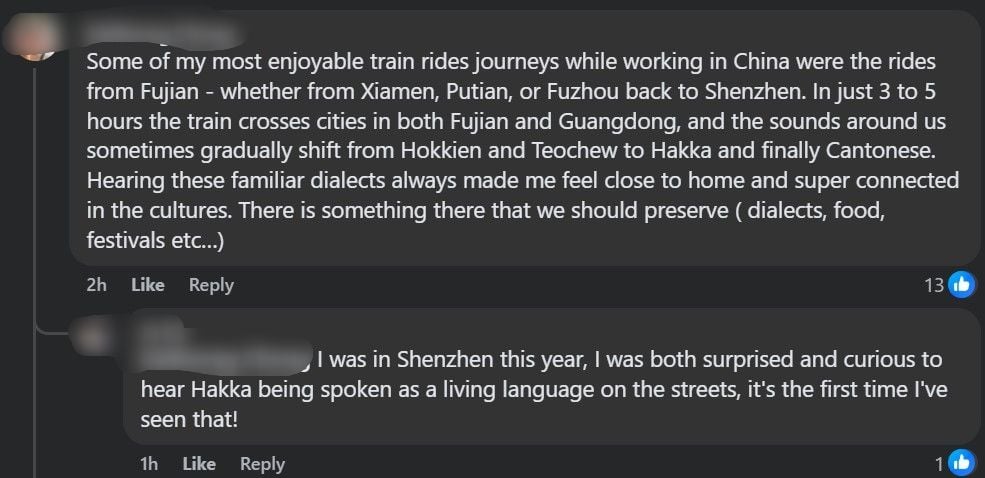
One commenter recalled travelling by train across Fujian towards Shenzhen, describing how the linguistic landscape shifted from Hokkien and Teochew to Hakka and Cantonese within hours.
The gradual changes in sounds created a sense of cultural connection, with the commenter saying there was “something there that we should preserve”, including dialects, food and festivals.
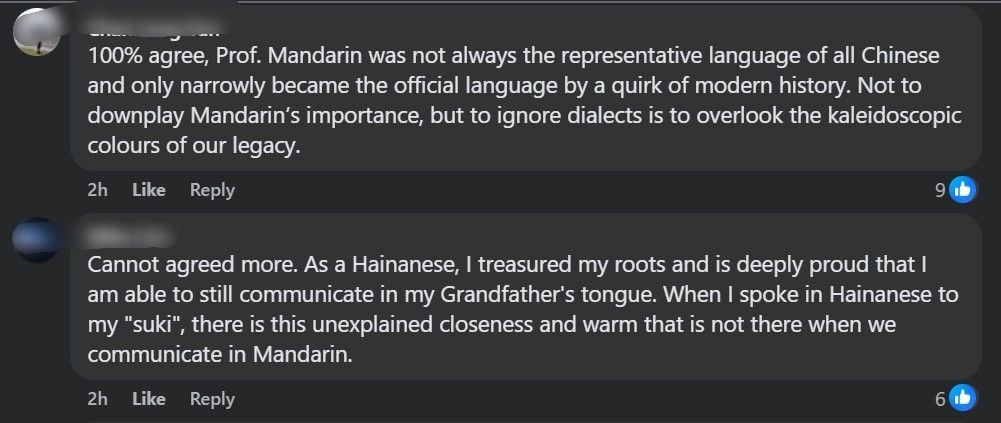
Others highlighted that Mandarin’s current dominance was relatively recent.
One commenter said Mandarin became the standard “by a quirk of modern history”, arguing that ignoring dialects overlooked “the kaleidoscopic colours” of Chinese heritage.
Another said Mandarin should not overshadow regional languages that can create more intimate connections between people.
Family memories and cultural identity
Several commenters described personal emotional relationships with dialects.
A Hainanese speaker said using their grandfather’s language created “an unexplained closeness and warmth” that was absent when speaking Mandarin.
Another person shared their experience watching a Teochew film with family, saying the use of dialect strengthened intergenerational understanding and added cultural texture.
Some commenters also raised practical concerns, noting the difficulty of learning multiple languages alongside English and Mandarin.
One commenter described Singapore as being “like our favourite local dish, Rojak — uniquely Singapore”, suggesting multilingualism could represent a layered identity.
Language learning constraints
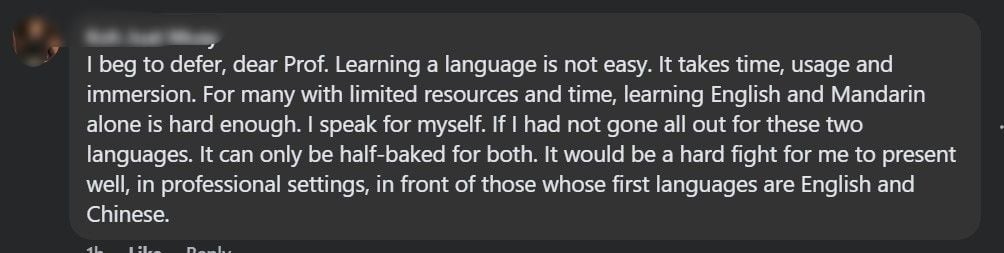
However, a comment disagreed with Prof Koh, saying language learning “is not easy” and requires time, usage and immersion.
For many with limited resources, mastering even English and Mandarin is already a challenge.
The user added that without fully committing to both, one risks becoming “half-baked in both,” especially in professional settings where fluency matters for effective communication and credibility.
Cross-border viewing experience
A Facebook user said his family travelled to Johor Bahru’s KSL to watch the Teochew version of Dear You, citing lower ticket prices of about RM15 or S$4.60 compared with Singapore cinemas.
The viewer, who speaks Cantonese, described the original-language version as “very moving and emotionally powerful”, saying it brought back childhood memories with Teochew-speaking grandparents.
The comment described the film as “simple yet so touching” and called it “probably the best movie I watched in recent years”.
The commenter argued that “movies and music should not have language barriers”.

Coexistence of Mandarin and dialects
Another commenter said promoting Mandarin and preserving dialects “have no conflict”, expressing support for both approaches.
The user wrote that the balance could be simply stated as “both are needed”, combining practical reasoning with emotional attachment to family heritage.
The commenter also referred to Koh’s Shanghai experience, describing how the phrase “I can still speak Shanghainese” immediately created warmth and recognition during a brief exchange.
The user argued that dialects contain “an invisible love for one’s hometown”, representing belonging and sincerity.