When a national newspaper outsources the frame
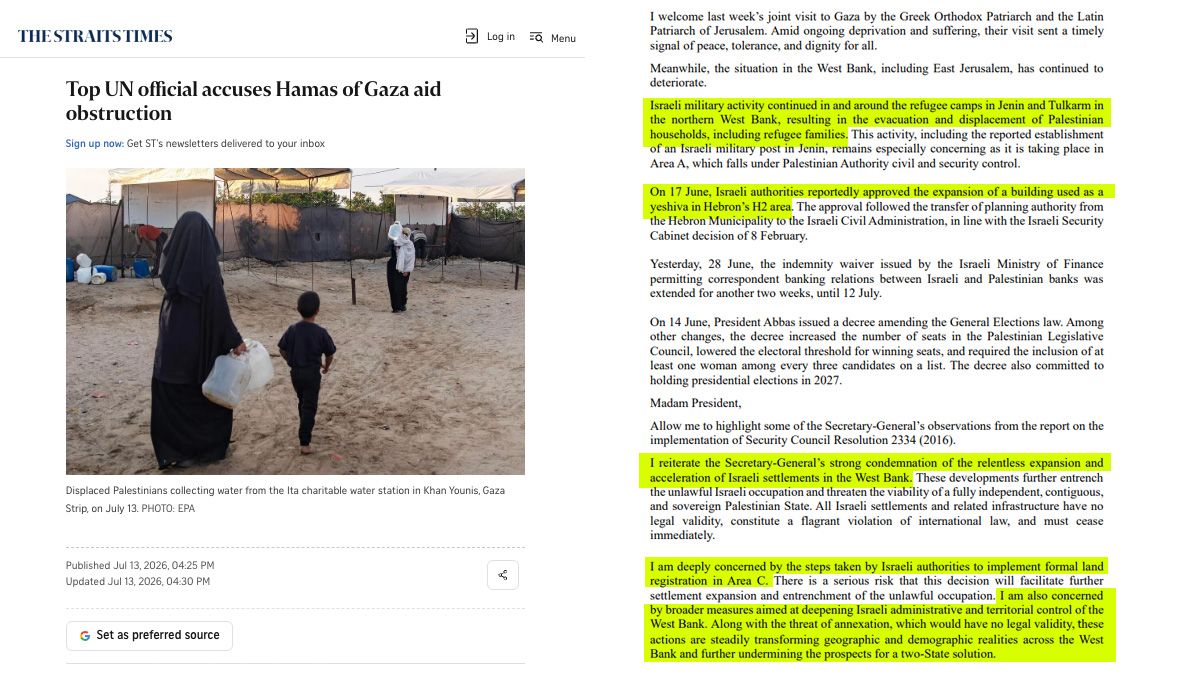
The Straits Times ran an AFP dispatch on a settlement in the annexed Golan Heights without noting Singapore's stated position that it cannot recognise unilateral annexation. For a publicly-funded paper of record, the absence of a Singaporean lens is worth examining.
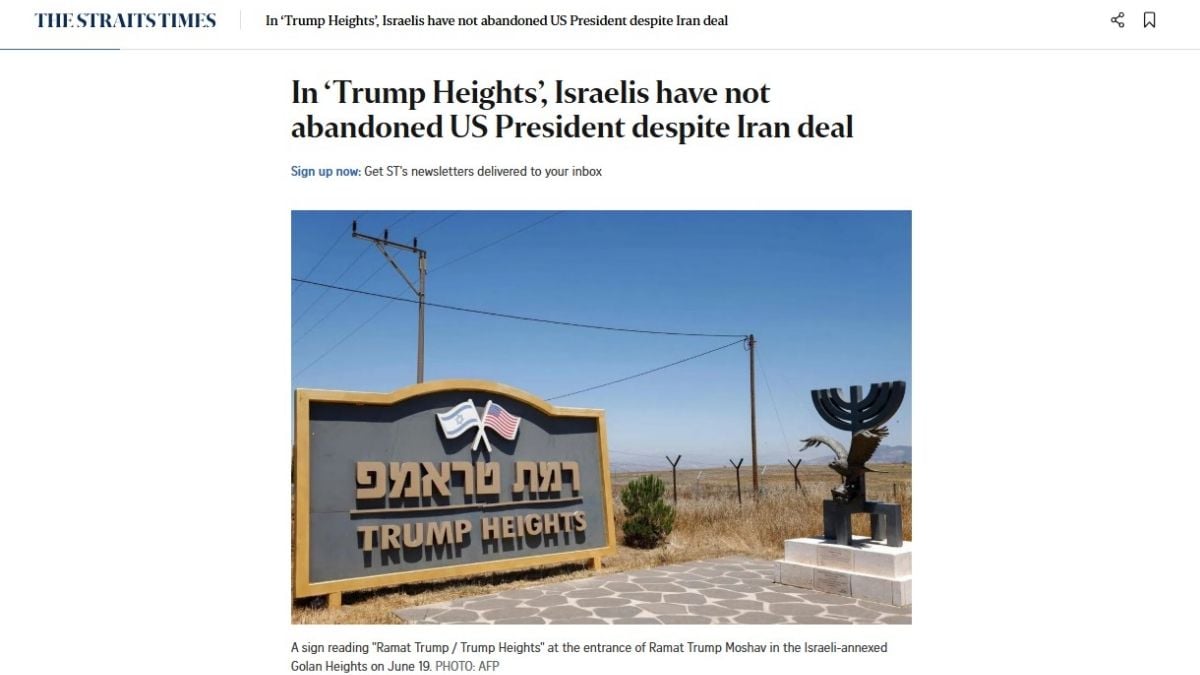

The Straits Times published a piece on 20 June 2026 headlined "In 'Trump Heights', Israelis have not abandoned US President despite Iran deal." It is a human-interest dispatch: residents of a hilltop settlement near the Lebanon border, asked how they feel about Donald Trump after the deal ending the war with Iran.
It is also, in full, an Agence France-Presse story. The dateline, the reporting, the quotes, the framing — all AFP's. The Straits Times carried it.
There is nothing improper in running wire copy. Every newspaper does it, and no outlet keeps correspondents everywhere. AFP's reporters were on that hilltop; The Straits Times's were not. For a foreign colour piece, a wire feed is the ordinary tool.
What gives this particular instance its edge is what the story is about, and what it leaves out.
Trump Heights sits in the Golan Heights, territory Israel annexed from Syria and which almost no state recognises as Israeli. The settlement is named for the US president who, in 2019, made the United States the first and so far only country to recognise Israeli sovereignty there. The AFP piece notes this. It does not note where Singapore stands.
Singapore's position is a matter of parliamentary record. In a ministerial statement on 22 September 2025, Foreign Minister Dr Vivian Balakrishnan told Parliament that Singapore "cannot recognise any unilateral annexation of occupied territory," describing such annexation as a "flagrant breach of international law."
That principle is general. In the same statement, addressing the West Bank, he set out Singapore's opposition to attempts "to create new facts on the ground" and announced targeted sanctions on leaders of radical settler groups responsible for violence against Palestinians there.
So a publicly-funded national newspaper reproduced, without a line of local context, a sympathetic portrait of a settlement community on annexed territory — on a question where Singapore's own foreign minister had staked out a clear and contrary legal position months earlier in the House.
To be precise about the limits of this point: AFP's piece was never trying to be a Singapore-policy story, and a wire dispatch carries the agency's frame, not the republishing paper's editorial view. No one should read the decision to run it as an endorsement of annexation or of the settlers' politics.
But that is the narrow question worth asking. Not whether The Straits Times agrees with the framing. Whether a national paper of record, on a matter touching Singapore's stated national interest, ought to have added the single contextual sentence that would have squared the dispatch with the position its readers' own government holds.
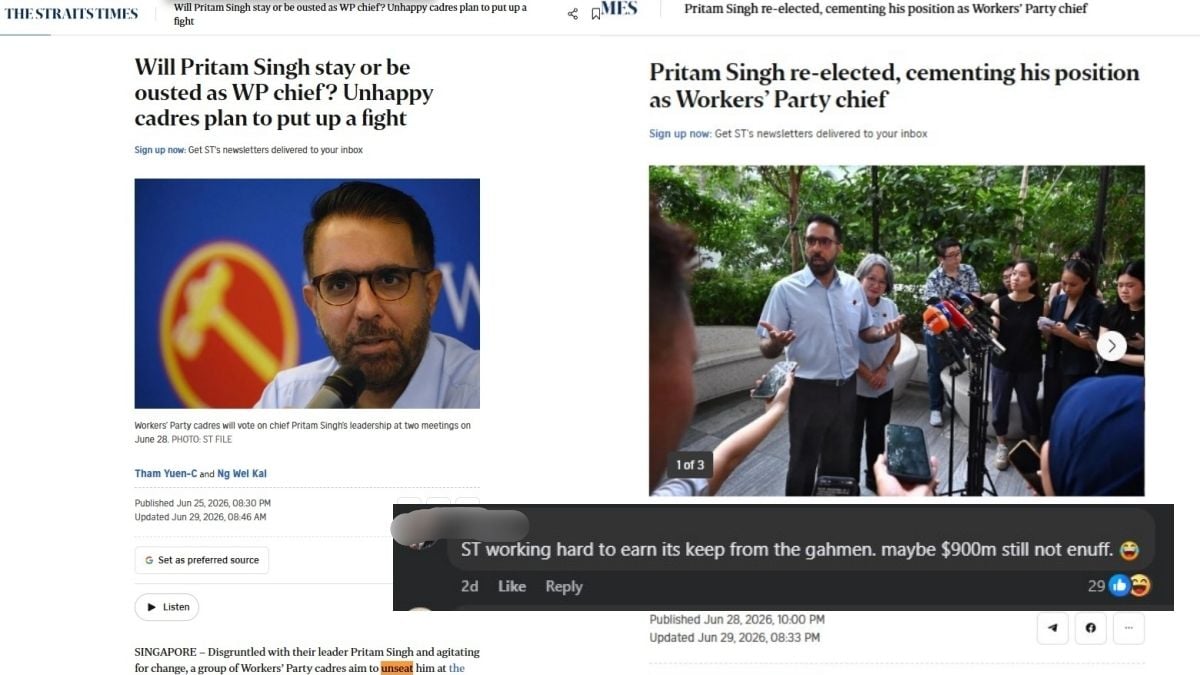
Here the funding becomes relevant — not as an accusation, but as a measure of expectation. The Straits Times is the flagship English-language title of SPH Media, its single most prominent publication. SPH Media receives up to S$900 million in government support over five years, and employs around 1,000 journalists, including correspondents abroad.
The justification offered for that funding is worth recalling, because it sets the standard. When the arrangement was debated in Parliament in February 2022, Communications Minister Josephine Teo made the case in terms of the national lens.
As open as Singapore must remain to the world, she told the House, "we must also have Singaporeans reporting on the world from the Singaporean perspective." Her own illustration was that a Singaporean reporting on China would afford a lens different from an American or European doing so — and on that basis, she said, the growth of SPH Media's overseas bureaus was a capability worth public support.
That is the standard. A Singaporean perspective on world events is the very thing public money was meant to buy. Running an agency dispatch unaltered is the one editorial act that supplies none of it.
Teo's other defence of the funding rested on reader trust. Pressed by Workers' Party Member Assoc Prof Jamus Lim — who asked whether the resort to public funds in fact suggested consumers did not entirely trust local media, and so were declining to pay for it — Teo maintained the trust was demonstrable: not her claim, she said, but readers "voting with their hands," confirmed by independent surveys such as the Reuters Institute's.
Set aside whether that settles Lim's challenge. Take the standard on its own terms. The case for funding rests on public confidence in the quality and judgement of the journalism, and on Singaporeans reporting the world through a Singaporean lens. A straight, uncontextualised pass-through exercises neither faculty.
In our view, an outlet resourced and mandated on those terms is fairly held to a higher bar than verbatim republication on a story where a Singaporean frame was available and absent. Not a government line — appending official positions to every foreign story would itself corrode the independence the funding is meant to protect. Simply the contextual awareness that a settlement on annexed land is not, from Singapore's stated standpoint, neutral ground.
The Straits Times had the means to supply that lens and chose to let the wire speak alone. On most foreign news, that is unremarkable — no Singaporean perspective is needed to report an election result or a flood. On this story, set on ground where Singapore holds a stated position, its absence is the thing worth noticing.