Gaza rebuilding efforts must include Palestinian Authority, warns Dr Estephan Salameh
Palestinian Authority minister Dr Estephan Salameh urges inclusion in US-led Gaza reconstruction efforts, questioning pledged US$17 billion funding and highlighting Singapore’s growing role in Palestinian capacity-building.
- Palestinian Authority urges inclusion in US-led Board of Peace for Gaza reconstruction.
- Dr Estephan Salameh questions viability of pledged US$17 billion funding.
- Singapore deepens capacity-building support during official visit.

Any international effort to reconstruct Gaza, including initiatives led by United States President Donald Trump, will not be sustainable if it excludes the Palestinian Authority, its Finance and Planning Minister Dr Estephan Salameh has cautioned.
Speaking to Singapore Malay daily Berita Harian on 24 February 2026 during his official visit to Singapore, Dr Salameh said new structures such as Mr Trump’s Board of Peace must respect existing Palestinian institutions.
“We would like the Board of Peace to respect the role of the Palestinian Authority as the entity that has the institutions on the ground,” he said.
“We have our own banking system, legislation, property rights – all of these things that need to be respected instead of inventing a new thing.”
Trump launched the Board of Peace on 22 January 2026 on the sidelines of the World Economic Forum in Davos.
The United Nations Security Council approved its formation in November 2025 as a transitional administration for Gaza.
The body is tasked with overseeing reconstruction until the Palestinian Authority completes a reform programme deemed satisfactory by international stakeholders.
More than two dozen countries, including Gulf states, Israel and Indonesia, have joined the US-led body. Over US$17 billion has been pledged to date.
However, Dr Salameh expressed scepticism about whether pledged funds would materialise.
“Let’s hope first that this money will come because there is a big difference between pledges and disbursements,” he said.
The Palestinian Authority supported the Board primarily out of urgency to end the war in Gaza, he added, while stressing that unity of governance remains essential.
“The role of the Palestinian Authority is key to ensuring the unity of the country and the unity of our people and the future of Palestine,” he said.
Critics have argued that the Board of Peace may serve to elevate Mr Trump’s profile as an international peacemaker while potentially sidelining existing multilateral mechanisms.
Dr Salameh maintained that any assistance would be welcomed if it preserved Palestinian unity and institutional continuity.
The Palestinian Authority exercises limited self-rule in parts of the Israeli-occupied West Bank under agreements with Israel.
It lost effective control of Gaza in 2007 when Hamas assumed administration of the territory.
Despite this, Dr Salameh said the authority continues to pay more than 67,000 staff and retirees in Gaza and has maintained service provision for nearly two decades.
“There is no guarantee that the war has ended completely,” he said, citing continued destruction and casualties even after ceasefire arrangements.
The conflict began following the 7 October 2023 attacks on Israel. According to Gaza health authorities, more than 72,000 people have been killed in Israeli military operations as of early 2026.
International rights groups have described aspects of the conflict as potential war crimes, while Israel has rejected those allegations.
Against this backdrop, Dr Salameh described himself as “cautiously optimistic” about long-term state-building efforts, pointing to continued engagement from international partners.
The Palestinian Authority maintains development partnerships with the European Union and the World Bank.
Dr Salameh was in Singapore from 22 to 25 February 2026 at the invitation of Foreign Minister Vivian Balakrishnan.
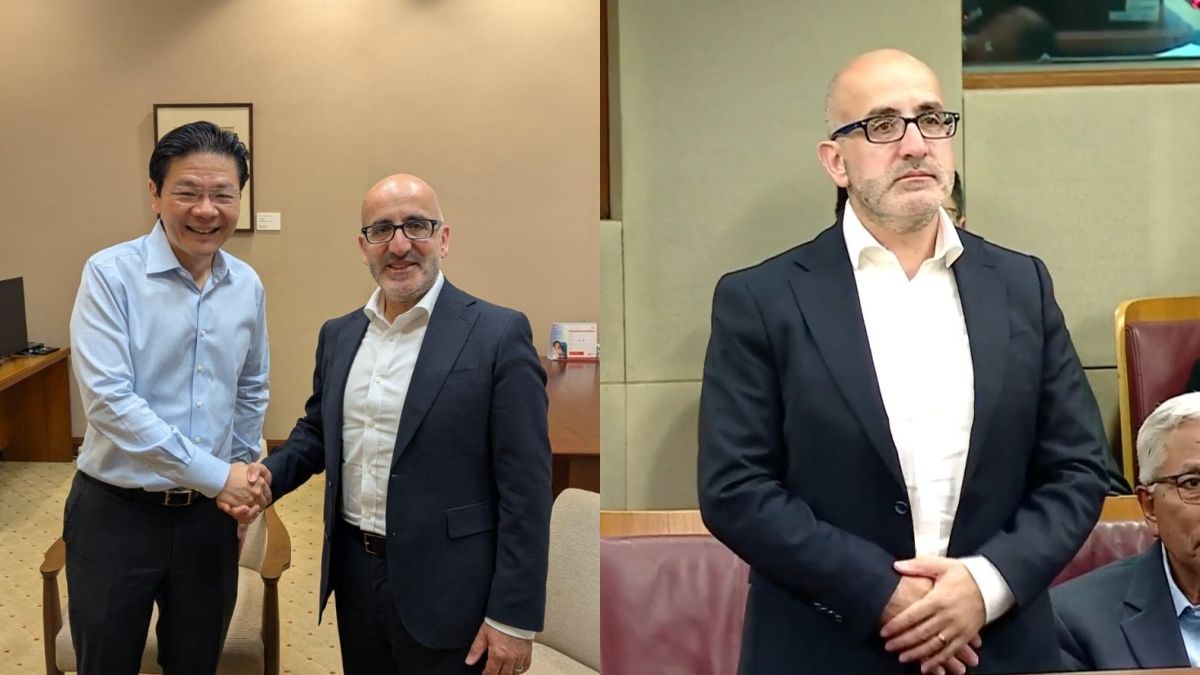
During the visit, he met Prime Minister Lawrence Wong, Acting Minister-in-charge of Muslim Affairs Faishal Ibrahim, and Ministers of State Zhulkarnain Abdul Rahim and Rahayu Mahzam.
He also observed part of the parliamentary Budget debate on 24 February and visited the Institute of Technical Education College West.
Prime Minister Wong later said Singapore remains committed to supporting the Palestinian people and strengthening institutional capacity as they work towards eventual statehood.
Singapore recently expanded its capacity-building programme for Palestinian Authority officials, launching two new courses for 2026.
Since the start of the Israel-Hamas conflict, Singapore has contributed more than S$25 million in humanitarian aid for civilians in Gaza, including S$1 million announced in December 2025.
Dr Salameh said Palestine views Singapore as a development model worth emulating, particularly in technical education and digital economy transformation.
“We are very keen to strengthen our friendship, our partnership,” he said, noting openness from Singaporean counterparts to share systems and administrative experience.
He urged Singaporeans to see Palestine beyond media portrayals of conflict, describing Palestinians as educated, family-oriented and culturally rich.
“Palestinian people love their country and are working hard to build it,” he said.
At the same time, he stressed the urgency of continued humanitarian support.
He described Gaza as more than 80 per cent destroyed, with tens of thousands killed.
Humanitarian needs also persist in the West Bank, which faces security restrictions and settler violence, he added.
As he returns to Ramallah, Dr Salameh faces a finance ministry burdened by more than US$15 billion in debt and constrained tax revenues.