Indranee's call for Marriage and Parenthood Reset; Netizens say 'My bank account doesn't support this reset'
Indranee Rajah’s call for a “marriage and parenthood reset” after Singapore’s resident TFR hit 0.87 in 2025 has sparked scepticism and satire online. Reddit and Facebook users questioned affordability, workplace strain, and whether public consultations will deliver concrete change.

- Indranee Rajah told Parliament on 26 February 2026 that reversing Singapore’s record-low TFR needs a “society-wide reset”, not only government action.
- A new work group chaired by Indranee will consult the public, businesses and the people sector, while the Marriage and Parenthood Survey will be enhanced in 2026.
- Online commenters on Reddit and Facebook responded with humour, frustration and detailed proposals, often arguing that costs, work intensity and policy follow-through matter more than “mindset shifts”.

Singapore’s record-low resident fertility figure has reignited debate over what would meaningfully change family-building decisions, after Minister in the Prime Minister’s Office Indranee Rajah called for a “marriage and parenthood reset” in Parliament on 26 February 2026.
Indranee said a “society-wide reset” is needed in how marriage and parenthood are viewed and supporlign work and family, and how society shares responsibility for outcomes.
Her comments followed preliminary figures indicating Singapore’s resident total fertility rate fell from 0.97 in 2024 to 0.87 in 2025, described in official materials as the lowest to date.
She said the government would form a new work group, chaired by her and involving relevant agencies, to consult widely across the public, business and people sectors and develop “concrete plans” in the coming months.
Indranee also said the Marriage and Parenthood Survey would be enhanced in 2026 to gain deeper insights into how attitudes and perceptions have evolved, positioning this as a basis for shaping the next phase of support.
In her parliamentary framing, the effort is not about pushing a single “correct” life path, but about enabling personal decisions on marriage and parenthood to be viewed positively rather than through fear and anxiety.
Online reactions, however, suggest a widening gap between the language of “reset” and what many people describe as immovable constraints: the price of daily living, the intensity of work, and the perceived cost of “doing parenthood right”.
On Reddit, one highly upvoted commenter mocked the idea of a cultural reset by saying their “bank account” could barely support a “reset” of lunch options, let alone major life decisions. The same commenter described the grind of long working days and burnout.
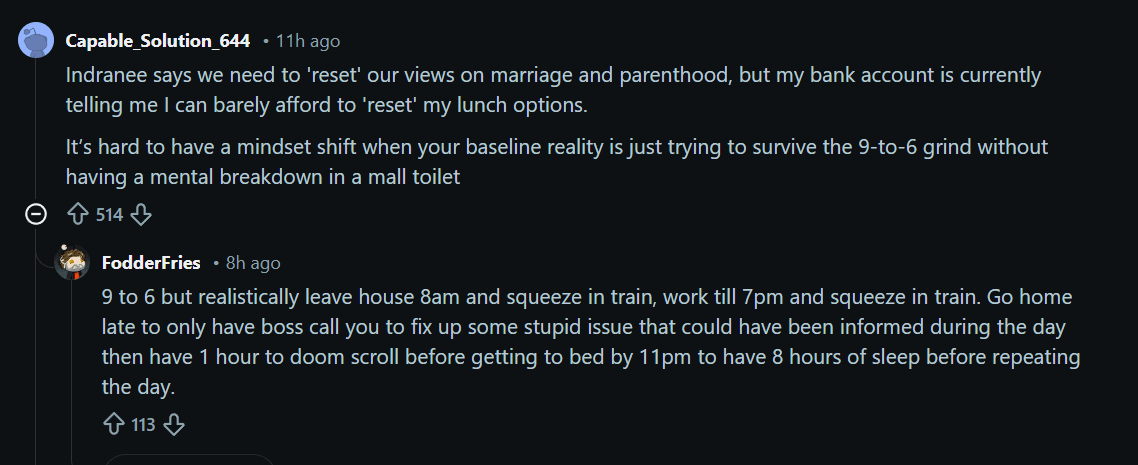
The tone on Reddit mixed gallows humour with a practical argument: mindset is not easily adjustable when the baseline reality feels like financial triage, unstable energy, and limited time to build relationships, rest, and plan for children.
The scepticism extended to process. Some Reddit replies treated the announcement of a new “work group” as familiar institutional choreography, questioning whether the next cycle would produce enforceable changes or another set of recommendations.

That theme echoed on Facebook discussion of the same parliamentary remarks, where commenters posted a range of critiques and proposals, often in sharper and more personal language. (Comments summarised below are anonymised.)
Several Facebook commenters questioned leadership optics. Multiple posts fixated on Indranee’s personal marital status, with variations of “lead by example” and “are you married?” used to cast doubt on whether she can relate to parents’ daily pressures.
Others pushed back against that line of attack. One commenter wrote, in effect, that being married is not a prerequisite to talk about policies that affect families, implying that credibility should be judged by outcomes and listening, not personal biography.
Beyond leadership questions, the dominant Facebook thread content was about costs, often described through mundane shopping experiences rather than macroeconomic statistics. One comment urged readers to walk through formula milk and diaper aisles and “do your maths”.
This aligns with a broader pattern in the discourse: the family decision is framed less as ideology and more as arithmetic, where recurring expenses feel relentlesmedical bill or childcare arrangement can tip budgets.
A second cluster of Facebook comments offered specific policy proposals. One suggested subsidising fertility treatments such as IVF and IUI more heavily, including the possibility of full subsidies, alos that help cover essential wedding expenses.
Another commenter proposed structural recalibration: linking the HDB BTO income ceiling to per-capita income rather than total household income, alongside transport-related subsidies such as COfamilies, and expanded tax relief for households with more children.
Leave policy was an especially consistent demand. Multiple Facebook commenters argued that six days of childcare leave is insufficient, particularly when children fall ill, and s more flexible age limits, or leave entitlements that scale with the number of children.
One commenter called for institutionalising significantly more paid caregiver leave, arguing that baby bonuses alone are “lip service” if parents are still forced to choose between job security and caregiving during frequent childhood illnesses.
Workplace exhaustion also featured prominently. One Facebook commenter argued that work-life balance must be “fixed first”, descing adults with “permanent panda eyes”, and implying that chronic fatigue is a hidden but decisive fertility constraint.
Indranee’s parliamentary speech placed workplace culture at the heart of the solution set, saying family-friendly practices can make a “big dhe work group will work with employers on more supportive norms.
Yet, online, the question often becomes whether these norms will be voluntary and uneven, or backed by stronger expectations that protect parents from career penalties and normalise workloadis taken.
Education pressure, another point Indranee raised, appeared frequently in Facebook comments too, sometimes in blunt terms. One commenter described the stress of competing for “good” schools and the cascade of costs for childcare, healthcare.
Indranee has argued that structural education reforms will work only if cultural attitudes shift away from competition and towards multiple pathways, with further engagements planned to mitigate the “arms race”.
Onlineny parents and would-be parents are unconvinced that cultural change can be willed into existence while the perceived stakes remain high and peer comparisons remain constant.
Some comments broadened the conversation to special needs support. One Facebook commenter described being rejected by a school that marketed special needs expertise, raising concerns about caregiving burdens and costs for children requiring additional support.
This introduces a less-discussed dimension of fertility debates: the perceived risk that families may not be adequately supported if a child has higher needs, and that uncertainty compounds anxiety for risk-averse couples.
A number of Facebook commenters also reached for symbolism and satire. Some compared “reset” to a phone factory reset, while others called for a “Parliament reset”, reflecting cynicism abountability.
Historical memory also surfaced. One Facebook commenter referenced the “stop at two” era, implying a long-run policy pendulum in which public messaging shifted over decades, and suggesting that trust can be damaged when narratives change.
Taken together, Reddit and Facebook reactions show at least four distinct public readings of Indranee’s 26 February call.
First is the “material constraint” view: reset language cannot override budget limits, housing size, and the cost of time. This view tends to demand structural relief before cultural persuasion.
Second is “workplace reality”: many believe the key bottleneck is not willingness to love children, but the fear of exhaustion, job penalties, and inadequate leave when reality deviates from plan.
Third is “process fatigue and nd surveys are seen as familiar steps, with public confidence hinging on whether the government delivers specific, measurable improvements within clear timelines.
Fourth is “values and social norms”: some commenters accept that mindsets matter, but argue norms are shaped by competition, insecurity, and perceived scarcity, requiring credible changes to reduce status anxiety.
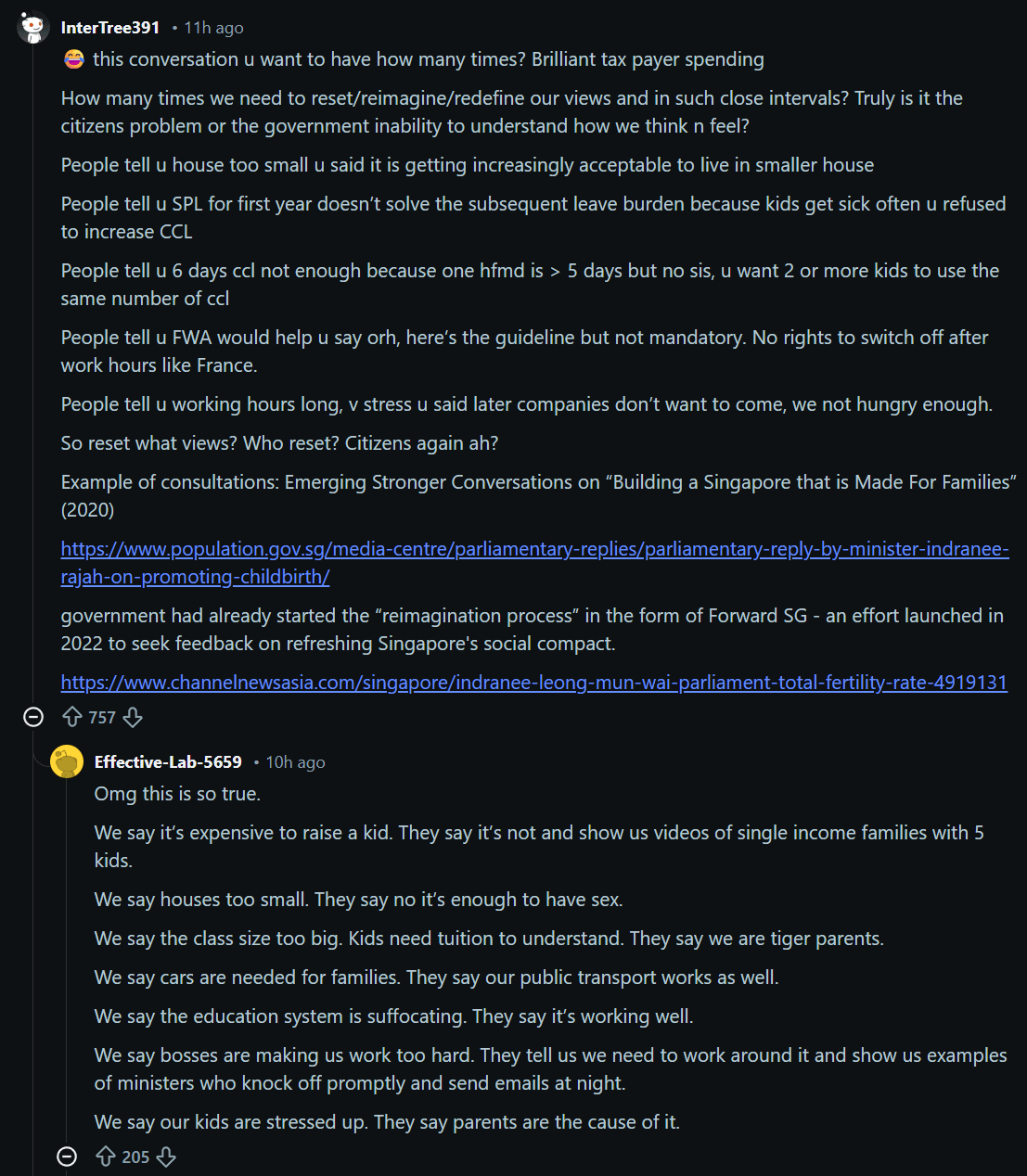
In parallel, official statements have tried to hold both frames at onct is committed to acting “head-on”, but also that reversing fertility decline is not solely a matter of increasing incentives.
CNA’s reporting has also highlighted how senior leaders framed ths part of a broader population challenge, including ageing and the long-run implications of sustained low birth rates.
The next test will be whether the work group’s consultations produce proposals that people can feel in daily life: more predictable leave, more realistic workplace norms, and cost structures that reduce the sense that parenting requires constant upgrading.