All HDB towns to get EV fast-charging hubs by end-2027 amid rising demand
Each HDB town will have at least one EV fast-charging hub by the end of 2027, as EV adoption hits record highs. Senior Minister of State Sun Xueling said more hubs will be rolled out, while MPs called for faster deployment and clearer capacity targets.
- Each HDB town will have at least one EV fast-charging hub by the end of 2027.
- Singapore has over 29,000 charging points, with 55% of new car registrations in January 2026 being electric.
- MPs call for faster rollout and clearer targets amid rising EV adoption and grid capacity concerns.

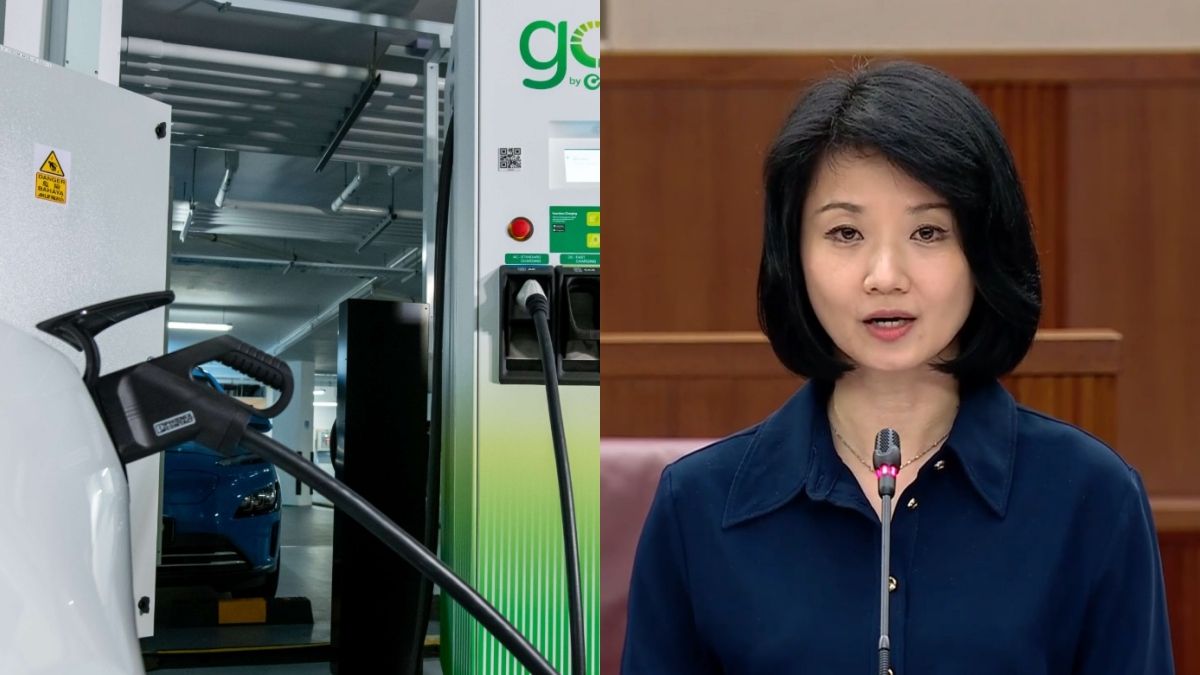
Singapore will deploy at least one electric vehicle (EV) fast-charging hub in every Housing & Development Board (HDB) town by the end of 2027, Senior Minister of State for Transport Sun Xueling said on 4 March 2026.
Speaking during the Ministry of Transport’s Committee of Supply debate, Sun said the move aims to support growing EV adoption and provide residents with faster charging options beyond overnight slow chargers.
“We will deploy more fast charging hubs so that there will be at least one fast charging hub per HDB town by the end of next year,” she said.
Each hub will be equipped with at least six fast-charging points rated at around 50 kilowatts (kW).
Rollout to begin in high-demand areas
Sun said deployment would begin in areas with higher charging demand and sufficient electrical capacity.
These include carparks near Compass One in Sengkang, MacPherson Market and Plantation Plaza in Tengah.
According to the Land Transport Authority (LTA), additional fast-charging hubs are planned in Bedok, Chua Chu Kang and Clementi, with more locations to be added progressively.
There are currently 21 publicly available fast-charging hubs islandwide. The new HDB town rollout is expected to add about 20 more.
EV adoption hits record high
Sun noted that EV adoption has risen sharply. In January 2026, EVs accounted for 55% of new car registrations, a record high.
She said more than 29,000 charging points are now available across Singapore, with around 12,000 publicly accessible.
“We have achieved our target to provide all HDB residents with convenient access to a charger, with more than 90% of HDB carparks equipped with slow chargers,” Sun said.
The Government had earlier deployed 150 fast-charging points across 70 carparks in HDB town centres and JTC premises.
Mix of charging options planned
Sun emphasised that the charging network would comprise a mix of slow, fast and ultra-fast chargers.
“Technology continues to evolve rapidly,” she said, noting that more EV models now support faster charging and that ultra-fast chargers can add hundreds of kilometres of range in under 10 minutes.
Under the Government’s approach, residents preferring overnight charging can continue using slow chargers near their homes, typically rated at 7.4kW or below.
Those running errands for one to two hours may use fast-charging hubs, while drivers seeking a 10 to 20-minute top-up can turn to ultra-fast chargers above 150kW, similar to the experience at petrol kiosks.
Sun added that agencies are working to optimise the national grid and reduce costly infrastructure upgrades as demand grows.
Concerns over charger capacity
During the debate, Workers’ Party MP Louis Chua raised concerns over whether the current pace and scale of deployment would meet rising demand.
He noted that most HDB multi-storey carparks typically have only three slow chargers, often rated at 7.4kW or lower.
Chua said about 88% of Singapore’s chargers are alternating current (AC), with roughly half rated at 7.5kW or below. By contrast, direct current (DC) fast chargers can bring a battery to 80% in about 30 to 45 minutes.
He cited advances overseas, including megawatt-level charging systems capable of delivering significantly higher power outputs.
“Everyday residents will find this increasingly inadequate,” Chua said, urging the Government to accelerate the rollout of fast chargers or increase charger numbers at high-utilisation carparks, particularly in Sengkang.
He asked what maximum electrical capacity had been factored into earlier tenders upgrading HDB carparks, and whether more than three chargers per site could be supported in the near term.
Government monitoring developments
In response, Sun said the Government began with a baseline deployment of at least three charging points per HDB carpark.
“More than 90% of our carparks have achieved this,” she said.
She added that future deployment would depend partly on available spare capacity at existing sites.
“We are sequencing our fast charging hubs,” Sun said. “This will rely on existing spare capacity at carparks where possible.”
For subsequent phases, agencies are working with the Ministry of Trade and Industry and the Energy Market Authority to optimise grid capacity and minimise costly upgrades.
“When we look at our charging infrastructure, we should look at it holistically,” she said.
“It should be a mix in future of slow chargers, fast chargers, and we’re keeping our eye on ultra-fast charging hubs.”