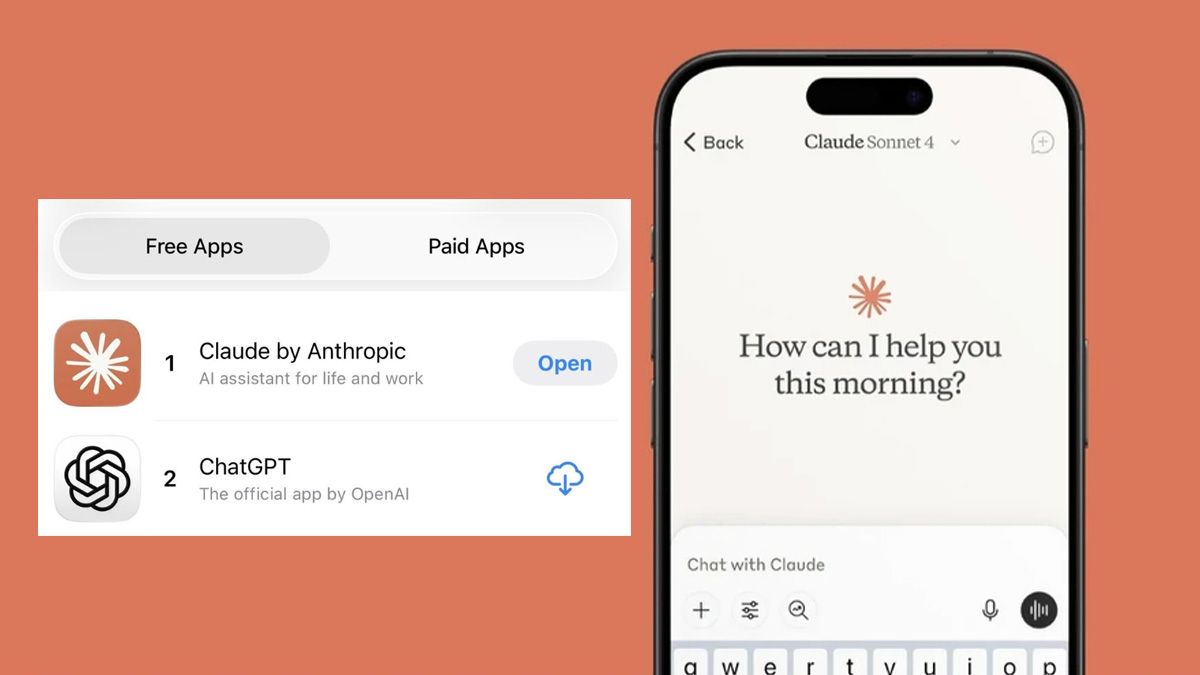
Claude stays No. 1 on US App Store as OpenAI revises Pentagon deal amid backlash
Anthropic's Claude AI chatbot topped the US App Store after the Pentagon designated the company a supply chain risk over its refusal to allow unrestricted military use of its tools, triggering a public feud with the Trump administration.
- OpenAI revised its Pentagon deal on Monday, adding explicit prohibitions on domestic surveillance of US citizens.
- ChatGPT daily uninstall rates rose 200 per cent after OpenAI's military partnership was announced.
- Claude reportedly remained in US military use during Iran operations despite Anthropic's federal blacklisting.

OpenAI has agreed to amend the terms of its hastily announced military AI deal with the US government, after chief executive Sam Altman acknowledged the original agreement had appeared "opportunistic and sloppy." The revision comes days after the company struck the contract with the Pentagon in the immediate wake of a public fallout between the government and rival AI firm Anthropic.
Altman posted on X on Monday to confirm the changes, including a provision explicitly prohibiting the use of OpenAI's systems to spy on Americans. Intelligence agencies, including the National Security Agency, would also be barred from accessing OpenAI's systems without a formal follow-on modification to the contract.
"The issues are super complex, and demand clear communication," Altman wrote. "We were genuinely trying to de-escalate things and avoid a much worse outcome, but I think it just looked opportunistic and sloppy."
A deal under fire from the start
The original agreement had been announced on Friday, hours after negotiations between the Pentagon and Anthropic collapsed.
A statement issued by OpenAI on Saturday had claimed its agreement contained "more guardrails than any previous agreement for classified AI deployments, including Anthropic's."
That claim was met with immediate scepticism. AI experts, lawyers, technology workers and members of the public questioned why the US government would abandon its partnership with Anthropic over safeguards it had publicly criticised, only to accept near-identical terms from a rival company.
The backlash quickly translated into measurable user behaviour. According to data from app analytics firm Sensor Tower, the daily average rate of ChatGPT uninstalls rose by 200 per cent compared to normal levels in the days following the Pentagon announcement.
Several prominent figures had already announced publicly that they were switching from ChatGPT to Claude, with pop singer Katy Perry among those urging others to cancel their subscriptions.
Claude holds the top spot; military use continues despite ban
Anthropic's Claude remained at the top of Apple's App Store ranking in the United States through Tuesday, several days after first dethroning ChatGPT. On Android, Claude rose sharply in both the US and the UK, though ChatGPT retained the leading position there, according to Sensor Tower.
In a further development that has complicated the official narrative, reports emerged that the US military had continued using Claude in operations connected to the US-Israel conflict with Iran, even after the Trump administration's ban on Anthropic took effect.
CBS News reported on Tuesday that Claude was still in active use. The Pentagon declined to comment on its dealings with Anthropic.
Anthropic's applications suffered service outages on the Monday following the initial surge, amid what the company described as "unprecedented demand for Claude."
More than 1,400 users reported disruptions shortly after 6am Eastern Time, according to outage-tracking platform Downdetector. By 11am Eastern Time, Anthropic confirmed the incident had been resolved.
Anthropic stated that free active users had grown by more than 60 per cent in the year to date, daily sign-ups had quadrupled, and paid subscribers had more than doubled.
"Every single day last week was an all-time record for Claude sign-ups," the company said.
The origins of the dispute
The confrontation between Anthropic and the Trump administration grew from the company's refusal to grant the Pentagon unrestricted access to its AI tools. Anthropic had grown increasingly concerned that the military intended to use its technology for what it described as "mass surveillance" and deployment in "fully autonomous weapons."
Anthropic's chief executive Dario Amodei declined to agree to what the Pentagon characterised as "any lawful use" of the company's tools. Amodei argued publicly that current AI models are insufficiently reliable for autonomous weapons systems, and that mass surveillance programmes would violate constitutional rights.
US Defence Secretary Pete Hegseth summoned Amodei to Washington DC for a meeting on a Tuesday amid escalating tensions.
The meeting produced two ultimatums: Hegseth threatened to invoke the Defense Production Act, which would allow the government to commandeer Anthropic's technology, and to formally designate Anthropic a supply chain risk.
By Thursday, Amodei had stated that Anthropic would rather end its Pentagon relationship entirely than comply.
On Friday, both Trump and Hegseth announced their decisions on social media. Hegseth posted on X that Anthropic would be "immediately" designated a supply chain risk, prohibiting any military contractor from engaging in commercial activity with the company.
Trump wrote on Truth Social: "The Leftwing nut jobs at Anthropic have made a DISASTROUS MISTAKE trying to STRONG-ARM the [Pentagon], and force them to obey their Terms of Service instead of our Constitution."
Anthropic's response and legal challenge
Anthropic said on Friday evening that it had yet to receive formal communication from the White House or the military regarding the status of negotiations. The company described a supply chain risk designation as "legally unsound" and warned it would set "a dangerous precedent for any American company that negotiates with the government."
The company declared that "no amount of intimidation or punishment from the Department of War" would alter its position on mass domestic surveillance or fully autonomous weapons. The Department of War is a name Trump has applied to the defence department.
Anthropic confirmed it would challenge any such designation in court. The label, if applied, would make Anthropic the first US company to be publicly subjected to such treatment.
Trump warned the company on Truth Social that it had better cooperate during the phase-out period, threatening "the Full Power of the Presidency" and "major civil and criminal consequences" if it failed to do so. Anthropic's tools are to be phased out of all government work over six months.
Anthropic's Pentagon contract is worth US$200 million (£149 million). The company's most recent valuation placed its worth at US$380 billion.
A former US Department of Defense official, speaking anonymously to the BBC, said the government's legal basis for threatening Anthropic was "extremely flimsy," and noted that the company "simply do not need the money."
The AI industry's wider reckoning
Before confirming the OpenAI deal, Altman had sent an internal memorandum to staff stating that he held the same "red lines" as Amodei.
The memo said any OpenAI military contract would reject uses "unlawful or unsuited to cloud deployments, such as domestic surveillance and autonomous offensive weapons."
Altman wrote that the situation had become "an issue for the whole industry," adding: "I do not fully understand how things got here; I do not know why Anthropic did their deal with the Pentagon and Palantir in the way they originally did it."
Amodei and Altman share a long professional history. Amodei rose to prominence as an early employee at OpenAI before leaving to found Anthropic following internal disagreements. The two companies now compete directly for individual and corporate customers.
How AI is currently used in military operations
The dispute has brought renewed scrutiny to the role of artificial intelligence in modern warfare. AI is currently used across militaries for a range of purposes, including logistics optimisation and processing large volumes of intelligence data.
The US, Ukraine, and Nato all use technology from Palantir, an American data analytics company that provides tools for intelligence gathering, surveillance, counterterrorism and military purposes. The UK Ministry of Defence recently signed a £240 million contract with the firm.
Palantir's AI-powered defence platform, known as Maven, integrates a wide range of military information — from satellite data to intelligence reports — which can then be analysed by commercial AI systems. Louis Mosley, head of Palantir's UK operations, said in a BBC interview that the system helped forces make "faster, more efficient, and ultimately more lethal decisions where that's appropriate."
Palantir, unlike Anthropic, does not advocate for a blanket ban on autonomous weapons, but maintains that there should always be "a human in the loop."
Lieutenant Colonel Amanda Gustave, chief data officer for Nato's Task Force Maven, similarly emphasised the role of human oversight, stating they were "always introducing a human in the loop" and that an AI would "never" make a decision unilaterally.
Prof Mariarosaria Taddeo of Oxford University offered a stark assessment of Anthropic's removal. "The most safety-conscious actor is now out from the room," she told the BBC. "That is a real problem."