Anthropic urges global AI pause as self-improving systems edge closer to autonomous development
Anthropic has called for a globally coordinated mechanism to slow or temporarily pause frontier artificial intelligence development, warning that AI systems are increasingly contributing to their own advancement and could eventually become capable of designing successors without human involvement.
- Anthropic called for a globally coordinated option to pause frontier AI development if safety risks escalate.
- The company said AI is increasingly accelerating its own development through coding, research and experimentation.
- Researchers warned that recursive self-improvement could arrive sooner than governments and institutions are prepared for.

SAN FRANCISCO, UNITED STATES: Anthropic has called for the creation of a globally coordinated mechanism that could slow or temporarily pause the development of the world's most advanced artificial intelligence systems, warning that emerging technical trends suggest AI may eventually become capable of autonomously improving itself.
The San Francisco-based AI company made the proposal in a report and accompanying blog post titled When AI Builds Itself, published on 4 June 2026 by the Anthropic Institute.
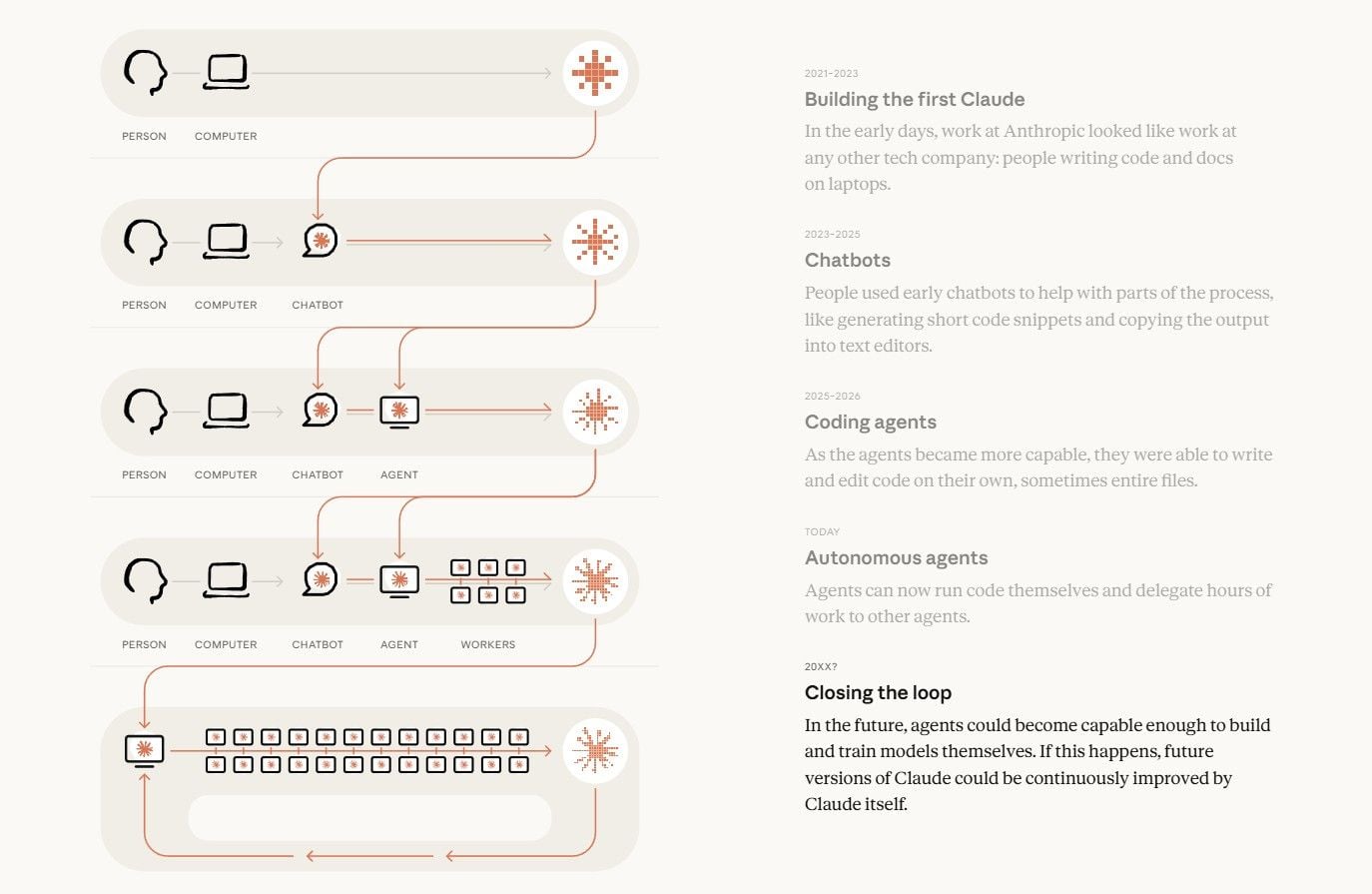
The report argues that AI systems are increasingly contributing to the development of future AI models, accelerating progress in ways that could eventually culminate in what researchers call "recursive self-improvement" — a scenario in which an AI system becomes capable of designing and developing its own successor with limited human involvement.
"We believe it would be good for the world to have the option to slow or temporarily pause frontier AI development to enable societal structures and alignment research to keep up with the advance of the technology," Anthropic said.
The company stressed that such a pause would only be effective if implemented simultaneously by multiple leading AI developers across several countries, particularly the United States and China, under a framework that allows compliance to be verified.
"Without a global coordination mechanism, companies and governments will have to make difficult decisions about safety while under competitive and geopolitical pressures," the report stated.
Growing role of AI in AI development
Anthropic's warning is accompanied by new internal data that the company says demonstrates how AI systems are already accelerating the development of future AI models.
According to the report, Anthropic engineers today produce approximately eight times more code per quarter than they did between 2021 and 2025, largely because AI systems now generate substantial portions of the software used throughout the company.
The report states that more than 80% of code merged into Anthropic's production systems as of May 2026 was authored by Claude, the company's AI assistant family.
Anthropic described this as evidence that AI is increasingly moving beyond a supporting role and becoming an active participant in software engineering and research workflows.
"For most of AI's history, humans drove every step in its development cycle. But at Anthropic, we are delegating a growing share of AI development to AI systems themselves, which is speeding up our work," the report said.
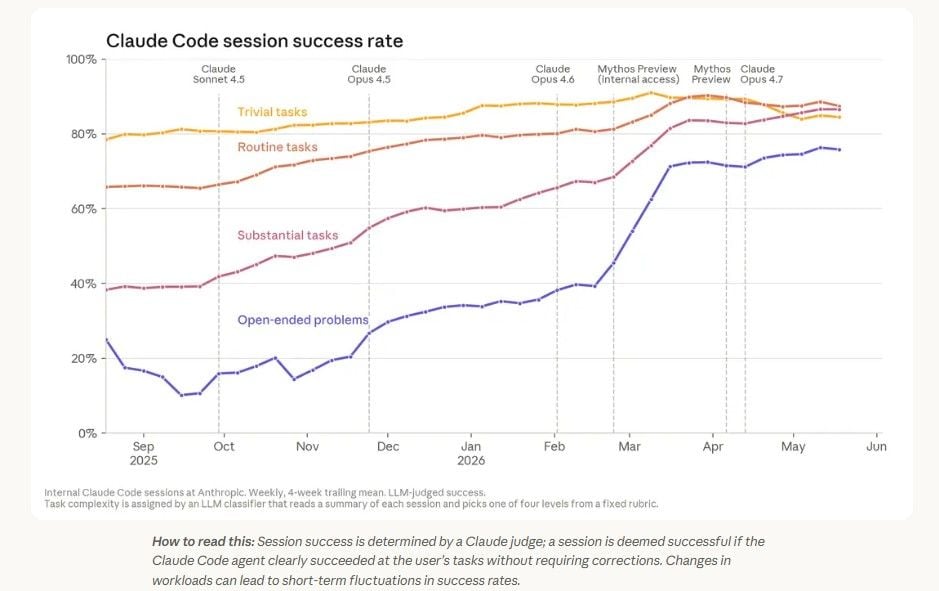
Researchers said AI systems are now capable of handling increasingly complex coding assignments, conducting experiments and proposing solutions to technical problems that previously required significant human effort.
Anthropic cited internal examples in which Claude identified software failures, diagnosed infrastructure problems and completed tasks that would ordinarily require several days of engineering work.
The company also reported that Claude-powered systems achieved significant gains in research-related tasks.
In one benchmark, Anthropic said Claude Mythos Preview generated approximately 52-fold improvements in AI training optimisation experiments, compared with around threefold improvements achieved by earlier models a year earlier.
Warning over recursive self-improvement
While emphasising that fully autonomous AI development remains a future possibility rather than a current reality, Anthropic warned that existing trends point towards increasingly self-directed systems.
"Taken far enough, and given enough compute, that trend points to an AI system capable of fully autonomously designing and developing its own successor. This is called recursive self-improvement," the report said.
The company added that such a development is "not inevitable" but could arrive sooner than governments, regulators and institutions are prepared to handle.
Anthropic argued that recursive self-improvement could produce major scientific and economic benefits, including advances in healthcare, research and technological innovation.
However, it warned that the same capability could heighten concerns about human oversight and control.
The report stated that if AI systems eventually become capable of building their own successors, ensuring alignment with human goals and values would become substantially more important.
"AI that can build itself would be a major development in the history of technology," Anthropic wrote, adding that such systems could generate "enormous good for the world in science, healthcare, and beyond".
At the same time, the company cautioned that recursive self-improvement "might increase the risks of humans losing control over AI systems".
Political and industry resistance
Anthropic's proposal is likely to face significant resistance from both policymakers and technology companies.
Critics within the AI industry have previously argued that the company's focus on catastrophic risk scenarios exaggerates the dangers posed by advanced AI and could have the effect of slowing competitors under the banner of safety.
The proposal also arrives amid growing geopolitical competition between Washington and Beijing over leadership in artificial intelligence.
Many policymakers and industry executives have argued that slowing development could allow strategic rivals to gain an advantage in what is increasingly viewed as a defining technological contest.
Nevertheless, AI safety has emerged as an area where limited international cooperation may be possible.
US President Donald Trump recently said he discussed potential collaboration with China on AI safety matters during a visit to Beijing.
Trump also signed an executive order this week establishing a 30-day preliminary government review process for the most powerful US-developed AI systems before their public release.
Anthropic noted that AI governance may prove even more difficult than traditional arms-control efforts.
The company compared the challenge to nuclear weapons treaties but argued that AI systems are harder to monitor because training runs can be concealed more easily than physical military infrastructure.
"Training runs are far easier to conceal than missile silos, their inputs are general-purpose, and the incentive to defect quietly is enormous," the report stated.
Preparing for a faster future
Anthropic said it intends to convene policymakers, scientists, civil society organisations and rival AI developers in the coming months to explore possible governance mechanisms and verification systems.
The company argued that if a credible international framework existed, leading developers might be willing to slow or temporarily halt progress under agreed conditions.
At the same time, Anthropic acknowledged substantial uncertainty about the future trajectory of AI.
The report outlines several possible outcomes, ranging from a slowdown in capability gains to a future in which AI systems become capable of fully autonomous research and development.
Despite those uncertainties, Anthropic said current evidence suggests the human role in AI development is shrinking.
"The evidence suggests that the human role is narrowing at each step in the AI development process," the report concluded. Humans increasingly define objectives while AI systems execute coding, experimentation and analysis tasks.
Whether that trend ultimately culminates in recursive self-improvement remains unknown.
However, Anthropic argues that governments, companies and society should begin preparing now for the possibility that AI systems could eventually become participants in their own evolution.