The Unstated Population: Planning for a future that no longer exists
In 2024, Singapore's citizen population grew by 25,279. Natural increase — births minus deaths — contributed 4,909 of that. The rest came from the pipeline. The "strong Singaporean core" is no longer reproducing itself. It is being maintained by conversion. The grey bomb was not bad luck. It was a scheduled delivery. And the pipeline that loaded it is still running.


In September 2025, Singapore's National Population and Talent Division published a number that should give every policy planner pause.
The number of Singaporeans aged 80 and older had risen 60 per cent in a single decade — from 91,000 in 2015 to 145,000 in 2025. Singapore was on the verge of becoming a super-aged society, with more than one in five citizens already aged 65 or above. By 2030, that figure is projected to hit one in four.
The official framing was sympathetic: an ageing population is a triumph of development. Health Minister Ong Ye Kung called it "the biggest social transformation for this generation."
What the official commentary does not readily address is a question worth asking: how much of this demographic shift was the foreseeable consequence of deliberate policy choices? And — more precisely — what exactly is being counted when the government speaks of the citizen population that Singapore's entire demographic strategy is built around?
A Question the Data Invites
Singapore's leaders speak constantly about maintaining a "strong Singaporean core," about the citizen population as the bedrock of national identity and social planning. The numbers are cited at every Budget, every Population White Paper debate, every discussion of support ratios and ageing projections.
What those discussions rarely surface is a straightforward arithmetic question: how much of citizen population growth reflects organic increase — births exceeding deaths among existing citizens — and how much appears to reflect permanent residents being converted into citizens through the immigration pipeline?
Official data from the Registry of Births and Deaths and the Department of Statistics allows us to examine this question. What it suggests is worth serious public discussion.
In 1997, the natural increase among Singapore citizens — births minus deaths — was 29,410. The citizen population appeared to be growing largely on its own terms. By 2010, that figure had fallen to 14,197. By 2020, it was 11,592. By 2024, it had narrowed to just 4,909.
In 2024, Singapore recorded 29,237 citizen births and 24,328 citizen deaths. The natural increase of 4,909 is the smallest gap in the modern data series — and the trend line continues downward.
Yet the citizen population grew by 25,279 that year — from 3,610,658 to 3,635,937. Natural increase accounted for just 4,909 of that, roughly 19 per cent. The Immigration Checkpoint Authority (ICA) granted 22,766 new citizenships in the same year. The arithmetic is unambiguous: new citizenships accounted for approximately 80 per cent of citizen population growth in 2024.
Singaporean births over deaths — the organic growth of the citizen community — contributed less than one in five.
This appears to be an accelerating trend rather than a recent anomaly. Working from the same publicly available data:
— Between 1997 and 2009, the implied conversion figure suggests PR-to-citizen grants accounted for roughly 22 per cent of citizen population growth. Natural increase still appeared to do most of the work.
— Between 2009 and 2019, that proportion appears to have shifted significantly — conversions potentially accounting for around 52 per cent of growth. The citizen population had become increasingly dependent on immigration to sustain its own numbers.
— Between 2019 and 2024, conversions may have accounted for as much as 74 per cent of citizen population growth. At the current trajectory of declining natural increase, the question of whether the citizen population could sustain itself without the ongoing conversion pipeline deserves an honest public answer.
To be clear: this analysis uses publicly available official statistics and infers conversion rates from the gap between natural increase and actual population change.
The government publishes naturalisation figures separately, and a fuller picture would require cross-referencing those. What the birth and death data alone suggests, however, is that the "strong Singaporean core" may be considerably more dependent on the immigration pipeline than public discourse acknowledges.
Did Policy Plant the Grey Bomb?
This matters for understanding the grey bomb, because the people moving through the PR-to-citizen pipeline are not uniformly young.
In his 1997 National Day Rally, Prime Minister Goh Chok Tong laid out the vision: "We can build the best home for Singaporeans only by tapping the best talent from around the world."
The immigration pipeline opened. Between 1997 and 2009, the PR population grew from 228,608 to 533,183 — more than doubling in twelve years. In 2008 alone, Singapore absorbed 191,000 new non-residents. The pace was extraordinary by any measure.
The 2000 Census of Population shows exactly what was being loaded into the demographic pipeline. The 30-34 age band that year already had the highest PR concentration of any working-age group: 53,385 permanent residents, nearly one in five in that cohort.
Between 2000 and 2009, a further 246,000 net new PRs arrived, predominantly working-age. The 2008 bulge at 40-44 and 45-49 was not produced by a local baby boom. It was loaded, deliberately and at speed, by policy.
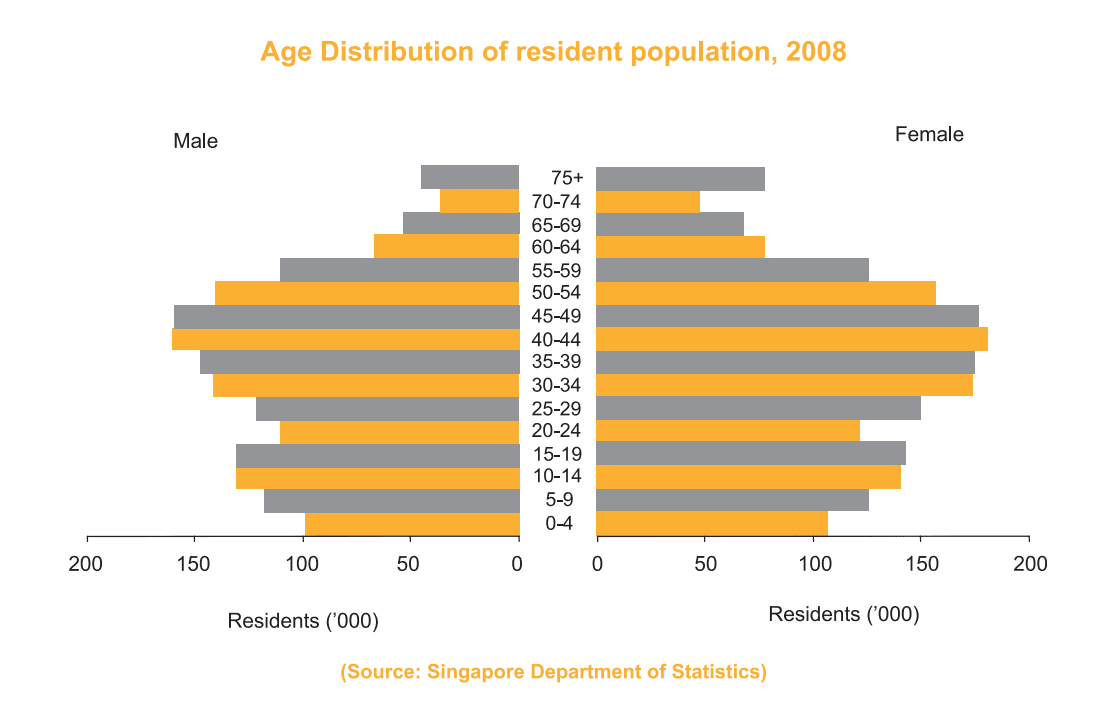
In 2026, that cohort is 66 to 75. The grey wave the planning documents now treat as a demographic surprise was visible in the data before it arrived.
Those who came contributed productively. Many became PRs, then citizens. The deal appeared genuine on both sides.
But the reasonable question — one that does not require attributing bad faith to anyone — is whether the greying of Singapore's population is partly a foreseeable consequence of that cohort moving through its life stages, and whether that consequence was adequately modelled at the time the strategy was designed.
The official presentation of Singapore's ageing crisis tends to frame it as a phenomenon driven primarily by low birth rates and longer life expectancy. Both of those factors are real. But if a significant portion of today's elderly and near-elderly citizen population consists of people who arrived as working-age immigrants one or two decades ago, then the scale and timing of the grey bomb may be substantially explained by policy choices, not demography alone.
That is a question the data invites. It is not a question that has been put to Parliament.
The Replacement of the Singaporean Core
The grey bomb is the past catching up. What follows is the present accelerating.
Mr Shawn Loh, PAP MP for Jalan Besar, named the endpoint on the floor of Parliament in February 2026. If citizen births continue to decline, he said, there would come a day when the number of new citizenships granted to immigrants exceeds the number of Singaporean babies born in that year. "We must delay this for as long as possible," he said.
That framing deserves examination. Delay implies the outcome is inevitable — that the question is not whether the crossover happens but when. A government that had a structural answer to this problem would not be asking Parliament to delay it. It would be describing how it intended to prevent it.
Mr Xie Yao Quan, PAP MP for Jurong Central, provided the workforce arithmetic that gives Mr Loh's statement its full weight. He traced Singapore's TFR collapse to 2001, when annual births fell from an average of around 47,000 to around 40,000. Those smaller cohorts are now entering the workforce. For the first time in Singapore's history, the birth cohorts hitting working age are smaller than the cohorts aged 65 to 69 reaching retirement — smaller by 30,000 persons. Five years ago, the gap ran the other way by 20,000. A swing of 50,000 in half a decade.
What this means, in plain terms, is that the "strong Singaporean core" the government has cited as the anchor of its population strategy is no longer reproducing itself at a rate sufficient to sustain its own numbers. The citizen count is being maintained — but increasingly through conversion of PRs, not through the organic growth of families that have been here for generations. The core is not being strengthened. It is being replaced, incrementally and by arithmetic, one naturalisation cohort at a time.
The philosophers call this the Ship of Theseus problem. If you replace every plank of a ship, one by one, is it still the same ship? Singapore's citizen population is not being replaced all at once — it is being replaced incrementally, cohort by cohort, one naturalisation cycle at a time.
At some point the question stops being arithmetic and becomes something harder to answer: what exactly is being preserved, and for whom?
This is not an argument against immigration. It is an argument for honesty about what the immigration pipeline is now doing — and what it means for a national identity built around the idea of a citizen community with shared history and accumulated belonging.
These were not opposition voices raising this alarm. These were government backbenchers, in February 2026, describing the logical endpoint of their own party's thirty-year population strategy. Not as something that had been solved. As something to be delayed.
The delay, on current projections, is running out. And the strategy designed to delay it — more immigration, more conversions, a larger pipeline — is the same strategy that produced the grey bomb, the housing pressure, the fertility collapse, and the question that neither speech answered: at what point does the Singaporean core become the pipeline, and what exactly are we then preserving?
The Loop That Created Its Own Problem
The pipeline did not just replace the core. It created the conditions that made the core unable to replace itself — and then made those conditions impossible to reverse without dismantling the asset values the entire social compact rests on.
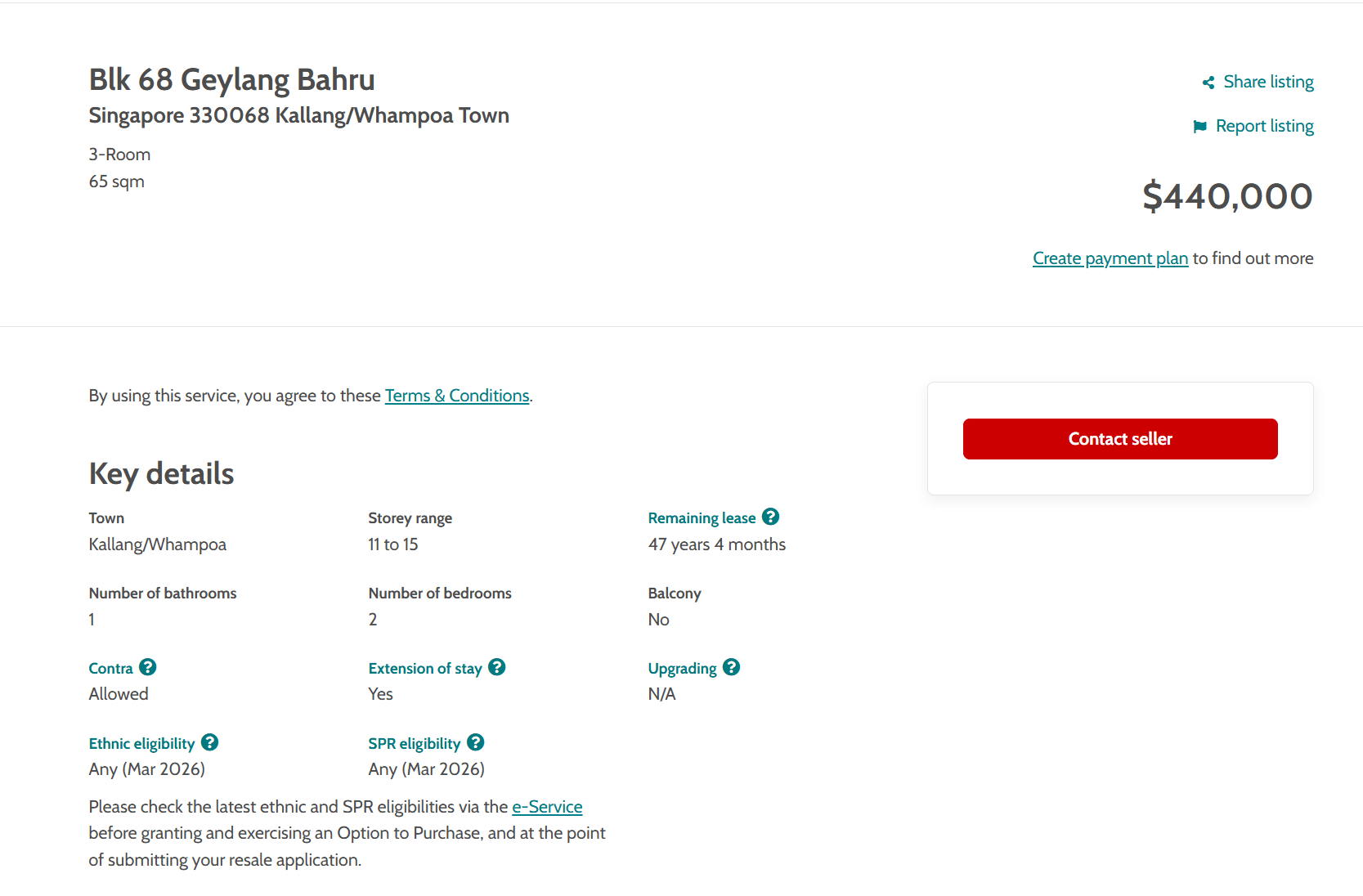
Mass immigration drove up demand for housing in a land-scarce city. In 1980, a three-room HDB flat in Geylang could be bought for $17,300. By June 2024, a new BTO three-room flat in the adjacent Kallang/Whampoa district started from $402,000 — and that is the subsidised price, the affordable option, the entry point the system was designed to provide. A comparable resale flat in the same area lists today at $440,000, with only 47 years remaining on the lease.
The pioneer generation bought the full asset for a fraction of the price. Their children are paying 23 times more for half of it — and even the queue for the cheaper version requires a multi-year wait. A genuine gain for early owners, but a barrier for those who came after — the population arithmetic that inflated their parents' asset values may have priced the next generation out of equivalent assets on equivalent incomes.
Singapore's own Marriage and Parenthood Survey from 2021 gives a precise picture: 89 per cent of singles who said they did not want children cited the cost of raising them as a key factor. Eight in ten cited lack of time and energy. Eight in ten cited uncertainty about future income.
If population growth contributed to the housing costs and economic pressures that these surveys identify as the primary drivers of low TFR, then the strategy designed to compensate for low TFR may have been deepening the underlying cause — a feedback loop that the official framing has not candidly acknowledged.
By 2013, Lee Hsien Loong was defending the Population White Paper in Parliament. He acknowledged the coming pressure directly — the support ratio heading from 6:1 to 2:1 by 2030, a tripling of the burden on each working-age person. His prescription: more immigration. 25,000 new citizens annually. 40,000 new PRs. "It would be irresponsible," he said, "to kick the can down the road."
The question of whether the 1997 strategy had contributed to the very problem the 2013 strategy was designed to address was not, to public knowledge, part of the White Paper debate.
2026: The Same Prescription
On 26 February 2026, Deputy Prime Minister Gan Kim Yong outlined the next five years.
Citizen population growth had slowed to 0.7 per cent and was heading toward 0.5 per cent. The fertility rate had reached a historic low of 0.87. The Government would take in 25,000 to 30,000 new citizens annually.
The PR pipeline would expand to roughly 40,000 annually. The Government was even prepared to revisit previously rejected applicants who had "assimilated well."
What was notably absent: any public reckoning with the citizen natural increase figure of 4,909 — and its trajectory.
Any acknowledgment that the citizen count is being sustained largely through PR conversions. Any discussion of the age profile of those being converted, and what that implies for the support ratios the strategy is designed to protect.
Three governments. Three decades. The same lever. The PR population was 228,608 in 1997. It is 543,832 today. The non-resident population was 672,635 in 1997. It is 1,906,660 today. Whether one regards this as success or as a pattern worth interrogating may depend on whether one also asks what happens next.
And what appears to be happening next — the variable conspicuously absent from current planning documents — is automation.
The Variable No Model Has Entered
There will not be jobs for all these people. Not the jobs the model was built around. Not on the timeline the model has assumed.
Humanoid robots capable of physical labour are no longer a horizon technology. AI systems displacing knowledge work are already in commercial deployment.
The roles Singapore's population strategy was built to fill — construction, services, logistics, eldercare, the middle-weight of the economy Singaporeans had graduated out of and others were imported to fill — are widely identified as among the first wave of meaningful automation displacement.
The cost arithmetic, when it tips, may not be recoverable. A robotic system requires no CPF contributions, no medical leave, no housing allowance, no repatriation. It operates continuously, requires only scheduled maintenance, and improves through software updates. The question is not whether this changes the hiring calculus but when — and engineers building these systems are not discussing decades. They are discussing years.
If that assessment is even approximately correct, then the support ratio projections that underpin every current population plan deserve to be re-examined. Those projections assume the workers being admitted will pay CPF and taxes as Singapore's elderly cohort expands. That assumption may not survive contact with the actual labour market of 2030.
The Marriage and Parenthood taskforce is attempting to raise TFR in a city where housing costs are driven partly by population arithmetic, in an economy where the job security that underpins decisions to have children is under structural pressure from automation. It is worth asking whether any incentive package can address that combination.
The eldercare infrastructure being built to serve the super-aged society is staffed substantially by workers in roles identified as early automation targets. The plan to care for Singapore's elderly assumes a human workforce available to deliver that care. The economics of robotic caregiving may not leave that assumption undisturbed.
Three engines of growth — workforce, consumer base, property market — all running on the same fuel. The fuel may be running out.
Questions the Planning Process Has Not Asked
What is perhaps most striking is not any individual policy choice but the systematic absence of certain questions from official planning documents.
At what point does the declining natural increase of the citizen population become a matter for public discussion, rather than being managed through administrative conversion of an ageing PR cohort?
If a significant proportion of today's elderly citizens arrived as working-age immigrants one or two decades ago, what does that imply for the support ratios being used to justify current immigration targets — which will themselves eventually age into the same dependency bracket?
If automation is projected to substantially displace the categories of work that have historically absorbed immigrant labour, on what basis are current immigration intake targets being set?
These are not rhetorical questions designed to arrive at predetermined answers. They are the kind of questions that long-term planning — Singapore's stated speciality — would ordinarily be expected to engage with. The absence of any public engagement with them is itself worth noting.
Singapore's leadership has, across multiple administrations, acknowledged the importance of confronting difficult long-term realities rather than deferring them. Lee Hsien Loong said in 2013 that kicking the can down the road would be irresponsible. That instinct, applied to the questions above, would look quite different from what the current planning cycle appears to contain.
What the Singaporean in the MRT Is Entitled to Ask
The Singaporean standing in a crowded carriage in 2026 is carrying several things simultaneously that official discourse has not assembled into a single honest frame.
They are in a city whose housing costs may have been driven in part by population strategies designed for other purposes.
They are heading to a job whose medium-term existence is genuinely uncertain in ways no SkillsFuture credit is calibrated to address. They are part of a society approaching super-aged status — a condition that may be substantially attributable to deliberate policy choices about who was invited to stay — and they may be among those expected to fund the care of that cohort through taxes and CPF contributions their own employment may or may not sustain.
And the citizen population they were told they belong to is, the data suggests, less self-sustaining than official descriptions imply — with natural increase approaching zero and the gap being filled by conversions of an ageing cohort whose dependency timeline may not improve the support ratios they were imported to maintain.
None of this requires attributing malice to anyone. The decisions were made by serious people, in good faith, responding to the pressures they faced at the time.
But good faith and adequate foresight are different things. And the Singaporean in the carriage — the one being asked to fund the consequences of decisions made before they had any say — is entitled to ask whether the foresight, on the questions that matter most to their future, was adequate.
The data available to any member of the public suggests it may not have been.
That is a question worth putting to the people who are still making the decisions.
This is the second in a series on AI, automation, and Singapore's economic future. Read the first piece — on what AI displacement means for education and Singapore's workforce — [here]. The third piece examines the infrastructure being built for a population Singapore's own government has not publicly described. The fourth asks the question the series has been building toward: what population is Singapore actually planning for, and who bears the cost when the plan runs out of road.
This series is the foundation of a longer work. If you think these arguments deserve a full book — with the data, the charts, the parliamentary record, and the regional comparisons this format couldn't hold — support the project at https://buymeacoffee.com/theonlinecitizen. Every contribution goes toward making that book happen.