Support for death penalty in drug cases rises, but youth arrests climb, CNB data show
Public support for Singapore's mandatory death penalty for drug trafficking has grown, a 2025 survey shows — but CNB figures reveal a simultaneous rise in youth drug arrests, creating a tension the government has not directly addressed.
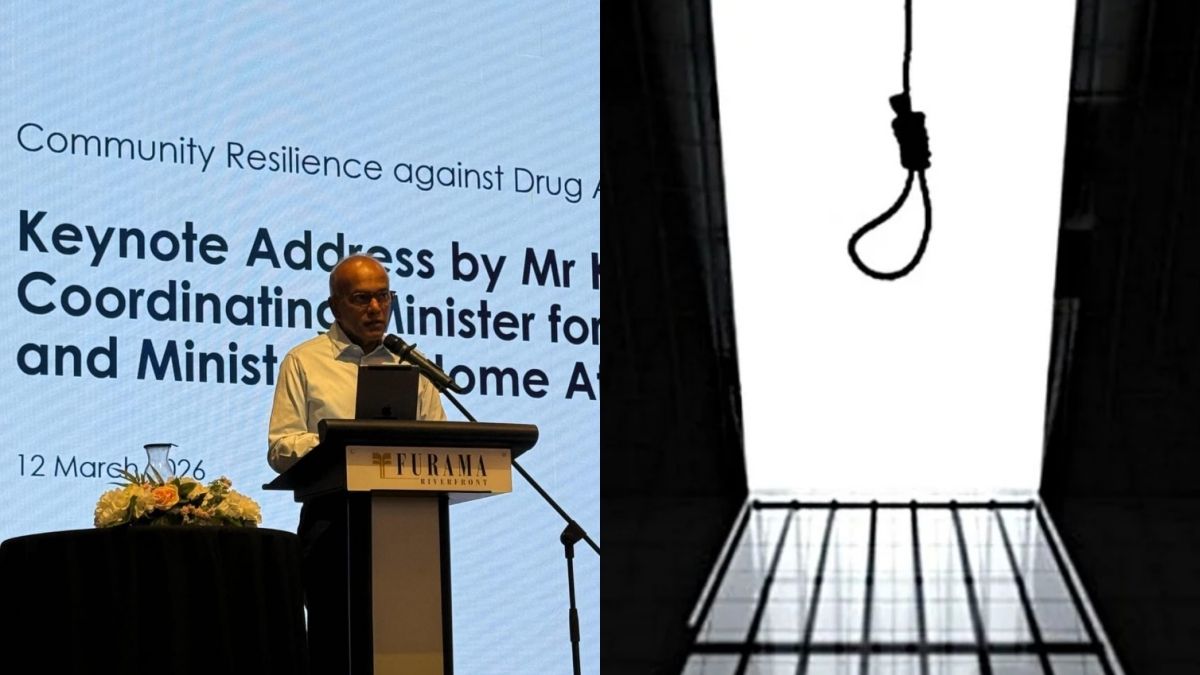
- Shanmugam says 77% of Singaporeans support the mandatory death penalty for drug trafficking, up from 69% in 2023, calling public backing "extremely heartening."
- The minister cited falling arrests since the 1990s as evidence of policy success, without referencing more recent CNB data.
- CNB's 2024 report shows new drug abusers under 20 rose 38 per cent year-on-year, with methamphetamine accounting for 75% of all new abuser arrests.

Public support for Singapore's tough drug laws has grown, according to survey findings disclosed by Coordinating Minister for National Security K Shanmugam on Thursday, 12 March 2026 — but official enforcement data published by the Central Narcotics Bureau (CNB) for both 2024 and 2025 point to a sustained rise in drug abuse among young Singaporeans, complicating the picture the minister presented.
Speaking at the Community Resilience Against Drug Abuse Roundtable held at Furama Riverfront, Shanmugam said a public perception survey conducted in 2025 found that nearly 77 per cent of respondents agreed or strongly agreed that the mandatory death penalty is an appropriate punishment for trafficking a significant amount of drugs, up from 69 per cent in 2023.
Nearly 87 per cent agreed or strongly agreed that the death penalty should be applied to the most serious crimes, including drug trafficking — an increase from approximately 77 per cent in 2023. The first such survey was conducted in 2021, followed by a second in 2023.
Arrests down from 1990s peak — but recent trend is upward among youth
Shanmugam noted that Singapore arrested approximately 6,000 drug abusers annually in the 1990s, a figure that has since fallen to around 3,000 per year. He cited this as evidence that the government's approach — anchored on enforcement, education, and rehabilitation — has been effective over the long term.
However, CNB's Singapore Drug Situation Report 2024, released on 26 June 2025, presents a more recent and less favourable trajectory, particularly for younger Singaporeans.
CNB arrested 3,175 drug abusers in 2024, a 2 per cent increase from 3,122 in 2023. Of the 996 new drug abusers arrested, 54 per cent were below 30 years old, up from 51 per cent in 2023.
The number of new drug abusers below 20 years old increased by 38 per cent, from 97 in 2023 to 134 in 2024 — the second consecutive annual increase. The youngest person arrested for drug abuse in 2024 was 13 years old, significantly below the average onset age of 16 indicated in the 2022 Health and Lifestyle Survey conducted by the Institute of Mental Health.
2025 figures extend the trend
CNB figures released on 10 February 2026 show the trend continued into 2025.
Of the 1,165 new drug abusers arrested that year, half were below 30 years old. The number of new abusers arrested rose 17 per cent from 2024, and new abusers below 20 years old increased by a further 22 per cent. The youngest person arrested for drug abuse in 2025 was 12 years old.
The two consecutive years of rising youth arrests were not referenced in Shanmugam's address.
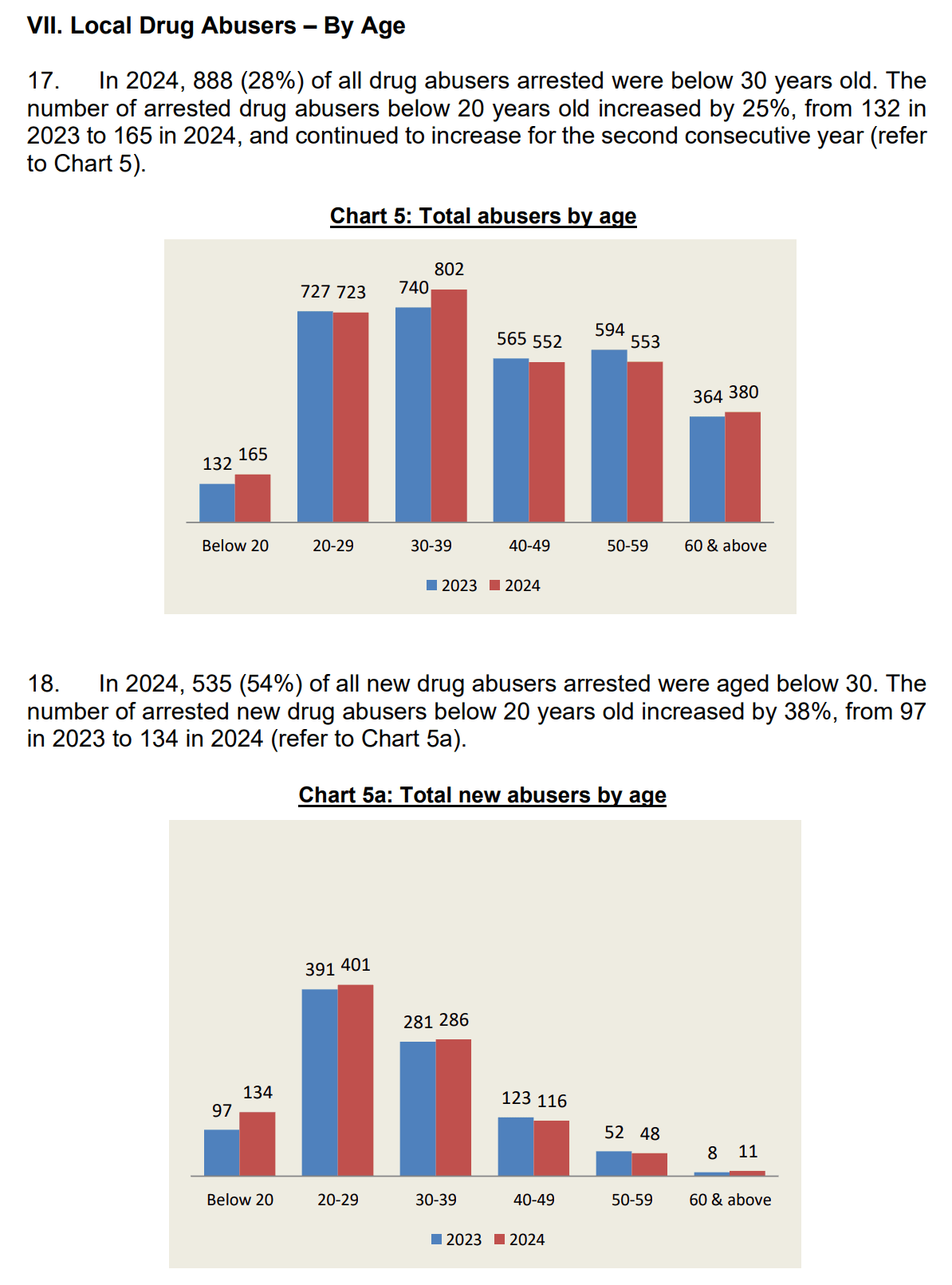
[Screenshot of report from the CNB's release issued on 26 June 2025]
Methamphetamine and cannabis trends
Methamphetamine accounted for 75 per cent of all new drug abuser arrests in 2024, up from 63 per cent in 2023. Of the 747 new methamphetamine abusers arrested, 55 per cent were below 30 years old.
Cannabis arrests also gave cause for concern. Of the 201 cannabis abusers arrested in 2024, 62 per cent were new abusers.
Those below 30 years old formed the largest proportion of both total and new cannabis abusers arrested, at 49 per cent and 57 per cent respectively. The number of cannabis abusers arrested in 2024 remained higher than the annual average recorded over the preceding 10 years.
CNB acting director Leon Chan said in the 2024 report that the data suggested a "growing trend of permissiveness towards cannabis among our youths."
Youth survey support up — but so are youth arrests
Shanmugam cited the 2025 National Drug Perception Survey to argue that youth attitudes remain broadly supportive of firm drug laws. Nearly 93 per cent of youth respondents and more than 95 per cent of adult respondents said Singapore should continue to maintain its tough stance, he said.
Support among youth has increased since the 2023 survey, with more than 87 per cent of youth respondents saying they understood the harms and consequences of drug abuse, up from 83 per cent in 2023. The corresponding figure for adults was approximately 90 per cent.
He described the results as "extremely heartening", and drew a direct link between government leadership and public opinion.
"The survey data is extremely heartening. It shows that when the government takes the leadership, has clear policy, it articulates it, has community support... effective public education can bring across to our people the harms of drugs," he said.
"And people then are prepared to support our tough policy."
The simultaneous rise in youth drug arrests recorded by CNB in both 2024 and 2025 was not referenced during Shanmugam's address. The minister's remarks, taken alongside CNB's own data, suggest that growing attitudinal support for tough drug laws among young people has not translated into a decline in youth drug abuse.
Shanmugam also highlighted Drug Victims Remembrance Day, introduced in 2024 and observed on the third Friday of May each year, as part of Singapore's broader effort to raise public awareness of the human costs of drug abuse.
Rebutting critics of the death penalty
Shanmugam directly addressed a 2024 article in the Sydney Morning Herald by Australian lawyer Lex Lasry, who had attempted to represent a drug trafficker in Singapore and argued that the death penalty had no deterrent effect in Singapore's context.
Shanmugam disagreed, citing a 2024 regional study in which more than 84 per cent of respondents said they believed the death penalty deterred people from trafficking substantial amounts of drugs into Singapore. More than 82 per cent believed it more effective than life imprisonment in discouraging trafficking.
He also dismissed critics who attribute high public support for the death penalty to government propaganda rather than genuine public conviction, calling such reasoning "lazy" and "infantile."
"Singaporeans are well-educated, well-informed. We can see what is going around in the world, the consequences elsewhere," he said.
He argued that Singapore's drug policy is grounded in evidence and that the government would revise its position if contrary evidence emerged. He stressed that the government's primary obligation was to Singaporeans, even where that placed Singapore at odds with international opinion.
"Our duty is not to listen to others, but to do right by Singaporeans. Even if it looks like we are out of step with other parts of the world," he said.
"Good governance means saying no for the good of our people, even if others are giving in to pressure."
Criminal gangs fill the void elsewhere
Shanmugam used comparative international examples to argue that permissive drug policies create conditions that organised crime exploits.
He pointed to South America as a key source and transit region for cocaine, noting that in Uruguay, criminal gangs had grown bold enough to attack the home of the country's anti-narcotics prosecutor with firearms.
In North America, he said, marijuana legalisation has produced significant public health consequences. In Europe, a broadly tolerant approach to drug policy has allowed criminal networks to take root, corrupt officials, and recruit young people to traffic drugs and commit violence.
"Criminal gangs have taken root... They are now corrupting officials, and recruiting young persons to carry drugs, traffic drugs and to assassinate others," he said, adding that the socio-economic costs of drug abuse fall on society as a whole.
Citing the World Drug Report 2025, Shanmugam noted that approximately 316 million people worldwide used drugs in 2023, up from 292 million recorded for 2022 in the previous year's report — a reflection of what he described as a deteriorating global drug situation.
Book launch on drug harm prevention
During the same event, Shanmugam officiated the launch of Island of Hope: Psychological Perspectives on Drug Harm Prevention, authored by Home Team psychologists and correctional rehabilitation specialists.
The book examines how psychological principles can reinforce resilience, support recovery, and promote the reintegration of individuals, families, and communities affected by drugs. It consolidates local research underpinning Singapore's drug prevention, assessment, and rehabilitation frameworks.
The event was organised by the Ministry of Home Affairs' Home Team Psychology Division, together with psychologists from CNB and the Singapore Prison Service.
"I think it will serve as a valuable guide as we take the work forward," Shanmugam said.