Chee Soon Juan challenges ‘transactional thinking’ behind defence of Singapore ministers’ high salaries
Dr Chee Soon Juan disputes claims that high ministerial salaries are needed to attract capable leaders, arguing true leadership is rooted in duty, not personal gain.

- Chee Soon Juan criticised defences of high ministerial salaries as rooted in “transactional thinking”.
- He argued leadership should be driven by duty and historical responsibility, not personal gain.
- A netizen’s defence of experience-based leadership prompted a detailed rebuttal from Chee.

Singapore Democratic Party secretary-general Dr Chee Soon Juan has criticised arguments defending Singapore’s high ministerial salaries, framing them as rooted in “transactional thinking” rather than public service.
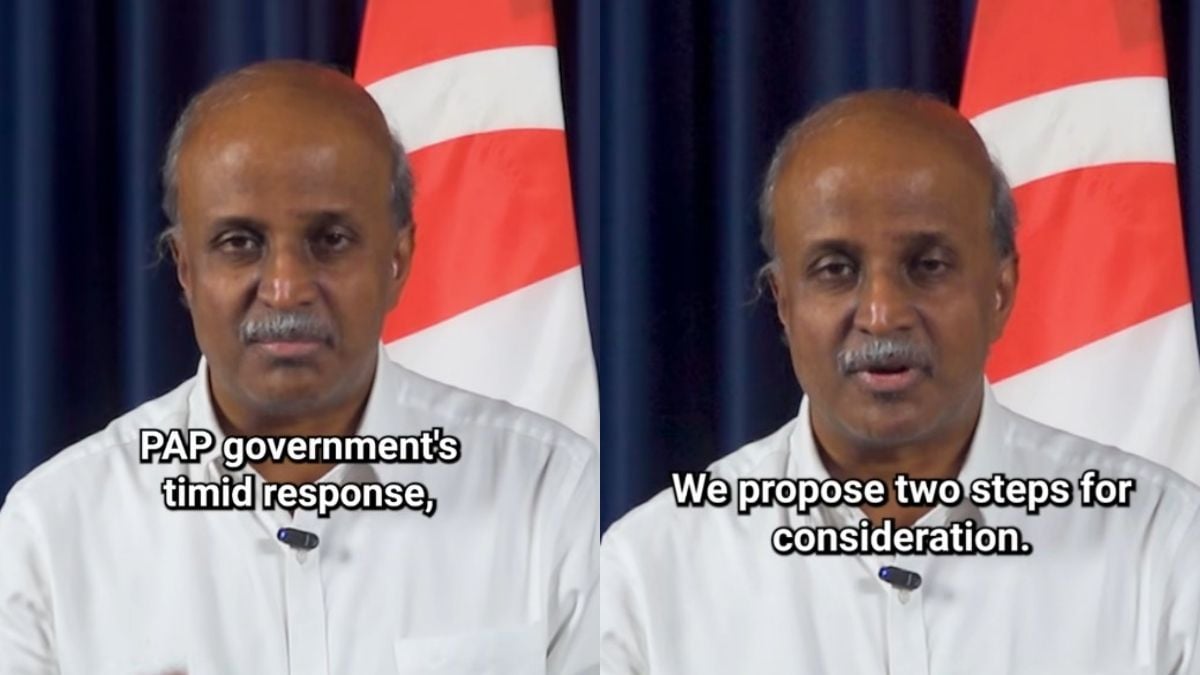
In a video posted on his Facebook page on 23 March 2026, Chee questioned whether high pay for ministers remains justified amid rising living costs, inequality, and social pressures faced by ordinary citizens.
The post sparked a detailed exchange between Chee and a netizen, William Mah, who defended the need for experienced leadership and competitive compensation in governance.
Debate sparked by social media exchange
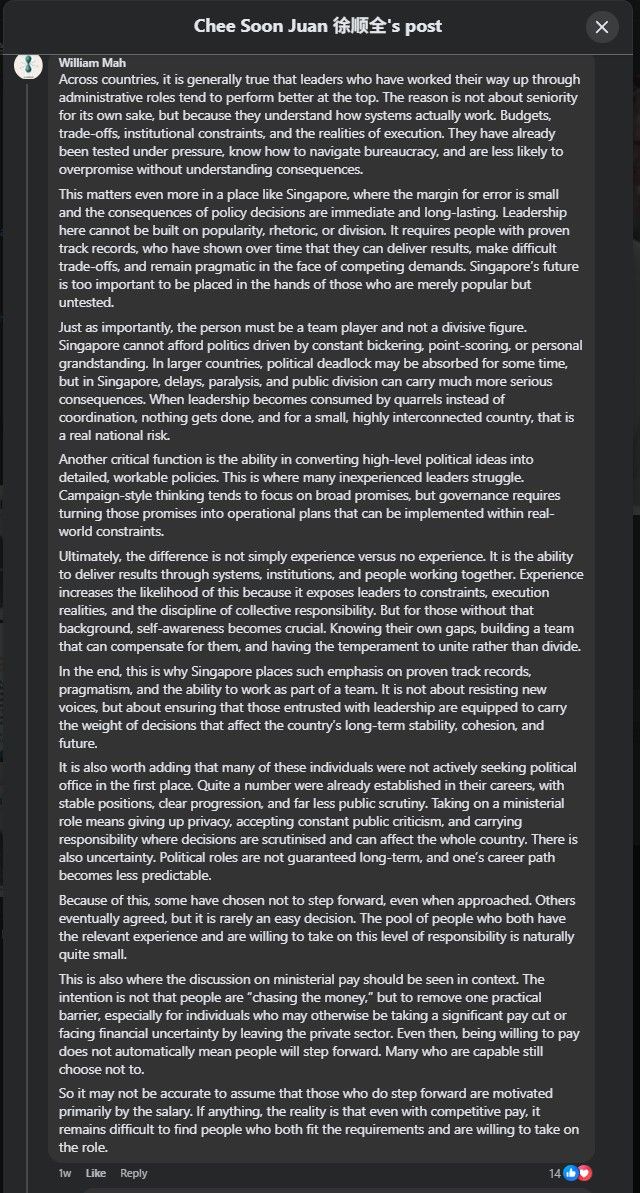
Mah’s comment responded to Chee’s video, arguing that leaders who rise through administrative ranks tend to perform better due to their understanding of systems, budgets, and policy constraints.
He emphasised that in Singapore, “the margin for error is small”, and leadership should prioritise pragmatism and proven track records over “popularity, rhetoric, or division”.
Mah also highlighted the gap between campaigning and governing, noting that inexperienced leaders often struggle to translate ideas into workable policies within real-world limitations.
He added that high ministerial pay helps remove a practical barrier for capable individuals who might otherwise avoid politics due to personal sacrifices and uncertainty.
Chee challenges ‘assumptions’ on leadership
In response, Chee said Mah’s arguments rested on several "assumptions" that warranted scrutiny.
Chee questioned the claim that administrative experience inherently leads to better leadership, asking whether such assertions were supported by evidence.
He argued that effective leadership has historically come from diverse paths, including individuals without extensive bureaucratic experience.
“Leadership is not about managing existing structures but about reimagining them when they no longer serve the people,” he said.
Warning against groupthink and conformity
Chee cautioned that a purely administrative pathway could create risks such as groupthink, risk aversion, and reliance on outdated models.
He cited examples of organisations and systems that faltered due to an inability to adapt, arguing that similar patterns could emerge in governance.
He also criticised the notion that Singapore is “too small to risk change”, describing it as a “worn-out” argument that may hinder progress.
“This risk-averse attitude encourages groupthink and conformity,” he said, adding that policies could remain in place long after they cease to be effective.
Leadership beyond competence and track records
Addressing Mah’s emphasis on track records, Chee argued that framing leadership as a choice between technocrats and populists was misleading.
“The real choice is not between ‘technocrats’ versus ‘populists’. It is whether leadership includes technical competence and moral imagination and critical thinking,” he wrote.
He questioned how “proven track records” are defined, suggesting that traditional benchmarks may reinforce existing perspectives rather than encourage innovation.
Chee argued that over-reliance on similar career pathways could reproduce “the same thinking, the same blind spots, and the same policies”.
Social challenges cited as evidence
To support his argument, Chee pointed to what he described as indicators of systemic issues, including widening inequality, rising mental health concerns, and financial strain among families.
He said such trends suggest the need for fresh thinking and reform rather than continuity alone.
“Leadership – effective visionary leadership – is not just about maintaining a system. It’s about knowing when the system itself needs reform,” he said.
Disagreement over ‘division’ and scrutiny
Chee also took issue with Mah’s warning about political division, arguing that dissent should not be conflated with instability.
“What you call division is often scrutiny. Without scrutiny, policies are not stress-tested,” he wrote.
He added that labelling dissent as division risks discouraging debate and critical evaluation of policies.
Mah, in his reply, maintained that while scrutiny is necessary, excessive political conflict could lead to delays and inefficiencies, particularly in a small and interconnected system.
Ministerial pay and ‘transactional thinking’
A central point of contention was the role of ministerial salaries in attracting capable leaders.
Mah argued that competitive pay reflects the responsibilities and opportunity costs of public office, rather than serving as a primary motivation.
Chee, however, framed this justification as inherently transactional.
“That’s just another way of saying: ‘What’s in it for me?’” he wrote.
He contrasted this mindset with what he described as the values expected of true leadership.
“As I said in my video, managers constantly ask ‘What’s my worth in the marketplace?’ True leadership asks: ‘What does history demand of me?’”
Reference to National Service debate
Chee also referenced remarks made by Defence Minister Chan Chun Sing in Parliament on 27 February 2026.
Minister Chan had rejected proposals to peg National Service allowances to labour benchmarks, warning against treating service as a transactional relationship.
“I don’t want us to get into the wrong concept that this is a transactional relationship,” Chan said, emphasising that National Service is a “sacred duty”.
Chee highlighted what he described as a contrast between this position and arguments supporting high ministerial pay.
“Is this a case of money for me but not for thee?” he asked.